
voice typing study group recaps: A Practical Guide to Voice Typing for Study Group Recaps
One ten-minute spoken summary keeps every voice in the notes.
 Voiskey Team
Why Recaps Matter More Than Meetings
A study group does not live during its meeting; it lives in what survives after it. Without a recap, the same three topics get re-explained every week, decisions vanish, and the group slowly becomes a hangout with flashcards. Voice typing study group recaps changes the mechanics: after each session, one person speaks a summary while the group is still together, and the text is in the shared notes before anyone has left. Speaking the recap is faster than composing it, and since the group is still in the room, the people who were quiet can add the point they did not raise earlier. A recap that contains every voice is a record the whole group actually trusts, and trust is what keeps attendance up.
Recaps also protect you from the silent divergence that kills group projects. Two members leave a meeting with two different ideas of what was agreed, and the difference only surfaces at deadline time. A dictated recap records the decision while it is fresh, including who was assigned what and by when, which makes the agreement physical rather than assumed. Add a short we decided paragraph and a we still do not know paragraph. The second one is just as important: it keeps genuinely open questions from being treated as closed, and it gives the next session a target. When the recap is written during the meeting, nobody can later remember it differently, and the group's effort stops being spent on reconstructing history and starts being spent on the actual material.
Keep the recap structure small enough that someone can produce it tired. Four items do the work: what we covered, what we decided, what is due next, and what we still do not understand. Dictate them in this order at the end of every session, two or three sentences each. Resist the urge to transcribe everything; a recap is a highway map, not a transcript, and the detail belongs in the notes people already took. Add the date and the session number at the top, so the series becomes a timeline of the group's thinking. A semester of short recaps is genuinely useful before the final, because it is the entire course already summarized in the group's own words and ordered by the week you learned it in.
The Ten-Minute Spoken Summary
Put the recap at the end of the session, never at the start of the next one, and give it ten fixed minutes. When the clock hits that boundary, everyone stops adding content and the rules change: no new questions now, only the summary. One person speaks, and the speaking has a shape. Start with the big ideas in the order you covered them, say what you decided about each, name the owner and due date for each action, and finish with the open questions. Speaking takes about the same time as reading the answers, but it forces the group to hear the whole session in one pass. When the wording is disputed, stop and settle it immediately, because a recap is an agreement, and agreements made in the last minute are the most useful ones.
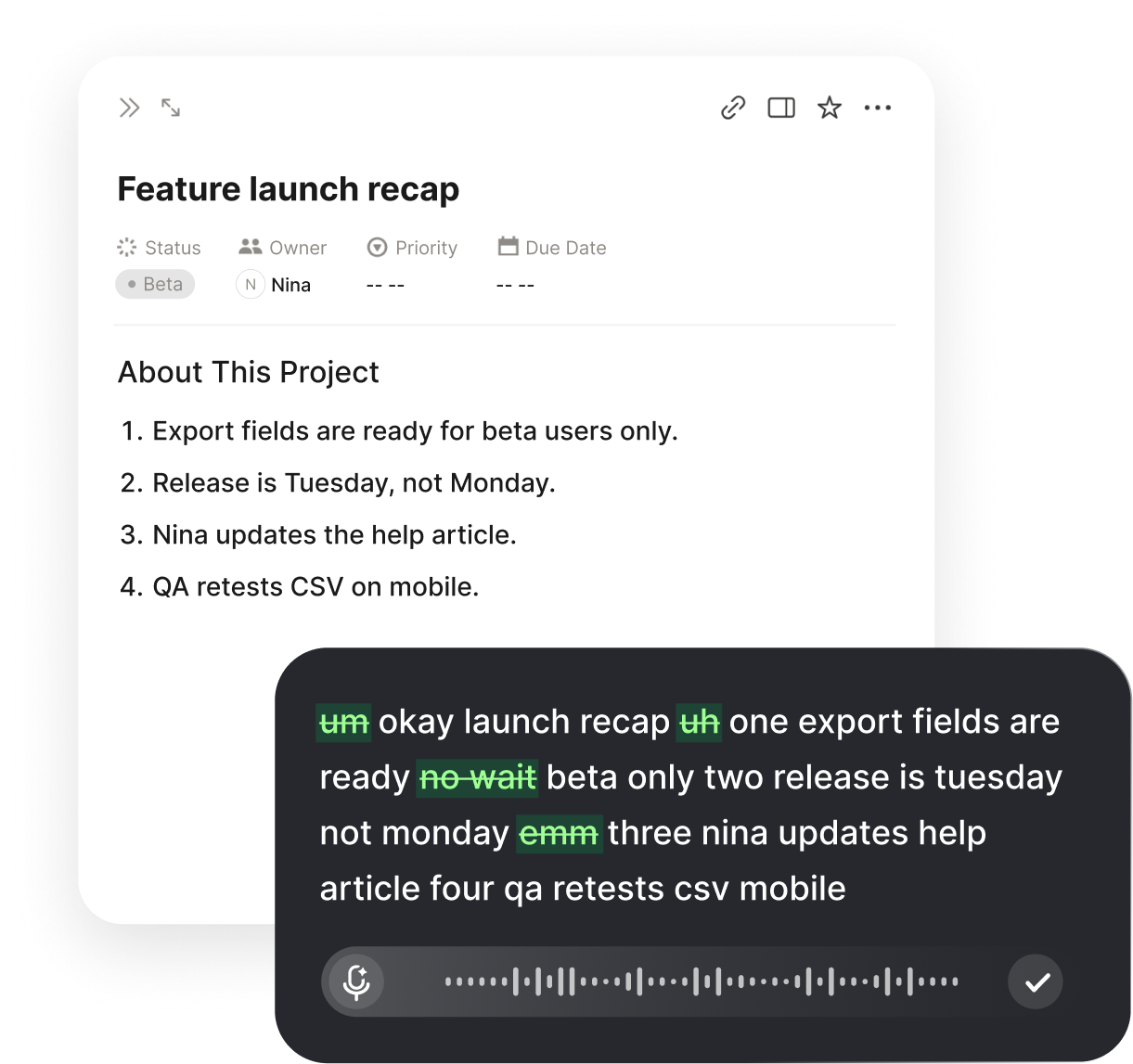
The person summarizing does not need perfect sentences. Dictate the content and let the text be rough; Voiskey cleans up fillers and restarts, so the summary comes out readable without the summarizer pausing to compose. Use the group's own vocabulary as it was used during the session, because the terms people used when they were confused are the terms they will remember. If the recap swallows a point someone made, that person should interrupt and restate it, since a recap that misses the point of the quiet member is already on its way to being wrong. Then ask one question at the end: did we actually answer what we meant to answer today? If the answer is no, that becomes the first item on the next recap, not a buried regret.
Resist completeness. The group can summarize an hour of discussion in ten minutes only if they agree on what matters, which is the real value of the exercise. If a topic took thirty minutes but produced one sentence of agreement, that sentence is the recap. If a topic took three minutes but changed the plan, that plan belongs in it. A good rule: the recap should be readable in ninety seconds on the day before the exam. Everything that survives that test is either something you understood or something you still do not, and both are worth keeping. When the summary is done, read it out loud once while everyone is still listening, because a recap nobody heard is just a text file, and the group hears it once and remembers it twice.
Roles: Speaker, Dictator, Editor
Assign three roles before the session starts, not after it ends, and rotate them each week. The speaker explains the topics; the dictator operates the dictation; the editor cleans the text. With the speaker talking and the dictator capturing, you do not need a scribe hunched over a keyboard, which is exactly the bottleneck that made old recaps fail. The dictator can also tap in a name before each person contributes, so the recap preserves who said what. Rotating roles keeps one person from owning the notes and keeps everyone aware of what a good summary requires. The first time you run this, expect the speaker to be too detailed and the editor to be too cautious. Both improve with practice, and the practice is the point, because the skills transfer straight into how you present in class.
The speaker's only job is coverage and clarity, in that order. Cover every topic the group touched, then make each one understandable to a member who missed the session. If two people have not understood something, say so and do not paper over it. The speaker should name facts and opinions separately, since a recap that mixes what was found with what was guessed causes trouble later. The dictator's only job is fidelity: capture the speaker's words, note who contributed which point, and flag anything that did not make it, using a marker such as question. The editor works from the transcript without changing meaning, removing repetition and fixing spelling, primarily names of concepts, because misspelled technical terms embarrass the group in front of the professor later.
The handoff matters as much as the roles. When the recap is dictated, the editor deals with it within the same evening, while the session is still half in everyone's memory. The editor checks three things: every major topic is present, every decision has an owner and a date, and nothing was added that the group did not say. If something requires judgment, the editor marks it rather than inventing it. Send the result to the group with a one-line message, here is the recap, and ask everyone to flag errors within twenty-four hours. A recap that is reviewed and corrected is worth more than one that is polished and ignored, because the correction happens while the memory is shared. Then archive it in the same place every week so the series stays searchable.
Distributing the Recap in Minutes
Distribution is decided once and then it never slows you down again. Choose one home for recaps, such as a shared document or a note in the group's file, and agree that the recap goes there every week, no matter what. Since Voiskey works anywhere you can type, the recap can be dictated straight into that shared file, and the no-integration setup means no upload step between you and the group. Then add one push: a group chat message with the link and a one-line summary. In busy semesters, the shared file is the memory of the course and the chat message is the reminder; both together mean nobody has to ask what was covered two weeks ago.
Make the recap skimmable in its raw form so nobody deletes it because it is ugly. Lead with the date and the session number, use plain headings for the four items, and keep answers to their minimum. If someone needs the full details of a topic, their own notes should point to it; the recap does not carry the whole session. Dictate the headings as you speak them, such as what we covered, bullet, enzymes and the lab report due Friday, so the text comes out structured on the first pass. If a member missed the session, the recap plus one follow-up question usually catches them up in five minutes, which is cheaper than a private re-explanation. And the recap doubles as an excellent absence excuse in exactly the form a professor wants to see.
If your group works across languages, the recap is where language friction shows up. Members who think fastest in another language can contribute their point in that language and have it land cleanly in the shared summary, because Voiskey handles more than a hundred languages and returns one clean version even when sentences mix. That keeps the group's technical terms the way each member actually learned them. Then the editor renders the final text in the group's agreed language, and everyone leaves with the same page. Reading a recap in your own words is also the fastest kind of comprehension check: if a sentence sounds wrong in your first language, it is usually because the group never actually agreed on that point, and the fix is one sentence, not a new meeting.
Recaps That Survive the Semester
A single good recap is a nice memory; an ordered series is a revision resource. Number every recap and store them in one folder or shared file, dated and named by topic. Before each session, spend three minutes reading the previous recap out loud, because that is what makes the group continuous rather than restarting every week. When a recurring question appears in three recaps in a row, the group should fix the gap with a topic review, not add it to a fourth. The series also tells you what to drop: topics that appear and then never return are done, while topics that keep appearing need a dedicated session. By the end of the semester you have a chronological course summary in the group's own words, which is the single most useful document before the exam.
Build a monthly review into the routine: once a month, the group reads every recap from the last four weeks out loud and does three things with them. Mark topics that are now understood. Mark topics that are still weak and need a return visit. And list the questions that keep coming back unanswered, which are usually the ones worth bringing to the professor or the next class. Dictate the month's outcomes into a short summary, so the group can see progress instead of just accumulation. This cadence is also what keeps a study group alive in heavy weeks, because a ten-minute recap is a lower commitment than a full session, and it turns the group's record into a living document rather than a folder that nobody opens.
At the end of the semester, the recap archive becomes the group's final exam kit. Compile the series into one document and read it from start to finish as a speed review. The parts you skim are the parts you remember, and the parts you slow down on are the ones to study. Before the last session, dictate a closing note that summarizes the group's strongest topics and the three gaps to protect in the exam. That note is a small act with a big effect, because it makes the last week begin from an honest state. Then thank the group in writing, because the archive will still exist next semester, and a group that shares its history is a group that starts fast. That is the quiet reason recaps matter more than meetings.
FAQ s
Four items, in order: what we covered, what we decided, what is due next and who owns it, and what we still do not understand. Two or three sentences each, dictated while the group is still together. Keep the structure identical every week so the series stays skimmable, and date and number every recap so the archive maps to the course.
Rotate three roles weekly: speaker, dictator, editor. The speaker summarizes while the group is present, the dictator captures into the shared notes in real time, and the editor cleans the text the same evening. Rotating spreads the load and teaches everyone how to summarize, which improves how each member presents material in class.
Flag and fix fast. Ask members to check the recap within twenty-four hours and make corrections while the memory is shared. Keep the correction, not just the fix, because documenting the disagreement prevents a later dispute. The recap represents the group's agreement only when everyone has signed off silently or corrected it.
Yes, especially as a series. Numbered, dated recaps become a chronological summary of the whole course in the group's own words. Read them front to back as a speed review, slow down on sections you do not remember, and circle the recurring questions to bring to your professor. That archive is usually the most efficient revision material the group creates.


 Voiskey
Your voice, amplified.
Choose a real task, follow the steps, and review the results with your team before expanding the rollout.
Use it across macOS, Windows, iOS, and Android