
Voice Typing for Scholarship Applications
Draft stronger scholarship essays by speaking, then editing with intent.
 Voiskey Team
Map the Prompt Before Drafting
Voice Typing for Scholarship work begins with a careful reading of the prompt, not with a blank page. Print the question or open it beside your draft, then underline the verb, the length limit, and every named audience. Scholarship committees often ask several things in one sentence, such as describing a goal, explaining its importance, and showing what you have already done. Break the prompt into a checklist with one line per requirement. Write the deadline and the submission format at the top of the file. This mapping stage takes ten minutes and prevents the most common failure in applications: a polished essay that answers a slightly different question.
Collect the raw material before you write a single sentence. List the experiences, projects, jobs, and moments that could support each requirement. For every item, note the situation, what you did, what changed, and what you learned. Do not worry about order or elegance yet; this is a private inventory, not the essay. Mark the three items that best match the prompt and the two that are weakest but still relevant. If a requirement has no matching evidence, write a question beside it and plan how to find an answer. A strong draft is built from specific material, and the inventory makes that material visible before the prose takes over.
Study the word limit as a design constraint. A three-hundred-word answer needs one story and one point, while a thousand-word essay can carry two or three connected examples. Divide the limit across the prompt requirements before drafting so no section becomes bloated. Write the target for each part at the top of the page, then check the total. If the limit is very short, cut the inventory to one item rather than compressing three thin examples. If the limit is generous, plan a structure with clear transitions instead of padding. Knowing the budget prevents the painful cutting stage later.
Identify the reader and the decision they are making. A scholarship committee is comparing many applicants against a rubric, often quickly. Ask what would make your application easy to evaluate: a clear opening, evidence for each claim, and a specific connection between your past and your plan. Note any values the scholarship states, such as service, research, or leadership, and decide which of your experiences genuinely demonstrates them. Write one sentence that states why you are applying to this program in particular. Save this reader note beside the prompt and return to it when the draft starts to drift or lose focus.
Speak the First Draft Without Stopping
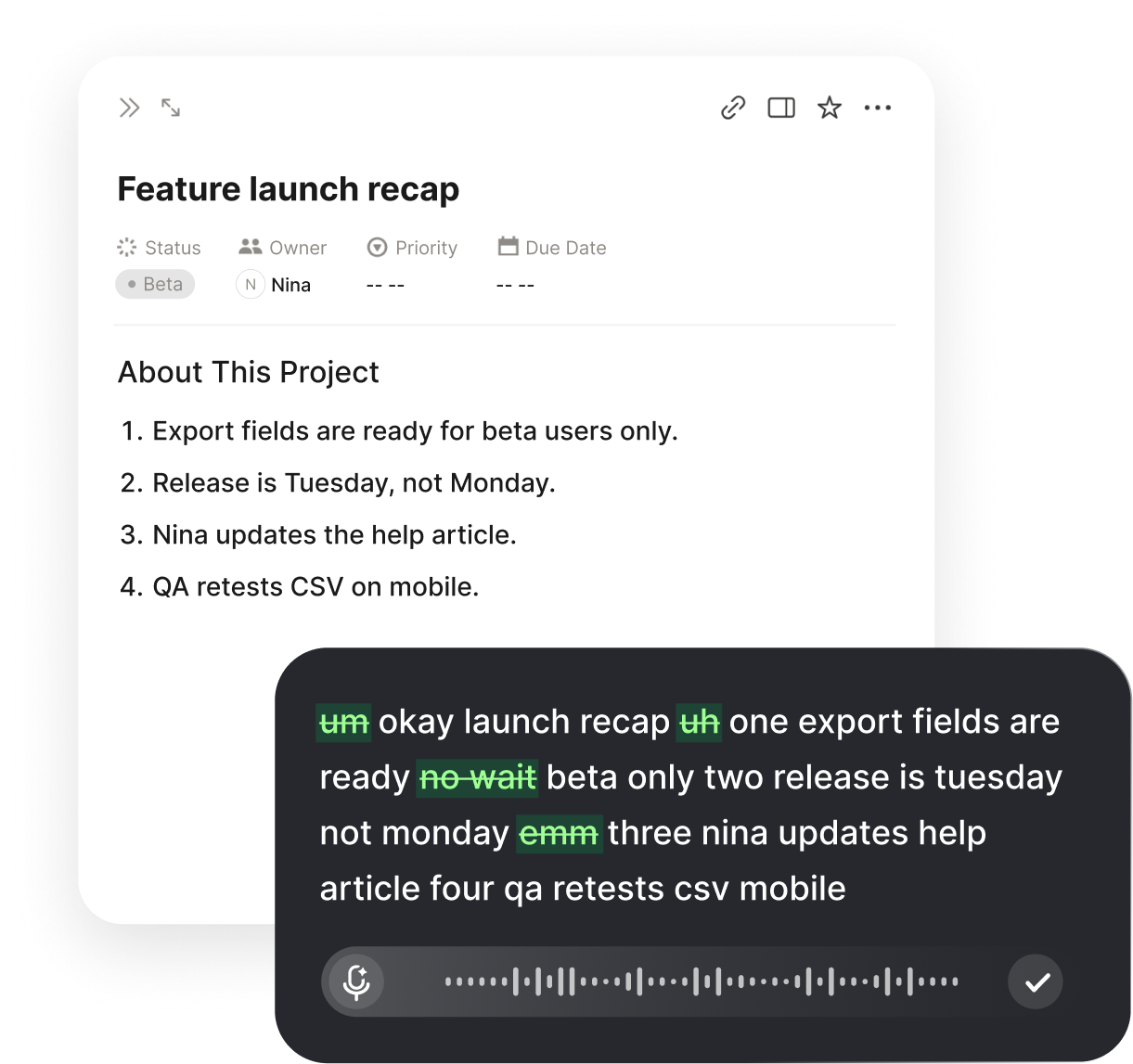
The first spoken draft should be fast and complete. Open your document, place the cursor under the prompt checklist, and speak the opening, the evidence, and the closing without correcting anything. If you get stuck, say next and move to the following point; the app removes filler, stutters, false starts, and self-corrections, so the transcript will read more cleanly than the performance felt. Keep the inventory visible and look at it only between sections. The aim is to get every idea onto the page in one sitting. A complete rough draft, even an uneven one, is much easier to shape than a perfect paragraph that took an hour.
Speak in scenes rather than in abstractions. Instead of saying I am passionate about community health, describe the afternoon you spent at a clinic and what you noticed. Scholarship readers respond to specific detail because it is hard to invent and easy to remember. For each paragraph, name a place, a person, an action, and a result. If you cannot supply those elements, the paragraph is probably still a claim rather than evidence. Keep the scene short and connect it explicitly to the requirement. One vivid example usually does more work than three general statements about your values and your goals.
Use simple spoken transitions to hold the draft together. Begin paragraphs with phrases such as the first reason, a second experience, or what this changed, then continue in full sentences. These markers are easy to say aloud and easy to replace later with more polished transitions. If a paragraph begins to repeat the previous one, say move on and start the next point. Keep the tone conversational for now; a natural voice is easier to edit than a stiff one. When the draft is complete, read it back once without editing and mark the paragraphs that feel thin or repetitive.
Stop at a planned point rather than when you run out of energy. Set a timer for the drafting session and finish the current section when it rings. Write a one-line note about what comes next and where the draft stands. Do not begin editing during the session; editing uses a different kind of attention and will slow the draft to a crawl. Save the file with a version number so the original spoken draft remains available. Close the document and take a short break before the first read-through. Distance makes the weak parts easier to see and easier to cut.
Match Tone to Each Application Section
Scholarship applications contain several kinds of writing, and each needs a different register. A personal statement can be reflective and narrative; a short answer about goals should be direct and concrete; an activities list should be factual and compact. Before revising each section, say the register aloud and adjust sentences that drift. Written language tends to become formal under pressure, so watch for sentences you would never say in a conversation. The app adapts tone, punctuation, and word choice to the task, which helps you move from a narrative paragraph to a factual list without rewriting the whole section from scratch.
Lead with the point in short answers. Committees read many responses quickly, so put the direct answer in the first sentence and use the rest for evidence. Avoid opening with a definition or a quotation unless the prompt asks for one. If the answer has a limit of two hundred words, aim for one example and one consequence. Remove throat-clearing phrases such as throughout my life and in today's world. A direct opening signals confidence and makes the response easier to score against a rubric. Read the first sentence of every answer in sequence and check that each one could stand alone as a complete response.
Keep the personal statement personal without becoming confessional. Choose experiences that explain a decision, a change, or a commitment, and show what you did with them. Reflection should follow action, not replace it. If a paragraph describes a feeling without describing a situation, add the missing scene or cut the paragraph. Use the same standard for hardship: state what happened, what you did, and what it changed, then connect it to the scholarship's purpose. A restrained, specific account is more persuasive than an emotional summary that gives the reader nothing concrete to verify or remember and no reason to trust the claim.
Check consistency across the whole application. Names, dates, job titles, and project descriptions should match the resume and the recommendation letters. Read the sections side by side and mark any difference, then choose the version that is most accurate. Tone should also be consistent: a personal statement that sounds warm and a short answer that sounds clinical can feel like two different applicants. Write one sentence describing the voice you want, such as clear, specific, and forward-looking, and use it as a test for each revision. Consistency across every section is a core part of the application and its credibility.
Edit Essays and Short Answers with Voiskey
The edit is where an application becomes competitive. Read the draft once for structure, then once for evidence, then once for language. Voiskey removes filler, stutters, and grammar slips from the spoken draft, and it adapts punctuation, formatting, tone, and word choice, so the cleanup pass can focus on meaning rather than transcription errors. Use the Speak-Polish-Type-Edit order: speak missing transitions, polish the phrasing, type headings and limits, then edit line by line. Keep the prompt checklist beside the draft and tick each requirement as you confirm it. Do not polish sentences before the structure is right.
Cut the draft by about ten percent before you refine it. Start with repeated examples, vague qualifiers, and sentences that explain what the reader already knows. Replace abstract nouns with verbs and concrete details. If a sentence contains more than two clauses, split it. Read the revised paragraph aloud and listen for places where you run out of breath; those are the sentences to shorten. Cutting first makes the remaining language easier to improve and brings the draft closer to the word limit. A tight draft also reads as more confident and leaves room for the evidence that matters most.
Use the app to test alternate phrasings without losing your voice. Say a sentence two ways, compare the captured versions, and keep the one that sounds like you. Avoid accepting a smoother phrase if it changes your meaning or adds a claim you cannot support. For a scholarship essay, the sound of authenticity matters as much as correctness. Keep a short list of terms you use about your field, and confirm that the spelling is consistent across every section. If the app learns your names, jargon, and spelling preferences, later drafts need far fewer corrections and sound more consistent across applications.
Finish with a requirement-by-requirement review. For each line on the prompt checklist, point to the paragraph that answers it and the evidence that supports the answer. If a requirement is answered only in the conclusion, move it earlier. Check that the draft does not exceed the limit and that the file name follows the instructions. Read the final version aloud once at a normal pace; if you stumble, the reader probably will too. Then ask one trusted reader to restate your main point after a single reading. If they cannot, the opening still needs work before you submit.
Proofread, Finalize, and Submit on Time
Proofread in passes rather than all at once. First check names, dates, program titles, and numbers against the source documents. Then read for grammar and punctuation, then for repeated terms and inconsistent capitalization. Read the essay backward sentence by sentence to catch errors that your eye skips when it follows the argument. Confirm that every file uses the required format and that the word count matches the official limit. Keep a clean copy and a working copy separate. A final proofread should be mechanical and unhurried, not another round of rewriting the argument or rethinking the whole structure of the application.
Plan the submission a day early. Create the account, fill in the profile fields, and upload a test file before the deadline week. Check the time zone used by the application and convert the deadline to your local time. List every required attachment, including transcripts and recommendation arrangements, and mark which ones depend on another person. Ask recommenders well before the deadline and send a short reminder with the link and the date. Do not wait for the final essay to start these steps; administrative delays cause more missed deadlines than weak writing, late documents, or poor planning in the final week.
Set up the tools you will use across several applications. Download Voiskey, install it for your operating system, and test the shortcut in the editor where you draft. If you qualify for the student offer, sign in with a school email and enter the code sent to that address. Create a master file with the prompt checklist, your inventory, and the voice note you wrote for each program. Duplicate it for the next application rather than starting from a blank page. A repeatable setup reduces the friction of drafting and leaves more time for the part that matters: choosing better evidence.
Track outcomes and reuse what works. After each submission, record the date, the program, the prompts, and the version you sent. When a decision arrives, add a short note about what you would change. If you advance to an interview, reread the essay before the conversation so your spoken answers match the written application. If you are rejected, resist the urge to rewrite the entire approach; identify one structural weakness and test a fix on the next application. Over a season, this record turns scattered deadlines into a managed process with visible improvement from one application to the next in the same season.
FAQ s
Speak the first draft in scenes and specific detail, then use the polish pass to remove filler, false starts, and grammar slips. Voiskey places the text in your drafting document and adapts tone and formatting, so you can shape a complete draft instead of polishing one sentence at a time.
Voiskey adapts tone and phrasing to what you are trying to do. State the register before revising each section, such as reflective narrative or direct factual answer, then adjust sentences that drift. Check that a smoother alternative has not changed your meaning or added a claim you cannot support.
Speak a complete draft, then cut about ten percent before refining the language. Remove repeated examples, vague qualifiers, and sentences that explain what the reader already knows. Voiskey removes filler from the spoken version, which makes the first cut easier, but you still count the final draft against the official limit.
Check names, dates, program titles, and numbers against the source documents, then confirm every prompt requirement is answered with evidence. Verify the format and the length limit. Voiskey removes grammar slips from the spoken draft, but you still proofread in passes and submit a day early.


 Voiskey
Your voice, amplified.
Download Voiskey for Mac and Windows and speak your next draft into place.
Use it across macOS, Windows, iOS, and Android