
Voice Typing for Business Case Competitions
Turn a spoken case story into slides, answers, and a reusable playbook.
 Voiskey Team
Assign Speaking Roles Before the Clock Starts
Voice Typing for Business competitions rewards teams that divide the work before the case clock starts. In a short sprint, assign five roles: case opener, market analyst, financial lead, recommendation owner, and question captain. Each person owns one section of the narrative and one set of exhibits, and each speaks that section aloud during planning so the team hears the logic early. Write the roles and the speaking order at the top of the shared outline. A clear division prevents the most common failure in a timed case, where everyone drafts the same introduction while the financial model remains unfinished.
Match roles to strengths rather than to titles. The strongest presenter should own the recommendation, because that section carries the most weight with judges. The most careful number checker should own the financial lead, even if someone else speaks the numbers on stage. Give the question captain the authority to stop a rehearsal when an answer drifts. Rotate one small section so every member speaks at least once during practice. Write the assignments in the outline with a backup for each role. When a member is absent, the backup speaks the section without needing a new plan or a new briefing.
Build a shared vocabulary list before drafting. Include the client name, the industry terms, the metric definitions, and the labels for each exhibit. Agree on how you will say numbers, such as millions and percentages, and on the short form of each competitor name. Keep the list beside the outline and add to it as the case reveals new terms. A team plan offers shared vocabulary and workflows, which helps when several members speak the same section across drafts. Consistent terms make the final presentation sound like one voice rather than five separate summaries stitched loosely together at the end.
Set checkpoints against the clock. A typical sprint needs a case read, a hypothesis, an evidence pass, a narrative lock, a slide build, and a rehearsal. Write the start and end time for each checkpoint and assign one person to call them. At each checkpoint, the owner speaks a thirty-second status: what is done, what is blocked, and what decision the team must make now. Capture that status in the outline so late joiners can catch up. Protect the narrative lock; once it passes, new ideas go into a parking list rather than into the deck. Time discipline is a competitive advantage.
Draft the Case Narrative by Voice
Speak the story before you build a single slide. Start with the situation, then the complication, then the options, then the recommendation, then the risks and the implementation path. Say it in plain sentences as if you were briefing an executive in a hallway. The first spoken version will reveal which parts of the case you actually understand and which parts you are repeating from the exhibit titles. Record the narrative in one file and read it back with the team. Do not open the slide software until the story survives that read-back without someone asking what the main point is.
Keep the narrative disciplined by giving each section a job. The situation establishes the decision the client faces. The complication explains why the current approach no longer works. The options compare two or three credible paths with explicit criteria. The recommendation chooses one path and states the trade-off. The implementation names the first three moves and the measure of success. Speak each section as a short paragraph, then reduce it to a headline. If a headline needs two clauses, the section is probably trying to make two points. Split the section or cut one of the weaker supporting points.
Numbers need a slower speaking pace and a second check. Say each figure with its unit and its source exhibit, then repeat it once in the sentence that interprets it. If a number is derived, say the calculation aloud: margin equals revenue minus cost, then the percentage. Ask the financial lead to listen for inconsistencies and to mark any figure that appears with two different values. Never estimate a figure to fill a gap; mark the gap and return to the case. In the spoken draft, write the exhibit number beside every number so the slide build has a traceable source.
Convert the spoken narrative into a slide outline while it is fresh. Give each paragraph one slide, and each slide one headline that states the point rather than the topic. List the two or three pieces of evidence that support the headline, then the exhibit that carries them. If a slide needs more than three pieces of evidence, split it. Keep the spoken paragraph beneath the outline as speaker notes; it is already in the language you will use on stage. Read the headlines in sequence to test the story. If the sequence does not persuade, fix the narrative before polishing the visuals.
Rehearse Judge Questions Under Time Pressure
Build a question bank as soon as the recommendation is locked. Ask each teammate for the five hardest questions they would ask if they were judging, then add the standard categories: market size, competition, financial assumptions, execution risk, and why not the alternative. Write each question in the judge's voice, short and direct. Group the bank by section so the owner can rehearse the relevant answers. Add a column for the evidence exhibit that supports each answer. A question bank built before rehearsal turns surprise into preparation and gives the team a shared map of its weak points before the clock runs down.
Train a four-part answer: direct response, evidence, implication, and next step. The direct response comes first, in one sentence, because judges reward clarity. The evidence names the exhibit or analysis that supports the claim. The implication explains what it means for the recommendation. The next step says what the team would do or check. Keep the whole answer to about forty-five seconds. Practice the same question twice, once with the full structure and once in thirty seconds, so the team can adapt to a judge who wants a short answer. Speak the structure aloud until it becomes automatic.
Rehearse the difficult questions deliberately. Ask a teammate to interrupt, challenge a number, and question the recommendation without softening the language. The answer owner should pause, restate the question in one sentence, and then respond. If the answer is unknown, say what the team does know, what it would check, and how quickly. Never invent a figure under pressure; judges notice. After each round, capture the strongest challenge and the best response in the question bank. Repeat the round with a different question order so the team learns the reasoning rather than a fixed script built for one particular judge.
Use a timer and a scorecard for every rehearsal. Score each answer on directness, evidence, and composure, using a simple three-point scale. Have the question captain call time and note any answer that ran long. Record which sections attracted the most challenges and which evidence was cited most often. If one exhibit answers every question, the analysis is probably too narrow. End the rehearsal by assigning one improvement per person for the next round. A short, scored rehearsal is more useful than a long discussion about how the presentation might go in front of a real panel under competition conditions.
Polish Slides and Speaker Notes with Voiskey
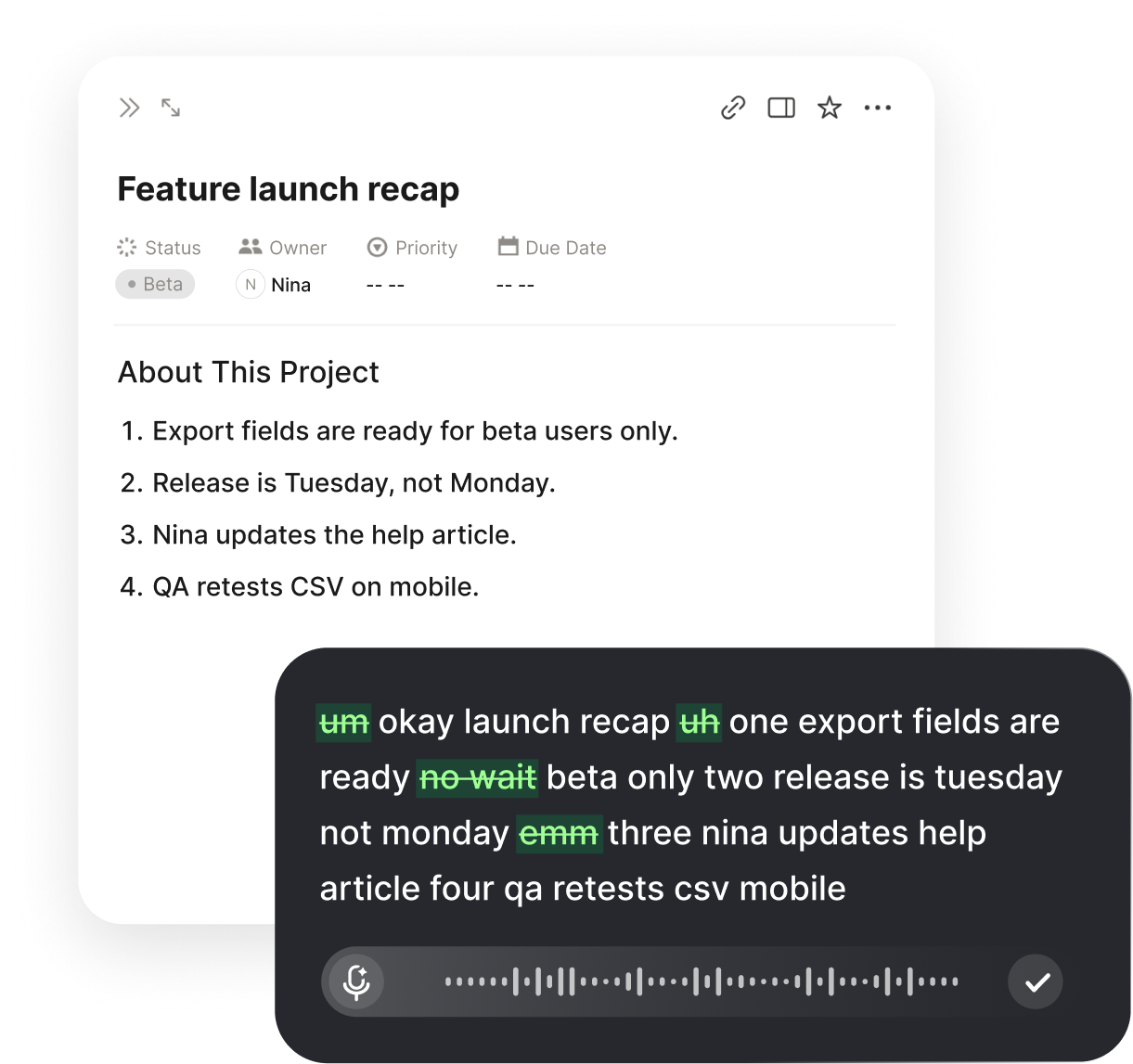
Use Voiskey to turn the locked narrative into speaker notes that sound spoken rather than written. Open the notes field for each slide, press the shortcut, and say the paragraph in the tone you will use on stage. The app places the text at the insertion point, removes filler and false starts, and adapts punctuation, formatting, tone, and word choice to the task. Keep the notes to four or five sentences per slide so they prompt rather than script. Read each note aloud and cut any sentence you would not actually say. The notes should support eye contact, not replace it on stage.
Slides need shorter text than notes. Speak a bullet list as a list, with each item starting with a verb, then let the app format it into separate lines. Limit each slide to three bullets and put the detail in the notes. If a bullet contains a number, check it against the financial lead's sheet before the slide is considered finished. Use the same labels for exhibits across the deck, and confirm that every reference in the notes points to the correct exhibit. A consistent deck lets a judge follow the argument without hunting for the chart that is currently being discussed.
Consistency across speakers is easier when the team shares vocabulary. Voiskey learns names, jargon, acronyms, and spelling preferences, and the team plan offers shared vocabulary and workflows, so a client name or metric label stays identical across members. Agree on the terms before drafting, then add each new term to the shared list as it appears. Check the deck for synonyms that describe the same idea, such as profit and earnings used interchangeably. Choose one term per concept and replace the rest. Consistency is not cosmetic; it signals that the team has one analysis rather than several loosely connected analyses.
Finish with a numbers and names audit. Read every slide aloud and mark each figure, date, and proper noun. Compare the figures with the source sheet and the names with the case packet. Check that the recommendation slide states the decision in one sentence and that the first implementation step appears before the risk slide. Cut any slide that does not advance the argument, even if it contains impressive analysis. Judges remember the story and the answer to their question, not the density of the appendix. A clean main deck with a strong appendix is usually the better trade for a short presentation.
Debrief and Reuse the Team Playbook
Debrief while the experience is still specific. Within a day, ask each teammate to answer three questions: what worked, what failed, and what you would change in the first hour. Capture the answers by voice into one file, then group them into planning, analysis, slides, and questions. Keep the comments concrete; replace we should communicate better with we lost ten minutes at the narrative lock because two owners disagreed. Assign an owner to each improvement and a date to test it in the next practice case. A debrief that produces actions is worth more than a friendly round of compliments.
Preserve the reusable parts of the work. Save the narrative template, the question bank structure, the slide outline, and the scoring sheet in one team folder. Remove client-specific content before storing the templates, and label each file with the competition and date. Keep a short note about which sections ran long and which evidence was hardest to find. When a new case arrives, start from the template rather than a blank page. The goal is not to reuse old answers but to reuse the structure that helped the team think quickly and clearly under pressure in a timed case.
Prepare the tools before the next competition. Download Voiskey, install it for your operating system, and run a shortcut test in the slide notes field and the shared document. If you qualify for the student offer, sign in with a school email and enter the code sent to that address. Build the term list and the template as a single starter file, then duplicate it for each new case. Test the setup with a two-minute practice sprint so no one discovers a missing configuration during the competition. Preparation of the environment is part of the preparation of the argument.
Close the loop after the next event. Compare the new debrief with the previous one and check whether the assigned improvements actually changed behavior. If the same problem appears twice, change the process rather than asking the team to try harder. Update the playbook with the new lesson and remove advice that no longer applies. Share the updated version with the whole group and ask one person to walk a newcomer through it. A playbook improves only when someone owns it, tests it under time pressure, and writes down what happened with enough specific detail to change the next attempt.
FAQ s
Speak the situation, complication, options, and recommendation in plain sentences before building slides. Voiskey places the spoken draft in your outline document, removes filler and false starts, and adapts formatting, so the team can review a complete story and turn each paragraph into one slide headline.
Yes. Speak each answer in the four-part pattern of direct response, evidence, implication, and next step, then read the transcript and trim it to about forty-five seconds. Voiskey removes stutters and self-corrections and adapts phrasing, so the practiced answer sounds composed rather than memorized.
Voiskey learns names, jargon, acronyms, and spelling preferences, which helps keep labels consistent across a deck. It does not calculate or verify figures. The financial lead must still check every number against the source sheet and confirm that each slide uses the same value and unit.
Agree on client names, metric labels, and exhibit terms before drafting, then keep one shared list beside the outline. The team plan offers shared vocabulary and workflows, so members can use the same terms while drafting notes. Review the deck for synonyms that describe one concept and replace them with the agreed term.


 Voiskey
Your voice, amplified.
Download Voiskey for Mac and Windows and speak your next draft into place.
Use it across macOS, Windows, iOS, and Android