
voice sops client onboarding: A Practical Guide to Voice SOPs for Sales and Client Onboarding Processes
Replay the client journey in your own voice and turn it into the team playbook.
 Voiskey Team
The Onboarding Playbook Gap
The onboarding playbook gap is real for most sales teams: the voice SOPs client onboarding actually follows live inside one senior rep's head, unrecorded. The sequence exists, the timing exists, the exact emails exist, and they belong to one person, which means the first impression your company makes is only as consistent as that person's memory. The rest of the team improvises, and the client can feel the difference: the handoff that happened without a hello, the kickoff that started with a question about access, the welcome email that listed the wrong steps. Every one of those moments is a rep replaying a journey without the map.
The consequences are structural, not cosmetic. Onboarding is the first thirty days, and the first thirty days are when clients decide whether the purchase was a good one. A rep who runs onboarding once a quarter never builds the muscle; a rep who runs it twice a week talks like they have done it a hundred times. When the playbook lives in a senior rep's head, the new rep on their second deal is left to rebuild the sequence from the chat history, and the client pays the cost in a slower start. The gap widens as the team grows, because every new rep makes the journey longer, not shorter.
Written playbooks fail here for a specific reason: they describe the process as a project plan, not as a conversation. Onboarding is a series of words, the email, the call, the follow-up, and a template of phases and owners never contains the actual words, so the rep who needs them writes their own, and the warmth and the detail are back in one person's head. The fix is not a better template; it is a captured conversation. When the senior rep replays the journey out loud, the playbook gets the sentences they actually say, which are exactly the sentences the new rep cannot improvise under pressure.
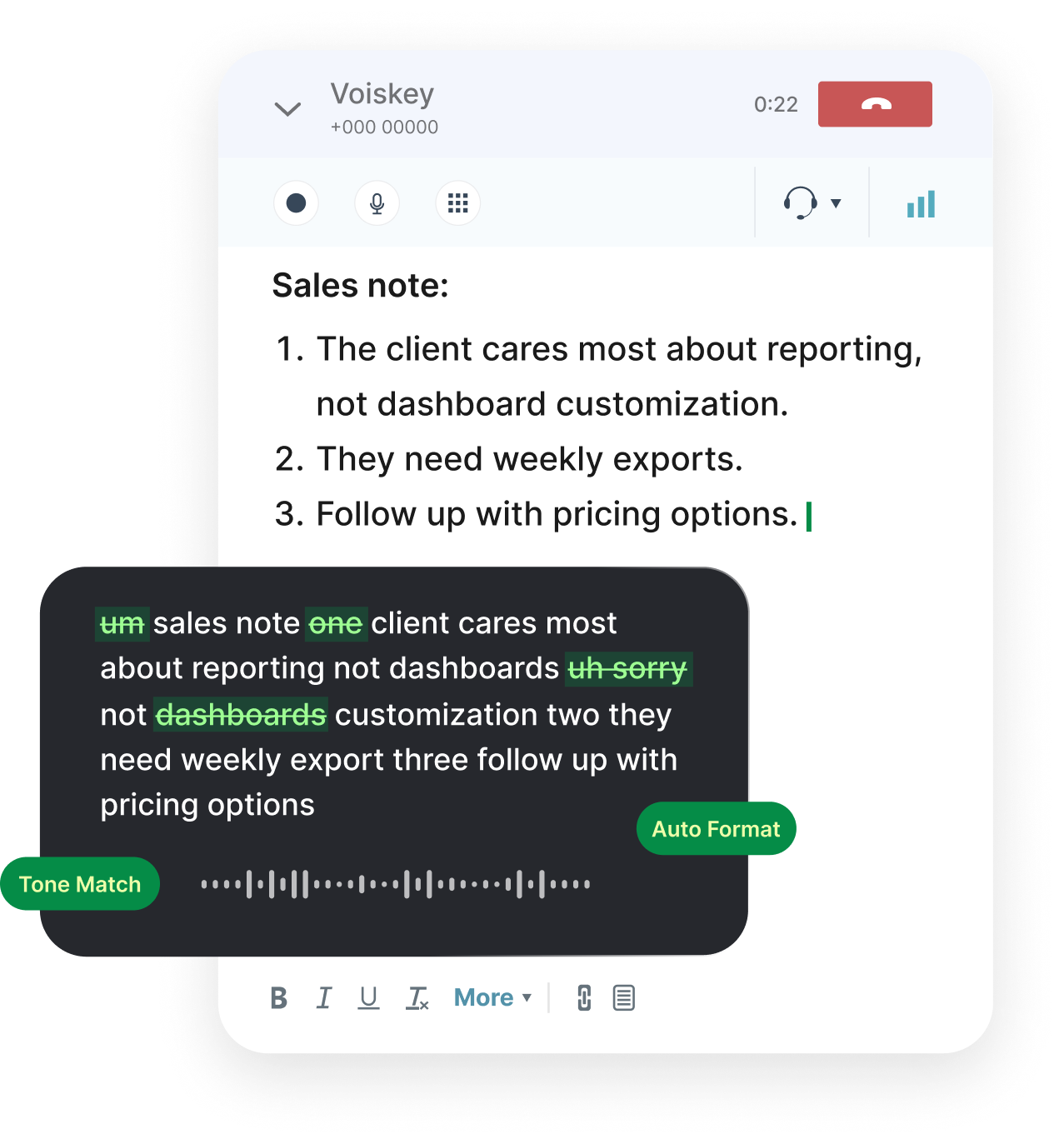
The shortest path is one closed deal, replayed in your own voice. Pick the last client you onboarded end to end and walk it: the first reply, the discovery call, the proposal, the signature, the kickoff, the handoff. As you talk, you are not writing the playbook from memory; you are narrating the journey while Voiskey transcribes the specific words, the subject lines, the questions you asked, the steps you checked. Resist the temptation to start from the ideal process: the ideal describes what should happen, while the narrated journey describes what does happen, and the gap between the two is where the team's real issues live. The first version of your team's onboarding playbook appears in the time it takes to tell the story of the last deal, and the story is the real process, not the one on the org chart.
Replay the Client Journey in Your Voice
Walk the journey in the order the client experiences it, not in the order the system records it. Start with the prospect's first reply, then the demo, the proposal, the signature pages, the payment, the accounts, the kickoff chat, the first deliverable. Narrate each moment as it happened, and say what you actually did at each one: I replied within the hour with a link to the calendar, I sent a short recap after the discovery call, I introduced the CS lead on the kickoff instead of in an email. The sequence in the client's inbox is the sequence the playbook needs, and narration produces it for free, because you speak the journey the way it was lived.
Capture the questions you ask, because the questions are the process. On the discovery call you ask about the team, the volume, the current tool, the deadline, and the decision maker; each question changes what happens next. Narrate them as a script: first I ask who owns this initiative, because if it is not the manager, the proposal stalls at the approval step. Then the playbook carries the logic, not just the list, and a new rep can adapt when the answers vary. The questions are also the part new reps fear most, and a playbook with the exact wording from a conversation is the difference between a confident opener and an awkward one.
Replay the demo and the setup as they are run, not as they are described. Say what you click, in what order, and what you point at while you talk: I show the dashboard first so they see the output before the input. Narrate the threshold moment where a client says that is what I need, and what you say next to turn it into the signature. Then the onboarding steps: the account creation, the training, the first report, the permission set. The demo and the setup are the two places where the process becomes real, and the narration is the only way to preserve the pacing that makes a demo work.
Include the timeline as the skeleton of the journey, and add the variants your clients fall into. Narrate the dates as you remember them: day one the reply, day three the discovery call, day five the proposal, day ten the signature, day fourteen the kickoff, day thirty the first review, because the real timing is what a new rep cannot guess. Then the variants: the small client who needs a lighter path, the enterprise client who needs a kickoff deck, the partner referral who skips the demo. Narrate the decision rule for each: if the deal is under the threshold, skip the steering call and send the agenda by email. The timeline makes the playbook a promise the team keeps, and the variants make it adaptable instead of rigid.
Steps, Owner, and Handoffs
After the narration, assign an owner to every step, and the owner is a role, not a person. For each step, say who owns it in the playbook: sales owns the proposal, the CS lead owns the kickoff, the admin owns the account creation. A step with two names is a step with zero owners, and an onboarding process with a handoff that has two routes is the start of the experience gap. Dictate the owner line in the narration as you get to the step: at this point I cc the CS lead, and she owns the kickoff from here. The playbook records the handoff exactly as you ran it, and the annotation becomes the role map.
Narrate the handoff moment in detail, because the handoff is where onboarding usually breaks. Say what you tell the client when the role changes: on the kickoff call I introduce the CS lead by name and say she is your primary contact now, and you will hear from her on every milestone. Narrate what changes in the room: the contract gets closed, the account gets created, the access gets granted, the training gets scheduled, and who does what and when the next check-in is. The handoff is a single sentence to the client and a checklist to the team, and both need to be in the playbook for the handoff to survive a change in staff.
Add the timing rules as days, not as feelings: send the welcome email within one business day, set up the workspace within two, run the kickoff call within five. Dictate the rule the way you would enforce it: if the kickoff has not happened by day five, I assume we lost the thread and I ping the client directly. The day-based rules make the playbook operational rather than aspirational, and they are what make a new rep able to run the process to the timeline without asking. The timing rules are the difference between a playbook people read and a playbook people follow.
Include the escalation line in the playbook: when you are unsure about a step, the person and the channel to ping, and what the ping looks like. The new rep's first instinct is to guess, and the playbook is the reason to ask instead: at the first sign the client is unhappy, add the CS lead to the email and phrase it as a request for guidance, not as a problem. Narrate an example from a real deal, an unhappy client, a delayed kickoff, and the playbook gives the rep a story to match the situation. The escalation line is not a failure; it is the reason the process survives a new person.
Client-Facing Wording That Stays Warm
The wording in the playbook is the product of the process, so keep the client-facing sentences verbatim. When you narrate the welcome email, the kickoff agenda, the weekly update, and the confirmation message, they land in the doc in the exact words, including the warmth, the next steps, and the person they should reply to. That is the tone you would want a new rep to inherit: the words that make a client feel handled, not scripted at. The playbook's role is to protect the human voice of the company, not to standardize it away, and the dictation preserves what the best rep would say.
Keep the playbook's client-facing lines short and concrete: one action, one date, one person. When you edit, cut the adjectives and keep the verbs, the email says: your workspace is ready, here is the link, your contact is Maria, reply here with the access list. The playbook should not contain the paragraph the rep sends; it should contain the sentence that makes the client feel taken care of. The best way to find those sentences is to narrate the ones that worked: the email that got an instant reply, the follow-up that closed the doubt, the check-in that fixed a wobbling week. Then the playbook holds the sentences that produce the trust.
Add the do-not-say list for client-facing conversations: no internal shorthand, no jargon in the email, no promise of a date you cannot keep, no we will send the proposal later without a date. Dictate the replacement phrases next to each: instead of the platform, say the portal; instead of we will get on it, say we will do it by Friday. The list is the safety rail that keeps a new rep from sounding like the tool's manual, and the replacements are the voice the company wants. The rule for keeping it current is the same as the rest: re-dictate the line the month it stops being true in the field.
Warmth is not a tone of voice; it is a set of small concrete facts. The warmer email says the name of the next step, the actual date, the actual person, the exact link, and the sentence that explains what happens next. Dictate those facts into the template of each email, and the warm template is the rep's friend, because the client does not need to know the words were rehearsed. The result is a playbook with the client's first impression in it, word for word, including the handoff sentence, and the team's service voice becomes the standard by which the client judges the company. The repetition of the small facts is the warmth, and the dictation makes it repeatable.
Playbook Review as a Standing Ritual
A playbook goes stale, so the review has to be a standing ritual, not an event. Put a thirty-minute block on the calendar monthly, invite the reps and the CS lead, and open the playbook to two sections only: the one that caused the most trouble this month and the one that changed. Then ask the group a question that finds the drift: which step did you skip this month and why? The skip is the second most valuable data in the room, because the honest answer tells you the step is wrong, and the correction can be re-dictated in the meeting: the fix lands in the playbook before the meeting ends.
During the ritual, ask each rep to contribute one real example from the month: the phrasing that worked, the client question nobody expected, the step that took too long. Dictate the example into the playbook as the case study, under the step where it belongs, because the example is what a new rep remembers and what makes a playbook feel alive. Then retire the step that no longer happens: the old path, the variant that never appears, and archive it rather than leave a ghost. The monthly editing keeps the playbook thin and truthful; a playbook that grows without pruning becomes a book nobody opens.
The review answers a simple debrief: what did the new rep do this month, and what did the senior rep do differently? If the gap is one step, the narration shows the deviation; if the gap is three steps, the ritual has found a section that needs a rewrite. Either way the playbook gets the correction while the story is fresh. The review is also where the rep tells you whether they used the playbook at all, and if they did not, the problem is usually the wording, not the will. The meeting itself becomes the small, steady force that keeps the playbook aligned with the real work.
Track the three numbers that tell the truth about onboarding: the time from signature to kickoff, the number of questions the client asks in the first two weeks, and the share of clients that reach their first success milestone on time. Compare the three across months and across reps, and the playbook's effect shows as a flattening of the variance: every rep onboarding like the senior one. When the variance is small, the playbook is working; when it is wide, the playbook has a hole, and the hole is the ritual's next topic. The result is a process that is repeatable, warm, and owned, and it cost one narrated replay to build.
FAQ s
Pick the last client you onboarded end to end, open a doc, and narrate the journey from the first reply to the first review: what you said, asked, checked, and sent at each step. That single replay takes about twenty minutes and produces the first real draft, because it runs from what happened, not from what the org chart says should happen. Add the timeline, and version one exists before the week ends.
Narrate the shared skeleton once, then add the decision points as if statements: if the deal is under the threshold, skip the steering call; if there is a partner, add the intro call. The if language comes naturally in speech, and it keeps the playbook as one document with branches rather than six separate ones. The variants are where the narration is most valuable, because the decisions are the part a new rep cannot infer.
Yes, the ones that worked. Narrate the welcome email, the kickoff invitation, and the weekly update the way you actually send them, including the greeting and the sign-off, and the playbook holds the exact voice of the company. Then strip the real names and replace them with placeholders. The sentences that produced an instant reply are the sentences another rep should inherit.
Keep the playbook's core to checkpoints and the five sentences that matter: the opener, the confirmation, the handoff, the check-in, and the escalation. The narrated rhythm is natural, so it reads as a practiced voice, not a memorized one. Let the reps dictate their own variations in the monthly review, and the scripted feeling disappears because the wording stays conversational, the way people actually talk to clients.
Monthly, thirty minutes, standing invitation. Open the two sections that caused trouble or changed, ask which step was skipped and why, and re-dictate one correction before the meeting ends. After each significant product or pricing change, review the affected sections in the same week. A short monthly ritual keeps the playbook current; a yearly full rewrite is a project nobody finishes.


 Voiskey
Your voice, amplified.
Choose a real task, follow the steps, and review the results with your team before expanding the rollout.
Use it across macOS, Windows, iOS, and Android