
Voice Notes for Witness Interviews
Design the note, capture attributed answers, and finish a reviewable summary.
 Voiskey Team
Design the Interview Note Before the Meeting
Voice Notes for Witness Interviews works best when the note has a design before the witness arrives. Decide whether the note will record answers close to verbatim, summarize themes, or track both. Name the matter, the interview date, the participants, and the reader who will rely on the note. Write the question list in the order you plan to ask it, leaving space under each question for the answer and for your observations. Note the facts you must confirm and the documents you will show. A structured note keeps the interview focused and makes a later summary reliable. Without a design, voice notes become a stream of impressions that takes longer to organize than the interview itself.
Plan the setup before the witness sits down. Confirm where the note will live, who can open it, and how you will keep the witness's words distinct from your own commentary. If the witness needs to read your questions as you speak, a real-time readable text view can help: a hearing speaker talks and the words appear as readable text for a deaf reader. Test the setup with one sentence before the interview starts. Keep the question list visible and the note file open at the right section. Decide how you will mark a quotation, a paraphrase, and a follow-up. A few minutes of setup prevents the common failure, which is realizing mid-interview that the note is in the wrong place or the wrong format.
Prepare the witness for the note-taking. Explain that you will be writing during the interview, that you may ask them to pause, and that they can ask to correct or clarify anything. Ask them to speak at a normal pace and to spell names that are easy to confuse. Confirm how they want their words represented, especially if the note may be shared with a court or the other side. Agree on a signal for an off-the-record explanation. This short conversation improves the quality of the notes more than any tool, because a witness who understands the process speaks more carefully and corrects errors as they happen.
Set the note conventions for the matter. Decide how you will label each witness, each question, and each answer. Choose a consistent way to mark uncertainty, contradiction, and follow-up. Note whether the note will be used to prepare a formal statement, a file memo, or both, because the level of detail changes with the purpose. Write the required headings in the file before the interview. If a supervisor will read the note, ask what they need to see first. These conventions take minutes to set and save hours later, because a note with consistent labels can be searched, compared with other interviews, and turned into a summary without re-reading every line.
Note Answers in Clean, Attributed Segments
During the interview, note one answer at a time. Let the witness finish, then record the answer under the question before moving on. Speak in short sentences and attribute clearly, using phrases such as the witness said or the witness could not recall. Keep your own reactions out of the answer block; put observations in a separate section. If an answer is long, capture the main point first, then add detail. If you miss something, ask the witness to repeat it rather than reconstructing it from memory later. Clean, attributed segments are the foundation of a reliable note, because they preserve who said what and keep the interviewer's interpretation visibly separate from the witness's account.
Preserve the witness's wording where it matters. When a phrase is significant, say that you are quoting and repeat it exactly. When you are paraphrasing, mark the passage as a paraphrase. Do not smooth a hesitant answer into a confident one, and do not resolve a contradiction while noting it. If the witness corrects themselves, record both the first statement and the correction. These distinctions matter when the note is compared with a later statement or used at a hearing. A note that preserves uncertainty is more useful than one that reads cleanly but hides the places where the witness was unsure.
Ask follow-up questions while the subject is fresh. When an answer raises a new fact, note the follow-up immediately in the margin and return to it before changing topics. Use the question list as a spine, but allow the interview to follow the witness's account where that produces better detail. Keep a running list of names, dates, and documents mentioned, and confirm the spelling of each before the witness leaves. If an answer depends on a document, note the document and the page. Follow-ups captured in the moment are far more reliable than ones reconstructed from memory after the interview ends.
Manage pace and accuracy together. Speaking notes is faster than typing, but the interview still needs room for silence and thought. Pause after a complex answer and read back the key sentence to the witness for confirmation. If the witness speaks quickly, ask them to slow down rather than guessing at their words. If you fall behind, note a marker and return to the answer after the witness pauses. Keep the note readable enough that you can find your place after a tangent. Accuracy in an interview note comes from deliberate pacing, not from writing at maximum speed, and a witness who is asked to slow down usually appreciates the care.
Record Context, Doubts, and Follow-Ups
Keep a separate context block for each interview. Record the date, time, place, participants, and the capacity in which each person attended. Note how the witness appeared and any relevant circumstances, using factual language rather than characterization. Record what documents were shown and what the witness was asked to review. Note any breaks and anything that changed during the interview. Context is what makes a note usable months later, when the participants' memories have faded and the reader needs to understand the conditions under which the answers were given. A context block takes two minutes and prevents a note from becoming a set of quotations without a setting.
Record your doubts explicitly. If an answer seemed evasive, inconsistent, or incomplete, note the specific words or behavior that produced that impression, not a conclusion about the witness. If you are unsure whether you heard a name or date correctly, mark it for confirmation. If a document contradicts an answer, note both and flag the conflict for follow-up. These notes are for the legal team, not for the witness, so keep them clearly separated from the answer blocks. Doubts recorded with specificity can be tested later; doubts recorded as a general feeling cannot. The discipline of writing down why something seemed off is what turns an impression into a usable lead.
Build a follow-up list as you go. For each open item, note what must be done, who will do it, and by when. Typical items include confirming a date, obtaining a document, checking a name against a record, and scheduling a second interview. Distinguish between questions for the witness and tasks for the legal team. At the end of the interview, read the list back and confirm the witness's contact details and availability. A follow-up list that is built during the interview is more complete than one assembled afterward, because the reason for each item is still fresh. Review the list with the witness before they leave, while the details are easy to confirm.
Close the interview deliberately. Thank the witness, explain what happens next, and confirm how they can reach you with corrections. Read back the most important answers and ask whether the witness wants to change anything. Note any correction they make. Confirm that the witness understands the note may be used in the matter. Save the note before the witness leaves, so an interruption cannot cost the session's work. A deliberate close protects both the record and the relationship, and it gives the witness a clear opportunity to correct an error while the memory is still reliable. Confirm the next contact date and who will make it.
Polish Notes Into a Reviewable Summary
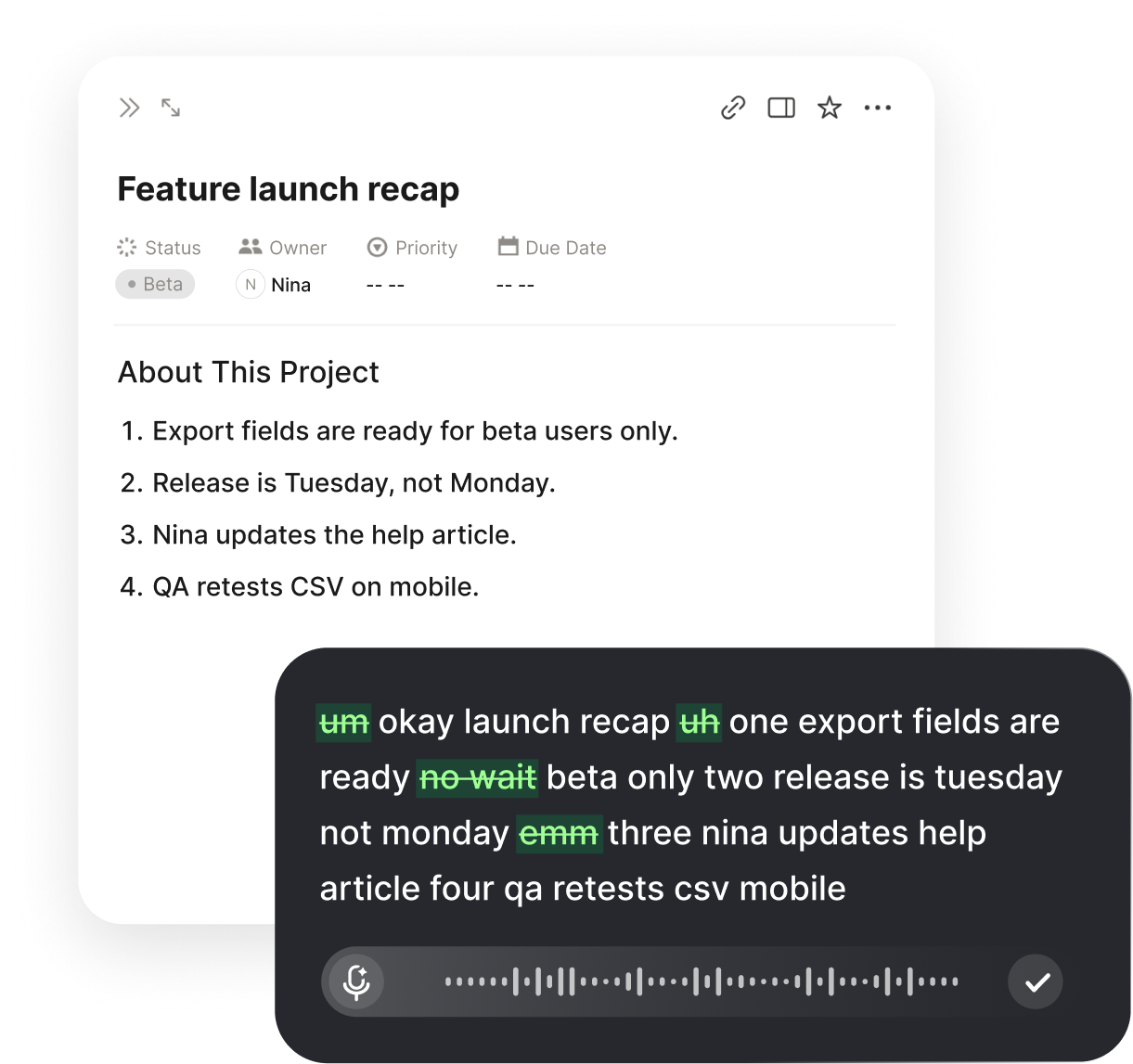
Polish the note before anyone else reads it. Read the answers in order and check that each one sits under the right question and that names, dates, and document references are consistent. Separate the witness's account from your observations, and make the distinction visible in the headings. This is where Voiskey's cleanup helps: it removes filler words, stutters, false starts, self-corrections, and grammar slips as you speak, and adapts punctuation and formatting to the note you are building, so the raw text needs less repair. Still, cleanup does not decide what is significant. Download Voiskey for the device you use for interviews and run one full note through the routine, then check every summary against the raw note.
Turn the raw note into a summary without losing the detail. Write a short opening that identifies the witness, the date, and the purpose. Then summarize the account in the witness's order, marking quotations and paraphrases. Add a section for inconsistencies, open questions, and documents mentioned. Keep the raw note attached so a reader can check any summary sentence against the original. If the case team needs a chronology, extract the dated events into a separate list with references back to the note. A good summary shortens review time without becoming a substitute for the record. Keep it short enough that a busy reader will actually finish it.
Check the summary against the interview for accuracy. Confirm that every quotation in the summary appears in the raw note, that every date matches, and that no observation has been presented as the witness's statement. Check that the summary does not resolve an ambiguity the witness left open. If a sentence combines two answers, make sure the combination is fair. Ask a colleague to read the summary and the raw note side by side for one section. A summary that overstates certainty is worse than a longer note, because later readers will rely on it without returning to the session.
Format the note for the reader who will use it. Use headings, short paragraphs, and consistent labels for questions, answers, observations, and follow-ups. Put the most important facts near the top, but do not distort the witness's account to do so. Add a version label and the date of the last edit. If the note will be shared outside the immediate team, confirm what should be removed or summarized. Save both the raw note and the polished summary in the matter file. A well-formatted note is easier to review, easier to compare with other interviews, and easier to turn into a statement when the time comes.
FAQ s
Voiskey removes filler words, stutters, false starts, self-corrections, and grammar slips as you speak, so the note that appears at the insertion point is closer to a clean record of the answer. It does not decide what is significant or resolve contradictions for you. The interviewer still separates quotation from paraphrase and checks the summary against the raw note before anyone relies on it.
Yes. Voiskey learns names, jargon, acronyms, and spelling preferences, which helps when an interview involves unusual spellings, place names, or entity names that repeat across a series of notes. Keep a glossary for the matter and confirm spellings with the witness. The learned terms reduce corrections, but the interviewer remains responsible for verifying every name and date in the final summary.
You press a shortcut, speak the answer into the note file, and text appears at the insertion point. Voiskey cleans the spoken text and adapts punctuation and formatting to the note you are building. Polish is your review pass, where you separate quotation from paraphrase and check names and dates. At up to 220+ words per minute, the routine keeps pace with an interview without forcing the witness to wait.
Yes. Voiskey works at the system level, so text appears at the insertion point in whatever app or text field holds your note. You can speak directly under each question in the file your team already reviews, with no separate suite to open. The workflow is Speak-Polish-Type-Edit, and the note stays in one place from the interview through the summary.


 Voiskey
Your voice, amplified.
Download Voiskey for Mac and Windows and capture witness interview notes that are ready to review.
Use it across macOS, Windows, iOS, and Android