
Voice Notes for Science Lab Reports
Capture bench observations, then assemble a verifiable lab report
 Voiskey Team
Prepare the Bench Note Template
Voice Notes for Science lab reports start at the bench, not at the keyboard. Before the session, build a one-page template with four labeled areas: setup, observations, measurements, and follow-up. Write the labels at the top of your note page so you can speak into the right section without thinking. Add the experiment title, the date, your bench number, and the names of your partners. List the instruments you will use and the units you expect to report. This preparation takes a few minutes and prevents the most common failure in lab writing: a page of observations with no record of the conditions that produced them.
Decide the exact phrases you will use for repeated actions. For each step, choose a short verb phrase such as added, stirred, heated, or waited, and use it consistently all session. Agree on how you will say units, decimal values, and ranges, for example twenty-five milliliters or a range from ten to twelve. Consistency matters more than elegance, because a reviewer must compare your entries with the protocol. Write these conventions beside the template. If a partner will also dictate notes, share the conventions before the session so your two records can be merged without translation, mismatch, or guesswork.
Plan where the device sits and when you will speak. In a shared lab, the safest moments are right after a step ends, before the next one begins, and during any waiting period. Choose a spot away from the sink, the centrifuge, and the doorway, and keep the screen angled so a glance is enough. If your hands must stay gloved, decide how you will start and stop speaking without touching the keyboard. Rehearse that gesture once before the session. A fixed position and a fixed moment turn note-taking into a habit instead of a decision you make while holding a beaker.
Set the quality bar for what counts as a usable entry. Each entry should name the step, the quantity, the unit, the time, and anything unusual that happened. If a reading looks wrong, note the value and the action you took rather than discarding it. If a step was skipped or repeated, say so plainly. The template should have a small space for deviations, because those are often the most important part of a lab report. A clear bar lets you judge the notes at the bench instead of discovering the gaps a week later when the report is due.
Dictate Observations While They Are Fresh
Speak each observation immediately after the step that produced it. Memory degrades quickly once the next task begins, and a delayed note tends to merge two steps into one. State the step, then what you saw, then the value and unit, in that order. If the result was expected, say expected; if not, say unexpected and describe the difference. Keep the sentence short and move on. Fresh sentences are easy to polish later, while reconstructed notes invite invented detail. The bench is the only place where the full context exists, so capture it there rather than trusting recall at the end of the day.
Describe what you see rather than what you conclude. Write the color, texture, smell, temperature, and timing before any interpretation. For an instrument reading, state the number, the unit, and the setting that produced it. Save interpretation for the discussion section, where it belongs and where you have the full set of results. If an interpretation forces itself into your head, add it after the observation with the label note to self. Separating observation from inference keeps the results section honest and makes the discussion easier to write later in the week. A reader should be able to tell which sentences describe the bench and which describe your thinking.
Handle interruptions without losing the thread. When a partner asks a question or an alarm sounds, finish the current sentence, then say where you paused and what comes next. That small marker lets you resume at the right step and keeps the note sequence readable. If the interruption produced a result, such as a changed setting after a warning, add it as its own entry. Do not summarize the interruption later from memory; the note is most accurate at the moment it happens. A discipline of short, complete entries survives a busy bench far better than long, elegant paragraphs spoken after the fact.
End the session with a spoken recap before you leave the lab. Say the experiment title, the steps completed, the steps remaining, and any deviation you recorded. Add the state of your samples and the time of the next check. This recap becomes the opening of your report draft and the checklist for the next session. If you dictate it into the template's follow-up section, you will not have to reconstruct the session from memory when you write the report. A two-minute spoken recap at the bench is the cheapest insurance against losing an afternoon of work, and it costs less than rewriting a lost afternoon.
Assemble Method and Results Sections
Write the method section from the template's setup and observation entries, in chronological order. Each sentence should state what was done, with what quantity, under what condition. Use the past tense and the passive voice only when the actor is genuinely unknown. Keep the conventions you chose at the bench so the method matches the notes. If a step was repeated or adjusted, describe the adjustment where it happened rather than in a footnote. A method section assembled this way is short, verifiable, and easy for a partner to follow, because it was built from entries written while the work was happening.
Build the results section from measurements, not from the narrative. List each measured value with its unit and the condition that produced it, then group values that answer the same question. Present the expected result and the unexpected result with the same care, because a surprising value is often the most useful part of a report. Add a plain description of any trend you see, and leave causal explanations for the discussion. If a value is uncertain, say how it was measured and what limits its reliability. Numbers with context are results; numbers alone are decoration and cannot be checked.
Keep interpretation and evidence in separate paragraphs. In the discussion, state the claim, then point to the specific result that supports it, then name the limitation that weakens it. If the results conflict, describe the conflict rather than forcing a neat conclusion. Acknowledge a failed step when it affected the outcome, and say what you would change next time. Use the template's deviation entries as the source for these limits. A discussion built from specific entries reads as honest reasoning, while one written from memory tends to overstate what the experiment proved. Keep each claim next to the evidence that supports it.
Finish with a report checklist and a peer pass. Check that every claim in the discussion points to a result, every result names its condition, and every method step appears in the notes. Confirm units, significant figures, and the spelling of instrument names. Ask a partner to read the method and repeat the experiment on paper; wherever they hesitate, the method is missing a step. Fix those gaps, then submit. The checklist is short, but it catches the errors that cost the most marks, and it takes one careful pass rather than a rushed reread the night before the deadline.
Test the Loop With Voiskey
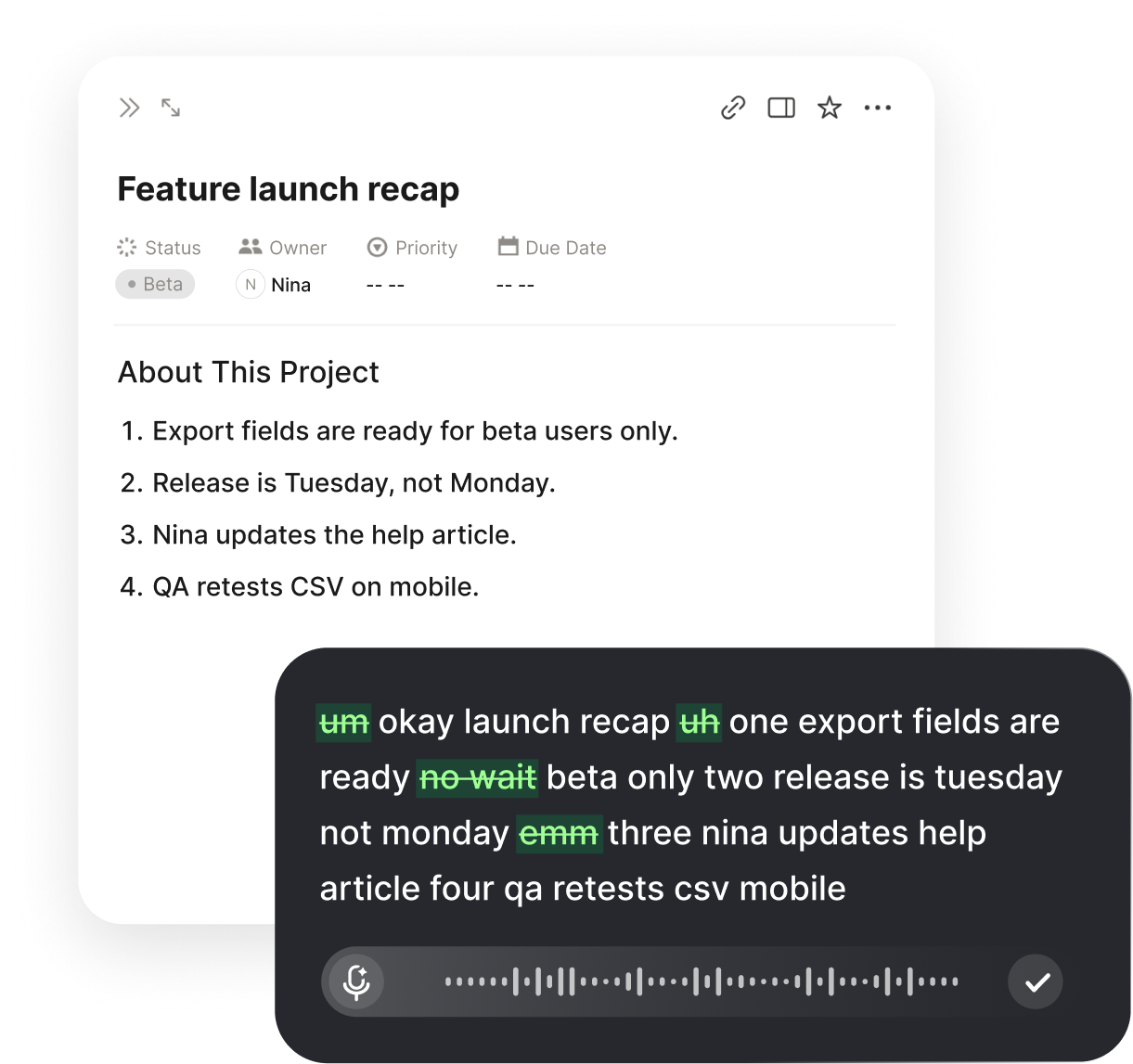
Run one full lab session with the spoken-note loop before you rely on it for a graded report. Set the template, choose the device position, and practice the start and stop gesture during a dry run. Then dictate at the bench exactly as you plan to during the real session. Voiskey suits this because you press a shortcut, speak, and text appears at the insertion point in the note document you already keep. It removes filler words, stutters, and false starts, and it adapts punctuation to the list style you are using, so the bench notes need less cleanup before they become a method section.
Review the output at three points: after the session, after the method draft, and after the results draft. At each point, check a different quality: completeness of steps, accuracy of units, and consistency between claim and result. Keep a short list of corrections and fix them in one editing pass rather than interrupting the bench work. If a term is repeatedly misrendered, say it clearly once and add it to the notes as a reminder. Voiskey learns names, jargon, acronyms, and spelling preferences, which helps across a term of related experiments. Download Voiskey if you want the same loop on another machine for the next lab.
Measure whether the loop saves time without lowering quality. Count the minutes spent dictating, the minutes spent editing, and the number of corrections per section. Compare a dictated report with one written from memory notes from an earlier session. If editing time is high, the problem is usually the spoken structure, not the tool, so simplify the cue phrases and try again. If quality drops, add a check rather than abandoning the loop. The goal is a report that is faster to produce and easier to verify, not a transcript of the session, so run the comparison on two real experiments before deciding.
Close the trial with a written verdict and a cleanup pass. Keep the cue phrases and template sections that worked, drop the ones you never used, and write the three corrections you made most often. Then try the loop again in a second session with the revised template. A trial is complete and trustworthy when a partner can read the method and results and follow the experiment from the page without asking you questions. If that test fails, the notes are still too thin, and the next session should add one more observation category before you consider a different tool.
Keep a Repeatable Lab Routine
Make the routine repeatable by standardizing the parts that never change. Keep one template, one cue-phrase list, and one checklist for each lab course, and store them where you prepare for the session. Before the lab, open the template, confirm the units, and set the device position. After the lab, run the recap and the three-point review. Write these steps on a card and keep it in your lab folder. A routine that begins with the same three actions removes the small decisions that cause a session to start late or a report to be assembled from scraps.
Review the routine after every two reports. Ask which entries were missing, which were redundant, and which took the longest to clean up. Adjust the template by adding or removing one field, not by rewriting the whole page. If a partner joins the course, hand them the template and the cue list before the first session so both records match. Keep a short log of changes with dates. A gradual, documented adjustment keeps the routine matched to the course, while a big rewrite every month tends to produce a template nobody trusts and a template nobody can compare with last month's notes.
Protect the routine during busy weeks. When a deadline compresses the schedule, drop the optional fields first and keep the core entries: step, value, unit, time, deviation. Speak shorter sentences and rely on the recap to hold the sequence together. Do not skip the review entirely, because the review is where the errors are caught before they reach the report. If you use Voiskey during these weeks, the same cue phrases and gesture keep the notes consistent even when the sessions are rushed. Consistency under pressure is the real test of a routine, and it is what makes the next report easy to start.
Hand the routine forward when the course ends. Save one strong report, its dictation template, and the cue list as an example for the next term or for a partner taking the same course. Write three lines about what to keep, what to drop, and what to add. Download Voiskey if you want to dictate the handover note and the first session of the new term into the same structure. Check the gesture, the template fields, and the review prompts once before the first lab. A handed-over routine is the clearest evidence that the method works beyond a single report.
FAQ s
Press the shortcut at the bench and speak each step, observation, and value into your lab template. Voiskey places text at the insertion point and removes filler words, stutters, and false starts, so entries are short and readable. It also adapts punctuation and formatting to the list style you are using.
Voiskey learns names, jargon, acronyms, and spelling preferences, so repeated instrument names and abbreviations grow easier across sessions. Say an unusual term clearly once, then use it normally. Support for 100+ languages also helps when a protocol or a partner's notes use another language.
Speak each observation immediately after the step that produced it, in the order step, observation, value, and unit. Keep sentences short and mark any interruption with the paused step. Voiskey polishes filler and grammar slips, and you can edit the result in the same note document before it becomes the method section.
Voiskey supports up to 220+ words per minute, about 5x faster than typing, which helps when a lab session produces many short entries. You press a shortcut, speak the note, and text appears at the insertion point, so you can stay at the bench instead of moving to a keyboard. Cleanup takes one editing pass, not a full rewrite.


 Voiskey
Your voice, amplified.
Download Voiskey for Mac and Windows and speak lab observations before details fade.
Use it across macOS, Windows, iOS, and Android