
Voice Notes for Tutorials and Office Hours
Ask better questions, paraphrase answers, review the same day
 Voiskey Team
Prepare Questions Before the Session
Voice Notes for Tutorials and office hours work best when note taking starts before the session, not in the last five minutes. A tutorial moves quickly, and a student who arrives without a written question often leaves with a vague impression instead of a usable explanation. Spend ten minutes the night before speaking your questions into a short list. Each question should name the problem, the step where you got stuck, and what you already tried. That preparation changes what you hear, because you listen for the answer to a specific gap instead of trying to copy everything the tutor says.
Group your questions by topic and rank them by what the next assessment will cover. Five sharp questions are more useful than fifteen scattered ones, because a tutor can answer five in depth and will rush through a long list. For each question, add one worked example or one line of your own attempt, so the tutor can see where your reasoning broke. If two questions overlap, merge them and note both parts. Speak the final list into the document you will carry to the session, then read it once more and delete anything you could answer yourself from the reading. A short, ranked list signals preparation and usually earns a clearer answer.
Set up a note template for the session before you leave your room. Use four headings: topic, questions, answers, and follow-ups. Under questions, paste the ranked list. Under answers, leave space for one short block per question. Under follow-ups, add a line for anything you still cannot do after the explanation. Put the date and the tutor name at the top, and keep the template in the same document for every session so the term's notes line up. A fixed template means you spend the session listening rather than designing a page, and it makes a missing answer obvious at a glance when you review later.
Agree on a simple plan with a study partner if you attend together. One person asks the prepared questions while the other speaks the answers into the shared document. Swap roles at the halfway point so both of you practice summarizing aloud. Keep the tutor's attention on the problem by asking one question at a time and waiting for the full explanation before speaking notes. If the tutor gives a method rather than an answer, ask for one example that uses the method. Write that example request into the follow-ups heading when you speak it, so the next session starts with the gap that remained.
Take Notes in Your Own Words
After each answer, pause and say the explanation back in your own sentences. A paraphrase that you can speak without reading is proof that you followed the steps; a sentence you copy verbatim often hides a gap. Start with the step you missed, then the rule that fixes it, then the check that shows the answer is right. Keep each summary to three or four sentences, because a long retelling drifts into the tutor's exact phrasing. If you cannot paraphrase, say so in the follow-ups heading and ask a narrower question before the session ends. This habit turns a passive hour into material you can actually use when you revise.
Label the tutor's method separately from your paraphrase. When the tutor gives a named procedure or a formula, speak the label first, then the steps exactly as given. When you add your own example, say my example before it. Voiskey adapts punctuation and formatting to the task, so a consistent spoken label produces a consistent written marker you can search later. Keeping the two types of note apart stops you from later mistaking your own guess for the taught method. During revision, the labeled method blocks become a checklist, and the examples become practice problems. A mixed block of method and guess is the hardest kind of note to trust.
Write down the exact point where your attempt failed. Vague notes such as I did not get it cannot guide a second attempt. Instead, speak the step number, the line of working, and what you expected to happen. For a proof, name the line where the argument stopped making sense. For a calculation, name the operation you applied in the wrong order. A precise failure point lets a tutor correct one step instead of re-teaching the topic, and it lets you retry the problem later without guessing where to start. Speak this note immediately after the answer while the working is still visible in front of you.
Where a deaf student attends with a hearing tutor, readable text can carry the explanation in the moment. The tutor talks and the words appear as readable text for the deaf reader, so the session does not depend on lip reading or a third person's summary. The student can then speak a short paraphrase into the same document after each block, which keeps the note in the student's own structure. This pairing works best when the tutor pauses at natural boundaries, such as the end of a step or an example, and confirms that the text has caught up before continuing. The written paraphrase remains the study note; the readable text is the bridge during the conversation.
Turn Answers Into Study Material
Convert each answer into a form you can reuse without the tutor present. The simplest form is a question with a worked answer underneath, written so that your past self could follow it. Speak the question first, then the steps, then a one-line check. If the answer was a method, add a second tiny example that uses the same method on different numbers. Store these under the topic heading, not under the session date, so they collect across weeks. A tutorial note that stays in date order is a diary; a note that collects by topic is a study resource. Spend the last five minutes of the session moving each answer to its topic heading.
Mark every unresolved item and carry it forward. At the end of the session, read the follow-ups heading aloud and decide which items to ask next time, which to look up, and which to drop because they no longer matter. Move the survivors into the next session's question list before you close the document. If an item has been open for three sessions, ask the tutor directly for a ten-minute walkthrough and say why the earlier answers did not settle it. Carrying items forward keeps the note honest about what you know, and it prevents the common pattern where the same confusion quietly follows a student through a whole module.
Check the answer against a second source before you trust it. Compare the spoken summary with the textbook section, the problem set solution, or a classmate's note. If the two differ, write the difference as a question rather than choosing a side. Small differences in notation are common and harmless, but a difference in a step usually means one source is wrong or one note is incomplete. Voiskey learns names, jargon, acronyms, and spelling preferences, so the notation you use repeatedly settles into a consistent form, which makes these comparisons much easier to run. Record the result of the check beside the answer, including the date and the source you compared against.
Share the cleaned notes with your study group and ask for one correction each. Say clearly that the notes are a paraphrase and that the tutor's method block is the part to trust. Ask each reader to mark one step that is unclear, then answer those marks in writing. The act of answering exposes gaps you did not notice while speaking. Keep the shared copy read-only and collect corrections in a separate thread so the original stays stable. When the group meets, start from the marked steps rather than re-reading the whole note. A shared note with named corrections is far more useful than a folder of unread documents.
Set Up Voiskey Before the Tutorial
Install and test Voiskey before the first tutorial of the term. Download Voiskey for your laptop, sign in, press the shortcut, and dictate one sentence into the note template. Confirm the text lands at the insertion point in the document you plan to use. Test the microphone in the room you will actually sit in, because a large room changes how loudly you need to speak. Keep the test sentence in the document as a marker and delete it before the session starts. Five minutes of setup prevents the awkward minute where a student discovers the app is not listening while a tutor waits for a question.
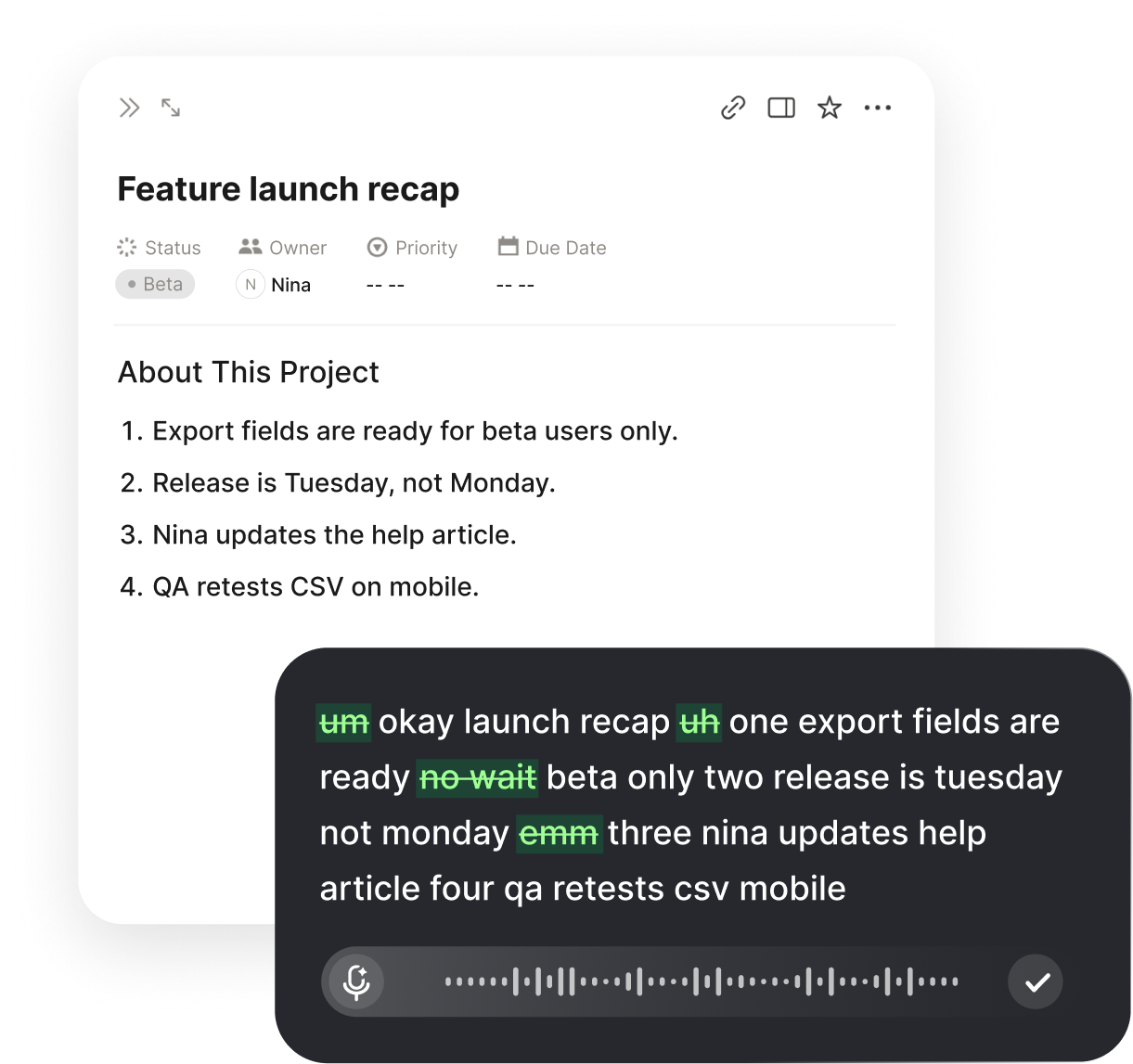
Choose one note document and keep it open for the whole session. Place the insertion point under the answers heading before you ask the first question, so the first note has a home. Speak in complete sentences and say the correction when a sentence goes wrong, because Voiskey removes false starts and self-corrections before the text appears. If the tutor speaks quickly, take the key step first and add the detail after the session. Trying to write every sentence during the conversation produces a messy page and a lost answer. A short accurate block written immediately beats a long block reconstructed from memory an hour later.
Plan for sessions where speaking is not possible. If the room is silent, if the tutor asks for no devices, or if you are sharing a table with someone who finds dictation distracting, take handwritten notes and speak them into the document within the hour. Keep the handwritten page next to you so the spoken version follows the real order of the session. Say the topic heading first so the block lands in the right place. This fallback keeps the note habit intact without disrupting the room, and the hour limit preserves the detail that fades after a long day.
Review the note within the same day and fix what the session left rough. Read the answers heading aloud, correct names and symbols, and move any stray sentence to its topic heading. Add a three-line summary at the top: what the session covered, what you can now do, and what remains open. Check that every question in the list has either an answer or a follow-up, so nothing silently disappears. If a block is too long, cut it to the steps and keep the explanation as one line. A same-day pass takes ten minutes and turns a rough session note into something you can study from without re-reading the whole page.
Run Productive Office Hours
Office hours reward a written agenda more than a long visit. Before you go, download Voiskey on the device you will bring if it is not already installed, and open the same note document you use for tutorials. Prepare three items: one conceptual question, one worked problem, and one planning question about the next assessment. Speak them into the document and read them once for clarity. An advisor who sees three specific items can help in fifteen minutes; an open-ended visit often ends with encouragement and no change to your understanding. The agenda also gives you a record of what you asked.
During office hours, take the answer down in short blocks and leave space between items. Ask for the reasoning behind a step rather than only the step, then speak that reasoning in your own sentences. If the advisor draws a diagram, describe it aloud as you copy it: what is on each axis, which arrow means what. Voiskey adapts tone and choice of phrasing to what you are trying to do, so a note spoken as a definition arrives in a different shape from a note spoken as a story, and telling it which one you want at the start helps. Keep each block tied to the agenda item it answers.
Leave every office hours visit with a written next step. State the next step as an action you can start that day, such as redoing problem four with the corrected order or reading one section before Friday. Speak the next step into the follow-ups heading and add the date you will check it. If the advisor suggested a resource, note where it is and what part to read, not just its title. A visit that ends without a concrete action tends to be forgotten by the next week, while a written action is easy to start and easy to review. The note becomes the bridge between the conversation and your own work.
Review office hours notes at the end of each month. Group the items by course, count how many stayed open, and look for a pattern in the ones that did. If the same topic keeps returning, the issue may be earlier than the specific problem, so raise that pattern at the next visit. Update the planner with any dates the advisor mentioned, and correct your question list for the next session. Download Voiskey on a second device if you study in more than one place, so the note habit does not break when you switch desks. A monthly review turns scattered visits into a track record you can act on.
FAQ s
Speak each answer into your session template right after the tutor explains it. Voiskey places the text at the insertion point, removes filler and false starts, and adapts punctuation, so a short paraphrase reads cleanly when you review the same day.
Voiskey learns names, jargon, acronyms, and spelling preferences. Say an unfamiliar term clearly once, then keep using it in later sessions; the notation and course vocabulary you repeat settle into a consistent form, which makes your tutorial notes easier to compare across weeks.
The text appears at the insertion point in the app or text field you are using. Keep the session template open and place the insertion point under the answers heading before the tutor starts, so each summary lands in the right block.
A hearing tutor talks and the words appear as readable text for a deaf reader. The student can then speak a short paraphrase into the same document, so the study note stays in the structure the student built rather than relying on a third person summary.


 Voiskey
Your voice, amplified.
Download Voiskey for Mac and Windows to keep tutorial notes in the document you already use.
Use it across macOS, Windows, iOS, and Android