
Voice Notes for Medical and Nursing Students
Build reliable clinical study notes from lecture, lab, and rehearsal.
 Voiskey Team
Build a Clinical Study Note System
Clinical coursework moves quickly, and the gap between hearing an explanation and writing it down is where most detail disappears. Voice Notes for Medical study gives you a way to close that gap: open a topic file, press the shortcut, and speak the explanation in your own words while the lecture is still fresh. Set up one file per condition or skill, with fixed headings for definition, risk factors, assessment findings, interventions, rationale, and red flags. Add the course code and week number to the file name so you can find it during revision. Keep the structure identical across topics; a predictable page reduces the effort of starting and makes comparison between conditions much easier.
Prepare terms before each class. Write the drug names, anatomy terms, acronyms, and scoring tools you expect to hear, then say each one aloud once. Generic names and abbreviations are common sources of error, so add the full form beside the short form in your vocabulary list. Voiskey learns names, jargon, acronyms, and spelling preferences, which means repeated corrections drop as the term goes on. Keep the list at the top of the topic file and update it after class rather than during the lecture. A two-minute review before the session is usually enough to prevent the same misspelling from appearing twenty times in your notes.
Use a consistent internal order for every clinical topic. Start with the definition and the population affected, then describe the usual presentation, the assessment findings that matter, and the first actions. Follow with the rationale for each action and the findings that signal deterioration. End with a short section for questions you still need to answer. Speaking this order aloud trains recall because the structure matches the way you will be asked to reason in an exam or a simulation. When a lecturer jumps between topics, capture the point under the correct heading and add a note about where it appeared; the reorganization can wait until the review pass.
Schedule a short daily review instead of saving everything for the weekend. Read the day's notes aloud and mark any gap with a question, then answer it from the course reading or a peer's notes. Keep a running list of unresolved questions at the top of the file and clear it before the next class. If you use a study group, bring three questions rather than a full summary; questions expose gaps faster. At the end of each week, merge duplicate entries and move completed questions to a short revision sheet. This rhythm keeps the notes usable and prevents a folder of transcripts from becoming an unread archive.
Turn Skills Lab Steps into Checklists
Skills labs reward sequence, and sequence is easy to dictate. Before the session, read the procedure once and speak the steps from memory without looking at the handout. The gaps in that first attempt tell you what to review. Then open a checklist file and dictate each step as a short imperative sentence: position the device, check the connection, confirm the reading, document the result. Keep one action per line so the list can be checked off during practice. Add the equipment needed at the top and the safety checks at the bottom. A spoken draft takes a few minutes and gives you a working checklist before the lab begins.
During the lab, capture the instructor's corrections as they happen. When a step is reordered or a check is added, speak the correction with the word because so the reason stays attached: clamp before removing the line because backflow can occur. This habit turns a list of actions into a set of decisions. Do not worry about elegant phrasing in the moment; the polish pass can tighten it later. If the instructor demonstrates silently, describe what you see in one sentence per movement. At the end of the demonstration, read the list back and ask about any step you could not explain. Unclear steps are the ones most likely to fail under assessment pressure.
Convert the captured sequence into a checklist that matches the marking rubric. Compare your order with the handout and note every difference, then decide whether the difference is an error or an acceptable variation. Mark critical steps with a star and place them where they cannot be skipped. Use the same verbs as the rubric so practice and assessment share a language. If a step has a time limit, write the limit beside it. Have a peer follow your checklist while you perform the procedure and ask them to mark every point where they hesitated. Those hesitations show which instructions are still ambiguous and need a rewrite.
Practice aloud with the checklist visible, then repeat without it. Speaking the steps forces recall and exposes the transitions you normally skip when reading silently. Time the run and compare it with the expected duration, but do not trade accuracy for speed. After each attempt, dictate one sentence about what slowed you down and one about what you will change next time. Keep these reflections in a dated log beneath the checklist. When the same problem appears three times, change the checklist rather than promising to try harder. A checklist that survives repeated practice is more valuable than a perfect first draft written once.
Rehearse Explanations in Your Own Voice
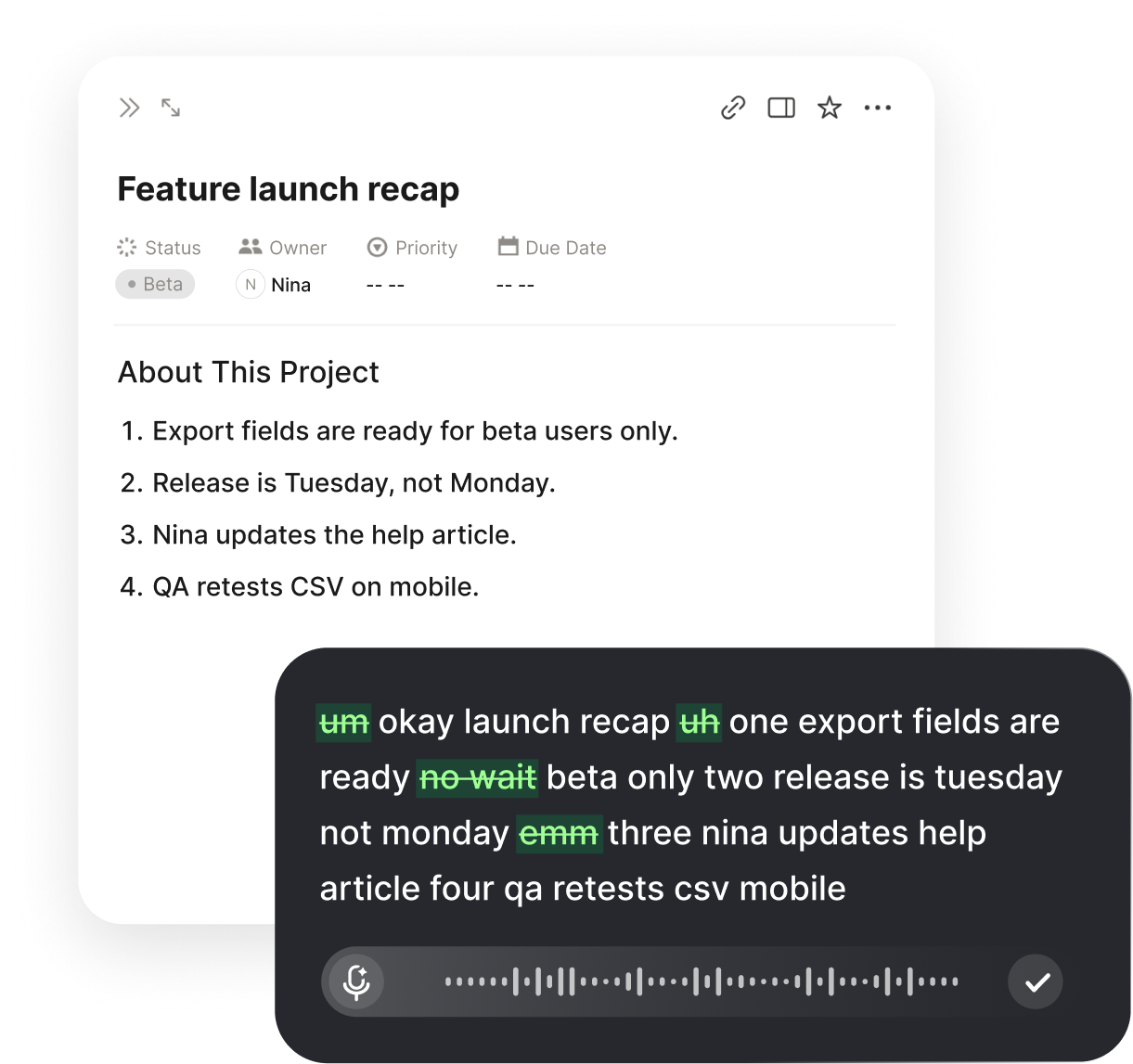
Clinical communication improves when you practice explaining a condition in plain language. Choose a topic, set a three-minute limit, and speak an explanation as if a classmate had asked what it means. Begin with the everyday consequence, then give the clinical description, then say what the listener should watch for. Keep the sentences short and define each term the first time you use it. When you stumble, finish the sentence and continue; the app removes false starts and stutters so the transcript shows the explanation rather than the hesitation. Read the result afterward and mark any place where a listener would need prior knowledge to follow you on a first listen.
Build a two-layer vocabulary for every major topic. The first layer holds the clinical term you must know for exams; the second holds the plain phrase you would use in conversation. Practice moving between them in both directions. For example, say the technical term, pause, then restate it simply, then return to the technical term. This exercise exposes vague understanding because a plain restatement is hard to fake. Keep the pairs in a short table under the topic notes. When a lecturer introduces a new synonym, add it to the table and say all three forms aloud. The goal is flexible recall rather than a memorized script, so change the order of the pairs on each practice pass.
Use peer questions as rehearsal material. Ask two classmates to interrupt your explanation with the questions they would actually ask, and capture those questions as they arrive. Answer each one in two or three sentences, then check whether your answer used evidence from the course material. If a question exposes a gap, mark it and return to the notes rather than improvising. Collect the best questions into a reusable bank organized by topic. Before an assessment, draw five questions at random and answer them aloud without preparation. This is a harder test than rereading notes and a better predictor of whether you can explain under pressure.
Finish each rehearsal with a short edit. Read the spoken draft and remove any sentence that repeats the previous point. Replace abstract phrases with a concrete example, and make sure every claim has a reason attached. Check that the opening answers the question directly rather than warming up. Read the revised version aloud once more and note the length; three minutes is roughly four hundred spoken words, so trim if you run long. Save the final version beneath the topic notes and date it. Repeating the same explanation a week later shows whether the structure has become automatic under mild pressure.
Polish Care Plan Drafts with Voiskey
A care plan is an argument, and the argument is easier to build aloud. Open the template your course requires, put the cursor in the first field, and speak the assessment summary before you fill any table. State the priority problem, the evidence that supports it, the goal in measurable terms, and the intervention with its rationale. Voiskey places the text at the insertion point in the drafting app you already use, so you never leave the template to compose in another window. Speak each field as a complete sentence even if the form expects a phrase; a complete sentence is easier to verify and easier to cut down later once the reasoning is sound.
Use the polish pass to match the required tone and format. Care plans mix clinical precision with plain description, and the balance differs by section. Speak the assessment in neutral, factual sentences, then use the planning section for measurable goals and the intervention section for reasoned actions. Voiskey adapts punctuation, formatting, tone, and word choice to the task, which helps when you move from a narrative summary to a numbered intervention list. Read each section against the rubric before moving on. If a goal cannot be measured, rewrite it until a classmate could tell, without asking you, whether it was met.
Accuracy outranks elegance in every clinical document. Check each intervention against the course text and the lab checklist, and mark any statement you cannot support. Do not let a fluent draft persuade you that a claim is correct; fluency and correctness are separate checks. Keep quotations and assigned terminology exact, and add the source beside each rationale. When the app suggests a cleaner phrasing, confirm that the clinical meaning has not shifted. If a term has a precise definition in your course, keep the course version even if a shorter alternative reads better in isolation during a quick review of the draft.
Close the draft with a structured review. Read the plan from top to bottom and confirm that each problem has an assessment, a goal, an intervention, and a rationale. Check that the highest priority appears first and that the goals describe a result rather than an action. Remove any intervention that belongs to another discipline unless the rubric asks for it. Ask a peer to apply the rubric to your draft without your explanation; their questions reveal missing reasoning. Save the final version with the course code and date, and keep the spoken draft beside it so you can see how the argument developed over time.
FAQ s
Speak each step as a short imperative sentence while the demonstration is fresh, and Voiskey places the text in your checklist file at the insertion point. It removes filler and self-corrections, so the captured sequence reads as a clean procedure you can rehearse and compare with the marking rubric.
Yes. Speak each template field as a complete sentence, then use the polish pass to adjust punctuation, formatting, and tone. Voiskey adapts these to the task, so a narrative assessment can sit beside a numbered intervention list in the same document, ready for a rubric check.
Voiskey learns names, jargon, acronyms, and spelling preferences. Introduce new terms in context and correct any misspelling once in the document; later sessions reuse that preference. Keep a short glossary at the top of each topic file so unfamiliar terms are easy to add and review.
Speak a three-minute explanation as if a classmate had asked, then read the transcript and mark places that assume prior knowledge. Voiskey removes stutters and false starts and adapts phrasing to the task, so the revised version shows the explanation rather than the hesitation and is easier to repeat aloud.


 Voiskey
Your voice, amplified.
Download Voiskey for Mac and Windows and speak your next draft into place.
Use it across macOS, Windows, iOS, and Android