
Voice Notes for Language Learners
Speak the language daily, translate on the fly, and watch your notes improve
 Voiskey Team
Why Speaking Builds Language Faster
Voice Notes for Language learners work because speaking forces retrieval. When you read a vocabulary list, recognition can carry you: the word looks familiar, so you assume you know it. When you speak, you have to produce the word, the ending, and the sentence order without a prompt. That production is where learning actually happens. Keeping a spoken note of what you said, and what you struggled to say, gives you a record of that retrieval. Over a few weeks, the notes show which structures you produce easily and which ones you avoid. That record is far more useful than a stack of completed worksheets.
The second advantage is volume. Language progress depends on how much meaningful speech you produce, and typing is a bottleneck for most learners. If you can only type twenty words a minute in your target language, your practice sessions stay short and cautious. Speaking at a natural pace lets you produce several times as much text in the same block, and the text appears in the document where you are already writing. More production means more chances to notice a gap, look it up, and try again. The goal is not speed for its own sake; it is enough volume to make the practice worthwhile.
Spoken notes also expose the gap between what you think you know and what you can actually say. A learner may recognize a tense in a reading exercise and still fail to use it in conversation. When you speak a note and read it back, the missed endings and the avoided constructions are visible. That visibility is uncomfortable but useful, because it turns a vague sense of progress into specific items to work on. The note becomes a diagnostic tool, not a diary. Treat every awkward sentence in the text as a clue about what to practice next rather than as a failure.
Finally, speaking connects the language to your own life, which is what makes it stick. A note about your morning, your lecture, or a problem you solved uses vocabulary you actually need. Textbook dialogues are useful, but personal sentences are memorable because they carry context. Spoken notes let you produce those personal sentences quickly and keep them in one place. Reviewing them later reactivates both the language and the memory of the day. That combination is why learners who keep spoken journals tend to retain vocabulary longer than learners who only complete exercises. That is the habit worth building first.
Setting Up Practice in the Target Language
Set up the practice space before the first session. Open a document dedicated to the target language, name it clearly, and decide the language variant you are learning so the notes stay consistent. If the language uses a different script, confirm that your document and your device are set up to handle it. Write a short header at the top with the date, the topic, and the one structure you want to practice, such as a past tense or a polite request form. A named focus prevents the session from drifting into whatever vocabulary happens to come to mind, and it gives you a way to judge the session afterward.
Prepare a small set of prompts in the target language. Five to ten questions are enough: what did you do today, what will you do tomorrow, describe a person you met, explain a process, give an opinion. Keep the prompts in the target language so the session stays immersive, and keep them visible beside the document. The prompts do two jobs: they remove the blank-page problem, and they make it harder to reuse the same easy sentences every day. Rotate through them across the week, and add a prompt when it starts to feel too comfortable. A prompt list is the backbone of a repeatable practice routine.
Warm up before speaking at length. Read the target structure aloud once, then say three short sentences that use it. This warm-up gets your mouth and your attention aligned, and it reduces the number of false starts once the real note begins. If a word or ending keeps failing, write it beside the prompt list and practice it separately before returning to the main note. The warm-up should take two or three minutes, not twenty. Its purpose is to move the target structure from recognition to production, so that the longer spoken note is practice rather than a test of everything at once.
Choose the right level of support. Beginners may need to speak a sentence, check a word, and continue; advanced learners can speak a full paragraph before reviewing. Match the setup to your level rather than copying someone else's routine. If you stop more than a few times per paragraph, lower the difficulty by using simpler prompts or a shorter target. If you never stop, raise it by adding a new structure or a longer explanation. The routine should feel slightly effortful but not overwhelming. Adjusting the difficulty each week keeps the practice productive and prevents the plateau that comes from repeating comfortable material.
Dictating and Translating Every Day
Make the daily note a fixed appointment rather than a spare-time activity. Choose a time when you are alert, and keep the note short: one paragraph in the target language is enough to maintain the habit. Speak the paragraph without stopping to correct every error, then read it back and mark the problems. This mirrors real conversation, where you cannot pause to consult a dictionary mid-sentence. Over time, the marked errors become a personal syllabus. A daily note of one paragraph, kept for a month, produces more usable evidence about your speaking than a single long session. Keep the appointment even on busy days.
Use translation deliberately rather than as a crutch. When you cannot produce a phrase, say it in your first language, translate it, and note the gap. The goal is to reach the point where the target phrase comes automatically, so record both versions and test yourself later. Translation is also useful in the other direction: write a short sentence in your first language, translate it aloud, and check the result. This two-way practice builds flexible control, which is what allows you to handle unfamiliar situations. Keep the translations short so the exercise stays focused on the structure rather than on vocabulary volume.
Build retrieval into the daily note by covering and recalling. After you speak the paragraph, read only the prompt and try to reproduce the main sentence from memory. Compare your spoken version with the written one and note the difference. The difference is your learning target for tomorrow. This cycle takes a few minutes and turns passive review into active recall. If a sentence is easy to reproduce, retire it and replace it with a harder one. The daily note should always contain one or two structures that are not yet automatic, so the practice stays at the edge of your ability.
Keep the note in one place and keep it searchable. A single document with dated sections is easier to review than a folder of separate files. Add a short line at the top of each day summarizing what you practiced and what still felt difficult. That line makes a month of notes scannable in a few minutes and reveals patterns, such as a tense that keeps failing or a topic you avoid. Speaking the summary line is quick, and it closes the session with a clear record. The habit of writing the summary also trains you to evaluate your own production, which is a skill that transfers to real conversation.
Building a Personal Vocabulary Log
A vocabulary log is only useful if it reflects your own gaps rather than a generic word list. After each spoken note, copy the three to five items you struggled with into a dedicated section, with the target phrase, the meaning, and one sentence you can say aloud. Voiskey helps here because it learns names, jargon, acronyms, and spelling preferences, so repeated terms in your target language come out more consistently the more you use them. The log should be short enough to review daily and specific enough that each entry points to a real moment when you needed the word. Fewer, personal entries beat a long list you never open.
Organize the log by function rather than by alphabet. Group phrases for asking questions, giving opinions, describing time, and explaining a process. Functional groups match how you actually speak, so reviewing a group prepares you for a real situation rather than a spelling test. When you download Voiskey, set up the log with the same headings you use in your daily note, so moving an entry from the note to the log is a matter of speaking a marker and continuing. This alignment reduces the friction that causes learners to abandon their logs after a week. A five-minute review beats a longer one you skip.
Review the log with a spoken test, not by rereading it. Cover the meaning column and say a sentence for each phrase, then check. If you can produce a sentence, mark the entry as active and move it to a monthly archive. If you cannot, keep it in the daily rotation and add a new example sentence. This active and inactive distinction keeps the log focused on what you still need. Revisiting an old entry with a fresh sentence also shows you how your grammar has improved, which is motivating in a way that a static list never is. That shared location is the whole point.
Let the log grow with your interests. When a new topic appears in your studies or work, add its core phrases before you need them, then practice them in a spoken note. A log built around your real life stays relevant, and relevance is what makes vocabulary stick. Review the whole log once a month and remove entries that have become automatic, but keep the date you retired them so you can see your progress. Download Voiskey and keep the log in the same document as your daily notes, so the two habits reinforce each other instead of competing for time.
Measuring Fluency Week by Week
Measure fluency with a weekly speaking sample rather than a feeling. Once a week, record a short spoken answer to the same type of prompt, such as describing your week or explaining a decision. Keep the sample in a dated section, and note three things: how long you spoke without switching languages, how many times you paused to search for a word, and which structure felt easiest. These are simple, observable signs, and they are more reliable than a vague sense that you are improving. Voiskey places the text in your document, so the sample is easy to compare with earlier weeks.
Compare samples side by side and look for change in specific places. Has the sentence length grown? Are the endings more consistent? Do you use a wider range of connectors? Choose one or two features to track per month rather than everything at once. A narrow focus makes progress visible and prevents the discouragement that comes from judging your whole ability every week. When a feature improves, celebrate it briefly and pick the next one. When it stalls, adjust the practice rather than the measurement, for example by adding a targeted warm-up or a new prompt type. Keep the weekly sample short and comparable.
Keep a simple error log alongside the samples. Group errors by type, such as verb endings, word order, or vocabulary gaps, and count how often each appears. The count tells you where to spend practice time, and it also shows when a fix is working. Do not aim for zero errors; aim for fewer errors of the type you are currently working on. Native speakers make mistakes too, and the goal is fluent, understandable production rather than perfection. A log that tracks one error type at a time is more actionable than a page of red corrections. Track one error type until it fades.
Close each monthly review with a plan for the next four weeks. Choose one structure to automate, one topic to expand, and one habit to protect, such as the daily note. Write the plan at the top of the next document so it is the first thing you see. If a week goes badly, resume with a single short note rather than trying to catch up. Fluency grows from consistent, slightly effortful practice, and the weekly sample is there to show you that the consistency is working even when it does not feel like it. Protect the habit and let the numbers follow.
FAQ s
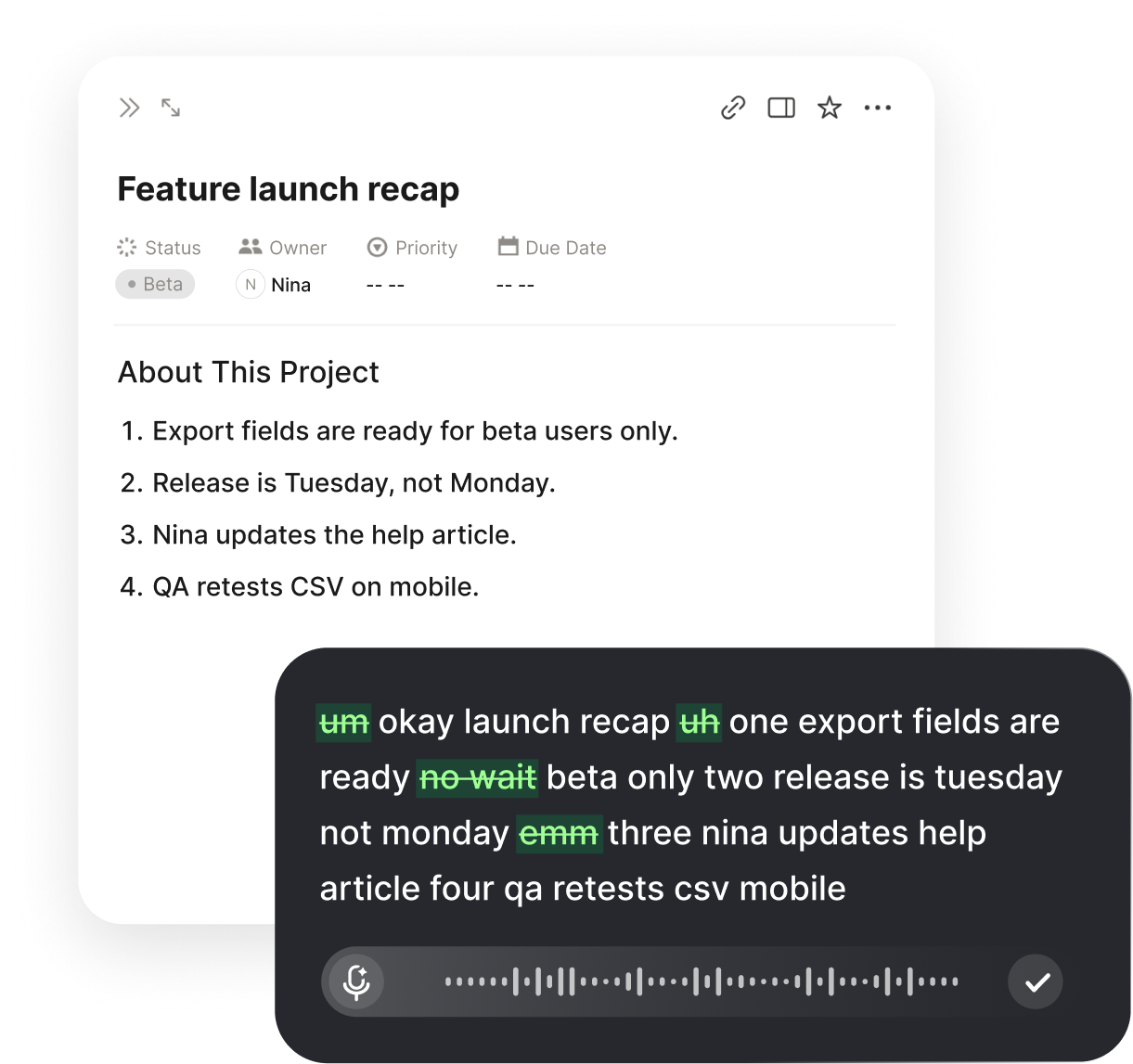
You press a shortcut, speak in your target language, and text appears at the insertion point in your document. Voiskey removes filler words, stutters, and false starts, which keeps the note readable, and it supports many languages and translation so you can move between your first language and the one you are learning.
Voiskey supports more than one hundred languages and translation. That lets you speak a phrase in your target language, note the meaning, and keep both versions in the same document instead of switching to a separate tool for each step of your practice routine.
Voiskey learns names, jargon, acronyms, and spelling preferences, so the words you use repeatedly in your target language become more consistent over time. Keeping a personal vocabulary log in the same document means the terms you practice most are also the terms the app sees most often.
Read the note back, mark the endings and phrases that came out wrong, and move the three to five hardest items into your vocabulary log. Voiskey already removes filler words and false starts, so you can focus on grammar, vocabulary choices, and the structures you avoided during the session.


 Voiskey
Your voice, amplified.
Download Voiskey for Mac and Windows and speak your target language every day.
Use it across macOS, Windows, iOS, and Android