
Voice Notes for Language Exchange Sessions
Capture corrections, phrases, and next steps from every language exchange.
 Voiskey Team
Set Up a Bilingual Session Log
Voice Notes for Language practice works best when the log is ready before your partner arrives. Create one file per partner and date, with four headings: topics we discussed, corrections I received, phrases I want to reuse, and tasks for next time. Add your target language and your partner's name at the top. Decide whether you will speak notes during the session or dictate a recap immediately afterward; the second option is easier when the conversation is fast. Keep the file open on a second screen or beside your notes. A fixed structure means you spend the session talking rather than deciding how to organize what you hear in the moment itself.
Agree on a correction policy at the start of the exchange. Some partners correct every error, while others wait for the end; both approaches work, but you need to know which one is in force. Ask for corrections in a consistent form: say the corrected phrase, then the reason. If you are the learner, repeat the correction aloud before writing it down. If you are helping your partner, use the same form so the exchange stays balanced. Write the policy in the log header and revisit it after a few sessions. Clear expectations reduce the awkwardness that makes partners hesitate to correct each other.
Prepare a short list of topics and questions before each meeting. Include one topic you can discuss comfortably, one that stretches you, and one practical situation such as ordering food or explaining a delay. Write two or three questions under each topic so the conversation does not stall. If you are meeting online, test the shortcut in your note app before the call. Keep the list short enough to scan in a glance. The goal is not a script but a set of openings that let you practice specific vocabulary and grammar without turning the exchange into a stiff interview.
Set a five-minute close for every session. Summarize what you discussed, read back the corrections you recorded, and confirm the next meeting. Ask your partner to add one phrase they think you should practice. Write the next date and topic in the log before you leave. If you noticed a recurring error, name it and ask for one tip to fix it. This close turns a pleasant conversation into a record you can act on, and it signals to your partner that you value the exchange enough to prepare genuinely for the next one and take the practice seriously each week.
Capture Corrections Without Breaking Flow
Corrections are the most valuable part of an exchange and the easiest to lose. When your partner corrects a sentence, repeat the corrected version aloud, then say the reason in a short phrase. If you cannot repeat it immediately, say hold and return to it at the end of the topic. Keep the log open and add the correction under the heading rather than in the middle of a paragraph. Use a consistent marker, such as a small arrow, so corrections are easy to find later. The aim is to keep the conversation moving while preserving the exact fix for later review.
Do not stop the conversation to perfect the note. Capture the corrected phrase and move on; the explanation can be completed during the close. If a correction involves pronunciation, describe it in plain terms, such as stress on the second syllable, rather than trying to reproduce the sound in writing. If it involves a grammatical pattern, write one example and ask for a second during the recap. Keep each entry to one line so the log stays scannable. A correction you can review later is worth more than a beautiful note that interrupts the real flow of the practice session.
Separate errors you want to fix now from errors you want to notice later. Some mistakes block meaning and should be corrected immediately; others are stylistic and can wait. Ask your partner to flag the first kind during the session and save the second kind for the recap. Mark each entry as now or later in the log. At the end of the month, count how often each type appears and choose one pattern to work on. This prevents the common trap of trying to fix everything at once and fixing nothing by the end of the month and losing momentum.
Review the corrections within a day, while the conversation is still memorable. Read each entry aloud and say the corrected phrase in a full sentence. If a correction no longer makes sense, mark it and ask your partner at the next meeting. Group related corrections under a small heading, such as past tense or polite forms, so patterns become visible. Delete duplicates and keep the clearest example. A short review the next day is more effective than a long review the week before the next session, because the context, tone, and situation are still fresh and vivid in your memory.
Build a Personal Phrase Bank After Each Meeting
A phrase bank turns individual corrections into usable language. After each session, choose five phrases you actually wanted to say but could not produce. Write the phrase in the target language, then a literal gloss, then a natural translation. Add one example sentence that fits a situation you expect to meet again. Keep the entries short and group them by function, such as asking for clarification, disagreeing politely, or buying a ticket. A bank organized by function is easier to practice than a list organized by the order in which the phrases happened to appear during a particular exchange session.
Speak the phrases aloud as you add them. Say the target phrase, pause, then say the situation where you would use it. If a phrase feels unnatural in your mouth, ask your partner to suggest a more common alternative at the next meeting. Record the alternative beside the original rather than replacing it, so you can see both. Practice three phrases at a time rather than the whole list; short repetition is more effective than one long review. Add a date to each entry so you can tell which phrases are new and which have already been practiced for weeks.
Use the bank during the next session. Choose three phrases and set a simple goal to use each one at least once. Put a small mark beside the phrase when you use it, and note whether it felt natural. If you avoided a phrase, write down why: you forgot it, the situation never came up, or you were unsure of the grammar. Those notes are more useful than a simple check mark because they tell you what to change. A phrase bank that never enters conversation is a dictionary, not practice, and it will not improve your fluency on its own.
Prune the bank every few weeks. Remove phrases you have mastered, merge duplicates, and move difficult entries into a separate practice list. Keep the bank small enough to review in ten minutes. If a phrase has been avoided three times, either simplify it or drop it; not every expression is worth the effort at your current level. Save the bank beside your session logs so it grows with the exchange. Over a term, the bank becomes a personal record of the situations you can now handle with confidence in the target language and a clear starting point for the next conversation.
Use Voiskey for Translation and Review
Use Voiskey to draft the bilingual parts of your log when you need a quick starting point. Speak the idea in the language you know best, then switch to the target language and say the version you want to practice. Voiskey supports more than one hundred languages and translation, which helps when you want to compare your phrasing with a translated version. Treat the translation as a draft, not an answer key; ask your partner to confirm anything that sounds unnatural. Read both versions aloud and note the differences in structure, politeness, and rhythm before you decide which version to practice.
Keep the two languages visually separate in the log. Use one heading for the target language and another for your working language, and never mix them in the same line unless you are deliberately comparing a phrase. When you dictate a review, say the target phrase first, then the translation, then the situation. This order trains recall from meaning to expression rather than from translation to meaning. If a phrase has two possible translations, record both and note when each is appropriate. Separation makes later review faster and prevents accidental language mixing during practice. It also makes the log easier to share with a partner.
Use the app to prepare for a specific conversation rather than to translate everything. Before a session, speak five sentences you expect to need, such as asking your partner to repeat or explaining that you do not understand a term. Check the translation, then practice saying the sentences without looking. If your partner uses a phrase you did not prepare, capture it during the session and add it to the bank afterward. Preparation should reduce hesitation, not replace the improvisation that makes an exchange valuable. Keep the list of prepared sentences short so you still have to think on your feet.
Review the translated entries with a critical ear. Translation can produce a sentence that is grammatically correct but too formal, too literal, or simply uncommon. Read each entry aloud and ask whether you would hear it in an ordinary conversation. If not, simplify it or ask your partner for a natural version. Keep the confirmed version and mark the source. Over time, the log becomes a record of phrasing your partner has actually approved, which is more useful than a collection of unverified translations. Review the confirmed entries before each session and gradually retire the ones you no longer need to practice.
Keep the Exchange Going Between Sessions
The days between sessions matter as much as the meetings. Set a fifteen-minute practice slot twice a week and review the phrase bank, the correction list, and the next topic. Read each phrase aloud and use it in a new sentence. If you have a question for your partner, write it in the log rather than saving it for a message you may never send. Keep the practice slot short enough to repeat. Consistency between meetings is what turns a weekly conversation into steady progress. Without that middle practice, each session starts close to where the last one ended.
Send a short recap after each session. Include the three phrases you practiced, one correction you are working on, and the topic for next time. Keep it to a few lines and write it in the target language if your level allows, with a translation below. Ask one specific question so your partner has an easy reason to reply. A recap gives the exchange a shared record and reduces the time spent reconstructing what happened. It also gives you another chance to use the language in a low-pressure setting. Keep the recap friendly and brief so it does not feel like homework.
Prepare your setup so the next session starts smoothly. Download Voiskey, install it for your operating system, and test the shortcut in the note app you use for the log. If you qualify for the student offer, sign in with a school email and enter the code sent to that address. Create a template with the four headings and a short phrase-bank section. Add your partner's name and the meeting day so the file is ready before the conversation begins. A reliable setup removes one more reason to postpone practice. Test the microphone and the shortcut before your partner joins the call.
Review the exchange every month and decide what to change. Look at the correction log, the phrase bank, and the topics you covered. If one skill keeps lagging, such as listening or polite disagreement, choose a topic that forces practice in that area. If the exchange feels stale, propose a new format such as a five-minute role-play or a short presentation. Ask your partner what they want to practice and adjust the balance. A good exchange is a partnership, and it stays useful when both people review and revise the routine. Put the review date in the log so it actually happens.
FAQ s
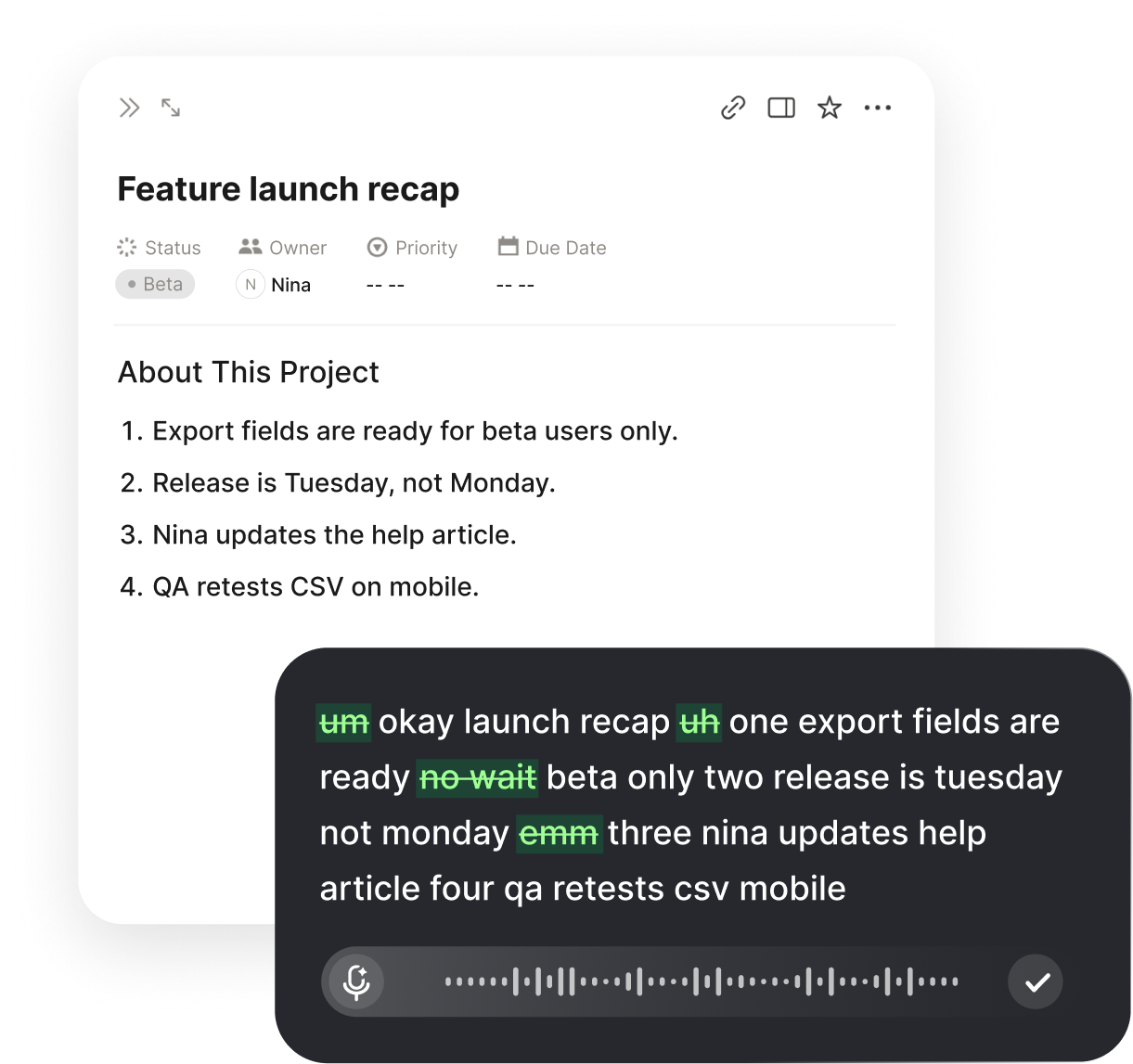
Keep a session log open and speak corrections, phrases, and next steps as they arise. Voiskey places the text at the insertion point in your note app, removes filler and false starts, and adapts punctuation, so you can stay in the conversation and review an accurate record afterward.
Voiskey supports more than one hundred languages and translation. Speak the phrase in the language you know best, then say the version you want to practice, and compare the two. Treat the result as a draft and ask your exchange partner to confirm anything that sounds unnatural before adding it to the phrase bank.
Read each captured correction aloud within a day and say the corrected phrase in a full sentence. Group related entries under a small heading, remove duplicates, and keep one clear example. Voiskey removes stutters and self-corrections from the spoken review, so the note stays readable and easy to practice from.
Speak five phrases you wanted to use but could not produce, then add a literal gloss and a natural version beneath each one. Voiskey supports translation and keeps the phrasing consistent across entries. Group the bank by function, practice three phrases at a time, and ask your partner to confirm the versions that still feel unnatural.


 Voiskey
Your voice, amplified.
Download Voiskey for Mac and Windows and speak your next draft into place.
Use it across macOS, Windows, iOS, and Android