
Voice Notes for Field Trips
Plan note stations, speak observations on site, clean up indoors
 Voiskey Team
Plan the Field Note Stations
Voice Notes for Field trips need a plan for where and when you will speak. Before leaving, list the stops on the trip and the observation each stop is meant to support. For every stop, choose a note station: a spot away from the group, the wind, and the traffic where you can speak for a minute. Mark the station on the map and write one prompt for each, such as what changed, what was measured, and what surprised you. This preparation turns a day of impressions into a set of comparable observations, and it prevents the common outcome of returning with many photos and no usable notes.
Decide what counts as evidence at each stop. A field note may need a location, a time, a description, a measurement, and a sketch or photo reference. Choose the two or three that matter for your course, and use them at every stop so the notes line up. If the site is crowded, plan a short station and a longer backup nearby. If the weather is uncertain, name an indoor replacement in advance. The plan should be specific enough that a partner could follow it without you, and short enough to fit on one page that survives a day outdoors in the wind.
Divide the roles if you are working with a partner. One person can manage the map, the timekeeping, and the photos while the other speaks the observations. Switch roles at the midpoint so both people practice describing what they see. Agree on the cue phrases in advance, such as station, observation, and photo, so the two note sets can be merged later. If a partner cannot attend, decide which station will be skipped rather than trying to cover everything alone. Clear roles keep the group moving and keep the notes from turning into a negotiation at every stop along the route.
Prepare the device and the backup plan. Charge the device the night before, pack a power source if the day is long, and keep the device in a pocket that stays dry. Save the course map and any reading you will need before leaving, so a weak signal does not stop the day. Write the prompts on paper as a backup, because a dead battery should not end the note-taking. Test the setup at the first stop for thirty seconds. A field routine is only as good as its weakest link, and the power and the paper backup are usually the weakest links.
Dictate Observations on Site
Speak at the station, not on the bus. Stand in your chosen spot, name the station, and describe what you see before you interpret it. Give the location, the time, the conditions, and the observation in that order. Keep each entry to three or four sentences, then stop and look again. Speaking on site captures details that the walk back erases, such as the direction of the wind, the sound of the area, and the exact position of the feature. The goal is a record that another person could match to the place without asking you what you meant by a phrase.
Describe, then compare, then question. First say what is there, then say how it differs from the expected state or the previous station, then ask the question the difference raises. This sequence keeps the note from jumping to a conclusion before the evidence is stated. If something is unusual, say unusual and describe it precisely rather than reaching for a label. If a measurement is needed, state the instrument, the value, and the unit. A short, ordered entry is easier to review at the end of the day and easier to turn into a report section later in the week or a lab write-up.
Record the conditions that could explain a difference. Note the weather, the time of day, the slope, the traffic, and anything that changed since the last visit. These conditions are the first place to look when two observations conflict. If a condition changes while you are at the station, note the change and its time in a separate line. Keep this line short, because conditions are context, not the story. A note with clear conditions can support a claim, while a note without them leaves a later reader guessing about the basis of the comparison or whether one was possible.
Handle the practical interruptions of a field day. When the group moves before you finish, stop at a complete sentence and mark the station as partial. When the wind or traffic drowns you out, step to the sheltered side and repeat the last phrase. When a site is inaccessible, say so and note the closest vantage point. Add each exception to the station entry rather than a separate file. Exceptions recorded on site are credible; exceptions reconstructed later are guesses. A field note that admits its limits is more useful than one that pretends every station was ideal from the start.
Clean Up Notes Back Indoors
Clean the notes the same day, while the route is still in your head. Open the entries in station order and fix the parts that would confuse a reader: missing units, unclear pronouns, and abbreviations only you understand. Add the full name of each location and the time you arrived. If a note refers to a photo, add the photo number beside it. Do not rewrite the observations from memory; only repair what is unclear. The cleanup pass should take about twenty minutes for a full day, and it is what turns scattered entries into a set you can analyze and write up.
Sort the day into a simple structure. Group the entries by station, then add a short line under each group naming the main observation. Mark the three most important findings for the course, and mark the questions you cannot answer yet. If two stations contradict each other, put them side by side and note the conditions that might explain the difference. Keep the raw entries beneath the summary so the reasoning can be checked. A structured page with a short summary is easier to use in a report than a chronological transcript of everything that happened on a long, tiring day in the field.
Create a short list of follow-up questions for the next trip. Each question should connect to a station and a missing observation, so it can be answered on site rather than at a desk. Rank the questions and assign at most three to the next visit. If a question needs a different season, a different tide, or a different time of day, note the condition and plan accordingly. A follow-up list keeps the fieldwork moving forward instead of repeating the same visit. The list also gives the next trip a purpose beyond collecting more photographs and fresh impressions. Keep it to one page.
Share the cleaned notes with your group before the next meeting. Send the summary page, not the raw entries, and ask each person to confirm the locations and the times. Corrections from the group are cheap now and expensive after the report is drafted. If the group disagrees about an observation, record both versions with the conditions that differ. Keep the shared page in the same folder as the raw notes so the two stay linked. A brief confirmation round is the fastest way to catch a mislabeled station before it becomes a wrong claim in the final write-up.
Test the Routine With Voiskey
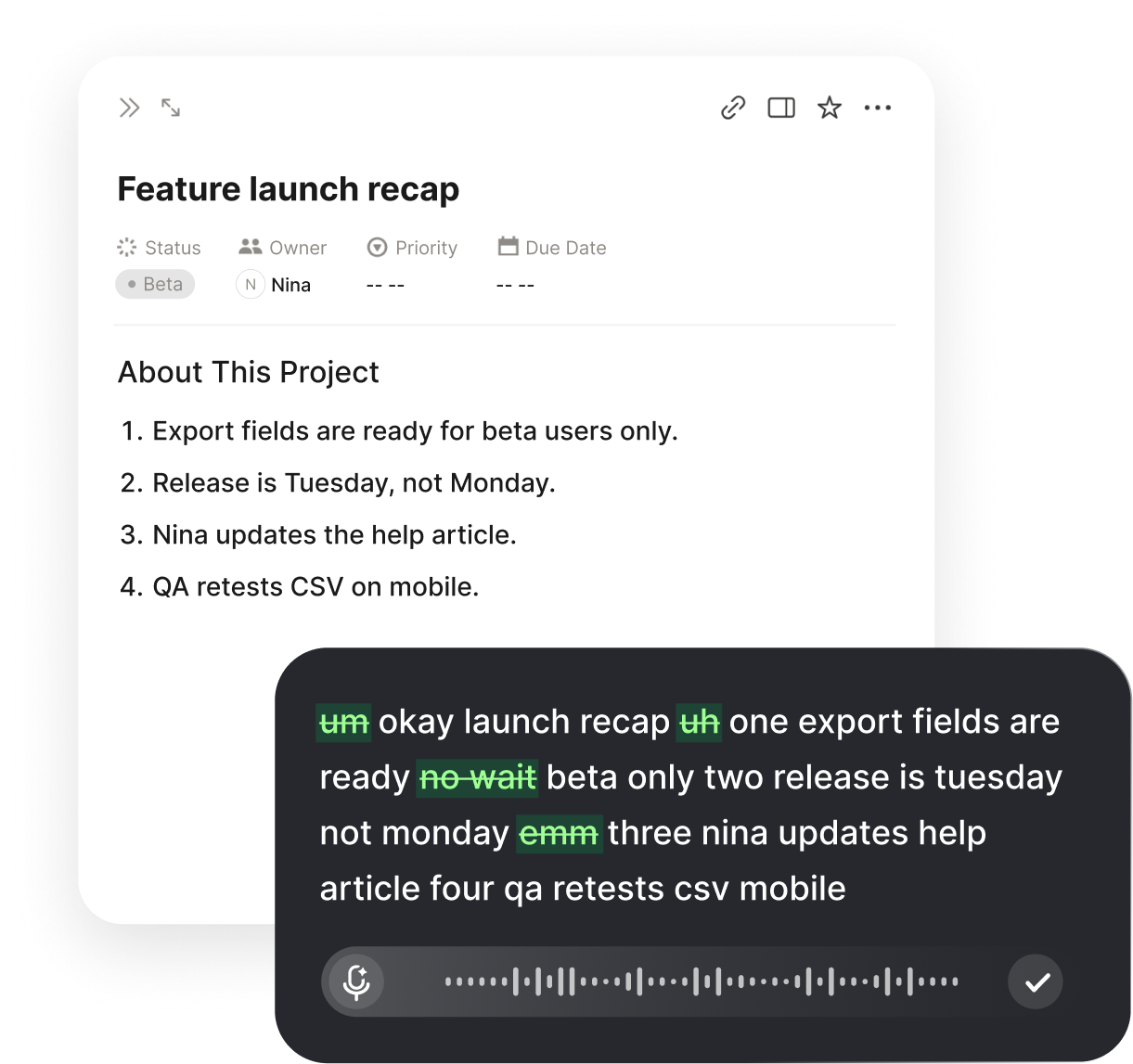
Run the field routine on one short trip before you depend on it for a graded report. Set the stations, the prompts, and the device position, then speak each entry exactly as planned. Voiskey fits a field day because you press a shortcut, speak, and text appears at the insertion point in the note document you already use. It removes filler words, stutters, false starts, self-corrections, and grammar slips, so a spoken station entry reads like a written note. It adapts punctuation and formatting to the list style you choose, which keeps the station entries comparable across every stop and site.
Test the routine against the conditions that break it. Try one station in wind, one near traffic, and one where the group is waiting. Speak slightly slower, finish the sentence endings, and step to the sheltered side before you start. If an entry is cut short, mark it partial and complete it indoors. Voiskey learns names, jargon, acronyms, and spelling preferences, which helps with place names and technical terms you use all day. Download Voiskey if you want the same setup on a second device before a longer multi-stop trip, so both days of notes stay consistent and easy to merge.
Compare the field notes with one set written by hand at the same stops. Check which version captures the conditions, which is faster to clean up, and which is easier to turn into a summary page. Keep the same station prompts in both so the comparison is fair. If the spoken version loses detail, add a cue for conditions. If it gains speed but loses precision, add a check at the first station. Record the result in one line so the next trip starts from evidence rather than from habit or hope. Run the comparison on two trips before deciding.
Close the trial with a verdict and a cleanup. Keep the stations and prompts that produced usable entries, drop the field you never filled, and add the fallback you actually used. Then speak one more station entry with the revised template. A trial is complete when a partner can read the notes and reconstruct the route without asking where each observation happened. If that test fails, the station labels or the location lines are too vague, and the fix is a stricter prompt at the station rather than a different tool. Write the verdict beside the template and keep it with the cleaned notes for the next trip.
Reuse Field Notes Later
Field notes earn their keep when they feed later work. Link each cleaned summary to the report, the lab discussion, or the exam topic it supports, so a future search finds the right page. Keep the raw entries and the summary together in one folder named by site and date. If a course asks for evidence of observation, the station summaries are ready to quote or paraphrase. A reusable note set turns a single trip into a resource, and it makes the next trip's plan easier because you can see which stations produced the most useful material for your course.
Build a small index across trips. One line per trip with the site, the date, the conditions, and the three main findings is enough to compare seasons or locations. Add a link to the folder and the summary page. When a report requires a comparison, the index tells you which trips are relevant before you open a single file. Update the index during the cleanup pass rather than at the end of the term. An index is a small habit with a large payoff, because it turns scattered folders into a searchable record of your fieldwork across the whole course.
Reuse the prompts across courses and seasons. The same four questions, what changed, what was measured, what surprised you, and what to check next, work for a geography trip, a biology survey, or an urban study. Adjust the evidence fields to the course but keep the spoken order. If you use Voiskey across trips, the consistent structure keeps entries comparable and makes the index easy to maintain. A stable prompt set also reduces the setup time before each trip, because the template is already familiar to you and to any partner who joins the next trip. Keep the template in the same folder as the index.
Close the term with an archive and a handover note. Save the best trip's raw entries, summary, and index line as one example, and write three lines about what to keep, what to change, and what to check next season. Download Voiskey if you want to dictate the handover note and the first station plan of the next field course into the same structure. Confirm the prompts and the device setup once before the new trip. An archived field routine is what lets the next course start with a plan instead of a blank map and a full camera roll.
FAQ s
At each station, press the shortcut and speak the location, time, conditions, and observation in that order. Voiskey places text at the insertion point in your note document, removes filler words and false starts, and adapts punctuation to your entry style, so a station entry reads like a written note.
Voiskey learns names, jargon, acronyms, and spelling preferences, so repeated place names and technical terms become easier across a trip. Say an unfamiliar name clearly once, then use it normally in later entries. Support for 100+ languages also helps when place names or readings are in another language.
Stand at the chosen station, name it, and describe what you see before interpreting. Give location, time, conditions, and observation in that order, then stop and look again. Voiskey polishes filler and grammar slips, and you can mark partial entries when the group moves before you finish.
Voiskey supports up to 220+ words per minute, about 5x faster than typing, which helps when you have a minute at each station. You press a shortcut, speak the observation, and text appears at the insertion point, so your hands stay available for the site. The cleaned result makes the indoor summary page faster to assemble.


 Voiskey
Your voice, amplified.
Download Voiskey for Mac and Windows and speak field observations at each stop.
Use it across macOS, Windows, iOS, and Android