
Voice Notes for Book Discussions
Prepare claims, mark passages, then rehearse the questions aloud
 Voiskey Team
Prepare Claims Before the Discussion
Voice Notes for Book discussions are most useful when they hold an argument rather than a summary. Before the seminar, speak three claims about the reading: one about what the text argues, one about how it argues, and one about what it leaves out. Each claim needs a passage and a reason. A summary of the plot or the chapter tells the group what they already read; a claim gives them something to agree with or challenge. Speak the claims into a single page and keep the page open during the discussion, so you can add the group's responses in the same place. Preparation of this kind turns a discussion into a record of thinking.
Choose the passages before you choose the claims. Read with a pencil and mark two or three sentences that carry the argument. For each mark, note the page and the reason you stopped. When you speak the claim, quote the passage first and then say what it shows, because a claim built on a quoted line is harder to drift from than a claim built on memory. If a passage supports two readings, say both and mark the one you find stronger. Voiskey learns names and jargon, so character and place names you use repeatedly become easier to dictate accurately, and the discussion page reads cleanly when you return to it.
Give each claim a shape the group can respond to. A useful shape is: the text says this, it means that, and it matters because. Speak all three parts, even when the third is uncertain. If you only state the first part, the group will ask what you mean, and the discussion will spend its first ten minutes on definitions. If you state all three, they can agree, disagree, or refine, and the conversation moves. Keep each claim to a short paragraph so three claims fit on one page. A discussion page that fits on one screen is easy to bring into the room and easy to review afterward.
Assign roles if you are preparing with a partner. One person speaks the claims into the document while the other checks the quoted passages and page numbers. Swap for the second half so both practice both tasks. Decide in advance which questions the group should settle, and give each question a place at the bottom of the page. If you are preparing alone, do the two roles on different days, because the check reads differently when the claims are not fresh in mind. A short role split catches misquoted lines and missing pages before the seminar, when there is still time to fix them.
Capture Passages and Page Marks
Record the passage and the page together, every time. A quote without a page is hard to defend and easy to misattribute. When you speak a passage into the note, say the page first, then the sentence, then the reason. If the edition has line numbers or section markers, use those as well. Keep the quotation exact and put your comment on a separate line, so the two never blur. During the discussion, when someone else quotes the same line, you can point to the page immediately. This small discipline is what makes a reading note credible, and it takes only a second longer than a vague reference.
Mark the passages you disagree with, not only the ones you like. A disagreement is a ready-made discussion question and often the most productive one. Say what the passage claims, what you think it overlooks, and which other passage complicates it. If the disagreement is with a character rather than the author, say so, because the group will read it differently. Keep a separate list of these contested passages so they are easy to find when the conversation slows. A reading page with three agreed points and three contested ones gives the group a better starting position than a page of admiration.
Use a short spoken code to keep the page tidy. Say insight for a point you will reuse, question for something unresolved, and link for a connection to another text. Speak the code before the note so the written page gets a consistent marker. Voiskey adapts punctuation and formatting to the task, so a consistent spoken marker arrives as a consistent written pattern you can search. The code keeps you from writing the same kind of note in five different ways, and it makes the page scannable when you prepare for a written response. Decide the code at the start of the term and keep it across books.
Leave room for the group's words. A reading page that contains only your preparation is half a record. During the discussion, speak the strongest counterpoint you hear and attribute it to the speaker by name, with a short note on whether it changed your view. Add any passage the group cites that you missed. These additions are what make the page valuable after the seminar, because they capture the exchange rather than only your starting position. Keep the additions visually separate from your preparation, for example under a heading for the session. A page that shows both sides of the conversation is a much better basis for an essay.
Turn Notes Into Discussion Questions
Convert your claims into questions that open rather than close the discussion. A claim such as the ending undermines the narrator becomes a question such as what would the book gain if the ending confirmed the narrator. Good questions name a specific passage or choice and ask what follows from it. Avoid questions that can be answered with yes or no, and avoid questions so broad that anyone can answer without the text. Speak three open questions into the bottom of the page and choose the one you will actually raise. A prepared question is a gift to a quiet group, and it keeps your own claim from dominating the hour.
Sort your questions by the kind of thinking they require. Some ask for evidence, some ask for interpretation, and some ask for comparison with another text or with the present. A discussion works better when it moves from evidence to interpretation to comparison rather than jumping between them. Speak the order you plan to use and mark each question with its kind. If the group answers an early question quickly, move to the next kind instead of repeating the same move. A short plan of three questions in a deliberate order is more useful than ten questions in a random list, because it gives the conversation a shape.
Keep a question list that survives the session. After the discussion, mark which questions were answered, which were deferred, and which produced the best exchange. Speak a note under each answered question summarizing the answer, and move the deferred ones to the next session's page. Over a term, the list becomes a map of what the group has actually worked through. If a question keeps returning, it is probably the real question of the course, and it deserves a written response rather than another round of talk. A maintained question list is a better study guide than a folder of unconnected summaries.
Test your questions before the seminar on one person who has read the text. Read the question aloud and watch whether they reach for the book. If they answer from memory without opening it, the question is too general. If they look puzzled about which passage you mean, add a page reference. Voiskey removes filler and self-corrections, so the spoken version of a question arrives close to its final form, which makes this test quick. Adjust the phrasing once, then stop editing; a question polished too long loses the energy that made it worth asking. The goal is a clear invitation, not a perfect sentence.
Rehearse With Voiskey
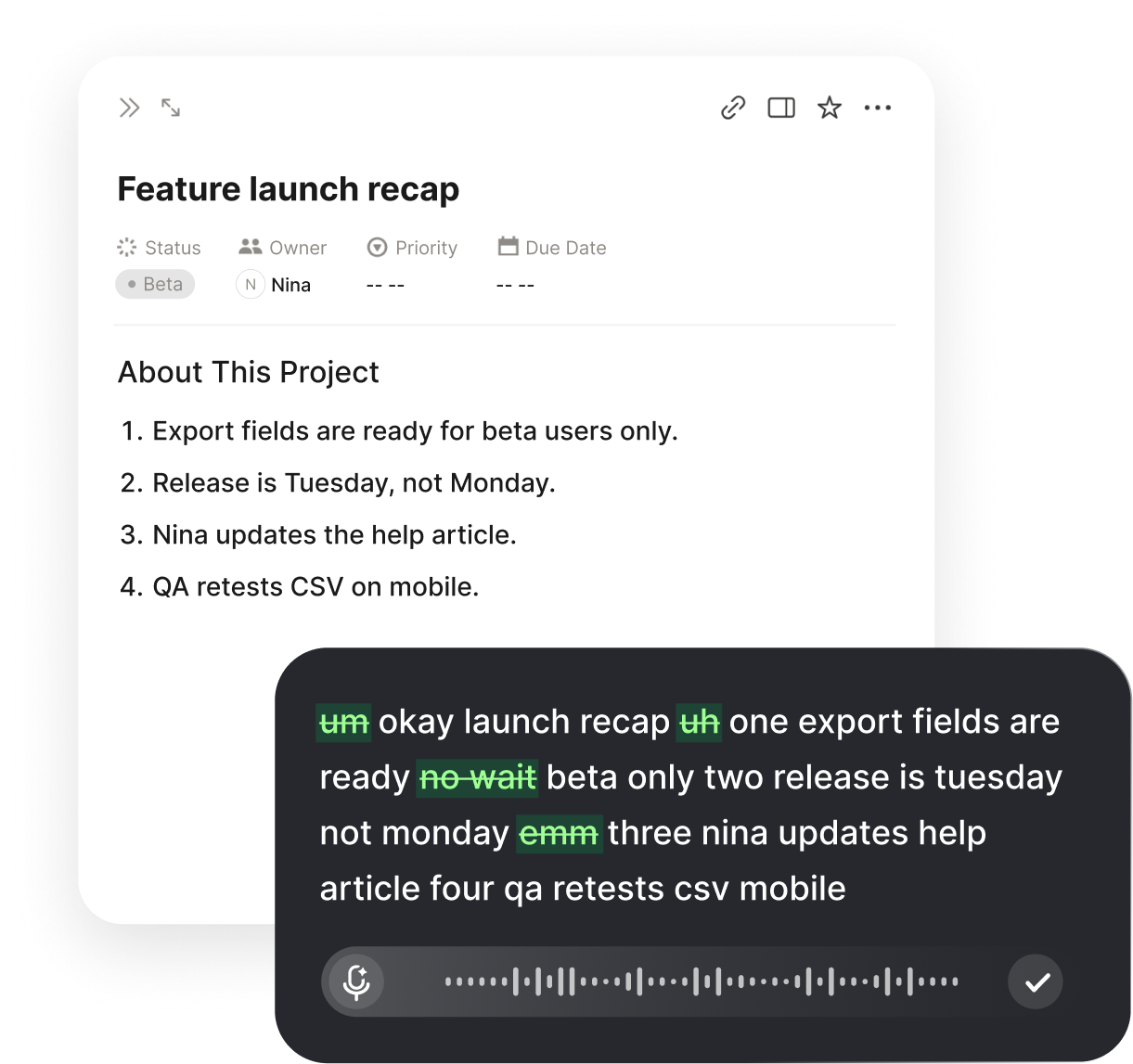
Rehearse the discussion out loud before the seminar. Download Voiskey if it is not on the device you use for reading notes, open the preparation page, and speak your three claims in the order you plan to raise them. Listen for sentences that trail off or assumptions you have not stated. Because Voiskey removes filler and false starts, the rehearsal text shows what you actually meant to say rather than the false starts around it. Read the clean version once and mark the one claim you would lead with. A five-minute rehearsal makes the difference between reading a note aloud and making an argument.
Practice the transition from claim to evidence. Speak the claim, then the page, then the quoted line, then the reason it matters. Do it three times with different claims and notice where you hesitate. Hesitation usually marks a missing link rather than a speaking problem, so fix the note rather than memorizing the sentence. If a quotation is long, practice shortening it to the essential clause. Voiskey learns names and jargon, so author and character names you have corrected once come back correctly in the rehearsal. Clean transitions are what let a listener follow an argument without seeing your page.
Rehearse the response to a likely objection. Speak the objection in its strongest form, then answer it in two sentences, then stop. Long answers to short objections sound defensive, and a two-sentence answer leaves room for the group to continue. If you cannot answer an objection, rehearse saying that you will take it back to the text, and write the follow-up on the page. Admitting a limit is stronger than improvising a weak reply. Practicing this once before the seminar reduces the chance that the first challenge derails your prepared points, and the written answer is ready for the next rehearsal.
Close the rehearsal by speaking the one thing you want the group to leave with. It might be a question, a tension, or a passage they should reread. Speak it as a single sentence and keep it at the top of the page. During the discussion, return to that sentence when the conversation drifts. A seminar without a closing thought tends to end in scattered comments, while one with a closing thought leaves the group with something to carry. The sentence is not a summary of the book; it is the contribution you want to make, stated plainly enough that you can say it from memory.
Keep a Reading Log That Lasts
Keep one reading log for the whole term and add to it after every discussion. Download Voiskey on the machine you use for coursework so the log is easy to update wherever you read. Each entry should hold the book, the date, the claim you brought, the passage that mattered, and the counterpoint that stayed with you. Speak the entry within a day of the seminar, while the exchange is still clear. A log built this way is far more useful than a folder of separate pages, because it shows how your reading changed across books. It also makes a final essay or exam answer much easier to assemble.
Review the log at the midpoint and end of the term. Read the entries in order and speak a short note on the pattern: which questions kept returning, which authors you read more carefully, and where your position shifted. Move the returning questions to the front of the log. If an entry is only a summary, rewrite it as a claim with a passage, because a log of summaries does not help you think. Voiskey adapts tone and wording to what you are trying to do, so a reflective note spoken as a review arrives in a different shape from a note spoken as a report. The pattern is the point of the log.
Protect the log from becoming a chore. Keep entries short, and do not require every book to receive the same treatment. A book that mattered gets a full entry; a book that did not gets three lines and a reason. If a week is busy, speak one sentence about the discussion and move on. The log survives because the minimum is small. A term-long habit with a low floor is more valuable than an ambitious format abandoned in week four. When you have time, expand the entries that matter; when you do not, the one-line entries still preserve the thread.
Use the log to prepare for written work. Before drafting an essay, open the log and speak the connections you see between three entries. Then choose the connection with the strongest textual support and outline the argument from there. Because every entry already carries a passage and a page, the evidence is ready and the risk of misquotation is low. Speak the outline into a new document and check each point against its log entry. A log kept across the term turns essay preparation from a search through scattered notes into a short selection from material you have already thought about.
FAQ s
Speak three claims about the reading, each with a passage and a page, then rehearse them aloud before the seminar. Voiskey places the text at the insertion point in your page, removes filler and false starts, and adapts punctuation, so the claims read cleanly when the group responds.
Voiskey learns names, jargon, acronyms, and spelling preferences. Say an unfamiliar name clearly once, then keep using it in later entries; repeated names come back in a consistent form, which makes a term-long log easier to read and search.
Say the page first, then the quoted sentence, then your comment, and keep the quote on its own line. Voiskey writes the note at the insertion point, so the quotation and your comment stay separate, and the page reference is there when you need to defend the point.
Speak the question aloud, then the passage it refers to, then the kind of thinking it invites. If a listener can answer from memory without opening the book, make the question more specific. Voiskey turns the spoken version into clean text, so you can adjust the phrasing once and stop.


 Voiskey
Your voice, amplified.
Download Voiskey for Mac and Windows to keep every book discussion note in one log.
Use it across macOS, Windows, iOS, and Android