
Voice Drafting for Motions and Memoranda
A repeatable order of work for drafting motions and memoranda by voice
 Voiskey Team
Build the Skeleton Before Speaking
Voice Drafting for Motions works best when the structure exists before the speaking starts. A motion and a memorandum share a predictable skeleton: caption, procedural history, statement of facts, legal standard, argument, and conclusion or prayer. Create that skeleton first, with headings, numbering, and the caption filled in. Then dictate into the spaces between the headings. The skeleton does two jobs at once: it tells you what to say next, and it shows you when a section has drifted into another section's territory. A draft that follows a known shape is easier to review, easier to revise, and easier to compare with the version you filed last time.
Write the legal standard before the facts. Novice drafters often start with the story and then look for the rule, which produces an argument shaped by narration rather than by elements. Read the controlling standard, reduce it to its elements, and speak those elements as the subheadings of the argument. For a motion to dismiss, the elements might be the pleading standard, the sufficiency of each claim, and the absence of any amendment that could cure the defect. Speaking the elements early gives the statement of facts a purpose: it should supply the facts each element needs, and it should not supply much else.
Decide the length of each section before you speak it. A motion is usually short and a memorandum is longer, but both suffer when a section expands without a plan. Give each heading a budget in sentences: two for procedural history, six for the facts, three per element, two for the conclusion. A budget is not a rule, and you can exceed it when the case demands, but the act of setting it forces a decision about what matters. When a section runs past its budget, ask whether the extra sentences belong under another heading. Most of the time they do.
Put the caption, the signature block, and the certificate language in the template, not in your dictation. These elements contain names, addresses, and standard sentences that should be identical across filings, and speaking them invites variation for no benefit. If your template is current, the only thing dictation needs to produce is the substance. Check the template once at the start of the matter, confirm the court, the parties, and the case number, and then stop looking at it. A correct template is quiet infrastructure, and quiet infrastructure is what makes a fast draft safe. Check it once, then leave it alone until the next matter begins.
Statement of Facts in Order
Dictate the statement of facts in chronological order unless the standard requires another order. Chronology is the reader's default expectation, and it makes gaps visible: if you cannot place an event in time, you may not understand it well enough to state it. Say each fact with its support attached, for example on March third the buyer sent the notice, citing the email at page twelve. Attaching support while you speak prevents the later scavenger hunt that turns a one-hour review into an afternoon. It also keeps you honest, because a fact you cannot source tends to disappear when you try to say it with a citation.
Separate what happened from what it means. The statement of facts should tell the reader what occurred and what the record shows, and it should leave characterization for the argument. Words like improperly, unreasonably, and without justification are conclusions, and a statement of facts full of conclusions invites the opposing party to dispute the story instead of the law. Speak the events plainly, then speak the inferences under the argument heading where you can support them with the standard. This division makes both sections stronger: the facts become hard to attack, and the argument becomes clearly yours. If a sentence mixes event and evaluation, split it before you continue.
Handle disputed facts explicitly rather than silently. Where the record conflicts, say so and identify both versions with their sources, then state which version the standard requires the court to accept at this stage. This is a legal judgment, so slow down and state it precisely. A statement of facts that acknowledges a conflict is more credible than one that pretends the conflict is absent, and the acknowledgment gives the argument a place to stand. If you are unsure which version controls, mark the passage and resolve it before the draft goes to review. Name the standard that resolves the conflict rather than asserting a winner.
Keep the facts section in one tense and one voice. Spoken drafting tends to drift between past and present, especially when you are describing a document that still exists. Choose past tense for events and present tense for what a document says, then hold that pattern for the whole section. Similarly, keep the parties named the same way every time: the buyer and the seller, not the purchaser and the respondent. Consistency in tense and naming is the cheapest form of clarity, and it is the first thing a careful reader notices when it is missing. Read the section once just for tense, and once just for naming.
Assemble the Argument
Assemble the argument element by element, and speak the element as a heading. Under each heading, state the rule, apply it to the facts, and state the conclusion. This order is old because it works: a reader who disagrees with the conclusion can see exactly where the disagreement begins. Voiskey adapts tone and word choice to what you are trying to do, so a spoken rule statement can sound like a rule statement rather than a chat. Still, check that each element has all three parts. An argument that states a rule and a conclusion but skips the application invites the court to do your work.
Speak the strongest point first within each element. Legal readers decide early and read to confirm, so a buried strong point is a wasted one. If the strongest point is a factual one, lead with the fact and its support, then the rule that makes it decisive. If the strongest point is a legal one, lead with the rule and then show why the facts fit. Say the point in one sentence before you elaborate, so the paragraph has a claim rather than a topic. That single sentence is also the part you will check when you review the argument for coverage.
Address the obvious counterargument in its own short paragraph. Name the opposing position fairly, then explain why the standard or the record defeats it. Do not set up a weak version of the other side, because a court will notice and discount the whole section. Speaking the counterargument forces you to articulate it, which is often where you discover the real weakness in your position. If you cannot answer it in a paragraph, the issue may need a different framing or a candid acknowledgment. Either outcome is better than leaving the question for the reviewer to raise. A short, fair paragraph is stronger than a long, dismissive one.
Keep the argument's internal references accurate as you go. When you say as discussed above, note which heading you mean, and when you refer to an element, use the same label as its heading. Spoken drafting makes these references feel natural, but they are easy to get wrong because you cannot see the page. After the argument is spoken, list every internal reference and confirm that the target exists. A brief that says see section two when there is no section two looks careless even if the substance is sound, and the fix is trivial if you catch it early.
Check Terms and Record Cites
Run one pass for defined terms and party names. Read the caption, then read every reference to a party in the body, and confirm that each matches the caption exactly. Do the same for any short form you introduced, such as the Agreement or the Policy. Voiskey learns names, jargon, acronyms, and spelling preferences, which reduces variation, but a check is still required because a single stray full name in the middle of a short-form document reads like a different party. Mark each variation and correct it in one batch rather than fixing as you read. Keep the list of short forms beside the draft while you read.
Run a second pass for record citations. For each citation, confirm three things: the source exists, the pinpoint is right, and the proposition it supports is actually in the cited passage. The third check is the one people skip, and it is the one that matters most. A citation to the right page that does not support the sentence is worse than a missing citation, because it looks deliberate. Read the passage rather than the label, and where support is partial, narrow the sentence. Mark each proposition that needed narrowing so the reviewer can see the change. This pass is slow, and it is the difference between a draft and a filing.
Check the legal standard against the current authority. Standards change, and a memorandum that recites last year's formulation can be attacked on that ground alone. Read the standard as you wrote it, then read the controlling case or rule as it stands now. If the language differs, decide whether the difference is material. Do not update a quotation by memory; speak it from the source and compare character by character. This is the one place where a small wording difference can carry a large legal consequence, so it deserves undivided attention rather than a multitasking review. Note the date you checked, so a later reader knows how current the standard is.
When the draft is ready for a wider review, download Voiskey and ask a colleague to run the same checklist on a section you drafted. A second reader who follows your checklist will find different problems than a reader who simply reads for sense. Give them the term list, the citation list, and the standard you used, and ask them to mark anything they could not confirm. The purpose of the exercise is not to grade the draft but to test the process. If the second reader has to invent a check, add it to the checklist and use it on the next motion.
Turn One Motion Into a Playbook
After you file, turn the motion into a playbook. Record the outline that worked, the elements you used for the standard, the length budgets for each section, and the checks that caught real errors. Keep the playbook beside the template rather than in a separate folder, because the two are used together. A playbook is not a form; it is a short record of decisions that you would otherwise reconstruct from memory. The next motion in a similar matter then starts from a known shape, which is the main advantage a repeat drafter has over a first-timer. Include the filing date and the outcome, because both shape the next decision.
Note where speech helped and where it did not. Fact sections with clear chronology usually dictate well, while a single sentence that carries the whole argument may need typing and several passes. Record those observations by section, not as a general impression. Over a few motions, a pattern emerges: certain kinds of paragraphs should be spoken, and certain kinds should be written with both hands on the keyboard. That pattern is more valuable than any general claim about speed, because it tells you what to do on a specific afternoon with a specific draft. Write the observation next to the section heading it belongs to.
Share the playbook with the people who draft with you. A short written outline, the element list for each standard you use often, and the closing checklist are enough for a colleague to produce a draft you can review quickly. If your group uses the shared vocabulary and workflows in the team plan, the labels and short forms you settle on can carry across matters. Whether you share or keep the playbook to yourself, update it after each filing so it reflects what you actually did, not what you meant to do. A playbook another person can follow is also a test of whether you understand your own method.
Review the playbook on a schedule rather than when a problem appears. Once a quarter, read the outline and the checklist against your last three motions and ask what has changed in the standard, the template, or the court's expectations. Remove steps that no longer earn their time, and add steps that caught a real error. A playbook that grows without pruning becomes a document nobody reads. The goal is a short list you will actually follow under deadline, when the temptation to skip checks is strongest and the cost of a mistake is highest. Put the review date on a calendar with a named owner.
FAQ s
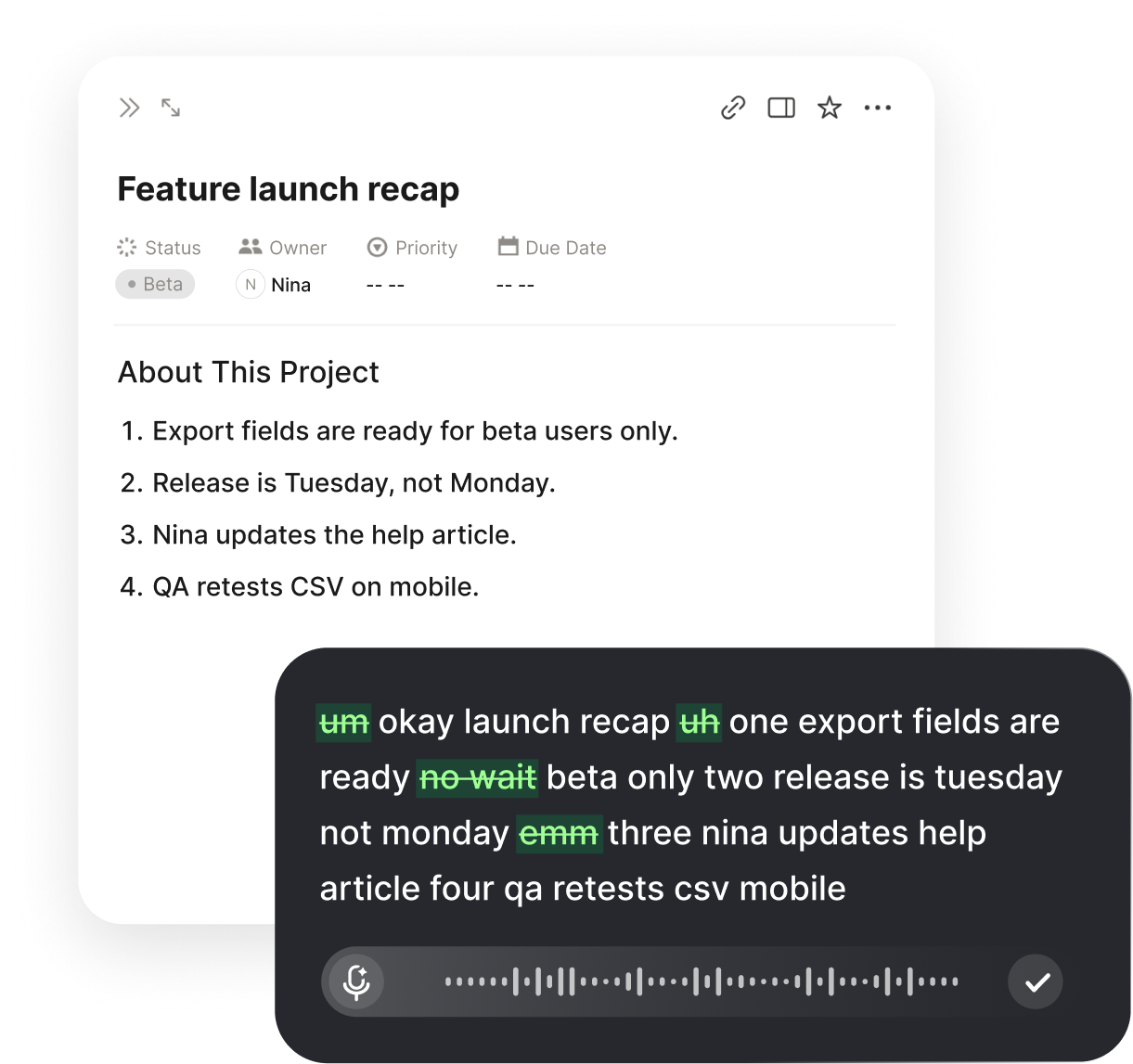
Voiskey turns speech into text at the insertion point in the app you already use, so you can speak the standard, its elements, and the application in the order a court expects. Because it removes filler words and self-corrections, the spoken elements arrive as clean lines you can expand. You still verify each element and each citation against the source.
Voiskey learns names, jargon, acronyms, and spelling preferences, which reduces variation across a long draft. A check is still required: read the caption, then every reference in the body, and confirm each party name and short form matches. On the team plan, shared vocabulary can carry confirmed labels across a group drafting in the same matter.
Run three passes. First, confirm defined terms and party names against the caption. Second, confirm each record citation exists, has the right pinpoint, and actually supports the sentence. Third, read the legal standard against current authority rather than from memory. Then ask a second reader to follow the same checklist and mark anything they could not confirm.
Turn the filed motion into a short playbook: the outline, the element list for the standard, the length budget for each section, and the checks that caught real errors. Note which sections dictated well and which needed typing. Keep the playbook beside the template, update it after each filing, and review it quarterly so it stays short enough to follow under deadline.


 Voiskey
Your voice, amplified.
Download Voiskey for Mac and Windows and start drafting by voice today.
Use it across macOS, Windows, iOS, and Android