
Voice Drafting Patent and IP Summaries
Map the disclosure, fix claim vocabulary, and dictate a summary reviewers can verify.
 Voiskey Team
Map the Disclosure Into Summary Blocks
Voice Drafting Patent and IP Summaries begins with a map of the disclosure, not a transcript of it. Break the material into blocks: the problem being solved, the prior approaches and their limits, the core inventive idea, the key components or steps, the variants, and the commercial context. For each block, note the page or figure in the source and the person who can confirm it. Mark the claims section separately from the embodiments. A summary that blends the two misleads the reader about scope, which is exactly the error a patent summary must avoid. Keep the map visible while you dictate and check each block against it before moving on.
Identify the technical vocabulary before you speak. Patent and IP material is dense with terms that sound alike and mean different things. Write a glossary of the key terms, their definitions as used in the disclosure, and the spelling the inventors prefer. Include acronyms, units, part numbers, and chemical or component names if they appear. Note which terms are defined in the disclosure and which are your own paraphrase. If a term has a specific meaning in the field, use that meaning rather than a lay equivalent. A glossary built before dictation prevents the summary from drifting into vague language that a technical reader will distrust.
Decide the audience and the purpose of the summary. A summary for an inventor differs from one for a partner screening a portfolio, which differs again from one for a filing team. Write one sentence naming the reader and the decision the summary supports. Then choose the level of detail: a screening summary may need only the problem, the idea, and the claim scope, while a technical summary may need the components and variants. Note the length the reader expects and the format the matter uses. Purpose and audience chosen up front determine which blocks to dictate in full and which to compress, and they prevent a summary that is thorough but unusable.
Prepare the working file and the review path. Open the matter template, confirm the headings, and place the cursor at the first block. Keep the glossary, the figure list, and the inventor contact details beside the document. Decide who will check the technical accuracy and who will check the legal characterization. If the summary will support a filing or a portfolio decision, note the related document and its deadline. Confirm how figures will be referenced, since a spoken reference to a figure number is easy to mishear. A prepared file and a named reviewer turn a dense drafting task into a sequence of checks rather than a single risky pass.
Standardize Claim and Prior Art Terms
Build a consistent vocabulary for claims and prior art. For claims, list the independent claims, the dependent claims, and the elements each one adds. For prior art, list each reference, its date, and the feature it discloses. Use one short name for each reference throughout the summary, and note the full citation beside it. Decide how you will refer to the invention and to the applicant, and use those terms consistently. Claim language rewards precision and punishes synonym drift, because a reader may treat two different words as two different concepts. A fixed vocabulary makes the summary reliable and makes later comparison with the claims straightforward.
Describe the inventive concept in a way that does not overreach. State what the disclosure describes, what problem it addresses, and what distinguishes it from the prior approaches. Use the disclosure's own characterization where it exists, and mark any characterization you add. Avoid words such as novel, inventive, or superior unless the disclosure or the reviewer supports them, since those words carry legal weight in a patent context. If the summary is for a screening decision, say what would need to be checked before a filing decision. A summary that respects the difference between description and conclusion is useful to both technical and legal readers.
Handle prior art comparisons carefully. For each reference, state what it discloses and what it does not. Avoid a blanket statement that the prior art fails to teach a feature unless the reference has been read closely and the reviewer agrees. If the comparison is preliminary, label it preliminary. Note the date of each reference against the relevant date of the disclosure, because timing can change the analysis. Keep the comparison in a table-like sequence so the reader can check one reference at a time. Careful, dated comparisons are the part of a patent summary that readers return to, and they are where a rushed dictation does the most damage.
Check the claim scope against the disclosure before dictating conclusions. Confirm that each element you attribute to a claim actually appears in the claims, and that each feature you attribute to an embodiment actually appears in the description. Mark any gap between the two. If the disclosure uses functional language, preserve it rather than converting it into a structural description. If a term in the claims is defined in the specification, use the definition. These checks take time, but they prevent the summary from asserting a scope the disclosure does not support, which is the most serious error a patent summary can contain.
Dictate the Summary in Logical Layers
Dictate in layers rather than in one continuous description. Start with a two-sentence overview: the problem and the core idea. Then dictate the background in a short paragraph, the prior approaches and their limits, and the inventive concept. Move next to the components or steps, then the variants, then the commercial context if the reader needs it. Each layer should stand on its own so a reader can stop after the overview and still understand the point. Announce each layer with a heading or a transition. Layered dictation produces a summary that is easy to skim and easy to expand later.
Speak the technical description in short, concrete sentences. Name each component once and then use the same name. State what each component does before describing how it is arranged. If a step has an order, say the order. If a figure shows the arrangement, reference the figure once at the point where it helps. Avoid stacking qualifications in a single sentence, and avoid pronouns when the referent could be ambiguous. If you are unsure of a detail, say that the detail needs confirmation and mark the block. Concrete sentences are easier for a technical reviewer to verify and easier for a legal reader to map onto the claims.
Dictate the variants and alternatives as a separate layer. Patent disclosures often describe several embodiments, optional features, or ranges. Group them so the reader can see the main embodiment first and the alternatives after. State which features are essential to the described approach and which are optional, using the disclosure's language. If a variant changes the scope, say so. Do not merge variants into one paragraph that implies they are all required. A clear variants section helps a reviewer see what the disclosure covers and helps a drafting team decide what to claim, without overstating what the summary itself concludes.
Close the summary with a short, careful assessment. State what the summary covers, what remains to be checked, and what decision it supports. List the open questions for the inventor or the reviewer, such as an unclear term, a missing figure, or a reference that needs a closer read. Avoid a conclusion about patentability unless the reviewer has asked for one and the analysis supports it. Read the overview and the closing together to confirm they describe the same invention. A summary that ends with a clear list of open items is more useful than one that ends with a confident claim the team cannot verify.
Refine Terms, Numbers, and References
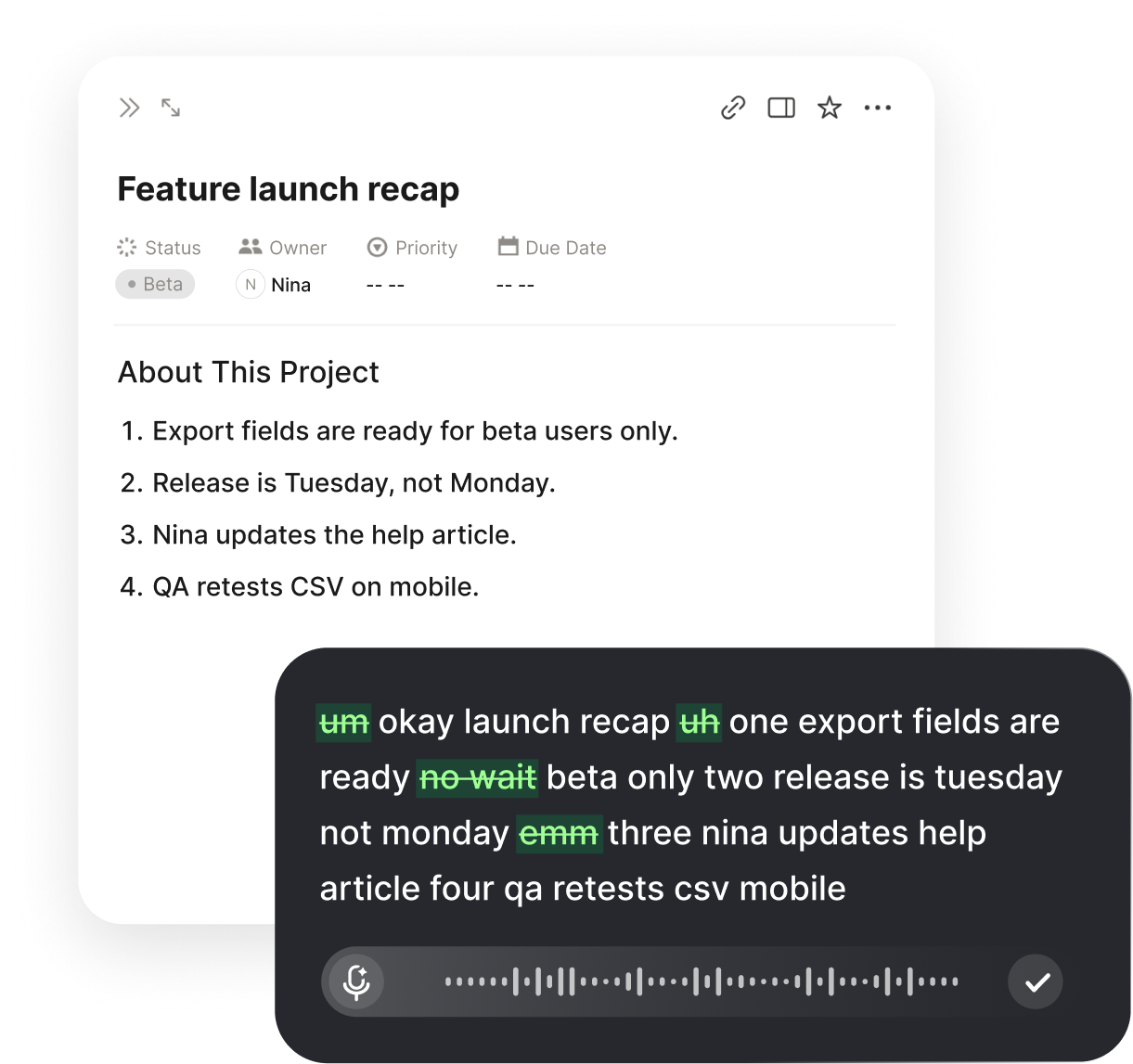
Refine the summary against the source before anyone else reads it. Check every technical term against the glossary and every figure reference against the disclosure. Confirm that part numbers, units, and ranges match the source, and that no number was changed by a misheard word. This is where Voiskey's cleanup helps: it removes filler words, stutters, false starts, self-corrections, and grammar slips as you speak, and adapts punctuation, formatting, and tone to the document, so the draft arrives with fewer spoken artifacts. Download Voiskey for the device you use for technical drafting and run one complete summary through the routine before relying on it for a filing decision.
Check numbers with special care. Read each number aloud and compare it with the source: dimensions, percentages, temperatures, dates, and reference numerals. Confirm that units are stated and consistent. If the disclosure gives a range, confirm the endpoints and whether they are inclusive. If a number appears in a figure and in the text, confirm they agree. Have a colleague read the numbers back to you from the source while you follow the draft. Numeric errors are easy to introduce in speech and hard to see in a dense paragraph, so a separate numeric pass is worth the time on every patent summary.
Tighten the language without changing the technical meaning. Remove adjectives that add emphasis but not information, and replace vague quantifiers with the disclosure's actual terms. Keep the distinction between what the disclosure describes and what the summary concludes. Check that the same component is not called by two names and that two components are not called by the same name. Read the summary aloud and mark any sentence that a technical reader would have to read twice. Those sentences usually contain a stacked qualification or an ambiguous pronoun. Clear technical prose is not simpler prose; it is prose where each term has one meaning.
Complete the reference and format checks. Confirm that every figure mentioned is included and labeled, and that every reference in the prior art list has a full citation. Check headings, numbering, and the inventor and matter details. If the summary will be attached to a filing or a portfolio review, confirm the required format and length. Save a clean copy with a version label and keep the glossary with it. Read the summary once more from the reader's point of view: can they state the problem, the idea, and the open questions after one reading? If not, the summary needs another pass.
Review With Inventors and Archive
Send the draft to the inventor or technical reviewer with specific questions. Ask them to confirm the technical description, the terminology, and the variants, and to flag anything the summary overstates or omits. Give them the glossary and the figure list so they can check terms in context. Record their corrections and the reason for each. If the inventor disagrees with a characterization, update the summary rather than arguing the point in a comment. The inventor's confirmation is the strongest check on technical accuracy, and a short, focused review request gets a faster and more useful response than a general request for feedback.
Route the legal review separately from the technical review. A partner or attorney should confirm the characterization of the claims, the prior art comparisons, and any conclusion the summary draws. Give the reviewer the open-questions list and the parts of the summary that touch claim scope. Record the approval and the date. If the reviewer asks for more research, note the request and the owner rather than filling the gap with a confident sentence. Separating technical and legal review means each reviewer checks what they are qualified to check, and it prevents a summary from appearing approved when only one dimension was reviewed.
Use the same drafting setup for revisions. Voiskey works at the system level on macOS and Windows: press a shortcut, speak, and text appears at the insertion point in the summary you are editing. It learns names, jargon, acronyms, and spelling preferences, which matters when a late correction changes a technical term that appears throughout the document. The workflow is Speak-Polish-Type-Edit, and at up to 220+ words per minute it is about five times faster than typing, so a revision after inventor comments can be completed in one sitting. When the summary is live, download Voiskey and dictate corrections into the master file so the review history stays together.
Archive the summary with the material it relied on. Save the approved version, the glossary, the figure list, the prior art list, and the reviewer comments in one place. Note the date of the review and the version that was approved. If the summary supports a filing or a portfolio decision, link it to that record and note the deadline. Update the glossary with any terms the inventor corrected so the next summary starts with better vocabulary. Then review the process: which blocks needed the most correction, and which questions produced the most useful answers. The next patent summary should begin from a stronger map.
FAQ s
Voiskey learns names, jargon, acronyms, and spelling preferences, so repeated component names, claim terms, and reference labels stay consistent as you dictate. It also adapts punctuation, formatting, and tone to the summary you are building. A glossary prepared from the disclosure remains the source of truth, and every technical term still needs a check against the source before the summary is reviewed.
Yes. Voiskey learns the terms you use and keeps their spelling stable across the document, which helps when a summary repeats a claim element or a prior art reference many times. Define each term once in your glossary and use the same form throughout. The reviewer still confirms that each term matches the claims and the specification, and that each reference carries a full citation.
Press a shortcut, speak the summary into the file, and text appears at the insertion point. Voiskey removes filler words, stutters, false starts, self-corrections, and grammar slips and adapts punctuation and formatting to the document. Polish is the pass where you verify technical terms, numbers, and figure references. At up to 220+ words per minute, the first pass produces a complete summary that is ready for inventor review.
Voiskey supports 100+ languages and translation, which can help when a summary refers to material in another language. You still need a qualified reviewer for technical meaning and for any translation the filing requires. Treat the dictated text as a drafting aid and verify terms, numbers, and citations against the original disclosure before the summary supports any decision.


 Voiskey
Your voice, amplified.
Download Voiskey for Mac and Windows and dictate patent and IP summaries from disclosure map to review.
Use it across macOS, Windows, iOS, and Android