
Voice Drafting Family Law Correspondence
Decide the message, gather the facts, and dictate calm correspondence clients can approve.
 Voiskey Team
Decide the Message and the Reader
Voice Drafting Family Law Correspondence starts with a clear decision about what the letter must accomplish. Family law letters cover scheduling, discovery, settlement offers, parenting arrangements, support, and warnings about filing. Each purpose needs a different register and a different level of detail. Write the purpose in one sentence at the top of the file, then name the reader: the other party's counsel, a mediator, the court, or the client. Identify the action you want the reader to take and the date by which you want it. A letter that tries to accomplish three things at once usually accomplishes none, so pick the primary message and put secondary points in a later letter.
Decide the tone before drafting. Family law correspondence is often read by people under stress, and a letter that sounds hostile can escalate a dispute that a calm letter could settle. Choose the register the situation calls for: cooperative for scheduling, firm for a deadline, formal for a position statement, and measured for a response to an accusation. Note the phrases your practice uses for each register. If the other side has been aggressive, resist matching the tone; a controlled letter is more persuasive and more useful if a court later reads the correspondence. Tone decided in advance is easier to sustain than tone corrected after a draft exists.
Identify the boundaries the letter must respect. Family law matters often involve protective orders, parenting schedules, communication restrictions, or agreements about how the parties contact each other. Check the file for any order or agreement that limits what may be said or to whom. Note whether the letter must go only to counsel and not to the client's former partner. Confirm the client's instructions about what may be disclosed and what must remain private. Write these boundaries at the top of the file before dictation. A letter that crosses a boundary can create a new dispute, and the boundary is much easier to respect when it is written down.
Prepare the working file and the review path. Open the letter template, confirm the letterhead and the signature block, and place the cursor at the first paragraph. Keep the chronology, the client's instructions, and the relevant order beside the document. Decide who reviews the facts, who reviews the tone, and who approves the letter before it is sent. Note the deadline and whether the letter responds to a deadline set by the other side or the court. If the client will review the letter, plan how it will be delivered and how quickly a response is needed. A prepared file and a named review path keep a sensitive letter from being sent in haste.
Gather Dates, Names, and Boundaries
Build a fact block before dictation. Record the parties' full names, the children's names and dates of birth, the case number, and the names of counsel and any mediator. Record the dates of the events the letter discusses, including exchanges, missed appointments, payments, and prior correspondence. Note the date of any order the letter relies on and the section that applies. Check the names and dates against the file. Family law correspondence is often read months later in a different context, so a letter that misstates a date or a name can damage the client's credibility. Use the file copy rather than memory.
Separate facts from characterizations. In the fact block, write only what can be documented: what happened, when, where, and who was present. Put impressions and concerns in a separate section for the drafting discussion. When you dictate, use the documented facts and state concerns as concerns rather than as established truth. This separation matters in family law because letters are often exhibits, and a letter that presents an assumption as a fact gives the other side an easy target. A clean fact block also makes the letter shorter, because it removes the need to argue about every point. That discipline keeps the letter credible.
Confirm the client's instructions and the limits on disclosure. Ask the client what outcome they want from the letter and what they authorize you to say. Record the instructions and the date. Note any information the client wants withheld, and confirm that withholding it is consistent with the firm's obligations and the case strategy. If the letter responds to a proposal, confirm the client's position on each term. Do not draft a position the client has not approved, even if it seems reasonable. A letter that commits the client to a term they did not authorize can create a binding problem and a serious loss of trust.
Note the procedural context. Record any deadline the letter responds to, any scheduled hearing or mediation, and any order that governs communication. If the letter is part of a negotiation, note the prior offer, its date, and its terms. If the letter must be filed or copied to the court, note the filing requirements. If the parties are in mediation, note whether the communication must follow a particular format. Procedural context determines what the letter should say and when it must be sent, and it is much easier to capture before dictation than to reconstruct afterward. Note the date of the next scheduled event.
Dictate in Calm, Short Segments
Dictate the letter in short segments, one point at a time. Start with the purpose, then the facts, then the request or response, then the next step. Keep each paragraph to one idea and each sentence short enough to read without effort. If a point makes you angry while you dictate it, leave it for the editing pass and write the neutral version first. Calm segments produce calm prose, and calm prose is more persuasive than a heated paragraph that the reader can dismiss. Announce each segment with a transition so the structure survives into the draft. A letter that a stressed reader can follow is a letter that is more likely to get a response.
Use neutral verbs and specific facts. Instead of saying the other party refused, say the other party did not respond to the request dated a certain day. Instead of saying the schedule was ignored, state the dates and times of the missed exchanges. Neutral verbs describe conduct; judgmental verbs assign blame and invite a counterattack. Where the client's concern is legitimate, state the concern directly and tie it to the facts. Specific facts are harder to dispute than adjectives, and they give the reader a clear picture of what happened without requiring them to accept a characterization. Prefer the plain description to the label.
Handle accusations and emotional content carefully. If the letter responds to an accusation, address the specific claim and leave the rest aside. Do not repeat an inflammatory allegation in full unless the response requires it. If the client wants to express frustration, explain that the letter will state the facts and the requested action, and that a separate conversation can address the emotion. If the letter must warn about a consequence, state it accurately and without relish. A measured response to a hostile letter often improves the client's position, because it shows that the client is reasonable and focused on resolution.
Close with a clear request and a workable next step. State what you want the reader to do, by when, and how to respond. If the letter proposes a meeting, offer specific times or a range. If it requests documents, list them. If it responds to an offer, state the response plainly. Avoid ending with a vague invitation to discuss, which leaves the reader unsure what is expected. Read the closing aloud and check that it matches the purpose you wrote at the top of the file. A clear close turns a letter into progress, and it gives the file a documented next step.
Polish Tone and Remove Heat
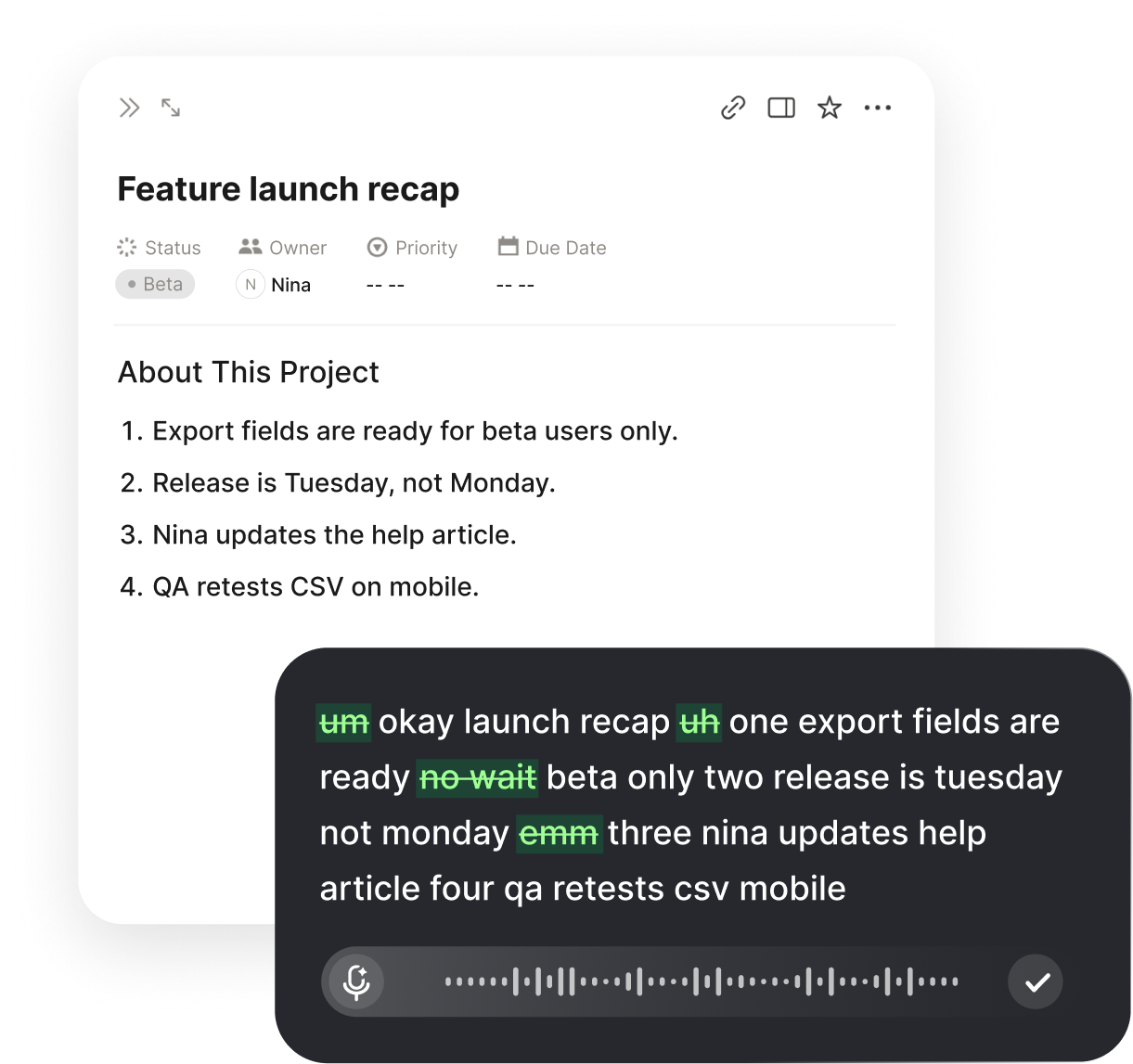
Polish the letter for tone before it goes to review. Read it once for the facts and once for the impression it creates. Remove sarcasm, rhetorical questions, and adjectives that assign motive. Replace accusations with descriptions of conduct and its effect. This is where Voiskey's cleanup helps: it removes filler words, stutters, false starts, self-corrections, and grammar slips as you speak, and adapts punctuation, formatting, and tone to the correspondence, so the draft arrives closer to the measured register you intend. Download Voiskey for the device you use for client correspondence and run one complete letter through the routine before relying on it in a sensitive matter.
Check that the letter says only what the client authorized. Compare each request and each statement of position with the client's instructions. If a sentence commits the client to something new, remove it or route it to the client. If a sentence discloses information the client asked to withhold, remove it and note why. Check that the letter does not promise a meeting, a payment, or a concession that the client has not approved. Authorization errors are harder to fix after sending than tone errors, because they can bind the client or damage the negotiation. Confirm the instructions in writing before you send.
Read the letter as the other side would read it. Ask what a hostile reader could quote out of context, and rewrite any sentence that would look bad in a filing. Ask what a mediator would think of the tone, and adjust if the letter sounds unreasonable. Ask whether the letter gives the reader a clear path to resolve the issue. If the answer is no, add a specific request or a proposed step. A letter that reads well to the client but poorly to the other side is not finished. The reader's perspective is the test that matters most.
Complete the factual and mechanical checks. Confirm the names, dates, case number, and addresses. Check that exhibits or documents referenced are attached. Confirm the letterhead, the signature block, and the method of delivery. If the letter responds to a deadline, confirm that it will arrive in time. Save a clean copy with a version label. Read the final version aloud once more, because a sentence that looked calm on the page can sound sharp when spoken. A letter that survives both a silent read and a spoken read is ready for approval. Keep the final copy with the fact block and the approval note.
Send, Log, and Prepare the Next Step
Route the letter for approval with a short note identifying the purpose, the key facts, the client's instructions, and any open questions. Give the approver the chronology and the prior correspondence so the decision is made with the full context. Ask for approval of the substance and the tone. Record who approved and when. If the approver changes a sentence, confirm that the change does not commit the client to something new. A clear approval record protects the client and the firm, and it makes the next letter in the matter easier to draft because the positions are documented. Send the note with the draft.
Send the letter through the correct channel. Confirm whether it goes to counsel, to a mediator, or to the court, and whether copies are required. Note the date of sending and the method. Voiskey fits the drafting and revision work: it is an AI voice typing app for macOS and Windows, and you press a shortcut, speak, and text appears at the insertion point in the letter you are editing. It learns names, jargon, acronyms, and spelling preferences, adapts punctuation, formatting, and tone, and supports the Speak-Polish-Type-Edit workflow at up to 220+ words per minute. Download Voiskey when you are ready to standardize the routine across the family law team.
Log the letter and its outcome. Save the sent version, the delivery confirmation, and any response in the file. Record the date and the substance of any reply, and note the next action and its owner. If the letter set a deadline, calendar it and confirm who will follow up. If the other side responds with a proposal, record it and route it to the client with a short summary. If no response arrives, decide whether a follow-up letter is appropriate and note the reason. A logged letter becomes part of a documented record that is useful in negotiation and, if necessary, in court.
Prepare the next step and review the routine. Decide whether the matter needs a follow-up letter, a call, a mediation session, or a filing, and record the decision with a date. Review the drafting process: which parts of the letter needed the most correction, which facts were missing, and where approval slowed down. Update the template and the fact block. Keep a short lessons note with the file. Over time, a consistent purpose statement, a clean fact block, and a calm review routine make family law correspondence faster to produce and easier to defend, and the client sees a professional process rather than a rushed reaction.
FAQ s
Voiskey removes filler words, stutters, false starts, self-corrections, and grammar slips as you speak, so the letter that appears at the insertion point is closer to the measured tone you intend. It adapts punctuation, formatting, and tone to the correspondence. Tone still depends on the facts and the request you choose, so the drafter reviews the wording and the client authorizes the position before it is sent.
Yes. Voiskey learns names, jargon, acronyms, and spelling preferences, which helps when correspondence repeats the parties' names, the children's names, and the case number across many letters. A fact block keeps the accepted spellings in one place. The drafter still checks every name and date against the file, because correspondence may be read months later in a different proceeding.
Press a shortcut, speak the letter into the template, and text appears at the insertion point. Voiskey cleans the spoken text and adapts punctuation, formatting, and tone to the letter. Polish is the pass where you remove heat, confirm the client's instructions, and check dates and names. At up to 220+ words per minute, the routine produces a complete draft that is ready for a careful tone review.
Yes. The team plan offers shared vocabulary and workflows, which helps a family law team keep client names, defined case terms, and letter formats consistent across drafters. Each letter still goes through the fact and tone review, and the client still authorizes the position. Shared vocabulary reduces spelling drift and repeated setup, but it does not replace the fact block or the approval record.


 Voiskey
Your voice, amplified.
Download Voiskey for Mac and Windows and dictate family law correspondence that stays calm under review.
Use it across macOS, Windows, iOS, and Android