
Voice Drafting Discovery Responses
Scope a request set, dictate each block in order, and polish the whole set.
 Voiskey Team
Scope Each Discovery Request First
Voice Drafting Discovery Responses starts with scope, not speed. Each request in a set has its own subject, its own limits, and its own likely objection, so read the whole set before speaking. Group requests that share facts or documents, and note where one answer will affect another. Identify the requests that need documents produced, those that need a written answer, and those that need both. Decide who holds the underlying facts for each group. Mark any request that is vague, overbroad, or duplicative, because those need a considered response rather than a quick answer. A short scoping table with request number, subject, owner, and planned response type will guide every later pass.
Confirm the governing rules before drafting. Check the deadline for the set, the required format for responses, and the wording your jurisdiction expects for objections and verification. Note whether responses must repeat each request verbatim and whether a signature or verification page is needed. Put the exact required phrases in a reference block at the top of your working file; you will speak them repeatedly, and using approved wording avoids accidental variation. If the set arrived with definitions and instructions, read those too, since they can change how a request should be read. Calendar the deadline with a plan that works backward: fact gathering, first draft, review, and service. Rules checked once at the start prevent a polished response set from failing on a technical defect.
Plan fact gathering around the people who own the information. For each request group, name the custodian, the records likely to be relevant, and the questions that must be answered before a response can be drafted. Send those questions early, in writing, with a return date that leaves room for follow-up. Ask for documents and facts separately, because a custodian may answer one and overlook the other. Record any gaps as you go rather than waiting until the drafting session. If a request touches a subject no one owns, escalate it now. Fact gathering is the slow part of discovery; dictation is fast only when the underlying answers are ready, and a clear owner list is what makes them ready.
Set the response conventions before the first sentence. Decide how you will label each response, whether you will quote the request in full, and how you will describe documents produced. Choose a consistent format for objections so that similar requests receive similar language. Agree on the tone: measured, specific, and free of argument that belongs in a brief. Note the difference between an answer that states facts, an answer that points to documents, and an objection that withholds information, and keep them visually distinct. Keep a model response from a prior matter as a style reference, but verify every clause against the current rules. Conventions fixed in advance make the dictated set coherent and shorten the review that follows.
Build the Response Skeleton From Rules
Create a skeleton that mirrors the request set exactly. Number the responses to match the requests, paste each request at the top of its block, and leave labeled spaces for objections, factual answers, and document references. Add a verification block and a signature line if the rules require them. For each block, write a one-line plan: what the answer will say and which custodian supplies it. This skeleton turns dictation into filling known slots rather than composing from scratch, which keeps the set complete. Check that no request number is missing and that the order matches the served set. A skeleton that mirrors the request set is also a completeness check you can hand to a reviewer before a single answer is dictated.
Draft the standard objections as reusable, approved text. For each objection type in your set, write the exact wording your practice uses, including the reason it applies. Store those passages in the reference block so you can speak them the same way each time. Then decide, for each request, which objections genuinely apply and which are reflex. Overusing objections weakens the credible ones and invites a motion. If an objection applies only to part of a request, plan to say so precisely and to answer the remainder. Note where an objection depends on a fact you have not yet confirmed. Objections dictated from a prepared, verified bank of language are consistent and defensible; objections improvised sentence by sentence are where overreach creeps in.
Prepare the factual answers as short, dated statements. For each request, write the key facts in plain order: who, what, when, where, and which document shows it. Keep each fact traceable to a source, and note the source beside it in the skeleton. Where an answer is simply that no responsive documents exist, plan that sentence and the search that supports it. Where documents will be produced, prepare the production labels and a description of what is being produced. Do not draft conclusions of law into the factual answer. The goal is a response a reader can verify, not an argument. Facts prepared this way can be spoken quickly and accurately because each sentence already has a source and a place in the structure.
Choose the order of work within the set. Start with requests whose facts are settled, because they establish rhythm and reveal gaps in the skeleton. Move next to requests with partial answers, where you can dictate the known part and mark the remainder. Leave the contested requests for last, when your understanding of the set is strongest. For each block, decide in advance whether it needs a full answer, a document reference, or an objection with a partial answer. Note the blocks that require client input and set a date to return to them. Working in a deliberate order keeps the session productive and prevents the most difficult requests from consuming time that simpler, complete answers needed.
Dictate Objections and Answers in Order
When you speak a response, follow the block order every time. State the objection first if one applies, then the answer, then the documents produced or withheld. Use the approved objection wording exactly; do not paraphrase it under the pressure of dictation. Speak request numbers aloud so the text remains anchored to the right block. Keep sentences short and avoid nested conditions. If you need to refer to a document, speak its label rather than describing it from memory. After each block, pause and read it back before moving on. This fixed order makes the dictated set predictable for reviewers and reduces the chance that an answer lands under the wrong request number.
Dictate the factual answers in the past tense and in chronological order. Say what happened, when, and which record shows it. Avoid adjectives and avoid speculation; if a fact is unknown, say it is unknown and note the follow-up. When an answer depends on a document you have not reviewed, say so and mark the block incomplete rather than guessing. Use consistent names for people, entities, and systems across every block, because discovery responses are read side by side. If two answers must agree, read the earlier one before dictating the later one. Consistency across a response set is persuasive; small contradictions between blocks invite follow-up requests and cost far more time than the pause needed to check.
Handle partial objections and partial answers with explicit boundaries. Say which part of the request is objected to and which part is answered, then answer the remainder fully. Avoid phrases that leave the reader unsure whether information was withheld. If documents are being produced, state the label and the request number they respond to. If documents are withheld, state the basis in the approved language and note the withheld category in your internal log. Keep the internal log and the served response distinct: the served text needs only what the rules require. Boundaries stated clearly protect the response on review and make the set easier to defend if the matter escalates to a conference or a motion.
Use the dictation session to build the record, not just the text. Note the time each block was completed and any question that required a break. Keep a running list of incomplete blocks with the reason and the owner. If a custodian's answer changes a fact used in an earlier block, flag the earlier block immediately for consistency review. Read the verification page aloud and confirm who will sign it. At the end of the session, read the list of incomplete blocks and assign return dates. A session that ends with a clean list of open items is far more useful than one that ends with a long draft full of unflagged gaps waiting to be discovered by opposing counsel.
Polish Consistency Across the Response Set
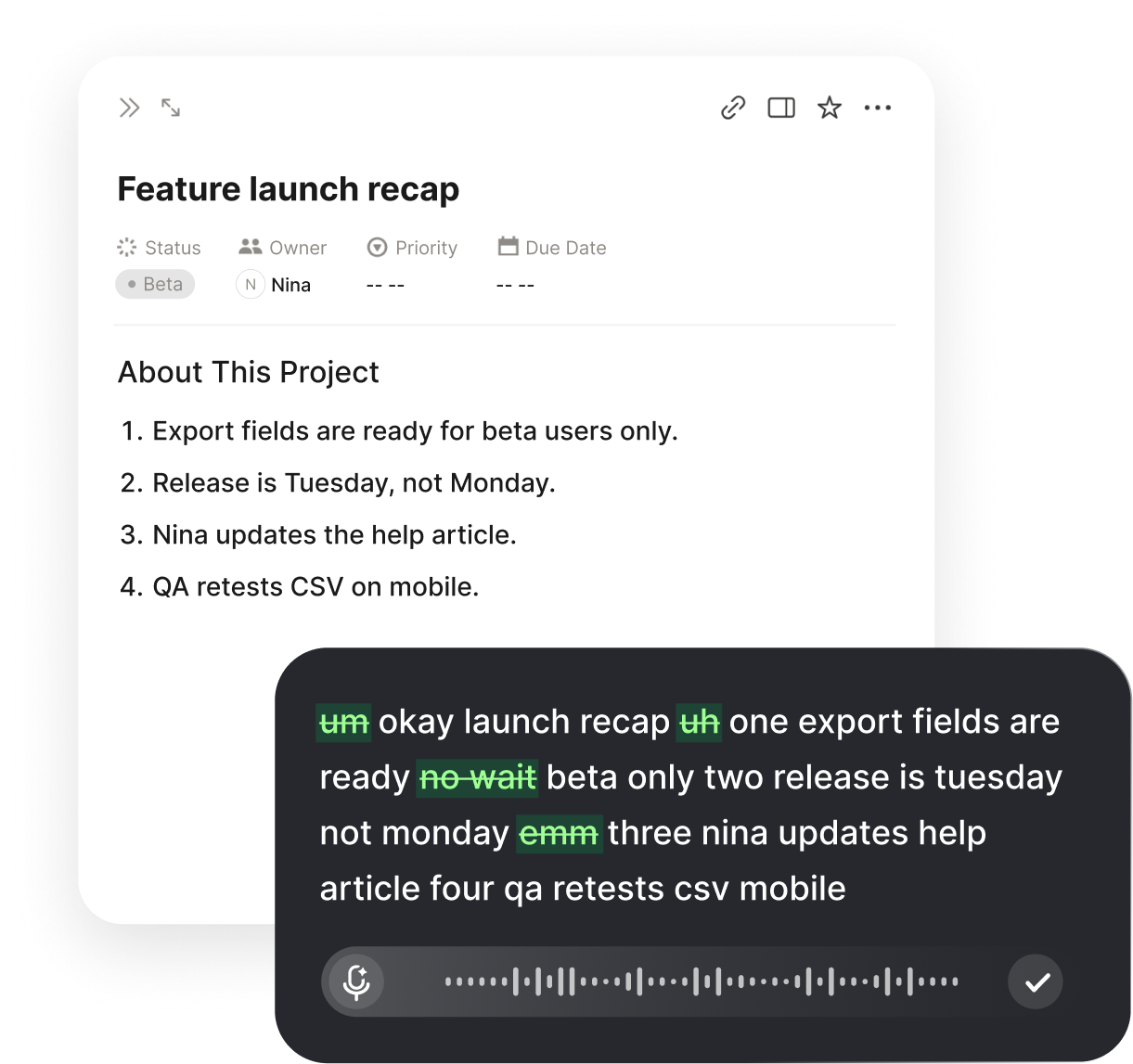
Polish the set as a whole, not block by block. Read the responses in order and check that names, dates, and document labels match across every block. Confirm that each request number appears once and that each block contains the elements the rules require. Then check tone: objections should be measured, answers should be factual, and no block should sound like argument. Voiskey's cleanup helps at the dictation stage, since it removes filler words, stutters, false starts, and self-corrections, and adapts punctuation and formatting to the task. But cleanup does not replace a deliberate consistency pass. The set is ready for review only when it reads as one document.
Run a citation and reference check. Confirm that every document label used in an answer appears in the production list, and that every production listed is described somewhere. Check dates against the fact record and party names against the caption. Verify that defined terms are used the same way throughout. Read the verification and signature pages against the rules you noted at the start. If the response set includes a privilege log or a withholding statement, check that it matches the objections. This pass is deliberately mechanical. Errors of reference are the most common reason a technically sound response set draws a deficiency letter, and they are the easiest errors to catch with a checklist.
Have a second reader test the set for clarity. Ask them to pick three blocks and say, without help, what is being answered and what is being withheld. If they hesitate, rewrite the block. Ask them to find any request that appears to have no answer. Ask them to confirm that each objection has a stated basis rather than a label alone. Give the reviewer the rules and the skeleton, not your intentions. Record their questions and resolve each one before service. A fresh reader finds the ambiguities the drafter has learned to read past. If the set is large, rotate reviewers so no one becomes blind to the same phrasing across hundreds of blocks.
Decide how you will produce the final document. If you dictated into a word processor, check pagination, headings, and numbering before export. If you need the tool on the machine that will prepare the final file, download Voiskey and keep the glossary and skeleton in the same place; the product is a voice typing app for macOS and Windows, and text lands at the insertion point in the application you already use for drafting. Confirm the signature and verification requirements one final time. Save the served version and the internal log together. A final production check takes minutes and prevents the embarrassing mismatch between the document you reviewed and the document you served.
Serve, Track, and Reuse the Framework
Serve the responses according to the rules and the deadline you calendared. Confirm the method of service, the recipient, and the proof you need. Save the served set with the date and the confirmation. Update the matter calendar with any follow-up dates, such as the date the responses are due to be supplemented or the date a conference may be requested. Tell the custodians which of their answers were used and which remain open. If a block was left incomplete, record the reason and the plan to complete it. Service is not the end of the work: the served set becomes the reference for future requests, depositions, and motions, so the file must show exactly what was said and when.
Track the set after service. Keep the internal log updated with what was produced, what was withheld, and what was promised. If new facts arrive from a custodian, decide promptly whether the response needs supplementing and record the decision. If opposing counsel raises a deficiency, answer it against the same skeleton and the same approved language, so the record stays coherent. Give the responsible attorney a one-page summary of open items and their dates. A response set that is tracked after service is far easier to defend than one that is filed and forgotten, because every later statement can be checked against the original text and the supporting record.
Capture reusable material for the next set. Save the approved objections, the response format, and the completeness checklist as a template. Note which request types were easy to dictate and which needed restructuring, and improve the skeleton accordingly. Add any new defined terms and unusual names to your glossary. If a reviewer found recurring ambiguity, write a one-line rule for the template. Keep a short lessons note with the matter file. Reuse should shorten the next set without importing stale language, so review every saved clause against current rules before the first response of a new matter is dictated.
Review the routine with the team and choose one improvement. Ask the drafter, the reviewer, and the custodian coordinator which step consumed the most time and which produced the most rework. Pick one change for the next matter, such as earlier fact gathering or a shorter review chain, and test it. Voiskey fits here as a drafting aid: you press a shortcut, speak, and text appears at the insertion point, with the app adapting punctuation, formatting, and tone to the document you are building. It learns names and jargon, supports 100+ languages, and the workflow is Speak-Polish-Type-Edit. A team plan adds shared vocabulary and workflows. Download Voiskey when you are ready to run a full set through the routine.
FAQ s
Voiskey learns names, jargon, acronyms, and spelling preferences, so repeated phrases and unusual defined terms stay stable while you speak them across blocks. It also adapts punctuation, formatting, and tone to the task. Approved objection language still comes from your own verified reference block, and you should read every served response against the governing rules before it leaves the office.
Press a shortcut, speak the response into the app where you are drafting, and the polished text appears at the insertion point. Voiskey removes filler words, stutters, false starts, self-corrections, and grammar slips as you go, then adapts punctuation and formatting. You complete the draft with a consistency pass across all request numbers. At up to 220+ words per minute, the first pass covers a full block quickly.
Yes. Voiskey is system-level, so text appears at the insertion point in whatever app or text field holds your response set. There is no separate suite to open. You speak the objection, answer, and document reference into the same file your team reviews, which keeps the served text and the working draft aligned throughout the matter.
Voiskey supports 100+ languages and translation, which can help when a response set refers to records or statements in another language. You still need a qualified reviewer for legal meaning and for any certified translation the rules require. Treat the dictated text as a drafting aid and verify names, dates, and quoted passages against the original records before serving the response.


 Voiskey
Your voice, amplified.
Download Voiskey for Mac and Windows and dictate discovery responses block by block with fewer corrections.
Use it across macOS, Windows, iOS, and Android