
Voice Drafting Deposition Summaries
Set the purpose, dictate by topic and page, and verify every quotation before use.
 Voiskey Team
Set the Summary's Purpose and Format
Voice Drafting Deposition Summaries starts with a decision about who will read the summary and what they need from it. A summary for a trial team needs the testimony organized around the issues and the exhibits. A summary for a motion needs the passages that support or defeat a specific fact. A summary for a client needs the plain account of what the witness said. Name the reader and the purpose at the top of the file, then choose the format: a topic outline, a question-and-answer digest, or a page-line index. The purpose controls what you keep and what you leave out, so settle it before you dictate a single entry.
Collect the transcript, the exhibit list, and the case chronology before drafting. Note the page and line numbering convention, the volume boundaries, and the exhibit numbers used at the deposition. Record the names of the witness, the counsel, and the interpreter if one was used. Note any stipulation about the transcript, such as a pending errata sheet or a ruling on objections. If a video record exists, note the time codes that correspond to the key passages. A summary built without these references will be hard to check and harder to use in a filing, where the page and line cite is the coin of the realm.
Decide the level of detail before you start. A full summary covers the testimony topic by topic with page cites. A focused summary covers only the passages relevant to the issues in dispute. A digest covers the questions and answers in a condensed form. Each format has a different cost and a different use, and mixing them produces a document that serves none of the readers well. Write the target length and the depth at the very top of the file, and note the portions of the transcript that can be skipped, such as preliminary instructions and off-record discussions.
Prepare the working file with the summary's structure. Create the sections: witness and deposition details, topics, summary by topic, key passages, admissions, and open questions. Keep the transcript, the exhibit list, and the chronology beside the document. Decide who reviews the summary for accuracy and who reviews it for usefulness to the case team. Note the deadline and the filing or meeting the summary supports. If the summary will be updated after an errata sheet, note the date the sheet is expected. A prepared file keeps a long transcript from becoming an undifferentiated mass of testimony that no one on the case team wants to open.
Dictate Testimony by Topic and Page
Dictate the summary topic by topic rather than page by page. Each topic should correspond to an issue in the case, such as the formation of the contract, the notice, the performance, or the damages. Under each topic, state what the witness said, the page and line where the testimony appears, and whether the testimony helps or hurts the case. Keep each entry short and use the witness's own terms for documents and events. A topic structure lets the case team find the testimony it needs without reading the whole transcript, and it shows at a glance which issues the witness addressed and which the witness avoided.
Dictate the key passages as quotations with exact cites. Keep the quotation to the sentences that carry the point, and note the page and line at the start and the end. Do not paraphrase inside a quotation, and do not lengthen a quote with material that does not bear on the issue. If the witness corrected the answer later in the deposition, note both passages and the correction. A summary that quotes accurately and cites precisely can be used in a brief; a summary that paraphrases loosely has to be checked against the transcript before anyone relies on it, which defeats the purpose of the summary.
Record the questions that the witness could not answer and the topics the witness avoided. Note the page where the witness said he did not recall, could not remember, or lacked knowledge. Note the objections that were made and the rulings that were given. These entries are often as valuable as the affirmative testimony, because they show where the witness is vulnerable and where the other side may need to supplement the record. Keep the entries factual and cite them. A summary that records only the clear answers gives the case team an incomplete picture of what the witness actually provided.
Dictate the summary in the order the reader will use it. If the case team will use the summary for a motion, order the topics by the elements of the claim. If the team will use it for trial, order the topics by the witness's role in the narrative. If the team will use it for settlement, order the topics by the strength of the testimony on each side. The same transcript can support several summaries, and the order should match the use. Write a short note at the top that states the order and the purpose, so a later reader knows why the topics appear as they do.
Capture Admissions and Impeachment Points
Identify the admissions and record them separately from the general summary. An admission is a statement by the witness that establishes a fact the other side needs to prove or that undercuts the witness's own position. Record the statement exactly, the page and line, and the issue it affects. Do not characterize the statement as an admission unless the words support the label; a summary that overstates an admission will be rejected when the transcript is checked. A separate admissions section lets the case team see the strongest points quickly and lets the reviewer confirm each one against the transcript.
Capture the impeachment material with the same care. Note the prior statement or document that conflicts with the testimony, the page where the conflict appears, and the exhibit that contains the prior statement. If the witness was confronted with the document, record the question, the answer, and the exhibit number. If the conflict was not raised at the deposition, note it as an open point for trial. Impeachment material is easy to lose in a long summary, so keep it in its own clearly labeled section and cross-reference it from the topic where the relevant testimony first appears in the transcript record.
Record the witness's demeanor and the conditions of the testimony only where they matter. A note that the witness paused before an answer or that an interpreter was used may be relevant to how the testimony should be read. Do not fill the summary with impressions. Keep such notes short, factual, and tied to a page. If the witness's demeanor affected a ruling or a line of questioning, record that connection. A summary that mixes observation with testimony becomes hard to use, because a reader cannot tell which parts are the actual record and which are the summarizer's own impression.
Cross-check the admissions and the impeachment points against the exhibits. Confirm that each document cited exists, that the exhibit number matches the deposition record, and that the page reference in the summary points to the passage in the transcript. Where a document was marked but not admitted, note the status. Where a document was used only for a question and never shown to the witness, note that too. The value of an admissions section depends entirely on its accuracy, and a single mismatched exhibit can undermine the reader's confidence in the entire summary and in the drafter's care and judgment.
Verify Quotes and Page-Line Cites
Verify every quotation against the transcript before the summary is used. Read the quotation in the summary and the passage in the transcript side by side, and confirm the page and line at the start and the end. Check the punctuation and the capitalization, because a quotation that changes either may be challenged. Check that the quotation does not begin or end in the middle of a sentence in a way that changes the meaning. Voiskey helps during this pass: it is an AI voice typing app for macOS and Windows, and you press a shortcut, speak a correction, and the text appears at the insertion point in the summary. Download Voiskey before the citation check and dictate fixes directly into the draft.
Check the page and line numbering against the transcript's own convention. Some transcripts number lines on every page, and some number them in blocks. Some volumes restart the page numbers and some continue them. Confirm which convention the transcript uses and apply it consistently. If the summary cites a time code from a video record, confirm that the time code matches the transcript page. A citation that uses the wrong convention sends the reader to the wrong place on the wrong page, and in a filing that error can be used to challenge the summary's reliability in front of the tribunal and the client.
Check that the summary distinguishes the witness's words from the questioner's words. A quotation that begins with the question and continues into the answer, without marking the transition, misrepresents the testimony. Use separate quotation marks and label each speaker, or quote only the answer. Where the witness adopted the questioner's characterization, note that the witness adopted it rather than said it. This distinction matters a great deal in a deposition summary because the questioner's words are not evidence at all, and a reader who cannot tell the two apart may rely on a statement the witness never made at any point in the deposition.
Record the verification and the open items. Keep a log with the date, the reviewer, the quotations checked, the cites checked, and any passage that remains uncertain. Note any transcript page that is missing or illegible and the plan to obtain a clean copy. Note any errata sheet that has not yet arrived and the passages it may affect. Voiskey learns names, jargon, acronyms, and spelling preferences, which keeps witness names and exhibit labels consistent across the summary, and it adapts punctuation and formatting. Download Voiskey when the team prepares summaries for several depositions. A logged check makes the summary defensible.
Deliver, Index, and Update the Summary
Deliver the summary with an index that lets the reader move quickly. List the topics with their page references, the key passages with their cites, and the admissions with the issues they affect. Add a one-page overview that states what the witness established, what the witness conceded, and where the testimony is weakest. The overview is what most readers will use first, so write it last, after the summary is complete. A summary with a good index and a clear overview is a working tool; a summary without them is a long document that the case team will avoid until the eve of a deadline.
Walk the case team through the summary when the deposition matters. Point to the passages that support each element and the passages that create risk. Note the questions the witness could not answer and the documents that were not shown. Record the team's follow-up questions and the additional documents they want reviewed. If the summary will support a motion or a trial examination, note the passages the team intends to use and confirm that the cites are correct. A walked-through summary is far more likely to be used correctly than one that is simply filed and never discussed.
Update the summary when new material arrives. An errata sheet, a supplemental deposition, or a newly produced document can change the picture. Record the date of the update and the passages affected. If the errata changes an answer, update the quotation and the cite, and note the change in the summary so a reader who saw the earlier version knows what changed. Keep the earlier version with the file. A summary that is updated without a record of the change creates real confusion when two readers rely on different versions, and the confusion usually surfaces at the worst possible time.
Review the routine for the next deposition. Note which topics were hardest to summarize, which quotations needed the most correction, and where the page-line convention caused trouble. Update the template, the index format, and the verification log. If a particular witness or case type needs a different structure, record it for reuse. Keep a short lessons note with the matter file. Over several depositions, a topic structure, exact quotations, and a logged verification pass produce summaries that are much faster to build and far more reliable when the case team has to rely on them under pressure during trial preparation.
FAQ s
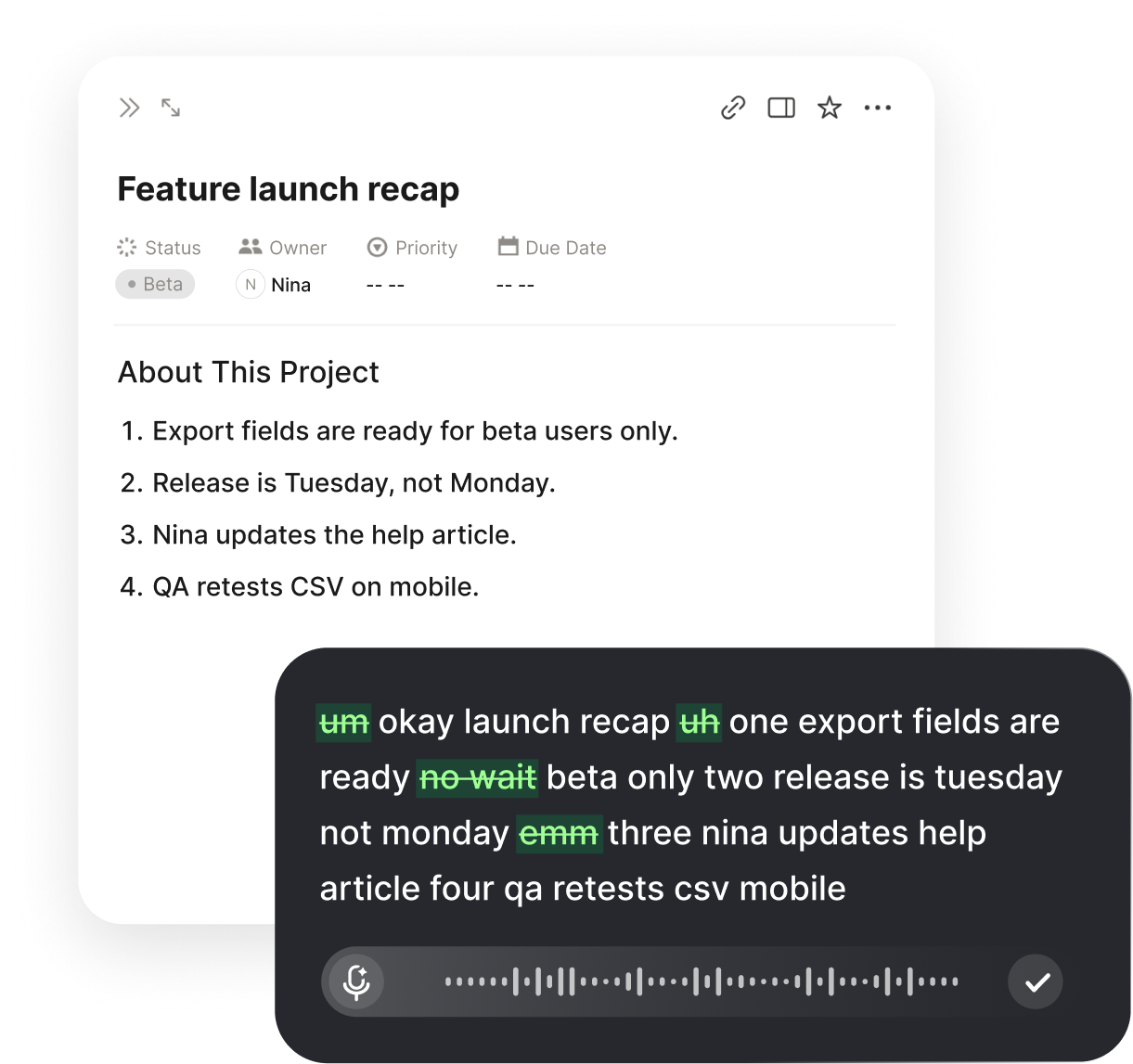
Voiskey is an AI voice typing app for the desktop. Press a shortcut, speak a summary entry or a correction, and the text appears at the insertion point in your summary file. It removes filler words, stutters, false starts, and grammar slips, so a spoken correction lands as clean text. You still compare every quotation and page-line cite with the transcript before the summary is used.
Yes. Voiskey learns names, jargon, acronyms, and spelling preferences, which helps when a summary repeats a witness name, an exhibit label, and a defined case term across many topics. A witness and exhibit table still fixes the approved forms. The spoken draft reduces retyping, and the reviewer checks each reference against the transcript and the exhibit list.
Press a shortcut and speak the summary topic by topic into the file, and text appears at the insertion point. Voiskey removes filler words, stutters, and false starts and adapts punctuation and formatting. Polish is the pass where you check quotations, page-line cites, and admissions against the transcript. At up to 220+ words per minute, the routine produces a complete draft for the verification pass.
Yes. Voiskey is system-level, so text appears at the insertion point in whatever app or text field holds the summary. You speak entries directly into the summary document and revise them in the same place, with no separate suite to open. The workflow is Speak-Polish-Type-Edit, so corrections land in the version the case team will review and use.


 Voiskey
Your voice, amplified.
Download Voiskey for Mac and Windows and turn long deposition transcripts into precise, cited summaries.
Use it across macOS, Windows, iOS, and Android