
Voice Drafting Compliance Policies
Map the audience, dictate plain duties, and review policy language with the teams covered.
 Voiskey Team
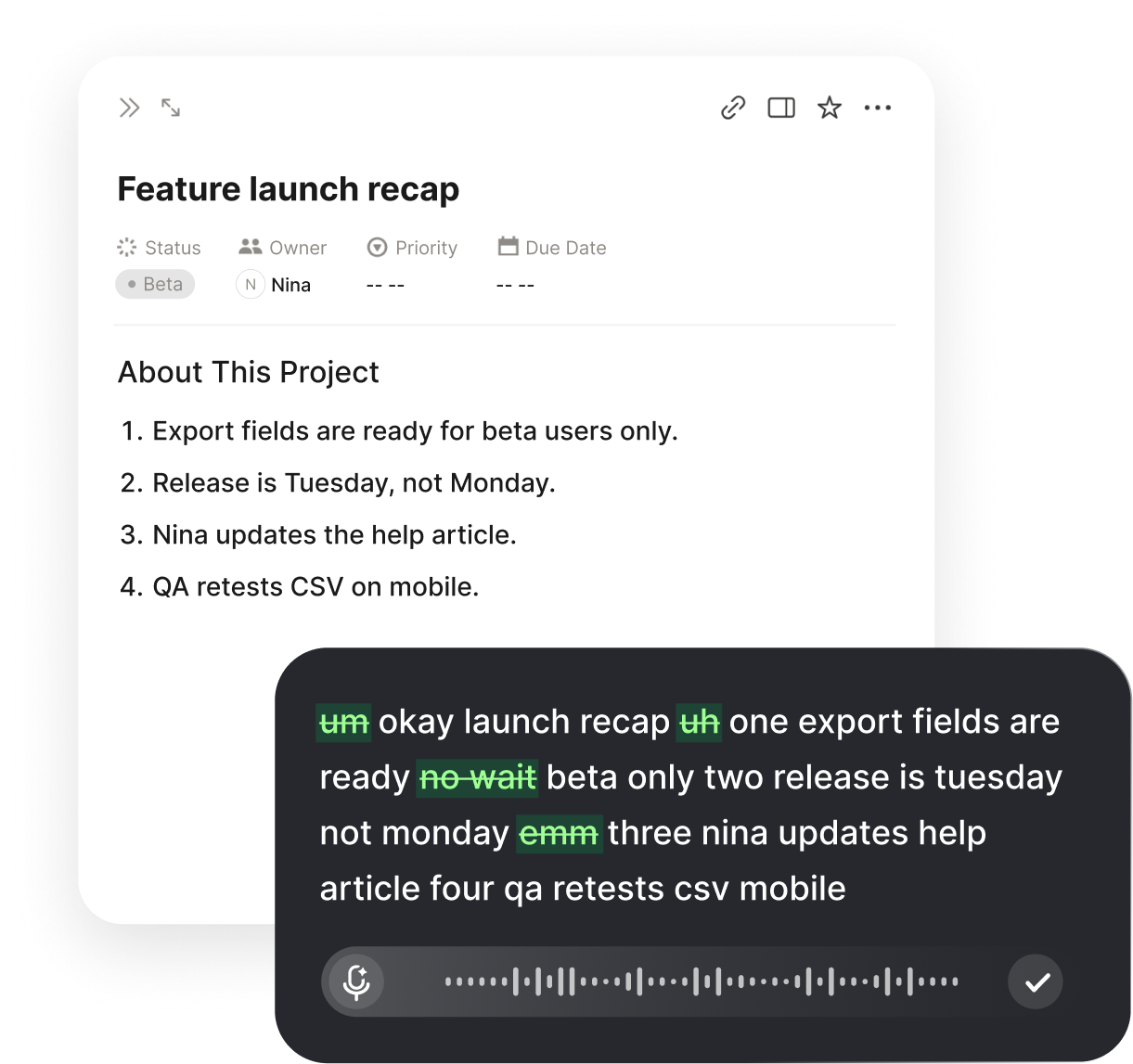
Map the Audience and the Trigger
Voice Drafting Compliance Policies starts with a map of who must follow the policy and what event brings it into play. Name the teams covered, the roles that carry duties, and the activities the policy governs. Then state the trigger: a new regulation, an audit finding, a contract term, or a change in how the business operates. Write both the audience and the trigger at the top of the file. A policy that does not say who it binds and when it applies will be read differently by every team it touches. The map is the reference point for every sentence you dictate afterward.
Collect the source material before drafting. Gather the regulation or standard the policy implements, the current version of any policy it replaces, the process descriptions from the teams affected, and the approval records for the last revision. Note the section numbers and the dates. Mark the obligations that are mandatory and the ones that reflect the company's chosen approach. If the source is ambiguous, write the ambiguity down and plan to resolve it with the owner before the draft is circulated. A policy built on an unclear source will be rewritten after the first review, and the rewrite will cost more than the research.
Decide the policy's scope and the boundaries it must respect. State what the policy covers and what it does not, and name the related policies a reader should consult. Note any legal or contractual limits on what the policy may require, and note the approvals needed before a new obligation is imposed. If the policy applies across regions, record where local rules differ and how the policy handles the difference. Scope decided in advance prevents two common failures: a policy that quietly extends into areas owned by another team, and a policy that leaves a gap a reader discovers only during an audit.
Prepare the working file in the document system where the policy will actually live and be maintained. Create the standard headings: purpose, scope, definitions, roles and responsibilities, requirements, exceptions, review cycle, and revision history. Place the cursor under the first heading and keep the source material and the prior version beside the document. Decide who drafts, who reviews for legal accuracy, who reviews for operational feasibility, and who approves. Note the effective date and the date of the next scheduled review. A prepared file with the standard headings keeps the spoken draft aligned with the format the organization already expects.
Dictate Duties in Plain Sentences
Dictate the purpose and scope in short, declarative sentences. Say why the policy exists, who it protects, and what it applies to, in language a new employee can understand on the first read. Avoid opening with a recital of the regulation. A reader who needs the legal basis can find it in an appendix or a footnote. Keep the purpose to a few sentences and the scope to a short list. If the scope requires exceptions, put them in their own section rather than burying them in a long paragraph. Clear purpose and scope save every later section from having to restate the basics.
Dictate each duty with an actor, an action, and a condition. Instead of saying records must be maintained, say the team lead retains each approval for the period stated in the retention schedule. Instead of saying employees should be aware, say each employee completes the briefing before the first shift and repeats it each year. Name the role rather than the department where possible, and name the artifact the duty produces. A duty written this way can be assigned, checked, and audited. A duty written as an aspiration cannot. The spoken sentence is the test: if you cannot picture who does what, rewrite it.
Dictate the exceptions and the escalation path with the same precision. For each exception, state who may grant it, what evidence they need, how long it lasts, and how it is recorded. For each escalation, state the trigger and the role that receives it. Do not leave the reader to infer that a manager may approve a deviation; say so or say the opposite. Make the escalation path short enough to remember, and name the point at which a matter goes to the policy owner. Exceptions and escalation are where policies fail in practice, so they deserve more care than the general requirements.
Dictate the review cycle and the revision history as part of the draft, not as an afterthought. State how often the policy is reviewed, who owns the review, and what triggers an out-of-cycle review, such as a change in the regulation or a repeated exception. Record the current version number, the effective date, and a short summary of what changed from the prior version. A reader who needs to know whether a behavior was permitted last year will look at the revision history first. A policy without a review cycle quietly becomes outdated, and an outdated policy is often worse than no policy at all.
Keep Defined Terms and Cross-References Tight
Build a complete definitions section before you dictate the requirements. List every term that carries a specific meaning in the policy: the systems covered, the roles named, the records involved, the thresholds that trigger a duty. Write each definition in one sentence. Use the same term everywhere and resist the urge to vary the wording for style. If a term appears in the regulation, use the regulation's definition and cite the section. If the company uses a term differently, say so explicitly. A policy with two meanings for one word will produce two behaviors in two teams, and the review will stall on the ambiguity.
Check every cross-reference by reading the target section aloud. References that point to the wrong paragraph are common when a policy is assembled from an earlier version. Read the sentence that contains the reference, then read the section it points to, and confirm that the two make sense together. If a reference points to an appendix, confirm that the appendix exists in this version. If a reference points to another policy, confirm that the other policy is current. Renumbering during editing breaks references silently and without warning, so repeat this check after every structural change, not only at the end.
Keep the language consistent across roles and regions. A requirement that applies to one team should not use a different verb than the same requirement for another team. Where a region has a different rule, put the regional variation in its own subsection rather than scattering it through the main text. Use tables for duties that repeat across roles, and keep the table columns identical so a reader can compare rows. Consistent structure makes the policy easier to update when one rule changes, because the change touches one row rather than a dozen paragraphs. Consistency is a maintenance decision as much as a writing one.
Read the full draft for terms that were never defined and duties that have no owner. Mark each one and resolve it before the draft goes out. A term used only once may not need a definition, but a term used in a requirement almost always does. A duty with no owner will not be performed, and the first audit will show it. Add a short checklist at the end of the drafting file: every defined term used, every duty assigned to a role, every cross-reference verified, every exception with an approver. A checklist that is completed before review turns the review into a discussion of substance.
Review With the Teams Who Must Follow It
Send the draft to the teams who must follow it before the approver sees it. A policy that reads well in the legal department can be impossible to perform on the floor, in a service center, or in a lab. Ask each team to mark the duties it cannot carry out with the tools and people it has, and to describe what it would need instead. Give the team a deadline and a specific question rather than a general invitation to comment. Voiskey helps here because it is an AI voice typing app for macOS and Windows: press a shortcut, speak the team's feedback into the review notes, and text appears at the insertion point. Download Voiskey before the review round and capture comments as clean notes.
Run the review as a structured walkthrough rather than a document exchange. Read each requirement aloud, ask the team to describe how it would perform the duty, and record the answer. Where the team describes a different practice than the one the policy assumes, write both down and decide which one the policy should require. Where the team says the duty is impossible, ask what would make it possible and who would own the change. A walkthrough surfaces operational gaps that written comments miss, and it gives the policy owner a record of the discussion to attach to the revision.
Resolve conflicts between the teams involved before the draft reaches the approver. Two teams may interpret one requirement differently, or one team may depend on another team's output without a defined handoff at all. Bring the disagreement into the open, name the decision, and record who made it. If the decision changes a duty, update the requirement and the related definitions together. Do not let a conflict remain in the draft as an ambiguity for the approver to settle, because the approver will usually choose the version that is easiest to approve rather than the one that works in practice.
Prepare the review summary for the approver. List what changed from the prior version, which teams were consulted, which concerns were resolved, and which remain open with a recommendation. Attach the walkthrough notes and the revised draft. Voiskey adapts punctuation, formatting, and tone to what you are writing and learns names, jargon, acronyms, and spelling preferences, so the recurring terms of the policy stay consistent across drafts. Download Voiskey when several reviewers contribute spoken comments and the policy owner needs one clean summary. A clear summary lets the approver decide on the record rather than on a memory of the meeting.
Publish, Version, and Schedule the Next Review
Publish the approved policy with the details that make it usable. Confirm the version number, the effective date, the owner, and the review date. Check that the table of contents matches the headings and that every appendix is attached. If the policy replaces an earlier version, mark the earlier version as superseded and keep it available for readers who need to know what applied in the past. Publish in the location the organization already uses for policy documents, and announce the change to the teams covered. A policy that is approved but hard to find is a policy that will be ignored.
Plan the communication and the briefing. Decide who needs to read the policy, who needs a briefing, and who needs a short summary of the changes. Prepare a one-page summary that states the new duties, the effective date, and where to ask questions. Schedule the briefing after the policy is published, not before, so the audience reads the final text. Record attendance and questions. Voiskey supports this work with 100+ languages and translation when a policy applies to teams working in more than one language, and it turns spoken requests into AI-ready prompts, including file names, paths, and commands. Download Voiskey to prepare briefing materials in the same voice as the policy.
Set the review rhythm and assign it to a named owner. Put the review date on a calendar that the owner actually uses, and define what the review covers: changes in the regulation, repeated exceptions, audit findings, and feedback from the teams. Keep a short maintenance log with the date, the reviewer, and the outcome. If a review finds no change, record that decision too, because a policy that is reviewed and left unchanged is still a policy the organization has confirmed. A review that is nobody's job will not happen, and the gap will be discovered by an auditor rather than by the owner.
Close the loop after the next audit or the next exception. Read the findings against the policy language and decide whether the policy was unclear, the training was incomplete, or the practice was simply not followed. Each cause leads to a different fix, and treating every finding as a training problem leaves an unclear policy in place. Update the policy, the briefing, or the monitoring, and record the change in the maintenance log. Over several cycles, a policy with a clear audience, defined duties, and a real review rhythm becomes easier to follow and easier to defend, and the teams stop treating it as paperwork.
FAQ s
Voiskey is an AI voice typing app for the desktop. Press a shortcut, speak a section of the policy, and the text appears at the insertion point in your document editor. It removes filler words, stutters, false starts, and grammar slips, so the draft reads as clean prose. You still verify definitions, duties, and cross-references against the source rules before the policy goes to review.
Yes. Voiskey learns names, jargon, acronyms, and spelling preferences, which helps when a policy repeats defined roles, system names, and thresholds across many sections. A definitions table still fixes the approved forms. The spoken draft reduces retyping of long terms, and the reviewer checks each use against the definitions table before the draft is circulated.
Press a shortcut and speak the purpose, scope, and duties into the document, and text appears at the insertion point. Voiskey removes filler words, stutters, and false starts and adapts punctuation, formatting, and tone. Polish is the pass where you assign every duty to a role and verify cross-references. At up to 220+ words per minute, the routine produces a complete draft for the team walkthrough.
Yes. Voiskey is system-level, so text appears at the insertion point in whatever app or text field holds the document. You speak sections directly into the policy file and revise them in the same place, with no separate suite to open. The workflow is Speak-Polish-Type-Edit, so reviewer comments land in the version that will be approved and published.


 Voiskey
Your voice, amplified.
Download Voiskey for Mac and Windows and draft internal policy documents that teams can actually follow.
Use it across macOS, Windows, iOS, and Android