
voice documentation recurring reports: A Practical Guide to Voice Documentation for Recurring Reports and Exports
Narrate a recurring report once, then run it from your own words forever.
 Voiskey Team
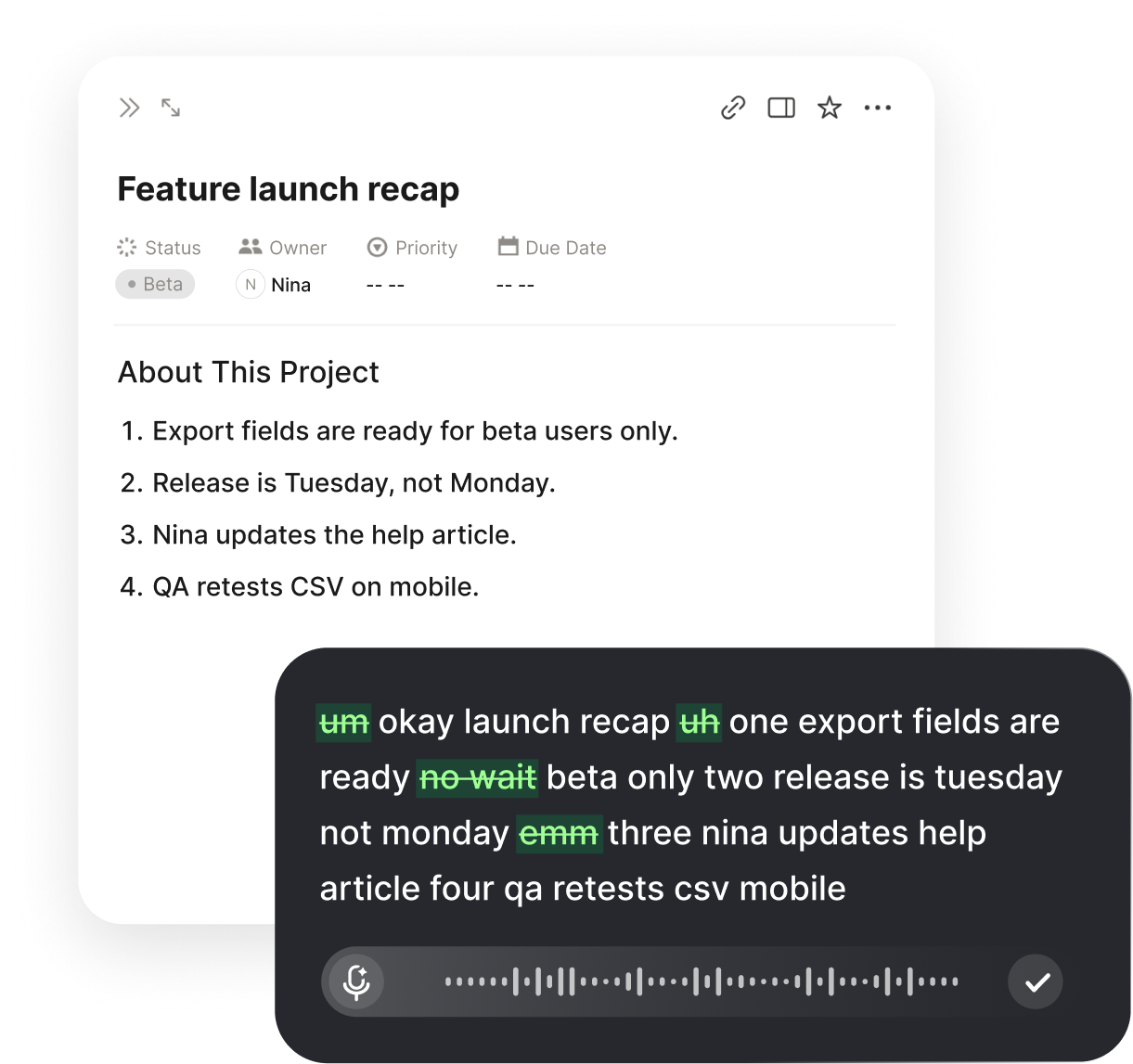
Narrate the Report Once, Run It Forever
Open the doc where the runbook will live, start Voiskey, and run the report as you normally would, narrating every step in the order you take it. Start with the source: open the billing dashboard, filter to the last thirty days, switch to the client view. Then the export: click the export button, choose the CSV format, check the file name is right. Then the transformation, the column you add, the formula, the numbers you verify. Say the things you would never write down because they feel obvious: the report only works after the day's data lands, and the totals column must be on the right. The obvious parts are the parts that make the doc work.
Name the verification steps explicitly, because a recurring report is only as good as its checks. Say present tense: the total on the dashboard matches the total in the sheet; the count of records matches the client count; the date range says last month, not month to date. Then say what you do when it does not match: stop, check the data cutoff, check the filter, check whether a client was archived. Dictation captures these checks exactly as you perform them, including the order, and the order matters, because a check performed too late is a check not performed at all. The verification section is the section that turns a report run into a trustworthy procedure.
Capture the output side as well: where the file goes, what it is called, who receives it and by what channel. Say the filename pattern out loud: report name, period, version, and the recipients, the finance group, the client's contact list. The doc should read like a short contract of the report's promise: the deliverable, the format, the timing, the audience. If the report is delivered through a shared drive, note the folder; if it goes through an automated run, name the job and the dashboard. The output section is what makes the runbook hand-offable, because a person who can produce the report cannot yet deliver it unless the routing is documented too.
Finish the narration by saying what done looks like: the email sent with the file attached, the dashboard refreshed, the task marked complete, the boss replied. State the exact criteria, then add the one thing that tells you the job was done wrong: the email bounced, the file was empty, the numbers were zero. That is the definition of a complete run, and the runbook is not complete until the definition of done is in the text. Narrate it as part of the run, as one more sentence after the send, and Voiskey will drop it into the doc exactly where you said it.
Schedules and the Right Checklist
Turn the spoken runbook into a schedule card for the recurring job: a single block of text per job with its name, cadence, deadline, owner, and the checklist. Dictate the card while running the job on its scheduled day, because the scheduled run is the moment of truth: the steps you take at that moment are the ones that matter, not the ones you would take in theory. The card is the public face of the runbook; it says what must happen and when, and the runbook sits behind it as the detail. A team that can see a card per recurring job has already won half the battle.
A checklist beats prose for recurring work, because a checklist is what a person reads at the exact moment of doubt. Write it as a column of seven to ten items, each one an action plus the expected result: backup verified, checksum matches; data loaded, row count is 14,203; filter cleared, last month only. As you narrate your run, these items are exactly what you say, so the checklist is not a design artifact; it is a transcript condensing. Then use it as the gate: the run is not done until every line is checked, and the not-checked line is the source of most recurring job failures.
Put the schedule and the escalation in the same card: what happens if the data is late, if the tool is down, or if the job needs to move. Dictate the fallback you would use: if the export fails, retry in fifteen minutes, if it still fails, send the partial file and note the gap. Name the person to ping, and say when a delay matters: the finance team needs the file by noon, and after that the report is late, not delayed. A recurring job doc that includes the failure path is a doc that will be read; one that includes only the happy path will be reopened only after the failure.
Keep one card per job, and copy the patterns between them: the same checklist shape, the same output convention, the same escalation contact. You will find that the schedule card is also the resumption guide: after a break, or when a new person takes over, the card says everything, and the runbook beneath it fills in the detail. Dictate the card first, because it is short, and the detail can follow. The card is the 80 percent that gets read, and the runbook is the 20 percent that gets checked only when the card fails, which is the correct ratio of effort and value.
What to Update When the Process Changes
The runbook is only true on the day it was written; keep the date and the reason visible at the top. Every recurring job doc starts with a line: version, date, last verified, and the history of the changes. When the process changes, the line changes with it. The habit is the discipline of updating the doc the day something changed, not the week after, when the memory has already blurred. Dictate the changed step in the moment, say the new step replaces the old, and Voiskey writes the correction. The logic of log lines is not about formality; it is about trust: a doc with a date is a doc people believe, and a doc without one is a doc people ignore.
Know the update triggers before they hit: a data source change, a renamed field, a new column, a moved dashboard, a new recipient, a changed schedule, a failed run. Each is a moment where the doc must be brought back to truth, because the one who updates it is the one who owns it, and the owner is the one who ran the report last. When the trigger fires, a three-minute re-dictation is enough: open the doc, run the changed step, narrate the correction, update the version line. A five-second edit on the change day beats a rewritten library at the audit.
When a process change is bigger than one line, re-narrate the whole flow, not just the paragraph. The point is that the spoken order is what matters: a re-dictated run reveals the new sequence, and the old doc, preserved, becomes the history note showing what changed and why. Keep old versions in an archive folder or a version history line, and let the current doc carry the truth. If the report became obsolete, write the obituary: the date it was retired, the reason, what replaced it. An archived doc with a note is closure; a deleted line is a mystery when someone asks in six months.
The silent killer is the doc that is right in the steps and wrong in the context: the data source is now a different table, the import path changed, the recipient list moved, but the actions look the same. To catch it, run the report from the doc once a quarter, and the mismatch will reveal itself as friction, the moment the step does not match what you would do. Narrate the correction from the doc, and the doc is true again. The quarterly verifying run is the whole maintenance loop, and with a dictation-based doc, the verify run costs a narration instead of a revision. The doc should be a living document, and the only way to keep it living is to use it.
Handing the Report Off with Confidence
A recurring report runbook exists to be handed off; the handoff is the test. When you hand off the job, walk the report with the new owner once, you narrate while they watch, and they run it from the doc while you correct. Then let them run it cold from the doc, and do not be in the room. The first cold run is the real test: any gap in the doc is visible as a pause, a wrong click, a guessed step. Those pauses are the exact lines to fix, and you have a complete list after one run. When they say it worked and produce the right file, the handoff is done.
The handoff package is four things: the runbook, the access list, the escalation contact, and the schedule card. Dictate the access list as a checklist of what the new owner needs: the dashboard view, the shared drive, the credentials location, the mailbox. Do not hand over the report as knowledge; hand it over as material, or the person holds the knowledge but not the door key. The escalation contact is the person who knows the data source, the person who knows the tool, and the person to ping when it breaks. These three names belong in the same doc as the steps, not in a separate chat thread.
After the handoff, keep a 30-day check-in: at day seven and day thirty, the new owner runs the report and you watch, or better, they run it cold and you compare the output with the previous month's. Diff the two runs: any difference in the output is a question about the doc, not a mistake by the person. The check-in closes the loop and the owner becomes the next author, because the person who now runs the report is the person who will see the next change first. That is the purpose of the whole system: at any moment, there is someone who can run the report, and the doc is the transfer of that ability.
The confidence that a report can be handed off is the confidence to take a day off, to scale, to say yes to a client without checking the calendar. Before you hand it off, you cannot take a day off without leaving a note and hoping. Once the doc exists, the absence costs nothing. The final test is the one sentence: can the new owner run it cold on the next scheduled day and not call you? If the answer is yes, the report is documented. If the answer is no, the missing step is usually one line, and the line is a two-minute narration from the person who knows it. The runbook is never a project; it is a running commentary on the work you already do.
FAQ s
Document the ones with a hard deadline and one owner first: the reports someone is waiting on, the ones that touch money or compliance, and the ones only you can run. A report the finance team needs by the fifth is a report that must have a doc. Then add the weekly ones you run from memory, because those are the ones you re-learn every week and the ones that break when you are away.
Keep narrating; the failure is the most valuable part. Say what you expected, what you saw instead, what you checked, and what you did to work around it. That segment becomes the troubleshooting section of the runbook, and the error message becomes a searchable anchor. A runbook with the failure captured is worth two with only the happy path.
Yes, with one habit: say digits individually when it matters. Read a formula out loud as it reads: equals sum of the amount column if the status is paid. Voiskey writes the words, and you can verify the text matches the cell before you move on. The narration also forces you to say what the number means, which is exactly the context the next runner needs.
Run the report from the doc once a quarter, and immediately after any of the triggers: a data source change, a field rename, a new column, a tool update, or a failed run. A quarterly verifying run takes one narration length, and it catches the silent drift that a clean-looking doc never reveals. The doc that gets used is the doc that gets checked.
Because the runbook is the memory that survives your absence, your vacation, your promotion, and your better offer. It is also the record that answers the future questions: why is this number different, who approved this change, when did the field land. The doc makes the report auditable, and the narration makes the doc cheap enough to keep truthful.


 Voiskey
Your voice, amplified.
Choose a real task, follow the steps, and review the results with your team before expanding the rollout.
Use it across macOS, Windows, iOS, and Android