
Vibe Coding Retrospective: What Worked and What Did Not
Review the prompts, tasks, and corrections, then leave with three actions that stick
 Voiskey Team
Set the Retrospective Frame
A Vibe Coding Retrospective is a short, honest review of how spoken prompts helped or hurt a piece of work. Set the frame before anyone speaks: the period covered, the tasks included, and the decisions this review can change. Name the people who did the work and the people who reviewed it. Say what is out of scope, such as hiring or budgets, so the discussion stays on the work. A clear frame turns a vague conversation into a review that produces a small number of concrete changes. If the frame fills a whole page, cut it down until the period and the scope fit in three lines.
Choose the evidence before the meeting. Gather the tasks, the prompts that were used, the corrections that were needed, and the time each task took. Save the prompt logs and the review notes in one place. Say which evidence is missing and whether the review can proceed without it. A retrospective that relies on memory alone tends to reward the loudest story. A short evidence pack keeps the discussion tied to what actually happened and makes the conclusions easier to defend. If the evidence pack is thin, shorten the review rather than filling the gap in it with pure recollection.
Agree on the questions the review will answer. A useful set is: which prompts produced usable results on the first try, which needed correction, where time was lost, and what the team would repeat. Write the questions on the board and answer them in order. Do not add new questions halfway through unless the group agrees to drop another. A fixed question list keeps the review from drifting into a general complaint session. If a question cannot be answered with the evidence in the room, mark it for the next cycle, note the owner, and move on to the next item.
Set the tone and the ground rules out loud. The review looks at the work and the prompts, not at who is clever or careless. Say that a correction is information about the prompt, not a verdict on the person. Ask each participant to bring one example that worked and one that did not. When the ground rules are clear, people describe real failures instead of polished successes, and the review produces something the team can use. If someone breaks the ground rules, restate them once and continue, rather than turning the review into a debate about tone and intent.
Replay What Worked
Start with what worked, and be specific. Name the prompt, the task, and the result. Say why it worked: the goal was one sentence, the constraint stood alone, or the example was exact. A specific success can be repeated; a general compliment cannot. Ask the person who wrote the prompt to read it aloud so the group hears the phrasing that helped. Collect three or four of these patterns before moving on, and write each one in a form the next task can reuse. If a prompt worked for a reason nobody can name, keep the example and study it later rather than praising it now.
Look for patterns across the successes rather than treating each one as a lucky accident. Did the prompts that worked tend to be short, start with the action, or include one example. Did they name the file and the check. When several successes share a trait, say the trait as a rule and test it against the next task. A rule drawn from real examples is more credible than advice imported from somewhere else, and the team is more likely to follow it. If the trait does not hold on the next task, drop the rule and keep the example that first suggested it.
Credit the parts of the process that made success easier, not only the prompt itself. A clear task map, a saved sample, or a quick review turn can matter as much as the wording. Say which support made the difference and whether it should be standard. When a success depended on one person's knowledge, note that dependency as a risk. A retrospective that only praises prompts misses the process that made them work. If that support cannot be repeated by another person, it is a personal habit, not a dependable process the whole team can rely on every single week.
Write the success patterns into a short list before the discussion moves on. Keep each pattern to one sentence with one example beside it. Read the list aloud and ask whether a new teammate could apply it without help. If not, the pattern is still too vague. A list of three tested patterns is more valuable than a list of ten clever ideas, because the team will actually use a short list. If the list grows past four items, the review is trying to change too much at once, so cut the weakest pattern out before the meeting ends soon.
Name What Did Not Work
Name what did not work with the same precision. Say the task, the prompt, and the point where the result went wrong. Avoid blaming the tool or the person; describe the gap. For example, the prompt gave three goals and the agent did the first one. A precise failure points to a specific change, while a general complaint points nowhere. Collect the failures before discussing fixes, so the group sees the pattern rather than reacting to the first story. If the group starts arguing about a person, return to the prompt and the task until the discussion is about the work again.
Sort the failures into kinds: a prompt that was too broad, a name that was misheard, a constraint that was dropped, or a task that was not ready to automate. Say how many failures fall into each kind. A kind that appears three times is worth a rule; a one-off is worth a note. This sorting keeps the review from inventing a policy for every small problem and helps the team spend its attention where it matters. If one kind dominates the list, that is the place to spend the first action rather than spreading effort across every failure.
Ask what the failure cost. Say whether it caused a rewrite, a review round, or a delay. A failure that cost ten minutes needs a note; one that cost a day needs a rule. Compare the cost with the effort of preventing it. When prevention is more expensive than the occasional repair, say so and accept the cost rather than adding process. A retrospective should produce proportionate changes, not a new checklist for every mishap. If prevention costs more than the repair, write that decision down so the next review does not reopen it without clear and compelling new evidence.
Record the failure patterns and their costs in the same short form as the successes. One sentence and one example each. Read the list aloud and remove anything that is really the same pattern in different words. Keep the list short enough to remember. A clear failure list tells the next task what to avoid without making anyone defensive, because it describes prompts and tasks rather than people. If a line names a person, rewrite it to name the prompt or the task, because blame makes the next review quieter and far less useful, and the team stops bringing real failures.
Write Actions and Download the Notes
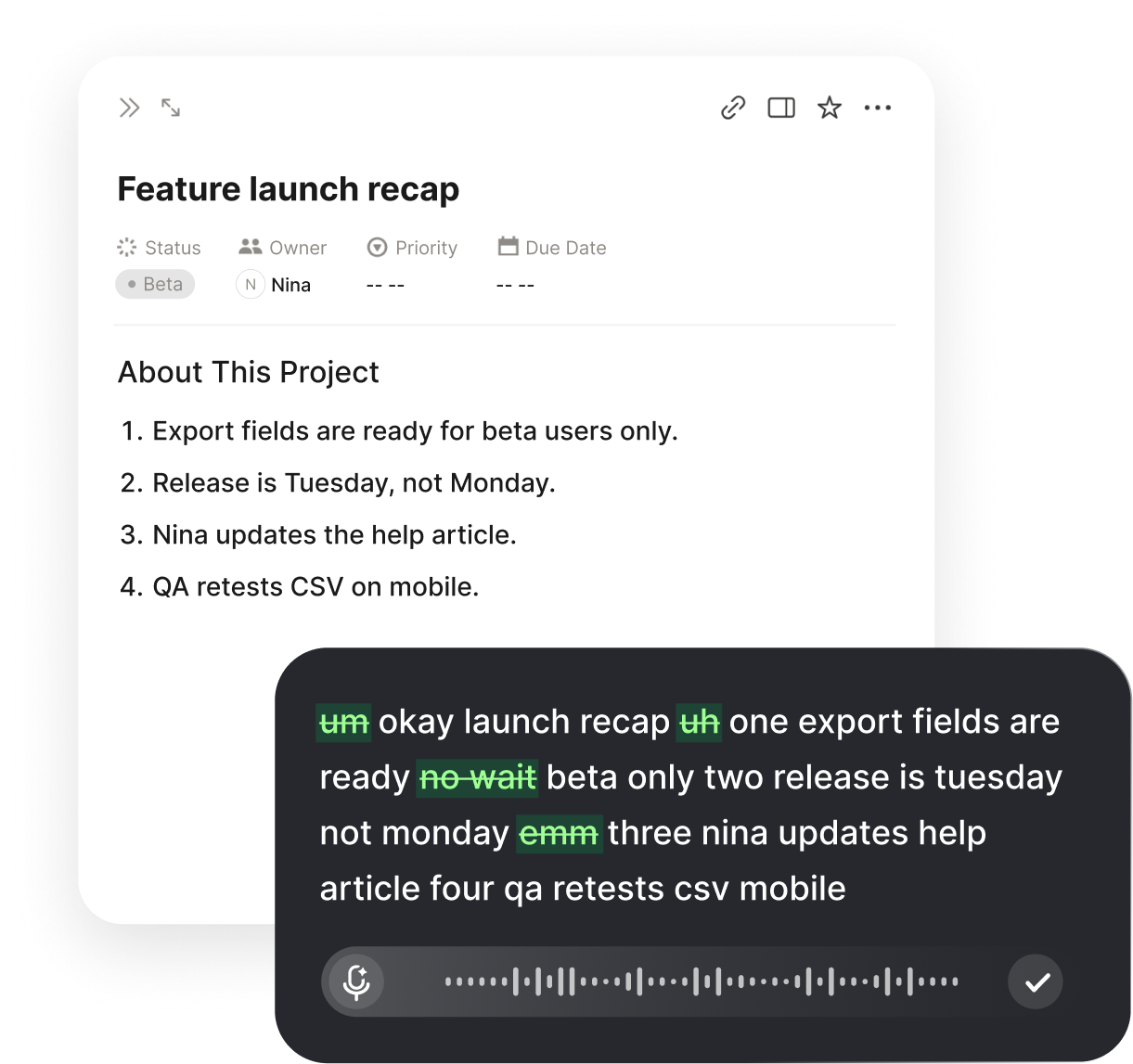
Turn the two lists into a small set of actions. Each action should name what will change, who owns it, and when it will be checked. Say the actions aloud and keep them to three or four. A retrospective with ten actions produces none, because nobody remembers them. Use Voiskey to dictate the actions at the insertion point in the notes, then read the polished list back for overlap. When the list is final, download the retrospective notes and share them with the team. If an action has no check, it is a hope, not an action, and the next review will not know whether it happened.
Write each action as a change to a prompt, a template, or a step, not as a wish to do better. For example, add a constraint line to the feature prompt template, or save one clean sample per import task. A specific action can be checked at the next review; a general intention cannot. Say how the team will know the action worked, and keep that check beside the action. Download the notes after the meeting so the actions survive the week. If a check needs a special setup, write the setup down, because an action nobody can verify will be quietly forgotten.
Assign the actions before the meeting ends. Name the owner, the date, and the place where the change will live. An action with no owner is a suggestion. Use Voiskey to add the owner and date beside each line, then read the list aloud one final time. If an owner is unsure what to do, rewrite the action until it is clear. Download the final notes and put them where the team already looks for project decisions. If an owner cannot attend, name a replacement before the meeting closes so the action still has a person behind it every day.
Close the retrospective with a short summary that the team can repeat. Say what worked, what did not, and the three actions you chose. Keep the summary to a paragraph. Ask one participant to read it back in their own words; if the summary changes in the retelling, rewrite it. Download the summary with the notes and attach both to the project record. A retrospective that ends with a clear summary is much more likely to change the next cycle. If the summary takes more than a paragraph, the review produced too many actions and needs another short cut today.
Run the Next Cycle Differently
Start the next cycle by rereading the actions, not the whole retrospective. Open the notes, read the three actions aloud, and check whether each one happened. For the ones that did, note the effect; for the ones that did not, ask why before adding a new action. Because Voiskey learns the project terms you repeat, the new notes stay consistent with the old ones. Download the updated notes at the start of the cycle so the actions are visible while the work happens. If an action was dropped, say why, so a future cycle does not reintroduce it as a new idea.
Run a short check halfway through the cycle. Say whether the actions are helping and whether a new pattern has appeared. A mid-cycle check catches a change that is not working while there is still time to adjust. Keep the check to fifteen minutes and focus on evidence from real tasks. Download the updated notes afterward. A retrospective that is only reviewed at the end of a cycle is a postmortem, not a tool for the current work. If the mid-cycle check finds nothing, keep it short and end early rather than turning it into a second review.
Compare this cycle with the last one using the same questions. Which prompts worked on the first try, which needed correction, and where time was lost. Say the answers side by side and look for movement. A small improvement in first-try results is a real result; a large claim without evidence is not. Download the comparison with the notes. Repeating the same questions each cycle is what makes the reviews comparable over time. If the comparison needs a number nobody collected, mark it as missing in the notes rather than estimating it roughly and loosely long after the fact.
Retire actions that no longer matter and replace them with the next most useful change. A retrospective process that keeps every old action becomes a checklist nobody reads. Say which action is finished, which continues, and which is dropped. Update the notes, download them, and share the short list with the team. A retrospective earns its place when each cycle leaves the team with fewer, sharper habits than the one before. If the team keeps the same three sharp habits for a year, that is success, not a reason to add more actions at the very next review meeting itself.
FAQ s
Speak each success and each failure as one sentence with an example at the insertion point in your notes. Voiskey removes filler so the two lists stay short and specific. Then dictate three actions with an owner and a date. A clean spoken record makes the next cycle easy to compare with this one.
Gather the tasks, the prompts that were used, the corrections that were needed, and the time each task took. Save the prompt logs and review notes in one place before the meeting. Speak the questions the review will answer and keep them fixed. Evidence from real tasks keeps the discussion tied to what happened.
Yes. The app learns the project terms and action names you repeat, so the new notes match the old ones. Say each action with an owner and a date, then read the list back for overlap. Keep three or four actions rather than ten. Consistent notes make it easy to see which actions actually happened.
Download the notes with the short summary and attach both to the project record. List what worked, what did not, and the three chosen actions with owners. Ask one participant to read the summary back in their own words. Send the same file to the team so everyone works from one version.


 Voiskey
Your voice, amplified.
Download Voiskey for Mac and Windows to capture a clear vibe coding retrospective and the actions that follow it.
Use it across macOS, Windows, iOS, and Android