
Studying Without Typing Every Word
Replace most study typing with spoken recall and edit the result into testable notes.
 Voiskey Team
Design a Study Session Around Recall
Studying Without Typing Every word begins with a decision about method rather than software: choose what you must be able to produce from memory before you open the chapter. Most students read, highlight, and copy, which produces a tidy page and very little recall. A better session has three passes. Read a short section once, close it, speak what you remember, then check the source and correct the gaps. The speaking pass is the one that does the work, and it is the pass that a voice typing app makes cheap enough to repeat. Repeat it until the pass takes less than ten minutes.
Set the size of a pass before you start. A chapter section of four to six pages is usually right; a whole chapter is too much to hold in mind and will push you back into copying. For each pass, write a one-line question at the top of the file, such as what problem does this model solve. Then read with that question in view. When you close the section, answer the question aloud before you say anything else. If you cannot answer it, you have found the real starting point for the next pass, and the session has already paid for itself.
Decide what stays on paper. Equations, diagrams, code, chemical structures, and music notation are faster and clearer by hand or on a keyboard than by voice. Keep a pen beside the laptop and use it without guilt. The method is not a ban on typing; it is a way to stop using typing for the tasks where it is slow. A good split gives the handwritten page to the symbols and gives the spoken file to explanation, comparison, and argument. Write that split down once so you stop renegotiating it every session. Put it at the top of the first page.
Build a small session kit and use the same one every time. You need the chapter or the lecture file, a blank note file with a question at the top, a timer, and a pen. Put the timer where you can see it and set it for twenty-five minutes. Turn off notifications and close every tab that is not the source. A session that starts with a hunt for materials has already lost ten minutes of recall time. The kit is boring on purpose, because boring removes the decisions that let a study block drift. Set it out the night before an early session.
Speak Your Way Through the Material
Speak as if a classmate were sitting across from you and had not done the reading. Explain the idea, give the example, and say why the example matters. This is harder than reciting a definition, and that difficulty is the point. When you hear yourself say something vague, stop and rephrase it, because vagueness in speech is usually vagueness in understanding. Speak in complete sentences rather than fragments, and let the app remove the filler and the false starts. The result reads like a first draft of an explanation, which is exactly what you want. Read it back once and cut the two vaguest sentences.
Work through examples, not just definitions. A definition spoken aloud tests whether you can repeat the textbook; an example tests whether you can use the idea. Say the example in steps, as if you were solving it on a board, and name the reason for each step. If the example requires a diagram, describe the diagram in words and sketch it on paper beside you. This double pass catches the gap between recognising a solution and producing one, which is the gap that exam questions are designed to find. Say the step you cannot justify, then mark it. One example per pass is enough at first.
Keep a gap log as you speak. When you cannot explain a step, say the gap out loud in a sentence such as I cannot explain why the second term disappears, then mark the line and keep going. Do not stop the session to reread. Stopping turns a recall pass into a reading pass, and the reading pass feels better than it works. At the end of the twenty-five minutes, review the marked lines and spend the remaining time on the two that matter most. A session with three honest gaps is more useful than one with a perfect summary.
Use speed as a drafting advantage rather than a thinking advantage. Voiskey handles up to 220 words per minute, about five times faster than typing, which means the mechanics of capture stop competing with the act of explaining. Your thinking is still the limit, so do not try to fill the speed with words. Pause when you need to, then continue. The aim is a spoken explanation you can edit into a page of notes, not a performance. When the draft is done, read it once and cut anything you would not say to a classmate. Then save the draft under the topic name.
Turn Speech into Cards, Outlines, and Answers
Turn each spoken explanation into cards while the words are still warm. A card has a question on one side and a short answer on the other. Take the question from the heading of your pass, and take the answer from the two clearest sentences you spoke. Keep the answer under thirty words; if it needs more, split it into two cards. Cards built from your own explanation are easier to answer later than cards copied from a deck, because you recognise your own phrasing. Build five cards per pass and stop; a small deck you review beats a large deck you avoid.
Build an outline by speaking a hierarchy rather than typing one. Say the topic, then the three main ideas, then the detail under each idea, using the same spoken markers every time: first, second, third, and under that. The app adapts formatting to the task, so a spoken hierarchy arrives as a list on the page. Check the outline against the source and fix the order if the chapter moved differently. The outline is not a summary; it is the skeleton you will hang details on during revision. Keep it to one screen. A hierarchy longer than that has stopped being an outline.
Practice exam answers by speaking them under time. Take a past question, set eight minutes, and speak a structured answer with a claim, two pieces of evidence, and a qualification. Do not stop to look anything up. When the timer ends, read the answer and mark where it drifted, where it repeated, and where it missed the question's verb. Then rewrite only the weak paragraph. This cycle trains the skill that exams actually test, which is producing a shaped answer under pressure rather than knowing facts in isolation. Mark the paragraph that lost the question's verb. Then speak the repaired paragraph once.
Close each week with one page per topic. The page should contain the outline, the five cards, the two gaps you closed, and one sentence about how the topic connects to the week before. Write the page by speaking the sections in order and editing lightly. One page per topic is enough to revise from, and it is small enough to reread in five minutes. Over a term, the pages form a course map that you built yourself, which is far more useful in the final week than a folder of lecture slides. Name each page after the topic, not the week.
Review With the Clock, Not the Page
Review by producing answers, not by rereading pages. Set five minutes on the clock, read only the question at the top of a topic page, and speak the answer from memory. When the timer ends, compare what you said with the page and mark the missing parts. This is uncomfortable, and that discomfort is the signal that recall is happening. Voiskey makes the cycle practical because you can speak a full answer at up to 220 words per minute and keep the spoken version beside the page, so the comparison takes a minute rather than ten. Keep both versions until the topic is scored complete.
Score each recall attempt simply: complete, partial, or missing. Record the score and the date at the bottom of the topic page. Then schedule the next attempt, sooner for missing topics and later for complete ones. A three-day gap works for most partial topics, and a week works for complete ones. Do not schedule everything for the same day; a review calendar with one topic per day is easier to keep than a weekend pile. The score is not a judgement of you, it is a routing decision for the next session. Write the next date beside the score before you close the page.
Use the clock for written exam practice too. Speak the answer while the timer runs, then edit the spoken draft into the shape the exam expects. Because the app adapts punctuation, formatting, tone, and word choice to what you are trying to do, the draft arrives closer to an answer than to a transcript. Keep the edit short: fix the structure, name the evidence, and remove the repetition. Then read the answer aloud once more and note the one sentence you would change first if you had another five minutes. File the answer with the topic it belongs to. Two timed answers a week is a sustainable pace.
Keep the tooling simple. One download covers the whole system, so the same shortcut works in your topic pages, your card file, and the document where you write practice answers. Start the app when you sit down to study and leave it running. At the end of each review, count how many topics you recalled and how many you skipped. If the skipped number is rising, the schedule is too ambitious, so cut it to three topics a day. Consistency with a small schedule beats an impressive plan that collapses in week three. Three topics a day for a fortnight beats ten topics once.
Keep the Habit Through a Full Term
Attach the habit to something you already do. If you always open your notes after a lecture, make the spoken summary the first thing you do in that file. If you always review on Sunday evening, make the first twenty minutes a recall session rather than a reread. A habit that needs a reminder will survive a busy week; a habit that needs motivation will not. Write the anchor in your calendar as a task with a start time, not as an intention. Then protect the first two weeks, because that is when the habit is most fragile. Miss one day and return the next, without negotiating.
Build the course vocabulary as you go. Every subject has terms that a general dictionary renders badly, and every department has preferred spellings. Say each new term once in a full sentence during a recall pass, and add it to a running list. The app learns names, jargon, acronyms, and spelling preferences from that use, so the list pays off twice: in cleaner text and in your own fluency. At midterm, read the list aloud, cross out what you can now define, and mark what still feels borrowed rather than understood. That mark is your reading list for the break.
Plan a minimum version for bad weeks. On a week with three deadlines, the full method will not fit, so define the smallest useful unit: one spoken summary per lecture and one five-minute recall per topic. Write that minimum on the same page as the full method. Having a fallback keeps a bad week from becoming a lost month, because the decision to do less is made in advance rather than in a moment of exhaustion. A minimum session still produces a file you can expand later, which is the whole point. Write the minimum in the same place as the full plan.
Close the term with a deliberate reset. Archive the topic pages, keep the vocabulary list, and write one page listing the ten questions you would answer first if the exam were tomorrow. If you move to a new laptop, download the current installer, sign in, and run a two-sentence test before the next term begins. Then repeat one recall pass on an old topic to confirm the method still works. A study system you can restart in ten minutes is one you will keep using, and keeping it is most of the benefit. Schedule the reset as a task, not a wish.
FAQ s
No. Voiskey is a voice typing app, so it replaces the typing step for explanations, summaries, and practice answers. Equations, diagrams, and code often stay faster by hand. The practical split is to speak the explanation and write the symbols. Voiskey places text at the insertion point in any field and removes filler words and false starts, so the spoken draft is usable after a light edit.
Active recall needs a cheap way to produce an answer and compare it with the source. Voiskey lets you speak the answer at up to 220 words per minute, about five times faster than typing, so a five-minute recall attempt yields a full draft. You then compare that draft with the page and mark what was missing, which is the step that actually strengthens memory.
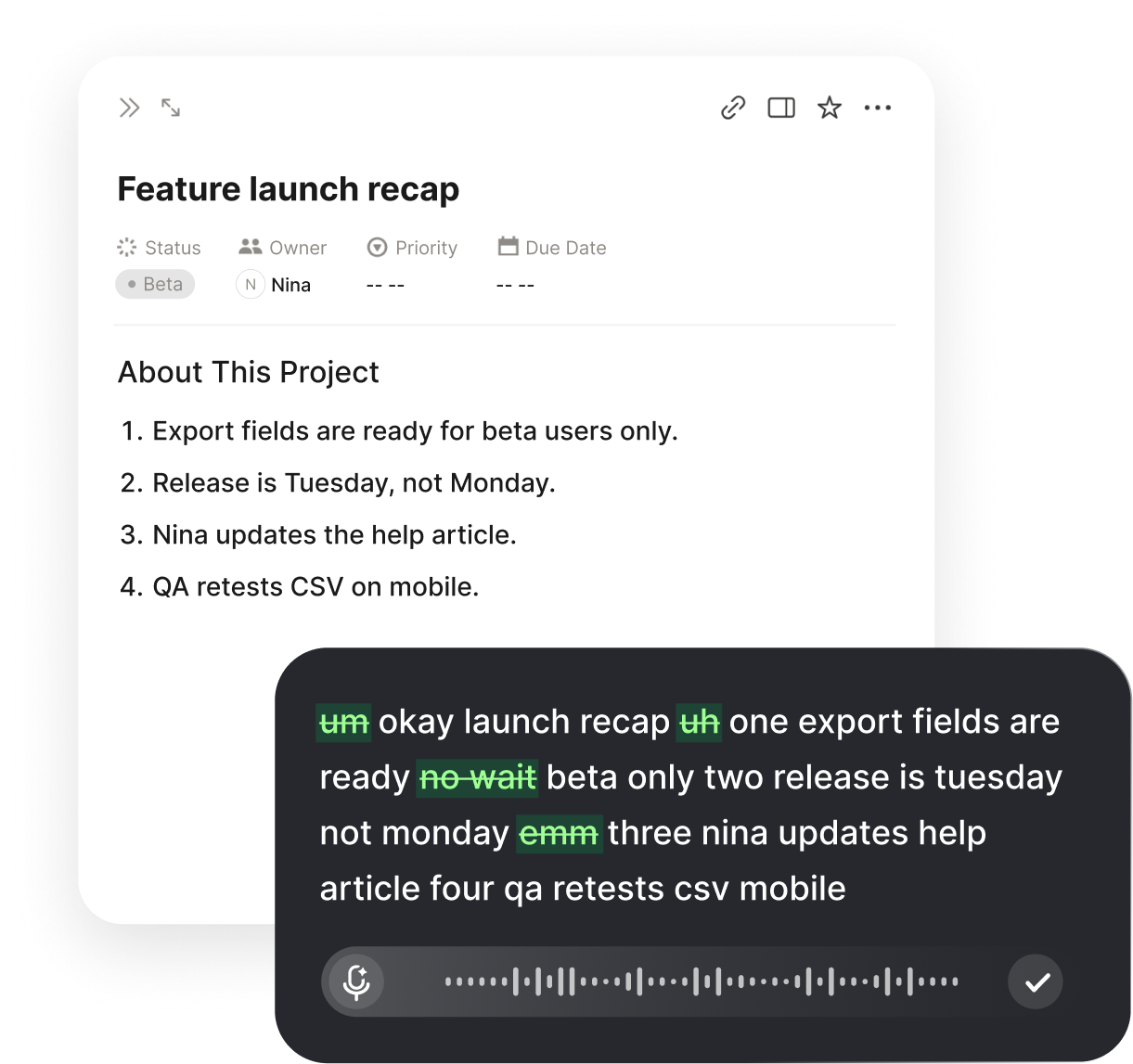
Yes. Voiskey supports up to 220 words per minute, and it removes filler words, stutters, false starts, self-corrections, and grammar slips as you speak. That means you can explain an idea at a natural teaching pace and still get readable text. It also adapts punctuation and formatting to the task, so a spoken list or a comparison arrives in a usable shape.
Use one page per topic with the same four parts: an outline, five question cards, the gaps you closed, and one link to the previous topic. Score each recall attempt as complete, partial, or missing, and schedule the next attempt from that score. Voiskey learns names, jargon, acronyms, and spelling preferences, so a course vocabulary built during these sessions keeps later notes cleaner.


 Voiskey
Your voice, amplified.
Download Voiskey for Mac and Windows and speak your study notes instead of typing them.
Use it across macOS, Windows, iOS, and Android