
Managing Study Sessions with Spoken Notes
Plan, capture, and review each study block by speaking your notes out loud
 Voiskey Team
Planning a Session You Can Speak Through
Managing Study Sessions with Spoken Notes starts before you sit down. Decide the single outcome of the block: a summary of one chapter, a worked example explained aloud, or a list of questions for a tutorial. Write that outcome at the top of the document where your notes will land. A session with a named outcome produces a usable recap; a session that begins with an open-ended reading task usually ends with scattered fragments. Give the block a fixed length, such as forty minutes, and split it into short cycles. The plan should be small enough that you can finish it in one sitting and honest enough that it reflects what you actually need to learn.
Choose the material before the session and put away everything else. Open the chapter, the problem set, or the slides you intend to work through, and close unrelated tabs that compete for attention. Spoken notes depend on a clear source, because you will be summarizing from memory and checking against the page. If the source is long, mark the three or four sections you will cover and leave the rest for later. A short, defined source keeps the recap focused and makes it possible to compare what you said with what the page actually contained. The boundary matters more than the total amount of reading.
Prepare the spoken opening. Say one sentence that states the topic and the question the session will answer, for example what this chapter claims and which evidence supports it. Then speak the vocabulary you expect to use: technical terms, names, and acronyms. This warm-up takes a minute and reduces the number of mid-sentence corrections later. Keep a short cue list beside you with the labels you will use during the session, such as key idea, example, confusion, and next step. The cue list is the spoken equivalent of a note template, and it keeps the recap consistent from one session to the next.
Define what done looks like in concrete terms. A finished session should leave three things: a spoken summary in your own words, a short list of unresolved questions, and one action for the next session. Write these three deliverables at the top of the document so you can check them at the end. If the session produces only a summary and no questions, you probably stayed inside familiar material and missed the hard part. If it produces questions but no summary, you may have read without consolidating. Both signals are useful, and both are easy to record once the deliverables are named in advance.
Running the Session Hands-Free
Run the session in cycles of study and speech. Read or work through a short section for ten to fifteen minutes with your hands free, then look away from the page and say what you just learned. The recap should be spoken without reading, because that is where retrieval happens. Keep the description short: one key idea, one example, and one thing that remains unclear. Then check the page briefly and correct anything you got wrong. Repeating this cycle three or four times gives you a complete recap of the material, a record of exactly where your understanding broke down during the block, and a clear starting point for the next cycle.
Use a small, consistent set of spoken labels to give the notes structure. Say key idea before the main claim, example before a specific case, confusion before something you could not follow, and next step before an action for later. The labels do the work that headings and bullet points normally do, and they make the transcript easy to scan afterward. When the material shifts from one idea to another, say the new heading aloud. Consistency matters more than clever phrasing; the labels are a tool for later review, not a performance. After two sessions the pattern becomes automatic, and the notes start to organize themselves.
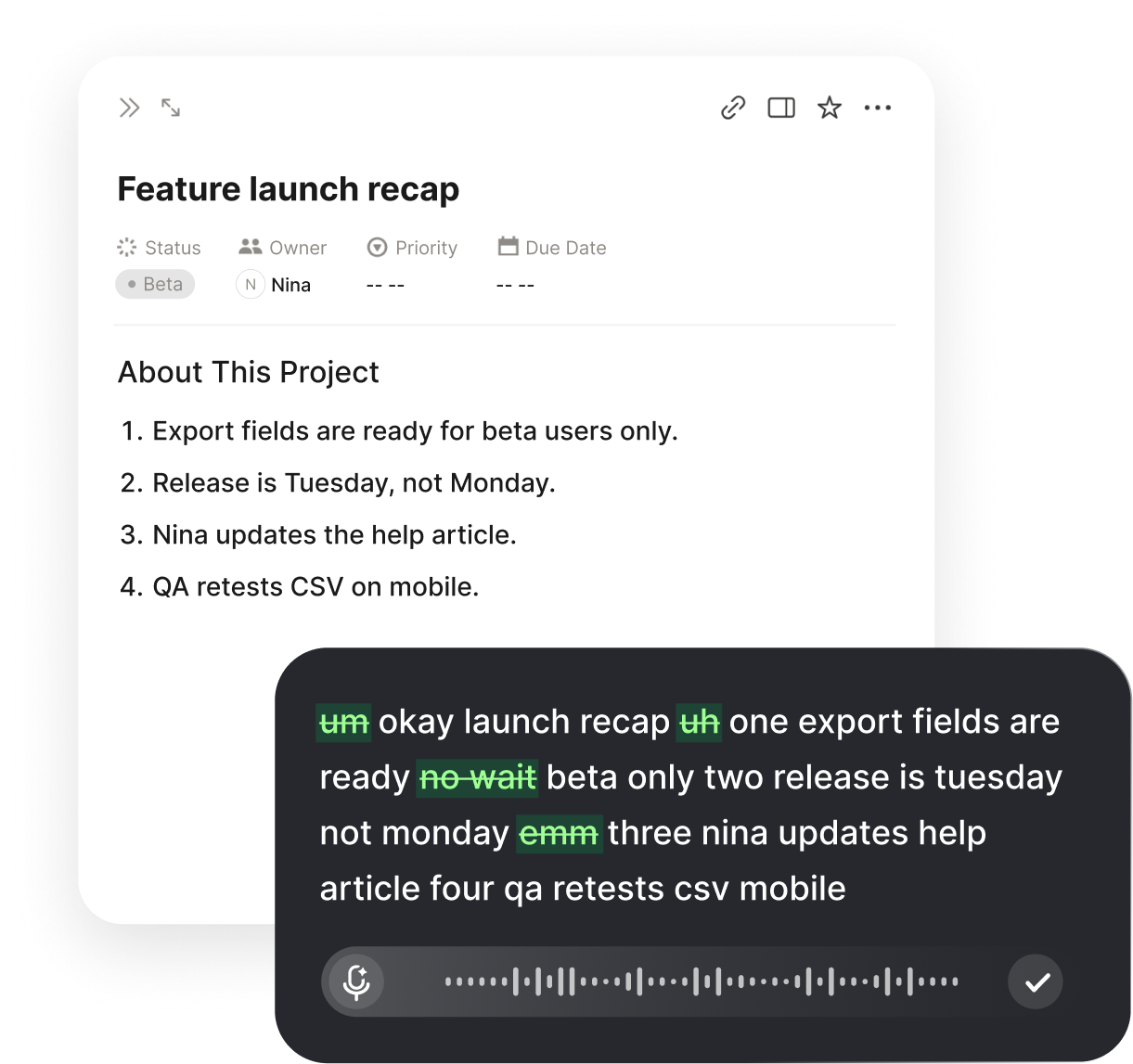
Keep your eyes on the material and your voice steady rather than perfect. Speaking notes is not presenting to a room, so pauses are fine and a flat tone is fine. What matters is that the words land in the document while the idea is still fresh. If you lose your place, stop, look at the page, and restart the sentence rather than filling the gap with noise. The app is designed to remove filler words and false starts, so you do not need to police every hesitation. Let the cleanup handle the mechanics while you concentrate on whether the summary is accurate and complete.
Know when to stop speaking and think. Some parts of a session need silent concentration, such as working a proof or tracing a line of code. Narrating those steps out loud can slow you down and produce cluttered notes. Use a simple rule: speak the setup and the result, stay silent through the manipulation, then say what the result means. For reading-heavy work, speak after each subsection rather than during it. This rhythm keeps the recap meaningful without turning the session into a running commentary. The goal is a clean record of what you understood, not a continuous broadcast of every passing thought.
Turning Speech into Review Material
The moment the session ends, read the spoken text once. You are not editing for style yet; you are checking whether the recap matches the source and whether the labels are in the right places. Fix names, numbers, and technical terms first, because those errors are the most damaging later. Then look for the confusion labels and make sure each one has a specific question attached. A vague note such as this part was hard is nearly useless two weeks later, while a note such as I could not follow how the second example supports the claim points directly to what you need to revisit.
Convert your own sentences into retrieval prompts. Take each key idea and rewrite it as a question you will answer without looking, then keep both the question and the spoken answer together. This turns a passive summary into active practice. Aim for five to eight prompts per session and keep them short. The best prompts come from places where your spoken recap was hesitant, because hesitation marks the edge of your understanding. Review the prompts at the start of the next session, before reading anything new, and note which ones you answer cleanly and which still need work. Rebuild the weakest prompts before the session ends.
Turn the recap into a one-page summary with a fixed shape. Put the main claim at the top, then the strongest example, then the questions that remain, then the action for next time. This shape is easy to rebuild by voice and easy to review quickly. Link the page to the session date and the source section so you can trace it back. A one-page summary is short enough to reread before an exam and specific enough to reveal gaps. If you cannot fill one of the four parts, that is a clear signal about what the next session must cover rather than a reason to write more prose or to reread the whole chapter.
Write the handoff for the next session while the material is fresh. State the single action you will take first, the section you will start with, and the question you most want answered. Keep it to two or three sentences and place it at the very top of the next document, so it is the first thing you see when you return. This handoff removes the cold start that wastes the opening ten minutes of many study blocks. Over time, the handoffs form a chain that shows how a course moved from one topic to the next, and that chain is often the most useful revision aid you have.
Keeping Notes Accurate Between Sessions
Accuracy between sessions depends on a short correction ritual. At the end of every block, scan the text for proper nouns, technical terms, and numbers, and fix the ones the cleanup could not know. Voiskey learns names, jargon, acronyms, and spelling preferences, so feed it the correct forms of the words your course uses repeatedly rather than correcting the same term every week. Keep a running list of these terms beside the note template and review it before the next session. A few minutes of correction now prevents a review session later where you cannot tell whether a wrong term was your mistake or a misheard one.
Use a version policy that survives a busy term. Name each document with the course code, the date, and the topic, and keep the latest version in a predictable folder. When you revise a recap, save it as a new version rather than overwriting the old one, and write one line at the top describing what changed. This sounds formal for personal notes, but it pays off when a summary from week three contradicts one from week eight. Being able to open both versions and see the sequence of your understanding is far more useful than a single ambiguous file. When you download Voiskey, set the document template up once so every session starts with the same structure.
Spot-check the parts that matter most. Read the numbers, formulas, and citations aloud against the source, because those are the details that silently drift. If a term appears in several sessions with different spellings, choose one and standardize the list. If a summary claims the source said something, verify the claim against the page rather than trusting memory. This check takes two minutes and protects the credibility of the whole note set. It also trains the habit of separating what the source said from what you concluded, which is the core skill of useful academic notes. Make this scan the last step of every block.
Keep an index that links the sessions together. A simple table with the date, topic, source section, and the file name is enough, and it can be updated by voice at the end of each block. The index lets you find a specific recap in seconds and shows which topics you have covered repeatedly without progress. Remove or merge notes that no longer serve a purpose, but keep anything that documents a question you still have not resolved. An index is not extra admin; it is the map that makes a term of spoken notes usable rather than a pile of unconnected documents.
Reviewing a Month of Study Sessions
Once a month, set aside one review block and read the summaries rather than the full notes. Start with the one-page pages and look for two patterns: topics that keep reappearing and topics that never produced a clear main claim. The first pattern suggests a concept you have not consolidated; the second suggests a source you have not really engaged with. Mark both. Then open one full recap from the weakest topic and check whether the handoff from that session was ever completed. Voiskey makes this review cheap because the summaries are already spoken into a consistent shape, so you can compare them side by side instead of rereading everything.
Compare what you planned with what actually happened. Look back at the outcome written at the top of each session and count how often you reached it. If most blocks fell short, the plans were too large, and you should cut them rather than adding more hours. If most were completed easily, raise the difficulty by choosing harder source sections or requiring a stronger example. This adjustment is the main reason to keep a written plan at all. Without the comparison, study sessions drift toward whatever feels comfortable, and the material that needs work quietly gets avoided for the whole term.
Prune and consolidate. Merge summaries that cover the same topic, delete duplicates, and keep a single current version with a date. Move resolved questions into a short list of what you now understand, and carry unresolved ones forward into the next month. A monthly consolidation stops the note set from growing without becoming more useful. It also gives you a realistic picture of coverage before an exam period begins, when there is no time to discover a missing topic. The goal is a lean, indexed set of summaries that answers the question what do I actually know about this course.
Make the next month easy to start. Choose three sessions for the coming week, name their outcomes, and place the handoff from this review at the top of the first one. Download Voiskey on the device you use most, keep the shortcut within reach, and let the monthly review become the point where you adjust the routine rather than abandon it. A review that ends with a concrete first session is far more likely to change behavior than one that ends with a general intention to study more. Schedule the next review before you close the document so the cycle continues.
FAQ s
You press a shortcut and speak, and text appears at the insertion point in the document you already have open. Voiskey removes filler words, stutters, and false starts, then adapts punctuation and formatting, so the recap you speak during a study block arrives as readable notes you can review later.
Voiskey learns names, jargon, acronyms, and spelling preferences, so the course terms you use repeatedly become more consistent over time. You can also keep a fixed spoken template, such as key idea, example, confusion, and next step, so each session recap follows the same shape and is easier to compare.
Yes. Voiskey works at the system level, so you press a shortcut, speak, and text appears at the insertion point in any app or text field. That means you can keep using your usual notes document instead of switching to a separate tool or copying text between apps.
Read the recap once and fix names, numbers, and technical terms, then turn your own sentences into retrieval questions and write a short handoff for the next session. Voiskey already removes filler words and false starts, so your attention can go to accuracy and to the gaps the recap reveals.


 Voiskey
Your voice, amplified.
Download Voiskey for Mac and Windows and give every study block a clean spoken recap.
Use it across macOS, Windows, iOS, and Android