
Study Group Recaps Without a Notetaker
Share the speaking load so every group session ends with a usable recap
 Voiskey Team
Why a Dedicated Notetaker Fails
Study Group Recaps Without a Notetaker work when the group treats the recap as a shared speaking job rather than one person's burden. The usual arrangement, where one member writes while everyone else discusses, fails for predictable reasons. The writer cannot think and write at the same time, so their contribution drops and the group loses a voice. The others forget that someone is transcribing and stop speaking clearly. By the end, the notes are one person's filtered version of the session, and the group cannot tell which decisions were actually agreed. Removing the dedicated writer and spreading the capture across the group fixes all three problems at once.
A single notetaker also creates a bottleneck after the session. That person has to clean up the notes, decide what matters, and send them on, usually from memory and usually late at night. If they are unwell or busy, the recap never appears. If they misheard a decision, the error propagates to everyone. Groups often respond by rotating the role, which helps but still leaves one person doing all the capture at any given moment. A better design distributes the capture during the session, so no single member has to reconstruct the whole conversation afterward. Distributing the work is the core idea.
The third problem is silent disagreement. When one person writes, the others do not see the record until it is finished, so a misunderstanding stays in the text and becomes the group's shared version of events. Speaking the record during the session exposes disagreements immediately. If two members describe a decision differently, the group can resolve it on the spot instead of discovering the conflict the night before a deadline. That real-time correction is the strongest argument for a spoken recap: it turns note-taking into a checking step rather than a private task. Spreading the capture solves the handoff problem.
Finally, a dedicated notetaker tends to record what was said rather than what was decided. Discussion is long and decisions are short, so a faithful transcript is mostly noise. A spoken recap forces compression, because each speaker has to state the outcome in a sentence or two. The result is a short record of decisions, owners, dates, and open questions, which is what a group actually needs. The recap is not a substitute for the discussion; it is the part of the discussion the group agrees to keep, and agreeing on it out loud is what makes it reliable. A short shared record is the goal.
Assigning Speaking Turns in the Group
Decide the speaking order at the start of the session. A simple rotation works: each member speaks the recap for the segment they led, then hands over to the next person. This connects the recap to the work rather than to a role, so whoever ran the problem set explains what the group concluded. Write the order at the top of the shared document, or say it aloud before starting, so nobody has to remember. A named order removes the awkward pause where everyone waits for someone else, and it makes the recap predictable enough that members prepare for it.
Give each turn a fixed shape. Ask every speaker to cover the same four items: what we worked on, what we decided, what remains open, and who does what next. Consistency is what allows the recap to be read quickly later, and it prevents one long turn from dominating the record. The shape also protects quieter members, because their turn has a defined scope and does not depend on them competing for airtime. Put the four items on screen or on a shared page during the session, so the speaker can glance at them while talking and the group can see whether anything was missed.
Keep the turns short and separate from discussion. A recap turn should take one or two minutes, and the group should not start debating during it. If a disagreement appears, note it as an open question and resolve it after the turn. This separation matters because a recap that turns into another discussion becomes long, repetitive, and hard to read. If a member needs more time, the group can return to that segment later. The discipline of short turns keeps the record tight and makes the end-of-session recap a review rather than a second meeting. Short turns keep the record readable.
Handle absent members deliberately. If someone is missing, the member who worked most closely with them speaks their part and marks the entry as second-hand. When the absent member returns, they read the recap and correct anything that was misrepresented. This keeps the record complete without pretending that a missing person's view was captured. Announce the arrangement at the start so expectations are clear, and keep the second-hand marker visible in the document. A recap that hides who was absent is less trustworthy than one that records the gap and the person who filled it. Recording the gap is part of the job.
Capturing Decisions and Open Questions
Separate decisions from discussion during the recap. A decision is a sentence the group agreed to act on, with an owner and a date. Everything else is context. Ask each speaker to say the decision in the form we agreed to, then the owner, then the date. If a decision has no owner, it is not a decision yet, and the recap should record it as an open question instead. This single rule prevents the most common failure of group notes, where the document is full of ideas but nobody knows who is doing what by when. One owner per decision is the rule.
Record open questions as questions, not as complaints. Phrase each one as a specific unknown that someone can answer, and name the person most likely to resolve it. A question such as how the second method handles missing values is useful; a note such as the second method is confusing is not. Put open questions in their own section so they are not buried among decisions, and carry them forward to the next session. A visible list of open questions gives the group a starting point and stops the same issue from being rediscovered and abandoned week after week. Specific questions are easier to close.
Capture the reasoning behind a decision in one line. Groups often remember what they chose and forget why, which leads to reopening the same debate later. A single line such as we chose the shorter method because the deadline is Friday preserves the tradeoff without reproducing the argument. Keep it brief and factual, and attribute it to the group rather than to one person. When a decision is revisited, this line is the first thing the group should read. If the reasoning no longer holds, the group can change the decision deliberately rather than by accident. Brevity keeps the reasoning usable.
End the capture with a read-back. Before anyone leaves, one member reads the decisions, owners, dates, and open questions aloud, and the group corrects anything wrong. This takes two or three minutes and catches misheard names, wrong dates, and decisions that were assumed rather than agreed. The read-back is also the moment to confirm that every action has one owner; shared ownership usually means no owner. A group that reads its recap aloud before leaving rarely discovers a contradiction later, because the contradiction had a chance to surface while everyone was still present. The read-back is the safety net.
Sending a Recap Everyone Can Use
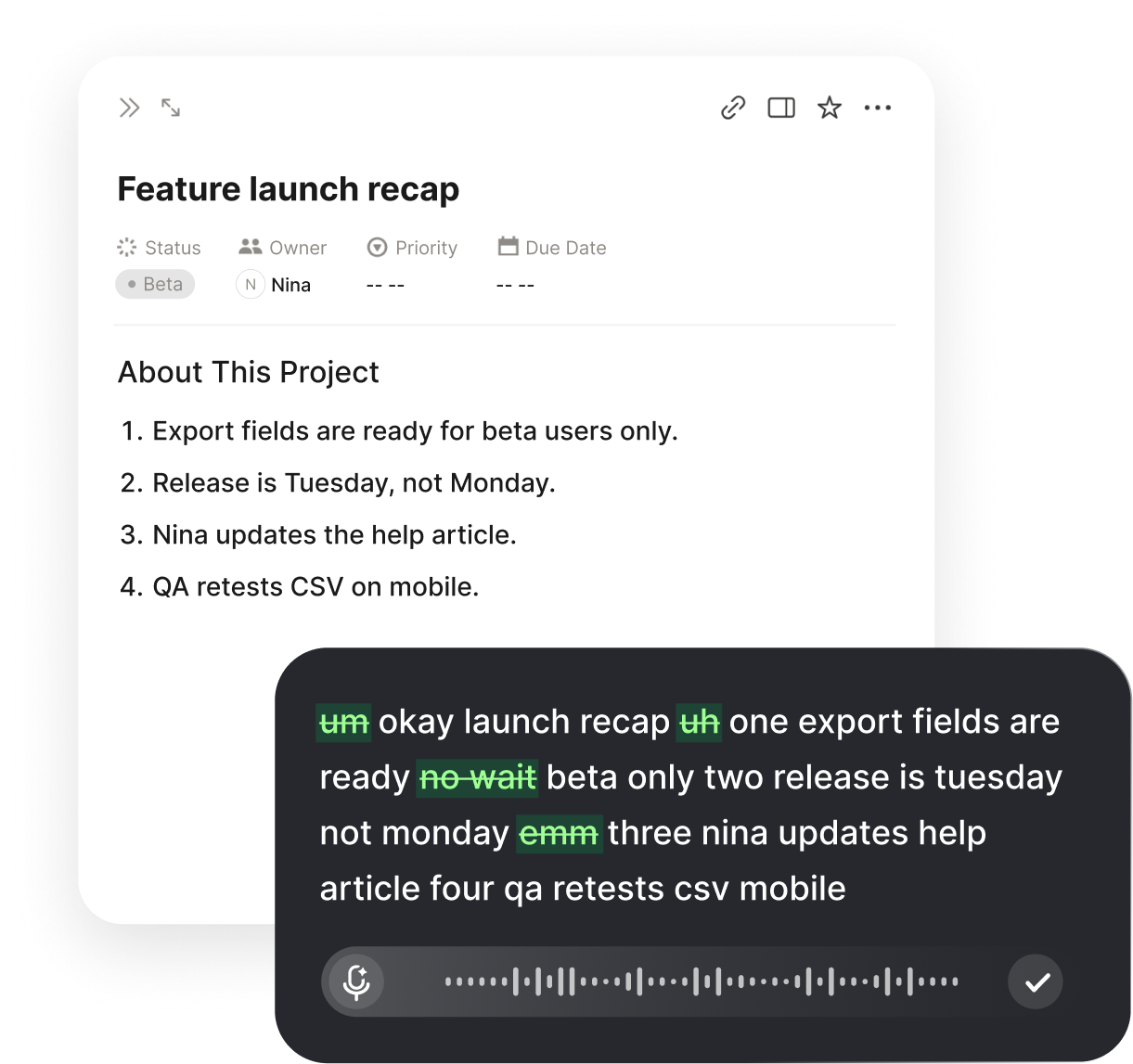
Voiskey makes the end-of-session recap fast because the text is already in the shared document. Each member presses a shortcut, speaks their turn, and text appears at the insertion point, so the recap is written as the session unfolds rather than reconstructed afterward. Voiskey removes filler words, stutters, and false starts, which keeps the document readable, and it adapts punctuation and formatting to what you are doing. The workflow is Speak-Polish-Type-Edit: speak the four items, polish the wording, type the names and dates, then edit against the read-back. No one carries the whole recap alone.
When you download Voiskey, agree on a single shared destination before the session starts. One document, one section per session, dated at the top, with the four-item shape used consistently. A shared destination prevents the common problem where the recap is split across messages, whiteboards, and personal notes. Keep the document open on each member's device, or project it if the group meets in person, so everyone can see the record forming. Visibility is what makes the real-time correction work; a recap that only the speaker can see is still a private record. A shared destination keeps everyone aligned.
Send the recap the same day, even if it is not polished. A short message that points to the document, names the decisions, and lists the open questions is enough. Include the date, the session topic, and the next meeting so the recap is self-contained when someone opens it a month later. Avoid rewriting the recap after the session; late edits are usually one person's interpretation and they undermine the shared record. If a correction is needed, add a dated note rather than silently changing the text. The group should be able to see what changed and why. Prompt sending beats late polishing.
Make the recap usable by people who were not there. Use full names instead of nicknames, spell out course terms, and state the context of each decision in one line. A member who missed the session should be able to read the recap and know what to do next without asking. This standard also helps the group at assessment time, when the recap becomes evidence of who contributed what. Download Voiskey and keep the shared document in the same place across sessions, so the term's recaps form a continuous record rather than a set of disconnected files. Full names help everyone follow the record.
Rotating the Recap Role Fairly
Rotate the role of session lead, but not the job of capturing the whole recap. The lead opens the meeting, states the four-item shape, calls the speaking order, and runs the read-back. The capture is still shared, because that is what makes the system resilient. Rotation matters because leading is a skill worth practicing and because a group that depends on one organizer is fragile. Put the rotation on a visible schedule, and give the lead a one-page checklist so a first-time leader can run the session without guessing. The checklist should fit on a single screen.
Keep a shared archive with a predictable structure. One document per term, one section per session, dated and titled, with decisions and open questions in fixed places. A predictable structure means the lead can find the previous recap in seconds and carry forward unresolved questions. It also means a new member can read the archive and understand how the group works without a long explanation. Review the structure at the end of each month and simplify anything that members consistently skip. A structure that is not used is worse than a simpler one that is. Rotation keeps the process from depending on one person.
Balance the speaking load across the term. If one member always speaks the methods section and another always speaks the conclusions, the recap reflects their strengths and misses their blind spots. Rotate the segments as well as the lead, so each member has to explain material they did not lead. This is uncomfortable at first and valuable afterward, because explaining someone else's work is one of the best ways to find gaps in your own understanding. Track the rotation lightly, perhaps in a line at the top of the archive, so the balance is visible rather than assumed. A simple structure survives a busy term.
Close each month with a short retrospective on the recap itself. Ask three questions: which recaps were actually used, which sections were always empty, and what one change would make the next month easier. Keep the answers to a few lines and apply one change at a time. A group that reviews its own process improves faster than one that only reviews the content. If the recap habit is slipping, reduce the shape to the two items that matter most, decisions and open questions, rather than abandoning the practice. The goal is a lightweight routine the group can sustain through a busy term.
FAQ s
Each member presses a shortcut, speaks their turn, and text appears at the insertion point in a shared document. Voiskey removes filler words, stutters, and false starts, so the recap is captured during the session and no single person has to reconstruct the whole discussion afterward.
Voiskey works at the system level and places text at the insertion point in the document you already use, so members can take turns speaking into the same record. Using a fixed four-item shape, such as what we worked on, what we decided, what remains open, and who does what next, keeps the result consistent.
Yes. Voiskey works in any app or text field, so you can dictate into the shared document your group already keeps open. There is no separate tool to maintain and no copying between apps, which makes it easier for members to take turns capturing the recap.
Read the decisions, owners, dates, and open questions aloud and let the group correct anything wrong. Confirm that every action has one owner, that names are spelled correctly, and that the recap is understandable to a member who missed the session.


 Voiskey
Your voice, amplified.
Download Voiskey for Mac and Windows and give every group session a shared recap.
Use it across macOS, Windows, iOS, and Android