
Voice Typing for Students with Learning Differences
Build a study routine that turns spoken ideas into usable notes.
 Voiskey Team
Design a Study Setup That Lowers Friction
Voice Typing for Students works best when the first step is almost effortless. Decide where you will work, which document you will open, and which shortcut you will press before you sit down. Create a single starting document with the course name and today's date already filled in. Keep it in a place you can reach in two clicks. If a setup requires five decisions before the first sentence, it will not survive a tired evening. The goal is to remove every avoidable obstacle between an idea and a written sentence, so attention goes to the work rather than the tools.
Notice where writing slows you down and route around it. Some students lose ideas while forming letters, others while organizing paragraphs, and others while rereading their own drafts. Use speech for the part that creates the bottleneck and typing for the part that does not. If handwriting is slow, speak the note and type only the headings. If organization is hard, speak freely first and structure later. The point is not to use one method for everything but to choose the method that keeps the thinking moving. Write down which parts you will speak and which you will type. Write the choice down so it is not a new decision every day.
Set up the physical environment for long, low-stress sessions. Use a comfortable seat, a stable surface, and a device position that does not require holding it in the air. Keep water and any needed materials within reach. Reduce visual clutter on the desk and on the screen. If background sound distracts you, use headphones or move to a quieter corner. Test the shortcut once before starting so a technical problem does not become a reason to stop. A calm environment is not a luxury; it is part of making the session repeatable on a difficult day. Keep the setup simple enough to rebuild in a few minutes.
Plan the session length around your attention rather than an ideal. A short block of twenty-five minutes with a five-minute break is easier to repeat than an ambitious two-hour plan that collapses after the first interruption. Write the start and end time on a sticky note and stop when the block ends, even if you feel productive. Save the file and note the next step in one line. Over a week, several short sessions produce more than one long session followed by exhaustion. Consistency matters more than intensity for a routine you need across a whole term.
Turn Spoken Ideas into Structured Notes
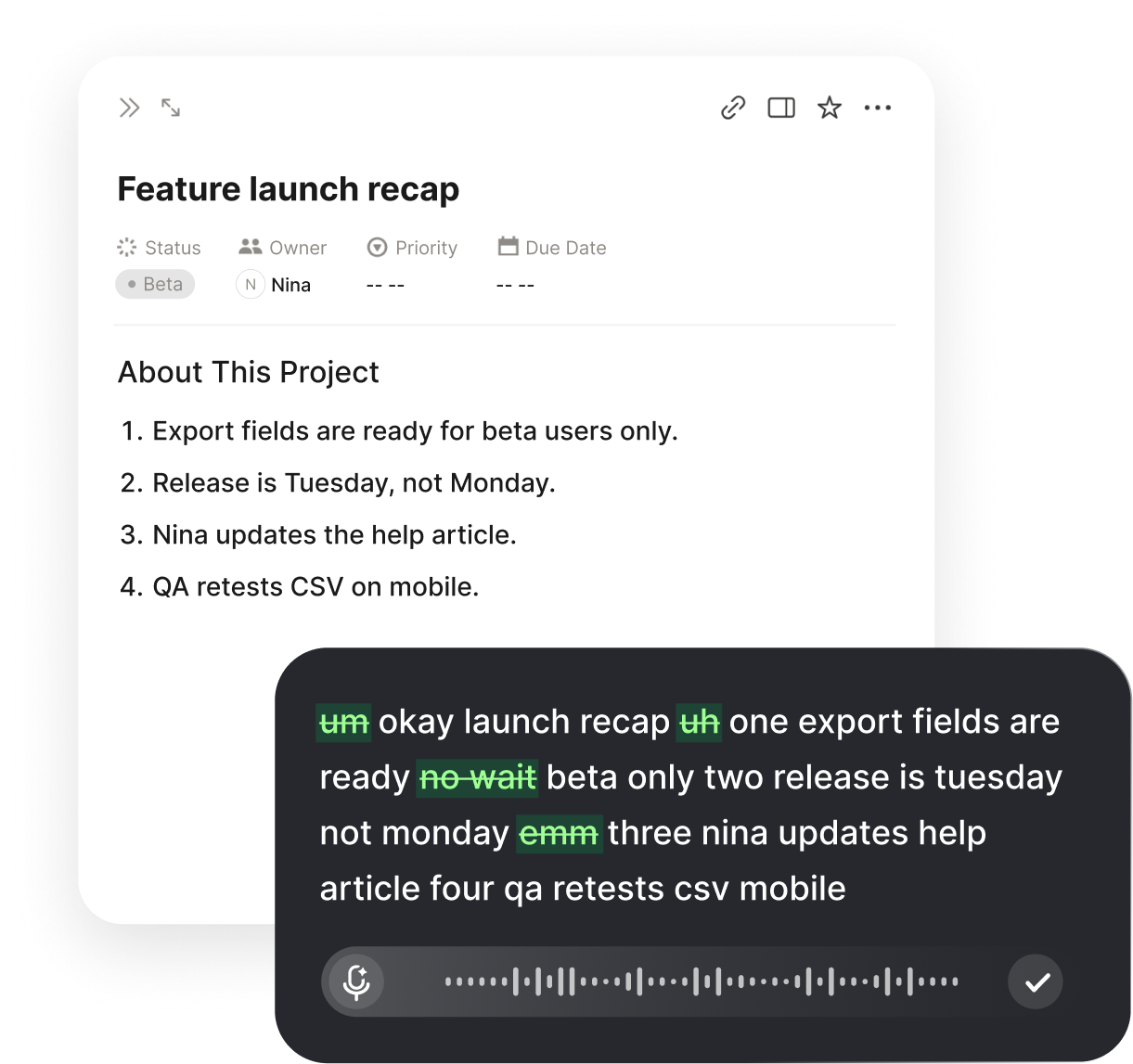
Separate the thinking pass from the organizing pass. In the first pass, speak everything you know about the topic without stopping or sorting. Let the sentences be uneven; the app removes filler, stutters, false starts, and self-corrections, so the transcript is cleaner than the spoken performance. Do not open a template or format anything yet. When the pass ends, read the transcript and mark the ideas that belong together. Only then choose headings and move the text into order. Trying to think and organize at the same time is what makes note-taking feel impossibly slow. The separation is the habit that makes the rest work.
Use a small set of headings that answer common study questions. For a lecture, try main idea, supporting points, terms, examples, and questions. For a reading, try argument, evidence, response, and connection. For a problem set, try given, method, steps, check, and error. Keep the same headings across a course so the notes feel familiar. Speak the heading, pause, then speak the content beneath it. Headings give the transcript a visible skeleton and make it easier to review, search, and compare with a classmate's notes. A familiar structure also makes it easier to notice when something important is clearly missing.
Chunk long ideas into short paragraphs. One idea per paragraph is easier to read and easier to revise than a dense block. If a spoken paragraph runs past six sentences, start a new heading and continue. Use a spoken marker such as next idea to create a boundary, then add the heading in the organizing pass. Keep sentences short and put the subject near the beginning. When a sentence becomes tangled, say it again in simpler language rather than trying to repair it word by word. Clear structure reduces the amount of rereading later. Short paragraphs are also easier to move when the structure changes.
Add a short review layer at the end of each note. Write three questions the note should let you answer, then check whether it does. Mark any term you cannot define and any claim you cannot explain. Add one sentence about how this topic connects to the previous one. This layer takes five minutes and turns a transcript into a study tool. If a note has no review layer, it is a record of what was said, not a record of what you learned. The difference matters when an exam asks you to apply an idea rather than repeat it.
Draft Assignments with Voiskey
Start assignments with a spoken plan rather than a blank page. Say the question in your own words, then list the three or four points you want to make. Capture the plan in a short file and read it back. If the plan is unclear, the essay will be unclear too. Choose the order of the points and write one sentence under each. This planning pass takes ten minutes and gives you a map to follow when the drafting gets difficult. A map reduces the chance of losing the thread halfway through a paragraph. Keep the plan visible while you draft the first version.
Draft the assignment in one spoken pass, then edit. Open the document, place the cursor under the plan, and speak each section without stopping to correct. Voiskey places the text at the insertion point, removes filler and false starts, and adapts punctuation, formatting, tone, and word choice to what you are trying to do. If you lose your place, say the next point from the plan and continue. The first draft does not need to be good; it needs to exist. Editing a complete draft is far easier than building one sentence at a time. Read the draft once before editing so you can see the whole shape.
Use structure to support your ideas. Give each paragraph one claim, one piece of evidence, and one explanation. Speak the claim first so the paragraph has a direction. If a paragraph has two claims, split it. Add a short introduction that states the question and your answer, and a conclusion that explains why the answer matters. Keep transitions simple and explicit. After drafting, read the first sentence of each paragraph in sequence; they should form a summary of the argument. If they do not, revise the structure before polishing the language. One clear claim and one example per paragraph is usually enough.
Finish with a proofreading routine that fits your strengths. Read the draft aloud and mark every place where you stumble, then fix those sentences. Check the assignment requirements one by one, including length, format, and citation style. Use a checklist rather than memory. If spelling is difficult, run a separate pass for commonly confused terms and names. Ask a classmate or course support staff to read for clarity, not to rewrite the work. Submit a version you can explain in conversation, because understanding the argument matters more than a flawless surface. Keep the checklist with the assignment so the next one starts faster.
Review Progress and Adjust the Routine
Review the routine every week rather than waiting for a crisis. Ask three questions: which session went well, which task took longer than expected, and what got in the way. Write the answers in a short log. If a problem repeats, change one part of the setup, such as the time of day, the session length, or the template. Do not change everything at once. A weekly review turns vague frustration into a specific adjustment and helps you notice progress that is easy to overlook during a busy term. A written log also helps you explain the routine to an instructor.
Track the conditions that help you focus. Note the time of day, the place, the length of the session, and the type of task. Patterns will emerge after two or three weeks. Schedule difficult drafting when your attention is strongest and reserve easier tasks for lower-energy periods. Build in breaks before you need them. If a session ends in frustration, write one sentence about what you would change next time. This record is more useful than a general resolution to work harder, because it points to a concrete change. Review the log before planning the next week so the pattern is fresh.
Prepare the tools you rely on before the next term starts. Download Voiskey, install it for your operating system, and test the shortcut in the document you use for notes and drafts. If you qualify for the student offer, sign in with a school email and enter the code sent to that email. Create your templates and place them where you can reach them quickly. Test the setup on a low-stakes task so the first real assignment is not also the first test of the tools. Familiar tools reduce the effort of starting. Keep a short checklist beside the device for the first week.
Review the routine at the end of the term and keep what worked. Write a one-page summary of the habits that helped, the ones that did not, and the changes you want to try next time. Share the relevant parts with instructors or course support staff when you need adjustments, and ask for specific help rather than a general extension. A routine built around your actual attention and energy is more sustainable than one copied from someone else. The aim is not to work like everyone else but to make your own work possible. Revisit the summary when the term gets busy and adjust one habit at a time.
FAQ s
Speak the note while the idea is fresh and let the text appear at the insertion point in your document. Voiskey removes filler, stutters, and false starts and adapts punctuation, so you can keep thinking without forming every letter by hand. Type only the headings if that part still helps.
Voiskey turns speech into text, and you choose the structure. Use a small set of headings, speak one idea under each, and separate the thinking pass from the organizing pass. Voiskey removes filler and grammar slips, which makes the draft easier to review and rearrange into a usable note.
Voiskey supports real-time readable text for deaf communication: a hearing speaker talks and the words appear as readable text for a deaf reader. Agree on seating, text size, and a one-speaker-at-a-time rule before the session, then capture questions and answers in a shared note the group can review.
Keep one starting document, test the shortcut before each session, and work in short blocks with planned breaks. Separate speaking from organizing, add a five-minute review layer, and check the setup weekly. Change one element at a time so you can tell whether it helped.


 Voiskey
Your voice, amplified.
Download Voiskey for Mac and Windows and speak your next draft into place.
Use it across macOS, Windows, iOS, and Android