
A Student's Weekly Review Routine with Voice
Speak the week back to yourself and leave with a plan you can follow
 Voiskey Team
Why a Weekly Review Needs a Script
A Student's Weekly Review routine with voice works best as a fixed appointment with a fixed script. Without a script, the review becomes a vague hour of rereading and worrying, and it rarely ends with a plan. With a script, it becomes a short, repeatable procedure that produces the same four outputs every week: what you finished, what you did not, what you learned, and what next week must cover. The script is not a constraint on thinking; it is what makes thinking possible, because you do not spend the first twenty minutes deciding what to review. Write the four questions down once and reuse them every week.
The review is valuable because a week is the smallest unit that shows a pattern. A single day is too noisy to reveal whether a study method is working, and a month is too long to correct a mistake before it matters. A weekly rhythm catches a slipping course while there is still time to change the plan. It also spaces the review close enough to the work that you can still remember what actually happened, rather than reconstructing it from deadlines. The point is not to judge the week but to convert it into decisions for the next one, and a script keeps that conversion from turning into self-criticism.
A script also protects the review from becoming another screen session. When the questions are fixed and the answers are spoken, you can run the whole routine in a short block without opening a dozen documents. That matters for students trying to spend less time at a keyboard and more time thinking. Speaking the answers forces you to summarize rather than copy, and summarizing is the part of a review that changes behavior. A typed review often becomes a list of open tabs; a spoken review becomes a short set of sentences you can act on. The same questions make the review fast.
Finally, a script makes the review comparable across weeks. If you answer the same four questions every week, you can see whether a problem is new or recurring, and whether a change you made actually helped. That comparison is impossible when each review has a different shape. Keep the four questions visible at the top of the document, and date every entry. Over a term, the sequence of reviews becomes a record of how you studied, not just what you studied. That record is useful when you plan the next term, and it is more honest than memory. That sequence is worth more than a single good week.
Speaking the Week Back to Yourself
Start the review by speaking the week back in order. Begin with Monday and move through the days, saying what you worked on, what you completed, and where you got stuck. Do not edit while you speak; the goal is to get the week onto the page before you judge it. Most students find that the act of narrating the week reveals patterns they did not notice while living it, such as the same course slipping every Thursday or the same task being postponed three times. The narration should take five to eight minutes, and it should be concrete: name the chapters, the problem sets, and the meetings, not just the feelings.
Move from events to evidence. After the chronological pass, speak what you can actually show for the week: the notes you produced, the problems you solved, the draft sections you completed, the questions you can now answer. This step separates activity from progress, which is the most common confusion in a busy term. A week full of reading that produced no notes may have been useful or may have been scattered; the evidence tells you which. Speak the evidence plainly, and do not inflate it. The review is private, so honesty costs nothing and pays back immediately in better planning.
Then speak what did not get done and why. Be specific about the cause: the task was too large, the instructions were unclear, the time was taken by something else, or you avoided it. Each cause points to a different fix. A task that was too large needs splitting; unclear instructions need a question to the tutor; lost time needs a calendar change; avoidance needs a smaller first step. Naming the cause is what turns a list of failures into a set of adjustments. Without that step, the same unfinished tasks reappear next week with the same explanation and the same result.
Finish the speaking pass with what you learned about how you study. This is not the subject matter; it is the method. Maybe mornings worked better than evenings, maybe speaking drafts was faster than typing them, maybe the group session was useful only when someone set an agenda. Speak one or two observations and keep them short. These observations are the raw material for the next section, where the week's experience becomes next week's plan. A review that stops before this step records what happened but does not change what will happen, which is the difference between a diary and a working routine.
Turning the Recap into Next Week's Plan
Convert the recap into a small number of commitments. Choose no more than three priorities for the coming week, and write each one as a specific outcome rather than an activity. Study more chemistry is an activity; finish the problem set on reaction rates and write two pages of notes is an outcome. Three outcomes are enough because they force a real choice about what matters. If everything is a priority, the plan collapses into a long list that you abandon by Wednesday. Speak the three outcomes, then read them back and ask whether you would be satisfied if only those three were completed.
Attach each commitment to a time and a place. A plan without a slot is a wish, so name the day, the block, and the location for each priority. Check the calendar before committing, and move things rather than adding them. This is where the review's honest record pays off: if Thursday evenings never work, stop scheduling difficult tasks there. Put the three commitments at the top of the next week's plan and keep them visible. A short plan with real slots beats an ambitious plan with none, because the short plan is the one you can actually follow when the week gets busy.
Carry forward the open questions deliberately. Review the questions from the previous week and decide for each one whether to answer it, park it, or drop it. Answering means scheduling a specific block; parking means writing the date when you will revisit it; dropping means writing why it no longer matters. Unmanaged questions accumulate and create a background anxiety that makes it harder to start work. A short, explicit decision on each question clears that background noise and keeps the plan focused on the three priorities. The question list should shrink or move every week, not grow forever. Real slots beat ambitious intentions.
End the planning step by speaking one sentence about the week ahead. Something like next week is about finishing the methods section and getting the statistics questions answered prepares you for the first work block. This sentence is easy to say and surprisingly effective, because it gives the week a theme that the three commitments share. Keep it at the top of the plan and read it at the start of the next review. If the theme and the commitments do not match, one of them is wrong, and it is better to notice that during planning than halfway through the week.
Keeping the Routine Short and Repeatable
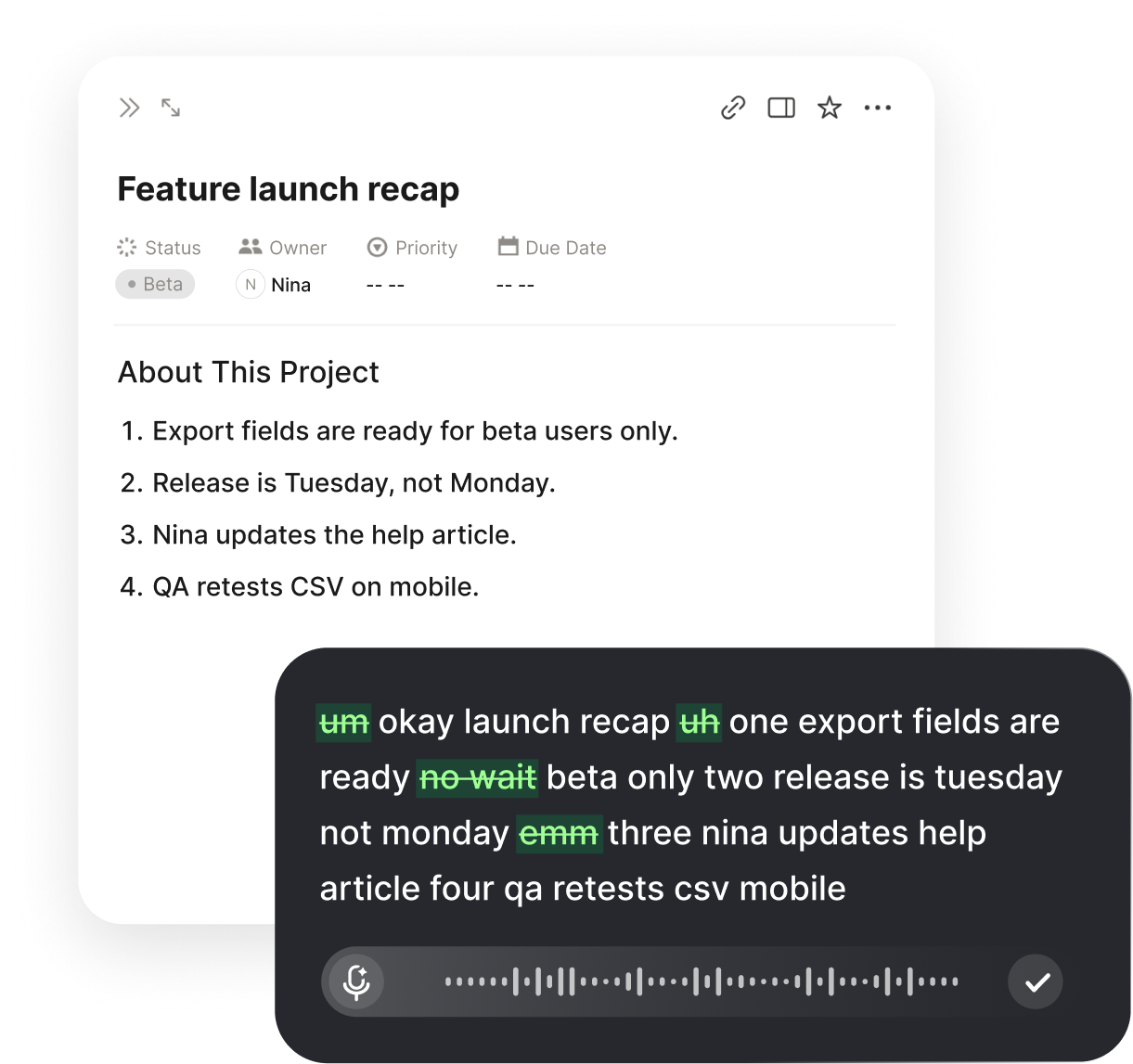
A review routine survives only if it stays short. Aim for twenty to thirty minutes, including the speaking pass and the planning step, and protect that time on the calendar. Voiskey helps because you press a shortcut, speak the answers, and text appears at the insertion point in the review document, so the routine does not turn into a typing project. Voiskey removes filler words, stutters, and false starts and adapts punctuation and formatting, which keeps the spoken review readable. The workflow is Speak-Polish-Type-Edit: speak the four answers, polish the wording, type the dates and numbers, then edit the plan. A short spoken review is far more likely to happen every week than a long written one.
When you download Voiskey, build one review document with a fixed template. Put the four questions at the top, then a dated section for each week. Keep the previous three weeks visible so you can compare them without opening old files. Speak into the current section only, and do not reorganize the template mid-review. A stable structure is what makes a short routine possible, because you never have to decide where anything goes. It also makes the review scannable later, when you want to see whether a change in method produced a change in results. Short routines are the ones that survive.
Choose a time that you can actually keep. The end of the week is popular but often crowded, and a review that keeps getting moved is a review that stops happening. Pick a time when you are alert but not in the middle of a deadline, such as Friday afternoon or Sunday morning. Put it on the calendar as a recurring appointment, and treat a missed review as information about the schedule rather than a personal failure. If the chosen time fails twice, move it. The routine should adapt to your week, not the other way around. A stable template removes daily decisions.
Protect the routine by lowering the bar on bad weeks. On a heavy week, do a five-minute version: three sentences on what happened and one commitment for next week. The shortened review keeps the habit alive and still produces something useful. Download Voiskey and keep the review document and the shortcut easy to reach, so starting the short version takes seconds. The goal is a routine that spans a term, and a term is long enough that some weeks will be bad. A flexible routine survives those weeks; a rigid one does not. A movable slot is better than a broken streak.
Adapting the Review Across a Semester
The review should grow with the term rather than stay identical. In the first weeks, focus on building the habit and learning what a normal week looks like. In the middle of the term, focus on catching courses that are slipping and balancing the load across subjects. Near the end, focus on converting the review record into revision priorities. Keep the four questions stable but change what you emphasize in the plan. This progression keeps the routine useful instead of turning it into a ritual you perform without thinking. Voiskey makes the change easy because you can speak a new emphasis into the existing template without rebuilding it.
Use the accumulated reviews to spot long trends. After four or five weeks, read the dated sections in order and look for recurring problems, such as a course that always gets pushed to the end of the week or a task that reappears in every plan. A recurring problem is a design problem, not a discipline problem, and it needs a structural fix rather than more effort. Change the schedule, split the task, or ask for help. The review record gives you the evidence to make that decision, and it prevents you from treating every difficult week as a new and mysterious failure. Lasting fixes are structural.
Adapt the questions when the term changes. A question about lab sessions may matter in one module and not another; a question about group work may matter only during a project. Keep the core four and add at most one context question at a time. Too many questions make the review long and the answers shallow. Retire a question when it stops producing decisions. Download Voiskey and store the current question set at the top of the document, so the version you are using is visible and you can see when it changed. Fix the structure, not your willpower. Keep the set small.
Close each month with a short retrospective on the review itself. Ask whether the routine happened, whether it produced decisions, and what one change would make the next month easier. Apply one change and keep the rest stable. This meta-review is the difference between a routine that lasts a semester and one that fades after a month. If the routine is working, resist the urge to redesign it; consistency is the source of its value. If it is not working, change one element and test it for a month before changing another. Consistency is what makes the routine worth keeping.
FAQ s
You press a shortcut and speak the answers to your review questions, and text appears at the insertion point in your review document. Voiskey removes filler words, stutters, and false starts, so the spoken recap is readable and the planning step starts from a clean draft.
Voiskey learns names, jargon, acronyms, and spelling preferences, so course and project names stay consistent as you reuse them. Keeping a fixed template with the same questions each week also makes the dated sections easy to compare when you look for recurring problems.
Yes. Voiskey works at the system level, so you press a shortcut and speak, and text appears at the insertion point in any app or text field. You can run the review in the document you already use without switching tools or copying the recap between files.
Turn the recap into no more than three commitments, give each one a day and a time on the calendar, and decide whether each open question should be answered, parked, or dropped. Keep the plan short enough to follow when the next week gets busy.


 Voiskey
Your voice, amplified.
Download Voiskey for Mac and Windows and make the weekly review a spoken habit.
Use it across macOS, Windows, iOS, and Android