
Building Reusable Legal Language with Voice
Turn repeated clauses and standard wording into a tested, shared language bank.
 Voiskey Team
Auditing the Language You Repeat
Building Reusable Legal Language with voice starts with finding the sentences you already write by hand. Pull ten recent documents from the same practice area and highlight every clause, recital, and closing that appears more than once with only small changes. Group the highlights by function: engagement terms, factual recitals, standard warranties, procedural steps, and signature blocks. Note which phrases vary by client, by matter, or by counterparty, because those variations must stay editable. Write a short inventory with three columns: the phrase, where it appears, and what changes between uses. This inventory becomes the raw material for a spoken library, and it prevents you from recording language that sounds reusable but is actually tied to one matter.
Count before you commit. A phrase that appears twice is a convenience; a phrase that appears twenty times is an asset. Rank the inventory by frequency and by the time it takes to retype, then start with the top handful rather than the most impressive clause. For each candidate, read the version in your files aloud once and notice where you stumble; a phrase you cannot say smoothly is a poor first choice. Ask a colleague in the same practice area to review the shortlist and mark anything that is jurisdiction-specific or deprecated. The audit ends with a ranked, reviewed list that fits on one page, which is a far better foundation than a folder of half-remembered templates.
Decide the level of granularity. Some teams store whole paragraphs, others store sentences, and a few store only the connective language that holds a document together. Whole paragraphs save more time but need more editing when facts change; sentences flex more but require assembly. A practical middle path is to keep a small set of complete blocks for routine documents and a larger set of sentence-level phrases for bespoke work. Write down which level you will use for each document type and who may change it. Without that decision, the library drifts into a mixture of overlapping versions, and nobody can tell which entry is current when a deadline is close.
Finish the audit with owners and rules. Name the person who approves new entries, the person who retires old ones, and the review interval. Record the source file for every phrase so a later reader can see how it was used in practice. Agree on a naming pattern that puts the document type first and the function second, which makes entries sort sensibly in a plain list. Keep the inventory in the same place the team already stores precedents, not in a personal folder. The deliverable is a one-page ranked list, a granularity decision, and named owners; with those in place, the spoken library has a purpose before the first clause is ever dictated.
Capturing Clauses by Speaking Them
Record phrases in the order you would draft, not in alphabetical order. Open a fresh file, state the document type and the phrase name, then speak the language at a steady pace. Read from an approved precedent rather than from memory, because memory quietly modernizes wording. When a phrase contains variables, speak a placeholder clearly, such as bracketed client name, and keep the same placeholder every time. After each phrase, add one line describing when to use it and one line describing when not to. This habit turns a recording into a usable entry rather than a paragraph with no context that someone will misapply six months later.
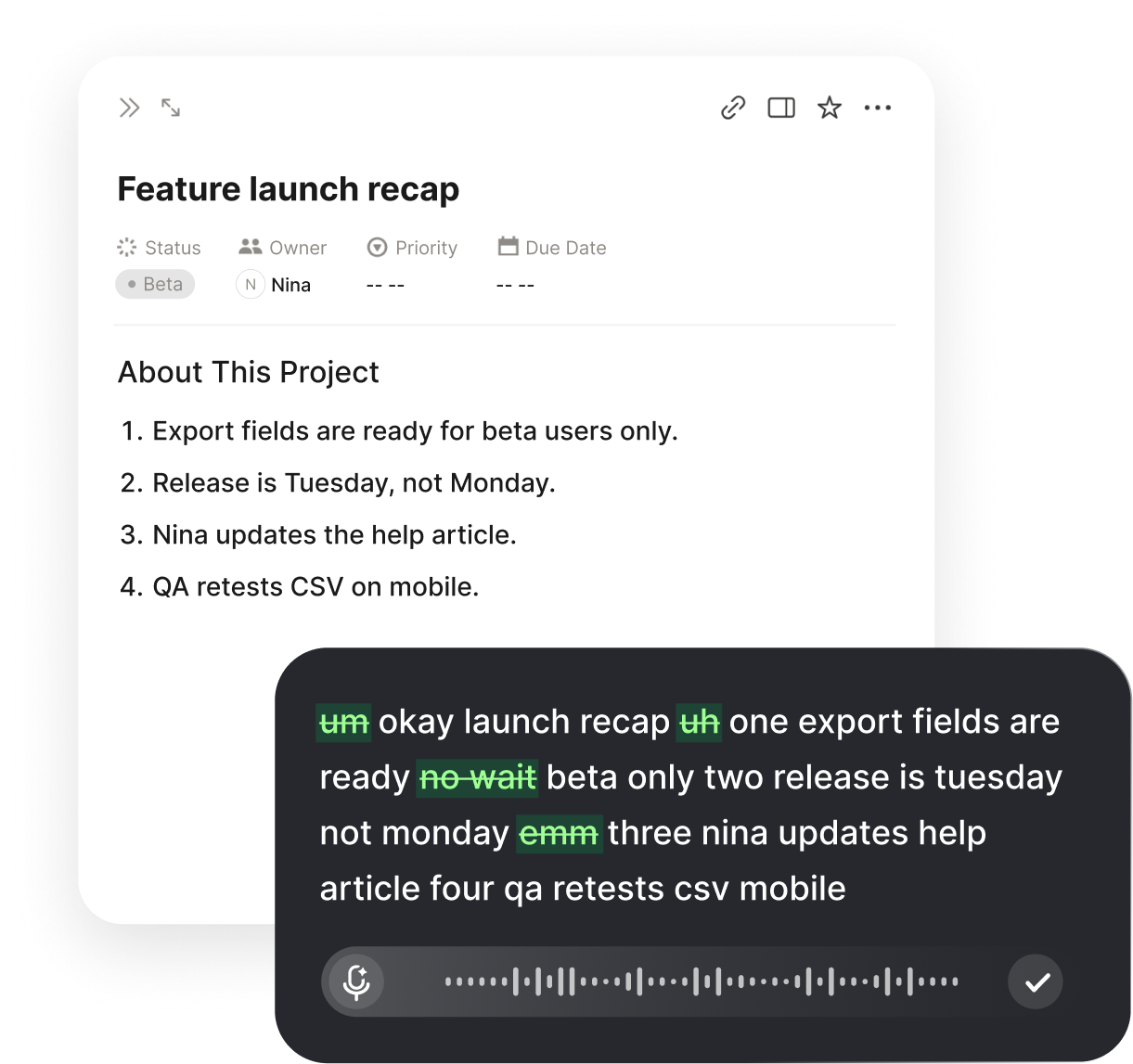
Speak in short, complete sentences and let the tool handle the small stuff. Voiskey is a voice typing app for macOS and Windows that types at the insertion point, so you can capture a clause directly in the file where you keep your library. It removes filler words, stutters, and false starts, which means a rushed reading still produces clean text. It also adapts punctuation and formatting to what you are doing, so a clause list and a formal paragraph arrive in different shapes. Say correction when you misspeak instead of restarting the whole passage. The point of the recording step is to capture approved language quickly, then edit at the desk rather than at the microphone.
Capture punctuation intent out loud. Say comma, period, and new paragraph where the placement matters, especially in long enumerations and defined terms. For quoted material, say quote, read the passage, and say end quote. For section references, say section followed by the number in full. Keep a personal convention sheet so the spoken commands stay consistent across sessions; a library assembled with three different conventions is harder to clean than one assembled slowly. Review each recording immediately, while you remember what you intended, and fix the punctuation then. A minute of correction at recording time saves ten minutes of reconstruction when the entry is finally used in a live draft.
Close each capture session with a completeness check. Read the new entry aloud against the approved precedent and confirm that no sentence was dropped and no variable was silently filled in. Check that the description lines are present and that the entry follows the naming pattern. Save a dated copy of the entry so later changes can be compared. If the phrase required several corrections, note why, because the same difficulty will recur when a colleague records a related clause. End by adding the entry to the inventory and marking its status as draft or approved. Nothing enters the approved list until a second person has read it against the source.
Testing Phrases Against Real Matters
Test each new phrase in a live but low-risk matter before it joins the approved list. Pick a matter where a partner will review the draft anyway, so the test adds no new risk. Insert the phrase, adapt the variables, and read the result in context rather than in isolation. Some clauses are flawless alone and awkward beside neighboring language, and only context reveals that. Record what you changed and why. If the phrase needed more than minor adaptation, either refine the entry or mark its scope more narrowly. Testing is not a formality; it is the step that separates a library from a collection of attractive sentences that nobody trusts.
Test across the variables that matter. Run the phrase with a short client name and a long one, with a company and an individual, with a date and a defined period. Check how it reads when the surrounding paragraph is short and when it is long. If the phrase assumes a singular party, confirm that it fails loudly rather than silently when two parties appear. Write the results beside the entry so the next user knows the boundaries. A library that documents its own limits is more useful than one that pretends to cover every case, because the reader can choose with confidence instead of discovering the problem during a filing deadline.
Collect the edits that reviewers make, not just the errors they catch. A reviewer who changes a phrase for style is telling you something about the firm's voice, and that signal should flow back into the library. Keep a short log of recurring edits and review it after every few matters. If the same change appears three times, update the entry rather than correcting it manually each time. If the changes conflict, the phrase may be trying to serve two document types and should be split. This feedback loop is the difference between a static template collection and a living bank of language that reflects how the practice actually writes.
Conclude testing with a decision for each candidate: approve, revise, split, or retire. Write the decision and the evidence beside the entry, including the matters used and the reviewer. Keep rejected candidates in an archive rather than deleting them, because a rejected phrase often becomes useful when the scope changes. Update the inventory ranking to reflect real use so the best entries rise to the top. Set a date to revisit entries that were approved but never used; an unused clause may be poorly scoped or simply unnecessary. Testing closes when every candidate has a recorded decision and the approved list contains only language that has survived a real draft.
Pruning and Versioning the Bank
Schedule pruning rather than waiting for clutter to become a problem. Every quarter, list entries by last-used date and by number of matters in which they appeared. Retire entries that have not been used and cannot be justified, and mark borderline entries for a further quarter before removing them. Check each entry against current precedent, since clauses age quietly as forms and practices change. Ask two frequent users which entries they trust and which they avoid; avoidance is a strong signal that an entry no longer fits. Pruning is maintenance, not criticism, and a smaller trusted bank outperforms a large one that nobody can scan.
Version entries in a way that a busy drafter can follow. Give each entry a number and a date, and keep a short history that names the change and the reason. When an entry changes scope, do not overwrite the old version; archive it so earlier documents can still be checked against the language they used. If you capture revisions by voice, open the entry file and dictate the updated clause beside the old one, then compare them before deleting anything. Voiskey learns names, jargon, acronyms, and spelling preferences, which helps keep long defined terms consistent across versions. Download the app for macOS and Windows when you need to work on the same bank from a second machine. Note the reason for each change so a later reader can follow it.
Watch for drift between the bank and real drafts. Compare a sample of recent documents with the approved entries and note where writers departed from the library. Some departures are errors, but others are early signals that a clause needs updating. Ask the writer why they changed the language, and record the answer. If the reason is sound, propose a revision through the normal review path rather than editing the entry informally. Drift review turns the bank into a feedback system instead of a shelf of documents, and it keeps approved language close to what the practice actually files. Record the answer next to the entry so the next reviewer sees it.
Close the cycle with a short report and a clear next step. The report names entries added, revised, and retired, lists the matters used for testing, and flags any unresolved questions. Keep it to a page so people actually read it. Set the date for the next review and the owner for each open item. If the bank is growing faster than it is being used, slow the additions and spend a cycle on adoption instead. The measure of success is not the number of entries but the number of drafts that start from trusted language and reach review with fewer corrections.
FAQ s
Press a shortcut, read an approved clause aloud, and the text appears at the insertion point in the file where you keep the library. Voiskey removes filler words and false starts, so a hurried reading still produces clean text, and it adapts punctuation and formatting to the entry you are capturing.
Yes. Voiskey learns names, jargon, acronyms, and spelling preferences, so repeated defined terms and party names arrive the way your practice spells them. That consistency matters when a clause is reused across many matters and a single variant spelling would force a manual edit.
Voiskey supports 100+ languages and translation, so you can speak a clause in one language and work with it in another. Practices that maintain bilingual precedents can capture the source wording and the translated wording in the same drafting session.
Voiskey supports up to 220+ words per minute, about five times faster than typing, so a clause that once took minutes to retype can be spoken in seconds. Accuracy still depends on reviewing the captured text against the approved precedent before it enters the library.


 Voiskey
Your voice, amplified.
Download Voiskey for Mac and Windows and capture approved clauses by voice in your draft.
Use it across macOS, Windows, iOS, and Android