
Research Notes for Long Papers
A schema-driven way to read long papers and speak notes that are ready for synthesis.
 Voiskey Team
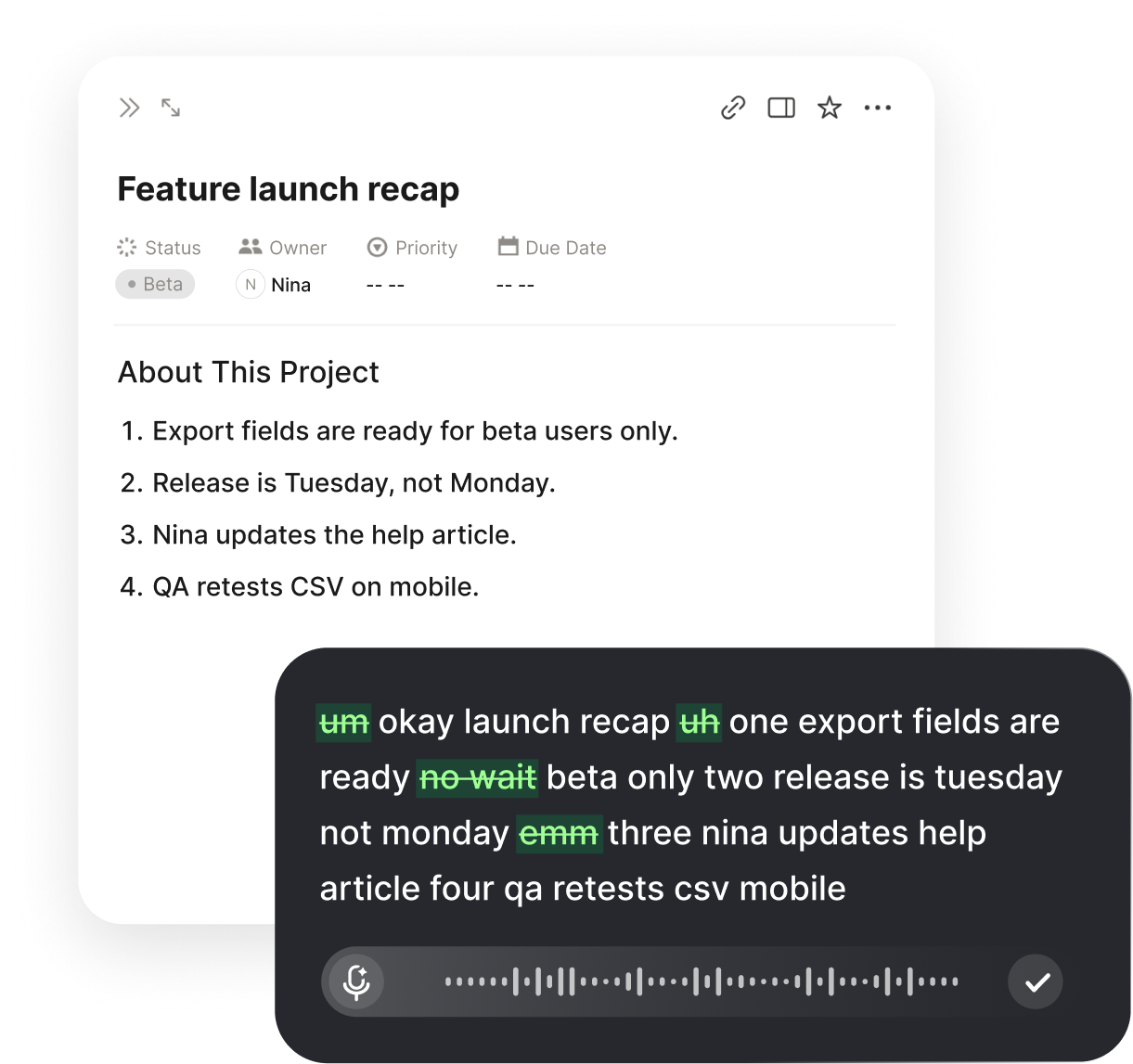
Map the Paper Before You Read It
Research Notes for Long papers need a map before they need a note: read the abstract, the headings, the figures, and the conclusion, then write the paper's shape in five lines. Most readers start at the first paragraph and run out of attention in section two. A map prevents that, because it tells you where the argument is going and which sections deserve a slow read. The map is not a summary; it is a table of contents you wrote yourself, in your own words, with the question the paper is trying to answer at the top. Five lines are enough for most papers.
Read the abstract and the conclusion back to back, then speak the difference between them. The abstract states what the authors set out to do; the conclusion states what they claim to have shown. The gap between the two is often where the interesting limitations live. Speak one sentence about the promise and one about the result, then note whether they match. If the conclusion claims much more than the abstract promised, mark the paper for a careful methods read. If the two are almost identical, the paper is probably a short report rather than a long argument. Write the pair of sentences before you read the body.
Decide which sections get a deep read and which get a skim. In a long paper, the method and the results usually deserve the closest attention, while the literature review can often be skimmed for the two or three positions the paper positions itself against. Write the decision beside each heading in your map, with a time budget: twenty minutes for the method, ten for the results, five for the review. The budget is not a strict limit; it is a signal that keeps you from spending an hour on the introduction and arriving at the results exhausted. Put the budget beside each heading.
Set up the note file with the schema headings before you read the body. The headings should be the same for every paper: question, method, finding, limitation, and relevance. Put the full reference at the top, including the authors, the year, the venue, and the link, and check the spelling of each author's name against the paper. Voiskey learns names, jargon, acronyms, and spelling preferences from that use, so a correct reference at the start makes the rest of the file cleaner. A schema that never changes is what makes a library of notes comparable. Copy the schema from the last paper you read.
Dictate Section Notes in a Fixed Schema
Speak one section note at a time, in the schema order. After the method section, say what the authors did, with what sample or material, and over what period. After the results, say the main finding in one sentence and the size of the effect in the next. After the discussion, say the limitation the authors admit and the one they do not. Keep each section note to one screen, and resist the urge to merge sections. The schema is the point: it forces each part of the paper to answer its own question before you move on. One screen per section is the target.
Use the relevance heading for your own project, not for the paper. This is the line that makes a research note yours. Say how the paper connects to your question, what you could borrow, and what you would need to check before relying on it. If the paper is only tangentially relevant, say that plainly and move on; a note that pretends every paper is central wastes the reader's time, and the reader is you in three months. A short, honest relevance line is more valuable than a long summary of a paper you will not cite. Write it before you close the file.
Anchor every quotation and every number to a location. Say the page or the section before the content, and repeat the anchor after the content if the quotation is long. A number without a location is a rumour, and a quotation without a location cannot be checked. When you dictate a statistic, say the unit and the comparison as well, because a bare percentage is easy to misread later. The extra five seconds per number is the difference between notes you can cite and notes you have to re-check against the paper. Anchor the number and the unit together.
Finish each paper with a three-line verdict. The first line says whether the paper is central, supporting, or background. The second says the one thing you would cite it for. The third says what you still do not understand. These three lines go at the top of the file, above the schema, so the verdict is the first thing you see when you return. A verdict written at the end of a reading session is more honest than one written a week later, when the paper has blurred into the others. Write the three lines before you close the paper.
Build a Synthesis Matrix by Voice
A synthesis matrix is the tool that turns a stack of notes into an argument. Use five columns: paper, question, method, finding, and limitation. One row per paper. The matrix is not a summary of each paper; it is a comparison across papers, and it only works when every row uses the same columns. Build it in the same file as the notes, or in a file that links to them, so a row can always be traced back to the longer note. The matrix is where the reading becomes a literature review. Keep it to one screen if you can.
Speak a row for each paper after you finish the note, not at the end of the project. Say the short name, the question in one sentence, the method in one phrase, the finding in one sentence, and the limitation in one phrase. Voiskey adapts formatting to the task, so a spoken row arrives as a list you can tidy into a table. Do this while the paper is fresh, because the matrix depends on compression, and compression is much easier when you still remember what mattered. A row written a month later is a guess. Write the row in the same session as the note.
Read the matrix across rows, not down columns. Look for two papers that answer the same question with different methods, or two that use the same method and reach different findings. Those pairs are the raw material for a literature review, because they show where the field agrees and where it does not. Speak a note beside each pair: what the disagreement turns on, and which paper you find more convincing. Keep these pair notes short and dated. They are the seeds of your argument, and they are much easier to write now than in the final week. Date every pair note.
Update the matrix when a new paper arrives and prune it when a paper drops out of scope. A matrix with thirty rows is useful; one with a hundred rows is a bibliography. If a row has not been consulted for a month, ask whether the paper is still relevant to the current question. If it is not, move it to a background list rather than deleting it, so the decision is recorded. The matrix should reflect the scope of the project as it now stands, not the scope you imagined at the start. Review the rows at every milestone.
Move from Notes to a Draft
Draft from the matrix rather than from the notes. Choose a pair or a cluster of rows that makes a point, and speak an outline with three parts: what the literature agrees on, where it disagrees, and what your project will do about the gap. This outline is the spine of a literature review section, and it comes directly from the matrix. Keep it to one screen and put the row names beside each point, so every claim in the outline can be traced to a paper. An outline with no traceable rows is an opinion, not a review. Name the rows in the margin.
Speak the paragraphs in the order of the outline, and cite as you go. Say the author and the year in the sentence, then the finding, then the link to your point. Voiskey handles up to 220 words per minute, about five times faster than typing, so a paragraph that costs ten minutes at the keyboard costs two or three spoken. It adapts tone and word choice to what you are trying to do, which means a paragraph spoken for a draft reads more like prose and less like a note. The edit afterwards is where the citations are checked and the argument is tightened.
Do a separate edit pass for claim, evidence, and link. Read each paragraph and mark whether it has a claim, whether the evidence actually supports the claim, and whether the link to your argument is explicit. Most weak paragraphs are missing the link, not the evidence. Rewrite the link aloud, then paste it into place. This pass is faster when the paragraphs were spoken, because the spoken version tends to state the claim plainly; typing encourages hedging, and hedging hides a missing link. One pass is usually enough for a first draft. Mark each paragraph pass, fix, or cut, then rewrite only the cuts.
Keep the draft and the matrix in the same project folder, and keep the notes reachable from both. When you change a claim in the draft, check whether the matrix still supports it, and update the row if it does not. This two-way link is what prevents a draft from drifting away from the reading. If you move to a new laptop, download the current installer, sign in, and test the shortcut in the draft field before the next writing session. The folder, the matrix, and the draft are one project, and they should move together. Check the links before you travel.
Keep a Research Log Across a Long Project
Keep one research log for the whole project, with a dated entry for each decision about scope. When you decide to exclude a set of papers, write why. When you change the research question, write what changed and what it affects. When a supervisor suggests a direction, write the suggestion and your response. These entries are short, and they are the only record of why the project looks the way it does. A log of decisions is more useful than a log of activity, because decisions are what you will need to explain in the final write-up. Keep each entry to four lines.
Review the log once a week and ask three questions: what did I read, what did it change, and what is still missing. Speak the answers into the log rather than typing them, and keep each answer to three sentences. Voiskey removes filler and false starts, so the review stays short enough to do on a Friday afternoon. The weekly review is also the best time to prune the matrix and to move irrelevant papers to the background list. A project that is reviewed weekly does not need a heroic catch-up at the end. Protect the review slot in your calendar.
Prepare for supervisor meetings from the log, not from memory. Before the meeting, speak a one-page summary with four parts: what you read since the last meeting, what it changed, what you plan next, and what you need help with. Send it ahead if that is the custom in your department. A written summary makes the meeting shorter and more useful, and it gives the supervisor a chance to correct a direction before you spend a week on it. The summary also becomes part of the project record, which is useful when you write the methods section. Keep the sent copy with the log.
Close the project with an archive, not a deletion. Keep the log, the matrix, the notes, and the final draft together, and write one page about what you would do differently: which papers you would read earlier, which method you would check sooner, which question you would narrow. If you move to a new laptop, download the current installer, sign in, and run a two-sentence test in the log field before the next project. Then read the lessons page once. A research process you can restart in ten minutes is one you will use for the next paper, and the one after that.
FAQ s
Voiskey lets you speak structured notes at the insertion point in your note file, at up to 220 words per minute and about five times faster than typing. It removes filler words, stutters, false starts, and self-corrections, so the note stays readable. You follow a fixed schema of question, method, finding, limitation, and relevance, which keeps every paper comparable.
Yes. Voiskey supports up to 220 words per minute, which is faster than most people speak when they are summarising an argument. The limit is your reading, not the typing. It also adapts punctuation and formatting to the task, so a spoken list of method, finding, and limitation arrives in a shape you can tidy into a table row.
Use five headings for every paper: question, method, finding, limitation, and relevance. Add the full reference at the top and a three-line verdict above the schema. Speak one section note at a time, anchor every number and quotation to a page or section, and write the relevance line for your own project rather than for the paper. The same schema across papers is what makes a synthesis matrix possible.
Keep one file per paper with the same schema, then speak one row per paper into a five-column synthesis matrix while the paper is fresh. Read across rows to find pairs that agree or disagree, and write a short note beside each pair. Review weekly, move out-of-scope papers to a background list, and keep the verdict at the top of each file.


 Voiskey
Your voice, amplified.
Download Voiskey for Mac and Windows and speak structured research notes as you read.
Use it across macOS, Windows, iOS, and Android