
Proofreading Voice-Drafted Legal Work
A three-pass routine for catching artifacts, facts, and meaning slips in spoken drafts.
 Voiskey Team
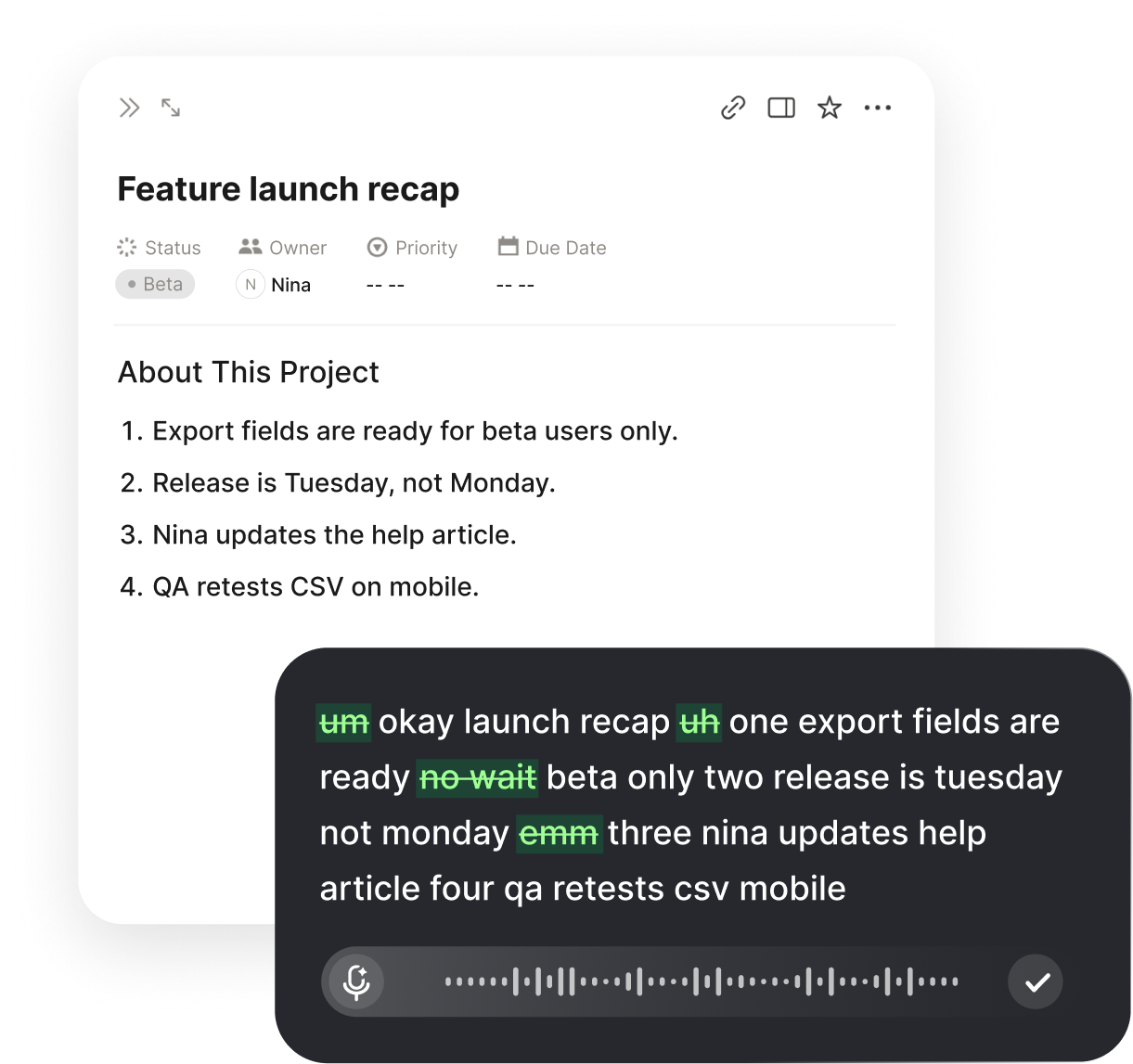
Knowing What Voice Drafting Leaves Behind
Proofreading Voice-Drafted Legal Work begins with knowing the typical artifacts. Voice drafting removes filler words and stutters, but a first draft can still carry repeated phrases, doubled words at restarts, and punctuation that follows speech rather than structure. Homophones appear where a name or term sounds like a common term. Numbers spoken quickly can be transposed. Lists may lose their markers. Knowing these patterns lets you read for them directly instead of reading generically and hoping to notice. A targeted proofreading pass is faster and more reliable than a vague instruction to check everything carefully. Write the artifact list where you proofread.
Build a checklist from your own corrections. For two weeks, note every fix you make in a spoken draft and group the fixes by type. Most writers find five or six recurring patterns, such as a specific homophone, a dropped closing parenthesis, or a date format that changes mid-document. Turn those into the top of your checklist and leave the rest of the list short. A personal checklist beats a generic one because it reflects the errors you actually make. Review it after a month and replace items that no longer appear. The shorter the list, the more consistently it gets used.
Distinguish artifact errors from drafting errors. An artifact is a mismatch between what you said and what appeared; a drafting error is a weakness in the argument or structure that would exist even in typed text. Both matter, but they need different passes. Read once for artifacts with the checklist, then read again for substance with the document's purpose in mind. Mixing the two passes makes both weaker, because attention splits between local detail and global meaning. Keep the checklist pass mechanical and the substance pass slow. Say which pass you are in before you start. Put the pass name at the top of the working note.
Decide what proofreading cannot fix and route it elsewhere. If a section is structurally wrong, proofreading will only polish the wrong structure. If a fact is unverified, proofreading will only make the assertion smoother. Note these issues and send them back to the drafting stage rather than correcting them in place. The deliverable from this stage is a short personal checklist, a clear separation between artifact and substance passes, and a list of issues that need redrafting rather than proofreading. Keep the redraft list beside the checklist. A redraft list prevents the proofreader from patching structure inside a polishing pass, which never works.
A Three-Pass Proofreading Routine
Use three passes with different goals. The first pass checks completeness: every promised section exists, every heading matches its content, and every cross-reference points somewhere real. The second pass checks local accuracy: names, dates, amounts, citations, and the personal checklist of artifacts. The third pass checks flow: sentence rhythm, transitions, and whether the document reads as one argument. Each pass reads the whole document but looks for one kind of problem. Three focused passes find more than one long pass, and they are easier to schedule around other work. Time each pass once to learn your own rhythm. Write the three pass names on one card.
Make the first pass structural and fast. Read only the headings and the first sentence of each block, then note any gap between what the heading promises and what the block delivers. Check the table of contents or the block map against the actual sections. Confirm that defined terms appear before they are used. This pass should take a fraction of the time of the others and should produce a short list of structural fixes. Fixing structure before local accuracy prevents wasted effort polishing text that will move or disappear. Do not edit during this pass. Leave the marked gaps for the second pass.
Make the second pass mechanical and slow. Read with a pointer or an insertion point and move line by line. Check each number against its source, each name against the inventory, and each citation against the reference. Apply the personal checklist one item at a time rather than all at once. Mark corrections rather than rewriting sentences, because rewriting during this pass invites new errors. When a correction changes meaning, note it and handle it in the third pass. The second pass is where most real errors are caught, and it deserves uninterrupted time. Work in sections so fatigue does not set in.
Make the third pass a read for meaning. Read the document as the intended reader would, from the beginning, without stopping for small fixes. Note places where you lose the thread, where a transition is missing, or where a paragraph repeats an earlier point. Fix only what affects understanding, and leave style preferences for a later skim. If the third pass produces many substantive changes, the draft needs another cycle rather than more proofreading. The deliverable is a document that is structurally complete, locally accurate, and readable as a whole. Record which pass found what. Note the pass number beside each comment.
Checking Numbers, Names, and Citations
Numbers, names, and citations deserve a dedicated check because they are the errors readers trust least. Read each number aloud and compare it with the source, digit by digit for amounts and term by term for dates. Check that a number used twice in the document is the same both times. For names, compare against the vocabulary inventory and confirm that first and subsequent mentions use the right form. For citations, confirm the reference and the source paragraph. This check is tedious by design; its value comes from being complete rather than clever. Keep the dedicated check separate from the other passes.
Check the relationships between facts, not just the facts themselves. A date can be correct and still be in the wrong order; an amount can be correct and still be attached to the wrong party. Read the sentence around each fact and confirm that the fact belongs there. For chronologies, read the sequence and check the arrows of cause and time. For tables, check the row and column headings against the cells. Errors of placement are harder to spot than errors of value, and they are often more damaging because they look plausible. Mark each relationship as you confirm it.
Use a second reader for high-stakes numbers. A reviewer who did not draft the document has no memory of what the number should be, which makes them better at checking it. Give them the source and the checklist rather than the whole document, so their attention stays on the comparison. Ask them to mark each item as checked and to flag anything they could not verify. Record who checked what, so a later reader knows the basis of the confirmation. A second reader is not a formality when the document carries a number that matters. Choose the reviewer before the draft is finished.
Close the check with a summary of confidence. List the facts that were verified against a source, the facts that were verified only by memory, and the facts that remain unverified. Treat the third category as open items and resolve them before release, even if resolving them is inconvenient. Keep the summary with the review record. The deliverable is a checked document with a clear statement of what was confirmed and how, which is far more useful than a general assurance that someone looked at it. Note the reviewer's initials beside the summary. Keep the open items at the top of the next session plan.
Reading Aloud to Catch Meaning Slips
Reading aloud exposes meaning slips that silent reading misses. When you speak the text, an awkward transition becomes audible, a missing term creates a stumble, and a repeated phrase sounds obvious. Read the document at a normal pace and stop wherever you trip. Mark the spot rather than fixing it immediately, then return after the read. If you drafted by voice, Voiskey can help with the reverse pass too: put the insertion point where a correction is needed and speak the replacement, and it appears at the same point in the app you are using. Download the app for Mac and Windows to keep that routine on both devices. Mark first, fix second.
Read for the reader's ear, not your own. Imagine the person who will act on the document and read at the pace they would read. If a sentence requires a second pass to understand, it needs work. If a paragraph sounds defensive when you intended it to be neutral, the tone needs adjustment. Reading aloud is especially useful for client-facing text, where a small tonal slip can change how the message lands. Keep a short list of the passages that sounded wrong and fix them in one editing session. Read the fixed passages aloud again before closing. Mark the tonal misses separately from the meaning slips.
Use a listener when the stakes are high. Ask a colleague to listen without following the text and then tell you what they understood. Their summary reveals whether the structure survived the transition from page to voice, which is a good proxy for whether it will survive a quick read. Note where they asked for clarification and treat those points as weak. A listener also catches repetition that the writer's eye skips. This exercise takes a few minutes and often finds the one paragraph that was carrying too much. Ask the listener to repeat the next step back. Their reaction is evidence, not an opinion to argue with.
Finish with a silent check of the passages you changed. Reading aloud can introduce new phrasing that has not been checked for accuracy, so confirm that every correction still matches the source. Read the changed sentences slowly and compare them with the facts and citations. If a change is stylistic only, confirm it does not alter meaning. The deliverable is a document that sounds right when read and still checks out when verified, which is the combination that proofreading is meant to produce. Keep the changed-passage list with the draft. Mark each changed passage as checked before you close the draft.
Building Proofreading Into the Schedule
Proofreading fails when it is the task left for the last hour. Put it on the schedule as a named block with a named owner, just like drafting. For a long document, reserve two blocks: one for the mechanical pass and one for the read-aloud pass. For routine correspondence, build the check into the drafting routine rather than adding a separate stage. Voiskey adapts punctuation, formatting, tone, and word choice to what you are trying to do, which reduces the volume of small fixes, but the scheduled check is still what catches the errors that matter. Download the app for Mac and Windows so the routine travels with the work.
Give proofreading a quiet slot and a hard stop. The task needs sustained attention, and it degrades quickly under interruption. Put it where the office is calm and where you will not be pulled into a call. Set a hard stop so the pass does not expand to fill the day; if the document needs more time, schedule a second block rather than rushing the first. Turn off notifications and keep only the source material and the checklist open. A protected block is worth more than twice the time in fragments. Note the block on the same calendar as the drafting sessions.
Track what the checks catch over time. Keep a simple count of the errors found per document type and note which pass found them. A rising count in one pass suggests that an earlier stage needs attention, such as clearer structure or better fact preparation. A falling count across all passes suggests the drafting habits are improving. Review the counts quarterly and change one thing at a time. Measurement here is modest by design, but it turns proofreading from an anxious habit into a process with feedback. Share the counts with the people who draft. Put the count on the same page as the checklist.
Close the loop by feeding findings back into drafting. If the same error appears repeatedly, change the drafting habit rather than relying on the proofreader. If a document type always needs a second reader, make that part of the plan. If a pass consistently finds nothing, consider whether it is still needed or whether it has become a ritual. The deliverable is a proofreading schedule with owners, protected blocks, and a feedback loop that improves the drafting that precedes it. Review the schedule once a year. Update the checklist, the template, and the session plan before the next draft starts, then tell the team.
FAQ s
Voiskey removes filler words, stutters, false starts, self-corrections, and grammar slips before the draft reaches you. That leaves fewer small artifacts to repair, so the proofreading pass can focus on names, numbers, citations, and whether the argument holds together.
Voiskey learns names, jargon, acronyms, and spelling preferences, so party names and defined terms arrive the way your practice spells them. Consistency across a long draft means the proofreader spends less time fixing variants and more time checking substance. That shift is the point.
Place the insertion point where the correction belongs, press the shortcut, and speak the replacement. Text appears at that point in any app or text field, so the fix is made in the document itself rather than in a separate window.
Voiskey supports 100+ languages and translation. When a draft includes another language, you can speak a correction in that language or work with a translated version, then confirm names, figures, and references before the document moves on. Record the choice for the next reader.


 Voiskey
Your voice, amplified.
Download Voiskey for Mac and Windows and proofread spoken drafts where they live.
Use it across macOS, Windows, iOS, and Android