
Dictating Long Documents in Sessions, Not Sprints
Plan long spoken drafts as sessions with block maps, checkpoints, and a clean finish.
 Voiskey Team
Why Long Drafts Need Session Design
Dictating Long Documents in sessions rather than sprints is a design choice, not a motivational slogan. A long drafting task has phases: planning, producing, checking, and assembling, and each phase demands a different kind of attention. Trying to do all four in one sustained push usually produces a fast first half and a careless second half. Splitting the work into sessions lets you finish a phase while your attention is still sharp and start the next one with a clear goal. The unit of progress becomes a completed phase rather than a block of time, which is far easier to plan and to review. Write the phase list before you begin, because a task without phases becomes one long sprint by default.
Define the session before you begin. Write its goal in one line, such as produce the facts section or check all citations in part two. Name the document section, the word range you expect, and the stopping point. A session with a defined end is easier to start and easier to stop, and stopping on purpose prevents the slow decline that comes from pushing past fatigue. Keep the whole document mapped in headings so the session has a visible place in the larger structure. When the goal is clear, the temptation to keep going until the document is finished disappears. Say the goal aloud before you press the shortcut.
Estimate session length from observed work, not from ambition. Most writers find that a focused speaking session produces a limited amount of usable text before accuracy drops, and the exact amount varies by person and by document complexity. Measure your own by comparing two sessions of different lengths and noting where corrections cluster. Then set a default length and a rule for stopping early. Protect the session from interruptions, because a five-minute break in the middle costs more than the five minutes. A realistic estimate makes a plan that survives contact with a real day. Review the estimate after every long document.
Plan the sequence of sessions before the first one. Put the hardest structural work early, when attention is strongest, and the mechanical checks later. Alternate heavy and light sessions so a demanding drafting block is followed by a checking block rather than another demanding block. Leave a short assembly session at the end for headings, cross-references, and a final read. Write the sequence on one page with the goal for each session. The deliverable is a session plan that names the goal, the expected output, and the stopping point for every block of the document. Pin the plan where you can see it.
Cutting the Document Into Spoken Blocks
Divide the document into blocks that match how you would explain it to a colleague. A block is a section or a sub-argument with a beginning, a middle, and an end. Write a one-line summary of each block before speaking, and keep the summaries in order at the top of the file. When you enter a session, open the block summary and speak toward it. Blocks make it possible to stop without losing the thread, and they make it possible to hand a single block to a reviewer. A document cut into clear blocks is easier to dictate, easier to check, and easier to revise. The block map is the real outline of the document.
Choose block sizes that fit a session. A block that takes far longer than a session will fragment across days, which weakens continuity; a block that takes ten minutes creates too many boundaries and too much overhead. Aim for blocks that match a comfortable speaking span, with a clear opening and closing sentence. For long factual sections, split by chronology or by witness. For argument sections, split by issue. The split rule should be obvious from the heading, so a reader can tell why the document is organized the way it is. Write the rule next to the map. Review the sizes after two sessions and adjust the boundary.
Mark transitions explicitly when you speak. At the end of a block, say the closing sentence and then dictate the first sentence of the next block, even if you plan to stop. This gives each block a hinge and prevents a draft that reads as a series of disconnected fragments. If a block ends with a promise, such as a point developed later, note where it is developed. Transitions are where long documents usually fail, because the writer knows the connection and the reader does not. Keep a list of promises and their destinations beside the map. Read the hinge aloud before you move on to the next block.
Review the block map before the next session. Confirm that every block has a summary, that the order still makes sense, and that no block has grown beyond its session budget. If a block has expanded, split it rather than extending the session. If a block has shrunk, merge it with a neighbor. Keep the map visible while you work. The deliverable is a block map with summaries, boundaries, and transitions, which is the basis for every later check. A five-minute review of the map prevents an hour of structural repair later. If the map and the draft disagree, fix the draft rather than the map.
Pacing Voice and Attention
Speaking pace and attention are linked. Fast speech produces more run-on constructions and more self-corrections, and correcting them costs more attention than slowing down would have. A steady, slightly slower pace yields cleaner sentences and fewer restarts. Pause at the end of each sentence rather than in the middle, and use those pauses to glance at the block summary. If you notice yourself speeding up, stop at the next period and reset. Pace is a skill that improves with attention, and it is the simplest lever for improving output quality. Note the pace that worked at the end of each session.
Protect attention with a small routine. Before a session, close unrelated windows, put the block summary in view, and decide what you will not do: check messages, look up a background fact, or reorganize the outline. Keep a scratch note for interruptions, so a stray thought gets written down and set aside rather than derailing the paragraph. During a session, work in stretches with a brief break between them. After a session, write one line about where attention broke down, because the pattern is usually consistent and fixable. Treat attention as part of the plan. A short written note is enough; the point is to notice the pattern.
Match the task to the energy you have. Structural drafting needs the most attention, mechanical checking needs less but demands accuracy, and assembly needs patience. Schedule structural sessions when you are freshest and checking sessions when you are steady but tired. Do not schedule proofreading at the end of a demanding session, because that is exactly when names and numbers slip through. Treat the session plan as an energy plan as well as a time plan, and move a block if the day has gone badly rather than forcing it. A moved block costs less than a damaged one. Mark the energy level beside each session on the plan.
Watch for the signs that a session has degraded. Frequent restarts, repeated corrections, and a growing urge to check the outline are early warnings. When two of these appear, stop at the next block boundary and record the state of the draft. A short break often restores enough attention to finish the block, and if it does not, the next session can start with a clean review. The deliverable from this stage is a pace and energy routine that keeps output quality flat across a long document instead of letting it decay. Write the warning signs on the plan itself.
Checkpointing Between Sessions
Every session should end with a checkpoint. Save the draft, write the block status, and note the next action in one line. A checkpoint makes the next session start in seconds instead of minutes, and it prevents the common failure of rereading the whole document to find your place. If you draft in the app where the document lives, Voiskey puts spoken text at the insertion point in that field, so a checkpoint is simply a save and a status note. Download the app for Mac and Windows if you work across machines and want the same shortcut and setup in both places. The status note is what makes the checkpoint useful.
Checkpoint the facts at least once per block. List the names, dates, amounts, and references used in the block and mark each as verified or pending. This separates the drafting work from the checking work and prevents a final session from becoming a frantic audit of the whole document. Keep the list beside the block summary. When a pending item is resolved, mark it and note the source. A block that is drafted and fact-checked can be handed to a reviewer without further assembly, which is a much better unit of progress. Review pending items at the start of the next session.
Record decisions as well as text. If you changed the order of sections or dropped a point, write the reason in a short decision log. Long documents accumulate small decisions, and without a log the next session repeats the same debate or reverses a choice by accident. The log also helps a reviewer understand why the document is shaped as it is. Keep entries to one line and group them by block. Decisions are part of the draft's history, and a checkpoint that records only text loses half the context. Date each entry. Read the log before you reopen a settled section.
Use the checkpoint to plan the next session rather than to celebrate progress. Read the status note, the pending fact list, and the decision log, then write the next session goal. If the pending list has grown, schedule a checking session before more drafting. If the log shows repeated reversals, stop and resolve the structural question before continuing. The deliverable is a checkpoint that lets a future session begin with a clear goal and an accurate picture of what remains. A good checkpoint takes under three minutes. If the picture is unclear, spend the next session rebuilding it rather than drafting.
Finishing Without a Marathon
The end of a long document tempts a marathon, and the marathon is where quality falls apart. Finish with a short assembly session, a separate checking session, and a final read. Assembly handles headings, numbering, cross-references, and the block map; checking handles names, dates, and citations; the final read handles flow and meaning. Keeping these separate prevents the last session from trying to do everything at once. Voiskey keeps the drafting and the corrections in the same app at the insertion point, which makes the assembly and checking passes faster, and you can download the Mac and Windows versions when you need the same routine on another machine. Schedule the three sessions before you start the document.
Do the final read at a different time of day from the drafting. Reading freshly drafted text is unreliable because the brain supplies what the writer intended. A gap of a few hours or a night makes omissions and awkward transitions much easier to see. Read the document from the block map down, checking that each block keeps its promise. Read the opening and the conclusion together, because they must agree. If you cannot leave a gap, read the document backward by section, which disrupts the expectation of flow. Write the read date beside the plan. Ask a colleague to read the opening and conclusion cold.
Use a short completion checklist rather than a long one. Include the document name and version, the block status, the verified facts, the open decisions, and the reviewer's name. A checklist of five items gets used; a checklist of thirty gets ignored. Keep it beside the block map and fill it in before declaring the draft finished. If an item cannot be completed, say so and name the owner. Completion is a state with evidence, not a feeling at the end of a long day. Store the checklist with the draft. Copy the checklist into each new document plan so it is ready.
Close with a brief retrospective. Note which session was hardest, where corrections clustered, and what you would split differently next time. Add one change to the session plan for the next long document. Hand the draft to the reviewer with the block map, the fact list, and the decision log, so they can check the parts that matter without rereading everything. The deliverable is a finished draft with a clear review path, and a session plan that improves each time you use it. Keep the retrospective to five lines. File it with the plan so the next document starts from it.
FAQ s
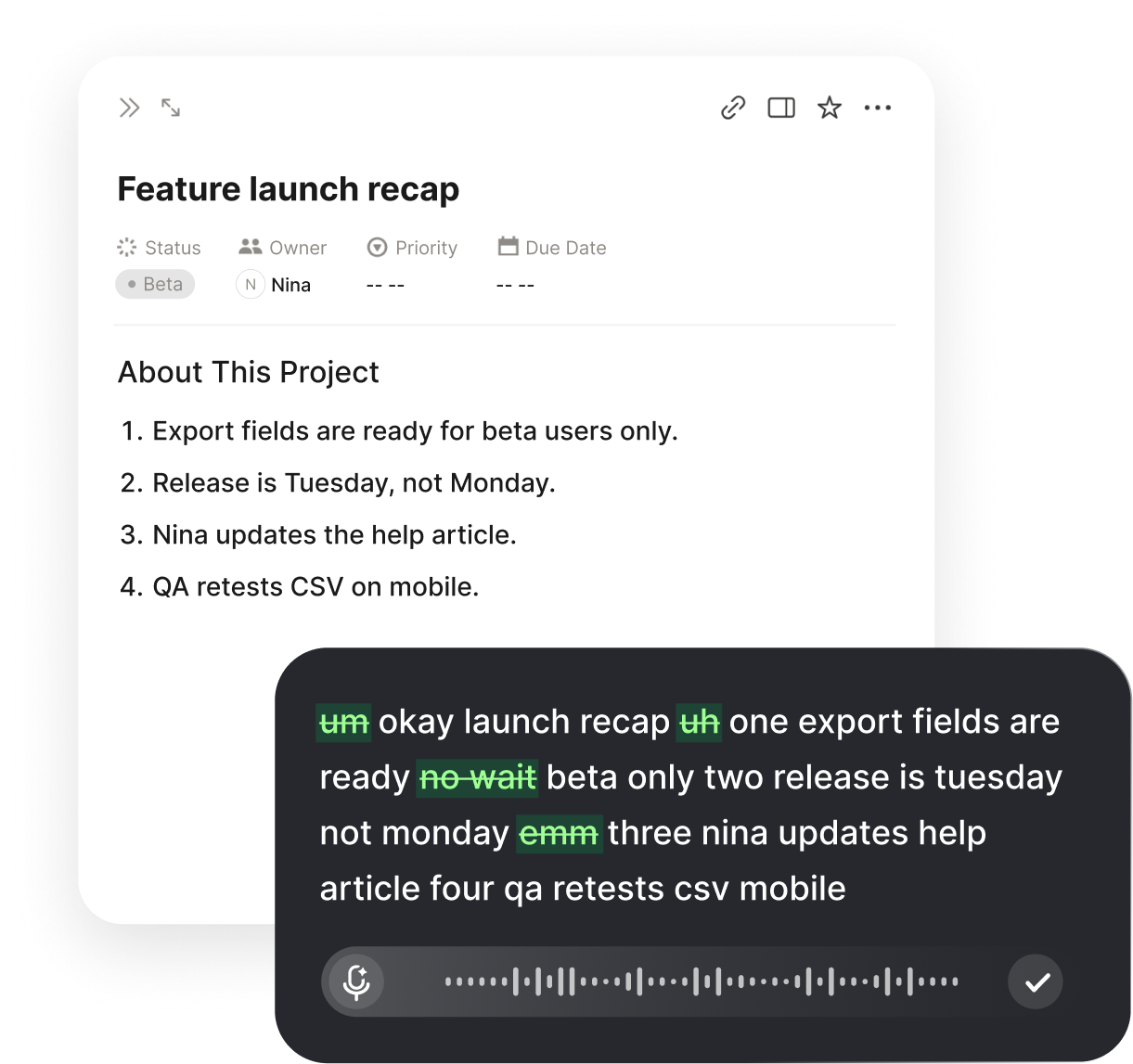
Voiskey works at the system level: press a shortcut, speak, and text appears at the insertion point in the app you are using. It removes filler words and self-corrections, so a session produces clean text, while the block map and review still keep the long draft on track.
Voiskey learns names, jargon, acronyms, and spelling preferences. Saying case names and defined terms at the start of a session helps them arrive the way you pronounce them, which matters when a long draft repeats the same parties across many sessions.
Voiskey supports up to 220+ words per minute, about five times faster than typing, so a session covers more ground than a keyboard sitting. Session design still matters, because pacing and checkpoints are what keep a long draft accurate, and the block map keeps it whole.
Voiskey supports 100+ languages and translation, so you can speak a passage in one language and work with it in another inside the drafting app. That helps when a long document includes translated evidence, while the original wording can stay where it is needed.


 Voiskey
Your voice, amplified.
Download Voiskey for Mac and Windows and dictate long drafts in planned sessions.
Use it across macOS, Windows, iOS, and Android