
Jensen Huang Just Called Typing a Commodity. Your Next Skill Is Asking.
Commodities get repriced; crafts appreciate. Asking is the craft now: start.
 Voiskey Team
Skill math: commodities get repriced, crafts appreciate
Every technology curve re-prices skills, and the re-pricing is more selective than the headlines suggest. When the spreadsheet shipped, arithmetic stopped being a job skill and modeling did not; when email shipped, transcription stopped mattering and negotiation never did. The pattern is not that work disappears; it is that the part of a role a machine can execute becomes a commodity while the part that decides what the machine should execute appreciates. Jensen Huang's July conversation with Harrison Chase, in which he said coding is essentially typing and typing is becoming a cheap commodity, is a statement of that pattern with a deadline attached. The commodity half is the typing; the appreciating half is what you do with the typing.
Commodity is not an insult; it is an economic description. Wheat is a commodity, and the farmer who grows it masters a real skill that is nonetheless not where the money pools. A commodity is anything whose price is set by supply and by the least skilled producer willing to sell, which is what happens to a skill once the machine sets the floor. The moment your output can be reproduced by any prompt, your output is priced like wheat, at the marginal cost of its production, and the marginal cost of a prompt is now roughly zero. That is not a judgment about your craft; it is a market observation about your keystrokes.
The craft side is the mirror image. A craft appreciates because its supply does not scale with compute: framing a problem, deciding what not to do, knowing which answer is wrong and why. These are not mysteries; they simply cannot be executed by a machine because they happen before execution exists. Notice the asymmetry: the machine can out-produce you at execution and cannot even reproduce you at framing. That asymmetry is the entire economic argument of this article, and it is why the skill worth training in the next twelve months is not faster prompting and not more typing. It is asking.
The good news is that, unlike typing speed, asking is a trainable craft, and this is the rare skill article where the plan is short instead of grand: one question a day, graded, for thirty days. The rest of this article specifies what a strong ask contains, what the daily drill looks like, how asking an agent differs from asking a person, and why voice is the fastest training surface available. No talent required, no typing test to pass, ten minutes a day, and no equipment beyond the machine you already own. That is the working definition of a skill worth starting.
The anatomy of an ask: outcome, constraints, evidence, follow-up
An ask has four parts, and most asks contain only one. Part one is the outcome, not the output: an output is an email; an outcome is the decision a reader can make after reading it. The difference shows up instantly in the quality of what comes back, because an agent can aim at objects more easily than at purposes. State the outcome in one sentence, the thing you need to be true after the answer exists, and watch the draft stop performing and start doing. Everything after this paragraph assumes you have done that, because every other ingredient is decoration without it. Write the outcome down before you open the tool, because the tool will happily accept a task masquerading as an outcome.
Part two is constraints, the boundaries the result must respect, and here the failure mode is usually silence. It feels redundant to say the email should be under 150 words, that the summary is for a CFO who hates jargon, that the tone in the exit ticket should not be emotional. It is not redundant; it is the difference between a draft and a decision, because the model fills silence with averages, and averages are by definition written for nobody in particular. Every constraint you add removes one guess from the pipeline, and every removed guess is one less edit later. The constraint is where the ask pays its rent.
Part three is evidence, and it is the part that separates asking from wishing: what do you already know, what did you verify, and which source can be trusted? Not to prove you looked busy, but because the agent's default is to blend every source it has into one smooth confidence, including the ones that contradict each other. When you supply the verified facts and flag the questionable ones, the answer stops being a blend and becomes a machine working on your materials. Supply the data, mark the source, and the responsibility for the claim lands where it belongs. And when you cannot supply the evidence, say so, because an ask that admits its uncertainty is an ask the model can fill honestly.
Part four is follow-up, the part that makes asking iterative rather than one-shot, and it is the part nobody teaches. Plan the second question when you write the first: what assumption did you use, what would break this, which alternative did you reject and why? A single well-designed follow-up routinely does more than three rewrites of the original ask, because the first answer reveals what the model thought you meant, and the follow-up corrects the misunderstanding at the level where it happened. This is the anatomy in full; the next section turns it into a drill with a calendar. The calendar is not the discipline in this plan; the grading is, and a daily grade beats a weekly intention every time.
The thirty-day drill: one graded question per day
Skill-building that works is small and graded, not large and inspirational. Thirty days of one graded question per day does for asking what six weeks of scales do for an instrument: it makes the structure automatic so the structure stops being where the thinking leaks. The rule is one question per day, one that you would otherwise have typed as a command, and the grading is the whole point, because practice without feedback is how people practice mistakes. Spend ninety seconds grading each ask against the anatomy: outcome present, constraints named, evidence attached, follow-up planned. Ninety seconds is not the price of virtue; it is the price of feedback, and feedback is the only thing that turns exposure into skill.
Week one is for the outcome, and every graded question should fail that grade the same way: the outcome was missing and you wrote a task instead. Week two adds constraints, and the failure mode changes from I did not say it to I forgot it existed, which is a different and much more informative bug. Week three adds evidence and reveals how little of what you ask for is actually verified, which is the week people find most uncomfortable, because the honest alternative to an assumption is a question for a human. Week four assembles the full anatomy and starts planning follow-ups. By day thirty the checklist is a default, not a ritual.
What to grade, concretely, before you read the answer. One: did the answer tell me the thing I needed to decide? Two: did it stay inside every constraint I set, or were there constraints I simply did not set? Three: did it use my evidence or blend the internet? Four: is my next question already written? These four grades take a minute, and they are the difference between thirty days of improvement and thirty days of exposure to prompts. Copy down the grades, not the wording, and the skill improves as a craft rather than as a habit. The grades are the coach, and they do not flatter, which is exactly what a coach is for.
The failure rule matters more than the plan: if a day's question gets a bad grade, do not silently move on. Re-ask the same question the next day with the missing part, and grade the second version. This is deliberate practice substituting for a coach, and it is why the daily cadence beats the weekly marathon: the gap between attempt and grade must stay short, or the brain files the attempt under done and the skill files it under nothing. Thirty days is not a completion; it is the point where the drill graduates into how the work is done, and the grade becomes reflexive instead of deliberate. By then you will have banked thirty graded questions and one honest habit, and the bank is the asset.
Asking agents versus asking people: same muscles, sharper surfaces
The muscle is the same; the surface is sharper. Asking a colleague well requires outcome, constraints, evidence, and follow-up, but humans fill gaps for free, out of context and out of politeness, so a mediocre question still gets a usable answer. An agent charges for the gap in a different currency: it executes the gap. That makes agents a better training environment than people, not a worse one, because the cost of a vague ask is immediate, visible, and attached to the exact sentence that caused it. Same muscle, sharper surface, faster feedback: the entire justification for practicing against a machine.
Two differences to respect in practice. One: people respect your time and will ask clarifying questions; the agent respects your words and will assume the rest, so evidence and constraints carry more weight in the ask. Two: people remember you; the agent remembers nothing unless you build the context, so the conversation, the references, and the constraint win become context you must supply deliberately. The consequence is a simple style change: write the ask as if the recipient is a brilliant new hire with no memory, because with an agent, every session is the first day. Write the context anyway; it is the cheapest insurance in the workflow.
The second difference is the reward for iteration. A person may be politeness-limited: you ask once, they answer, and asking again feels like nagging, so you absorb the gap and move on. An agent has no feelings, a follow-up costs one sentence, and the loop that people politely avoid is precisely the loop the agent rewards. This is the fixed point of the whole skill: the people who treat each first answer as a draft and ask the clarifying question improve fastest, and the people who accept answers improve at the speed of acceptance. Test it once with the same problem asked to a colleague and to an agent, and notice which conversation gets sharper.
Because the surface is sharper, the transfer is real. There is an old management saying that a clear question is the whole job of a leader, and the reason it is true is that framing is the part of work that does not delegate. Asking an agent well trains exactly that: audience, constraint, red line, follow-up. And it trains it with a machine that never flatters you, which is the rarest coaching surface available, a sparring partner that does not care how smart you looked. The thirty-day drill against an agent is cheap preparation for the conversations with people, where the same question carries more weight and the consequences of vagueness are heavier.
Train on the fastest surface: speak the question, polish, and send
Training speed matters, and no surface is faster than speech. A typed question is drafted at typing speed, and the drafting is where most of the anatomy leaks, because rewriting ideas into sentences trades away the noisy half-thoughts that contained the actual intent. Speaking keeps the intent intact: the hedge, the hesitation, the wrong start are present in the signal, and they are precisely the evidence of what you meant. The practical version is not to dictate; it is to think out loud and let the layer between speech and text do the polishing for you, so the intent survives the transfer instead of being smoothed away by it.
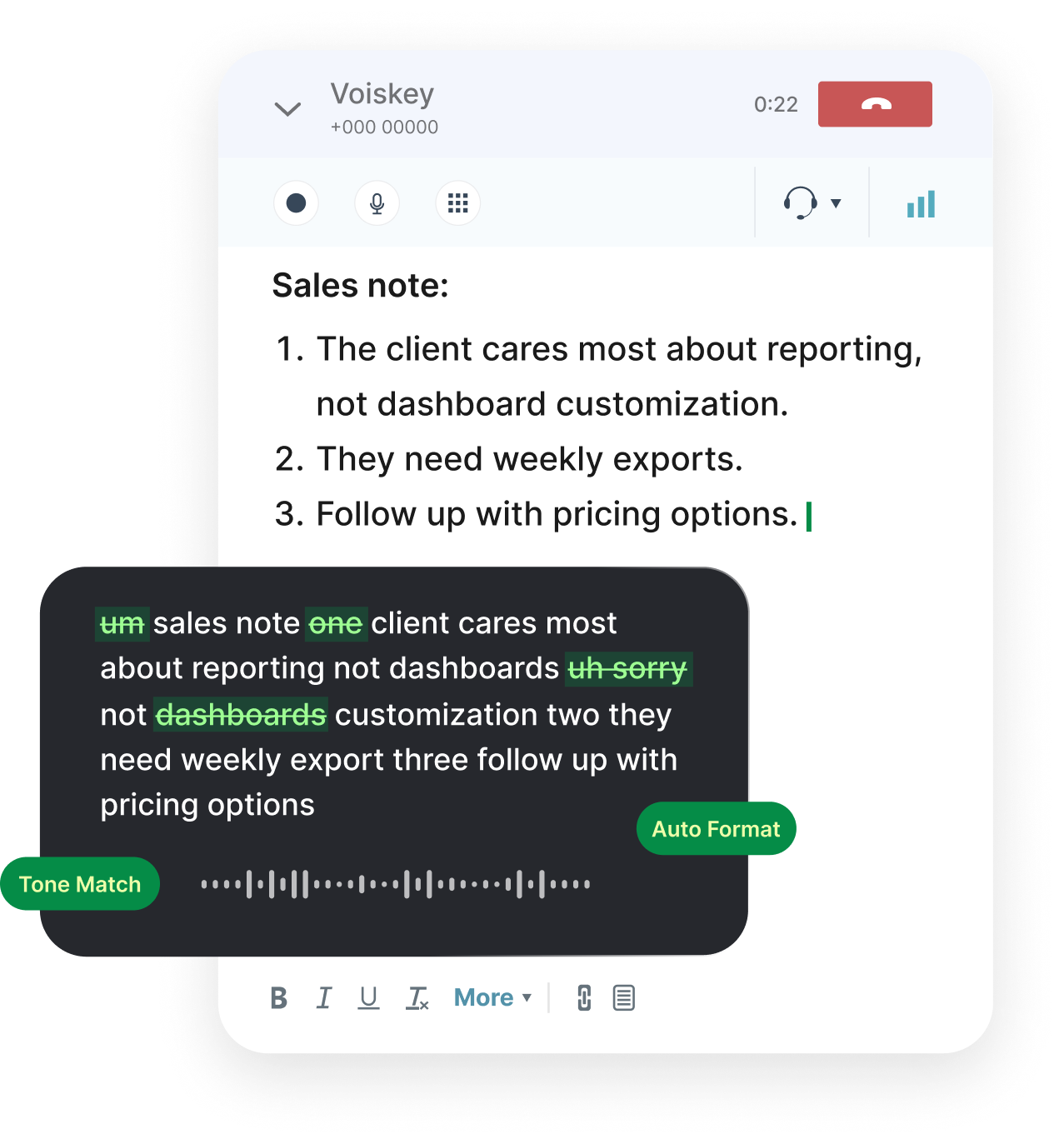
That layer is expression intelligence, and it exists because dictation failed for exactly this reason. Dictation hands back a verbatim transcript, ums, restarts, dead ends included, and then you type the polish anyway, which is the loop we declared over. What is different is understanding intent: the layer recognizes what you meant, strips what carried no meaning, and outputs text you would send, which means the training loop closes at speaking speed rather than typing speed. More attempts per hour, tighter feedback per attempt, faster habit formation, which is precisely what a training surface is for. The grade arrives as a sendable text, so the feedback loop closes without a second tool.
Voiskey runs this as system-level voice input on Mac and Windows and supports more than 100 languages, and the privacy posture is what makes it viable as a daily training surface: audio is processed locally by default, with zero server retention and SOC 2 Type II attestation. Speaking your real questions aloud, including the candidate framings you would not want in a shared document, is only a sustainable habit if the raw audio never leaves the machine. Half-formed questions are the training data of this skill, so their privacy is not a detail; it is the design. And a design you trust is a surface you will actually use, which is the real test of a training environment.
Close the loop, and the loop is small. Speak the question the moment it forms, read the polished version, and use the gap between what you said and what came back as the grade, because the gap is the anatomy made visible. The day you notice that your spoken question and the sendable version are the same thing is the day the skill stops being a drill. That is the reward structure of the whole argument: typing got cheap, the question became the craft, and the fastest way to learn it is to stop typing it and start saying it. Start today, with the question you have been avoiding all week, which is usually the expensive one.
FAQ s
You press the shortcut, speak the request in plain words, and Voiskey removes the fillers and false starts, then returns a polished question you can send or paste. Because you can say the intent aloud faster than you can type it, the speaking surface lets you spend effort on the framing rather than the keystrokes.
Yes. Voiskey runs as system-level input on Mac and Windows, so it types into whatever field has focus: Gmail, Outlook, Slack, a document, or a coding assistant such as Cursor. You speak the question once and the polished text lands wherever your cursor is, with no copy-paste step or separate transcription window.
Standard dictation gives you a verbatim transcript, including every um and restarted sentence. Voiskey adds an expression layer that understands intent, strips fillers and verbal missteps, and rewrites the result into clear, sendable text. The workflow is speak, polish, type, edit, so you get a finished question rather than a transcript you still have to clean up.


 Voiskey
Your voice, amplified.
Run the drill: one graded question a day for thirty days, and let speech carry the ones that matter.
Use it across macOS, Windows, iOS, and Android