
Building Exam Revision Notes from Speech
Turn spoken answers to past questions into a revision file organized by exam topic.
 Voiskey Team
Start From the Exam, Not the Textbook
Building Exam Revision Notes from speech starts with the paper, not the chapter: read the instructions and the marking guidance before you decide what a note should contain. Most revision notes are organised by the textbook, which is the order the material was taught rather than the order it is tested. Those are rarely the same. Spend an hour with two past papers and a marker, and write down what the questions actually ask. That hour will change the shape of every note you build afterwards, and it costs less than a single reread of a chapter. Do it before you write anything else.
Collect more papers than you think you need. Six to eight past papers are usually enough to reveal a pattern, provided they come from the same syllabus and a similar period. For each paper, list the questions by topic and by the verb they use: define, compare, explain, calculate, evaluate. The verbs tell you the depth expected, and the topics tell you where the marks cluster. Keep this list in one file with a date, so you can tell which papers came before a syllabus change and which ones still reflect the exam you will sit. Add a new paper whenever the course publishes one.
Map the marks to the topics. For each topic, count how often it appears and how many marks it carries, then rank the topics by that product. A topic that appears in every paper for three marks matters less than one that appears in half the papers for fifteen. This ranking is your revision order, and it should replace the order of the textbook. Write the top ten topics on a single page and keep it visible. When you are tired and cannot decide what to study, the page decides for you, and that is most of its value. Keep the page on paper as well as in the file.
Set a note standard before you write anything. For this method, a revision note is a question, a structured answer of five to eight lines, and a reference to the source. Nothing else. No long summaries, no copied paragraphs, no decoration. The standard is deliberately narrow because a narrow standard is repeatable on a bad day. Write the standard at the top of your revision file along with the top ten topics. Then start with the highest-ranked topic and build the first note while the exam is still in front of you. The first note is a specimen for the rest.
Speak Answers Before You Write Them
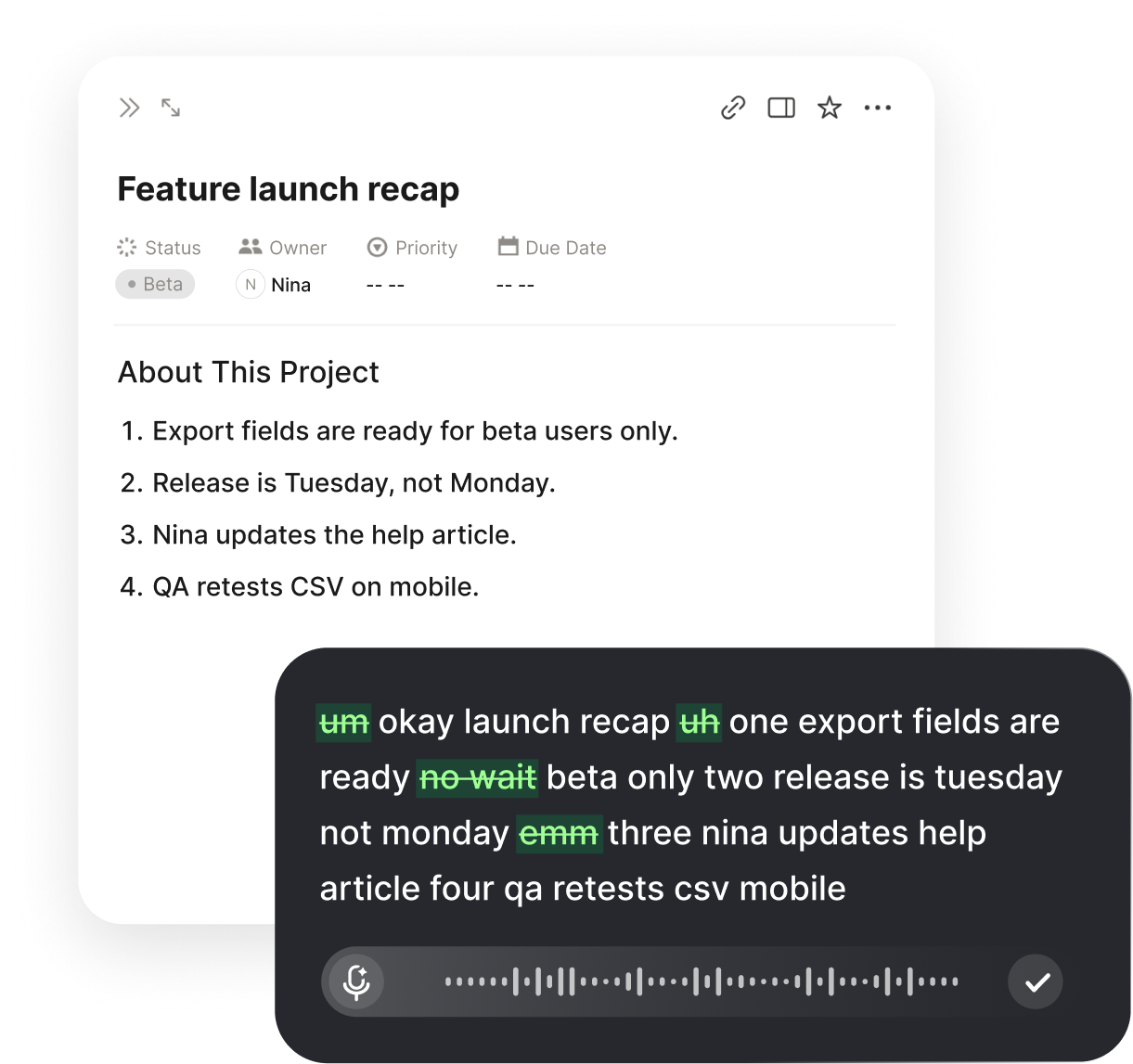
Take one question from a past paper and answer it aloud before you look at your notes. Set eight minutes, read the question once, and speak a full answer as if the examiner were listening. Do not stop to check a fact, and do not restart the answer. The first attempt is evidence, not a performance: it shows what you can produce under the conditions the exam will impose. Voiskey types the answer at the insertion point as you speak, removing filler words and false starts, so the draft you review afterwards is the shape of your thinking rather than the shape of your hesitation.
Give the answer a structure you can repeat for every question. Start with the claim, in one sentence that answers the verb. Then give two pieces of evidence, each with a source or an example. Then add the qualification, which is the limit of the claim or the condition under which it fails. If the question asks for evaluation, end with a short judgement that weighs the two sides. This four-part shape works across most essay-style questions, and it is easy to speak because each part has a clear job. Write the shape on a card and keep it beside you.
Compare the spoken answer with the marking guidance and mark the gaps. Look for three things: a claim that is missing, evidence that is vague, and a qualification that is absent. Count the marks you would have earned if you can, and write the number at the bottom of the answer. The number is not a judgement of you; it is a routing signal for the next session. If the answer was strong on evidence but weak on structure, the next session should practise structure. If it was well shaped but empty, the next session should return to the source.
Rewrite only the weakest paragraph, and rewrite it aloud. Do not rewrite the whole answer, because the whole answer is not the problem. Speak the paragraph again with the missing evidence added, then edit the result into four or five sentences. Keep both versions side by side, with the date, so you can see the change next week. This small repair loop is the core of the method: attempt, compare, repair one part, attempt again. It is slower than rereading, and it is the only version that produces answers you can actually write under pressure. Schedule the next attempt before you close the file.
Build a Question Bank, Not a Summary
Turn every topic into questions rather than paragraphs. A topic note should contain four questions that could appear in the exam, each with a spoken answer of five to eight lines. Vary the verb across the four: one define, one compare, one explain, and one evaluate or apply. This variation forces you to see the same material from different angles, which is exactly what a well-written paper does. Keep the questions in the order of the top-ten list, and leave space between them for the next attempt. A question bank grows by revision; a summary only grows by copying.
Speak the answers in short bullets rather than flowing prose. Say the claim, then the first piece of evidence, then the second, then the qualification. The app adapts formatting to the task, so a spoken list arrives as a list, which is easier to scan a week later. Under each bullet, add the source page or the example that supports it. If you cannot name a source, mark the bullet as unsupported and treat it as a gap. An unsupported claim in a revision note is a warning, not a fact, and the mark should remain visible until you fix it.
Record a confidence score for each question: solid, shaky, or missing. Write the score beside the question and the date of the last attempt. This score drives your schedule, so it needs to be honest. A question you can answer only while looking at the note is missing, not shaky. A question you answer with two pieces of evidence and a qualification is solid. Review the scores once a week and move the lowest three to the front of the queue. The score is more useful than a highlight because it records what you produced, not what you recognised. Review the scores every Sunday without exception.
Check coverage against the syllabus every fortnight. Open the syllabus, take the top-ten list, and mark which topics have at least four questions and which have none. A topic with no questions is invisible in your revision, however familiar it feels. Add one question for each empty topic before you polish the ones you enjoy. Then prune duplicates: if two questions ask the same thing with different wording, merge them and keep the harder version. A bank of forty sharp questions beats a bank of a hundred near-duplicates, because you can actually run through forty in the final week.
Run Timed Recall Sessions
Run three recall sessions a week, twenty minutes each. Open the question bank, choose four questions from different topics, and answer them aloud with the timer running. Do not look at the notes. When the timer ends, compare each answer with the stored version and mark the difference. Voiskey makes this practical because you can speak a full answer at up to 220 words per minute, about five times faster than typing, so the session is spent answering rather than typing up what you answered. Three sessions a week is a rhythm you can keep for a term. Put the three sessions in your calendar as fixed events.
Keep the sessions closed-book even when it feels wasteful. The point is not to produce a perfect answer; the point is to find out what you can produce without help. A session where you check the note every minute feels productive and teaches you very little. If you are stuck for more than thirty seconds, say so aloud, mark the question, and move to the next one. At the end, spend five minutes with the notes on the marked questions only. That five minutes is where the learning happens, because it follows an honest attempt rather than replacing one.
Use the same shortcut in every part of the session. One download covers the whole system, so the shortcut works in the question bank, the practice answer document, and the field where you leave a note for a study partner. Start the app before the timer and leave it running. If you change laptops mid-term, download the installer, sign in, and run a two-sentence test before the next session. A recall habit should not depend on a particular device, because the weeks when you most need it are the weeks when something breaks. Test the shortcut after every system update.
Score each session and schedule the next one from the scores. A question answered solidly moves back three days; a shaky one returns tomorrow; a missing one returns tomorrow and again in three days. Write the next date beside the question, not in a separate planner, so the schedule travels with the material. At the end of the week, count how many questions moved from missing to shaky and from shaky to solid. That count is the only progress measure worth tracking, because it reflects production rather than familiarity. Write it at the top of the next week's page. That page becomes your schedule for the week.
Audit Weak Topics and Rebuild Them
Audit the scores every Sunday and pick the two weakest topics. Weak means missing answers, unsupported evidence, or a question you have avoided for two weeks. Do not pick the topics you like; pick the ones the audit names. For each, write one sentence explaining why it is weak: no source, no example, or no structure. That sentence decides the repair. A topic with no source needs reading; a topic with no structure needs a spoken drill; a topic with no example needs a worked case. The diagnosis is half the repair. Write the repair as one action for the week.
Rebuild a weak topic from the source rather than from your old notes. Read the relevant pages once, close them, and speak a teach-back that explains the topic to a classmate in plain language. Then open the source and correct the teach-back. This pass is slower than reviewing the old note, and it is the only one that fixes a topic you never really understood. Add the corrected teach-back to the question bank as a new question, and mark the old note as superseded so you do not revise from two versions. Date every version you keep.
Plan the final two weeks before they arrive. Choose the ten questions you would answer first if the exam were tomorrow, and schedule them across the remaining days with the spacing you have been using. Keep one day free of new material for a full timed paper. Speak the paper under exam conditions, then mark it against the guidance. The result tells you where to spend the last days, and it also rehearses the physical rhythm of sitting and producing answers for the required time, which is a skill in itself. Mark the paper the same day. Then choose the next two papers from the audit.
Close the cycle deliberately. Archive the question bank, the scores, and the marked papers together, and write one page about what worked: which session length, which spacing, which note shape. If you move to a new laptop before the next exam period, download the current installer, sign in, and run a two-sentence test before the first session. Then run one recall session on an old topic to check that the bank still makes sense. A revision system you can restart in ten minutes is one you will use for every exam that follows. Put the restart task in the first week of the next term.
FAQ s
Voiskey lets you speak an answer at up to 220 words per minute, about five times faster than typing, so a timed attempt produces a full draft you can compare with the marking guidance. It removes filler words, stutters, false starts, and self-corrections, and it adapts formatting to the task. You then repair one paragraph and keep both versions beside the question.
Yes. Voiskey handles up to 220 words per minute, which is faster than most people speak when they are thinking through an argument. The limit in a timed answer is your reasoning, not the typing. The app fits punctuation and formatting to the answer, so the draft arrives readable, and you spend the remaining time editing structure rather than transcribing yourself.
Speaking exposes what you can produce without notes, which is what the exam tests. Typing encourages editing while you think, and editing hides gaps. With Voiskey the spoken attempt becomes text at the insertion point, so you can compare it with the marking guidance and see exactly which claim, source, or qualification was missing before you repair the weakest paragraph.
Keep one file per topic with four questions, each using a different verb, and a five to eight line answer under each. Add a source for every piece of evidence and a score of solid, shaky, or missing beside each question. Review the scores weekly, move the weakest three forward, and check fortnightly that every syllabus topic has at least one question.


 Voiskey
Your voice, amplified.
Download Voiskey for Mac and Windows and build revision notes by speaking your answers.
Use it across macOS, Windows, iOS, and Android