
Editing Dictated Legal Text for Precision
Two separate passes that turn a fast spoken draft into exact text
 Voiskey Team
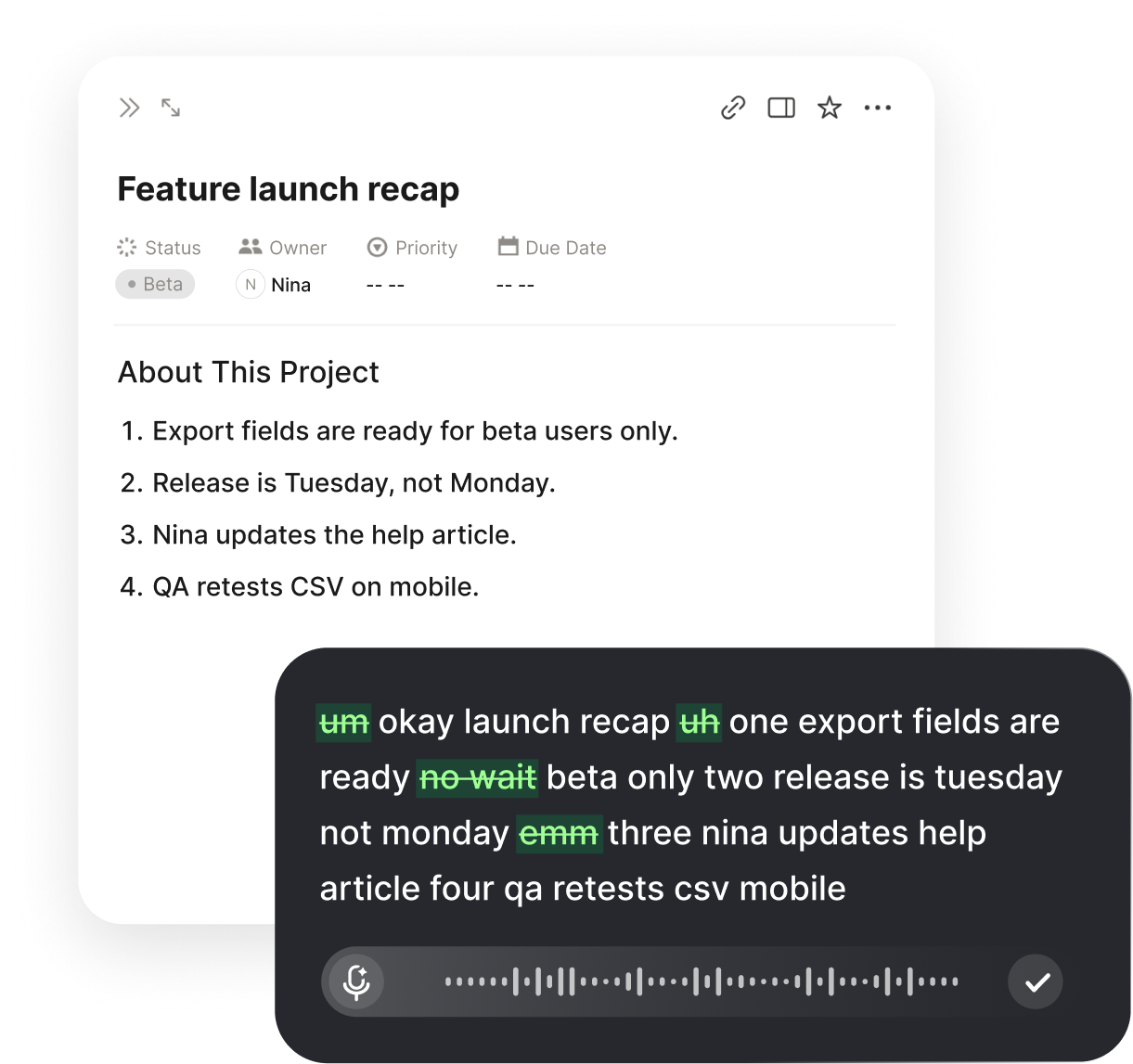
Two Passes, Two Jobs
Editing Dictated Legal Text for Precision is a distinct skill from dictating it, and most of the quality comes from the second job. Speech removes the mechanical barrier, so the first draft arrives quickly and with confidence, and confidence is exactly what an editor must test. The editor's task is not to rewrite in a different voice but to check that the document says what it was meant to say, consistently, and with nothing extra. That requires two passes with different questions. One pass asks whether the text is internally consistent, and the other asks whether each sentence survives a hostile reading. Keeping them separate is what makes the edit reliable.
Start with a consistency pass that does not read for meaning. Check the document against itself: defined terms, party names, numbering, headings, dates, and cross-references. A consistency pass is mechanical, and that is its advantage, because it works when you are tired. Use search for each defined term and each party name, and read every occurrence. Then check the numbering sequence and the heading levels. Most dictated legal text fails here first, not in the argument, and these failures are the easiest to fix. Search for each defined term in both its forms, because the variation is often a capitalization rather than a different word.
Then run a meaning pass, one paragraph at a time. Read the paragraph, cover it, and state its point in one sentence. If you cannot, the paragraph is doing two things or nothing. Compare your sentence with the paragraph's first sentence, and if they differ, the paragraph buries its point. Mark the place and continue. Do not rewrite during this pass, because rewriting consumes the attention the pass requires. A list of problem paragraphs, with a one-line reason for each, is a better output than a half-edited document. When a paragraph hides its point, the fix is usually to move the first sentence or split the paragraph.
Keep the original and the edited version separate until the edit is complete. Comparison is how you catch a change of meaning that arrived during a wording improvement. When you change a word, ask what obligation or condition the change affects. In legal text, a synonym is rarely neutral: shall and must may be equivalent in one document and not in another, and a defined term's short form may carry consequences. The editor's discipline is to treat every wording change as a legal change until proven otherwise. Keep a version before the edit, so a questionable improvement can be compared with what it replaced.
Read for Defined Terms and Pronouns
Read for defined terms before you read for anything else. Every defined term should appear in the defined form, with the same capitalization, everywhere it is used. A term that appears in two forms suggests two concepts, and a reader will assume two concepts. Check the first use in each section, because that is where a variation usually begins. Then check the places where a defined term should have been used and was not, such as a full party name in the middle of a short-form document. Consistency in defined terms is the cheapest precision available. Where a term is used in a heading, check that the heading form matches the defined form.
Then read for pronouns, which are where dictated text most often loses its subject. A spoken sentence can carry a clear referent in the speaker's mind, and the written sentence may have three candidates. For each it, they, this, and such, identify the noun. If the identification requires a guess, replace the pronoun with the noun or restructure the sentence. Legal text can tolerate repetition better than ambiguity. The rule is simple: a pronoun must have one obvious referent, and the reader must not have to choose. A sentence with two possible referents is not clarified by emphasis, so rewrite it.
Check the scope words that quietly change a clause: all, any, each, every, and, or, unless, and except. A dictated sentence often uses and where or was intended, or drops an unless that carried the negotiated exception. Read each scope word and ask what it includes and what it excludes. Where a list uses and, decide whether the items are cumulative; where it uses or, decide whether the choice is exclusive. These small words do more legal work than most of the nouns around them. Read the sentence without the scope word and see what changes, because the change is the legal effect.
Read the paragraph aloud once as a final check on terms and pronouns. The ear catches a referent that the eye skips, especially in a long sentence with several parties. If you stumble at a pronoun, the reader will too. If a defined term sounds wrong in your own voice, it probably is wrong in the document. Reading aloud is not a stylistic ritual, because it is a test that uses a different part of your attention, and it finds a class of errors that silent reading misses. Stop at each stumble and fix it before continuing, because the stumble is the finding.
Numbers, Dates, and Lists
Check every number twice, once in the sentence and once against the source. A dictated number that looks plausible is the hardest error to see, because the sentence around it confirms the wrong value. Read the number aloud as you compare it, and check the unit as well as the digit: days against business days, dollars against thousands of dollars, a percentage against a proportion. When a number appears in two places, compare both places, because one may have been corrected and the other not. Numbers are where a fast draft can be most expensive. Keep a short table of the figures as you check them, so a later pass does not repeat the work.
Check dates in the same way, including the year. A dictated date can arrive with the right month and the wrong day, and the error is invisible until a deadline passes. Confirm the date against the source, confirm the year, and confirm whether the date is a deadline or a reference point. Where a document uses both a date and a period, check that they agree: a notice dated March third with a five-day period produces a different deadline than one dated March fifth. The arithmetic belongs in the edit, not in the draft. Write the computed deadline beside the date, so the arithmetic is visible rather than implied.
Check every list for count, order, and closure. Count the items in the document and compare with the number you intended. Check that each item begins the way the others do, because a list with one item in a different grammatical form reads as an afterthought. Check the closing sentence, which should signal that the list has ended. Check the numbering, including any cross-reference to a list item. Lists are where structure and substance meet, and a list error is usually a substance error. Read the list as a reader would and ask whether the order is the order of importance or of time.
Check tables last, after the text is stable. A table that was accurate against an earlier draft becomes wrong when a figure changes in the body. Read the table against the text, then against the source. Confirm the units, the column order, and the total, if there is one. If the table was dictated, read the row labels aloud to ensure they are parallel. Tables are the part of a legal document most likely to be trusted without being checked, which is exactly why the check belongs to the editor rather than the reader. If the table has a total, check it against the column rather than against your expectation.
A Precision Checklist Inside the App
Keep a precision checklist inside the drafting app, next to the text. The list should be short enough to run in one sitting: defined terms, pronouns, scope words, numbers, dates, lists, and cross-references. Run it in that order, because the early items are cheap and the later ones depend on the text being stable. Voiskey keeps the document in the app you already use, so the checklist and the text share a window and the edit does not require moving anything. A checklist that lives somewhere else is a checklist that gets skipped under deadline. Print the list and keep it on the desk, because a list you have to open is a list you will skip.
Turn the checklist into a physical habit: read the item, search for the pattern, fix the pattern, tick the item. Searching for a defined term or a number takes seconds and finds every occurrence. Ticking the item prevents the most common editing failure, which is starting the list, being interrupted, and returning to the middle without knowing what was finished. A ticked list is also a record. When someone asks whether a document was checked, the list answers the question without a reconstruction. If a check finds nothing three times in a row, keep it for one more month before deciding.
When the checklist is stable, download Voiskey if you have not already and apply the same list to a document you drafted in a different way. The comparison is instructive, because typed text fails different checks than spoken text. Typed text tends to have consistent terms and weaker sentences, while spoken text tends to have stronger sentences and more term and number errors. Knowing which failure mode belongs to which method tells you where to spend the edit. Download Voiskey once and keep the checklist with the template, so the next document starts with both. Note which method produced which failure, and use that note to choose the next document.
Review the checklist quarterly and remove items that never find anything. A checklist with ten items that all work is better than one with thirty that nobody finishes. Add an item when a real error escapes, and note the error beside the item so its purpose is clear. The checklist is a record of the mistakes your practice has already made, and its value is that it does not forget them. Precision editing is not a talent; it is a list applied consistently by someone who is willing to be bored for twenty minutes. A checklist that grows without pruning becomes a document you read instead of a task you perform.
Keep an Edit Log That Teaches
Keep an edit log for a month and read it at the end. For each document, record the type of error you fixed: a wrong defined term, a missing exception, a transposed number, a pronoun with two referents, a list with a dropped item. Do not record the whole sentence, because the sentence is not the lesson. At the end of the month, count the categories and look for the largest one. Voiskey handles the mechanical transcription, so the log measures your editing, which is where the remaining risk sits. Keep the log in the same place as the checklist, so recording an error costs one line.
Use the largest category to change one habit. If numbers dominate, slow down at figures and read them aloud. If defined terms dominate, read the definitions before drafting and say the term list aloud at the start. If pronouns dominate, write shorter sentences with repeated nouns. One change per month is enough, and it is more than most practices manage. The log makes the change testable, because the next month's count shows whether the habit worked. This is ordinary improvement applied to writing, and it compounds. If the count does not improve after two months, the category was misdiagnosed rather than the habit ineffective.
Share the log with anyone who edits your drafts. A reviewer who knows your common errors can look for them first, which makes the review faster and more useful. If the same error appears in several drafters' work, the fix belongs in the template or the checklist rather than in individual habits. That is how a practice improves: a repeated correction becomes a structural fix. The log is the evidence that justifies the fix, and evidence is what turns a preference into a standard. A template change is visible to everyone, while a personal habit is visible only to you, which is why structural fixes last longer.
Finally, decide when precision editing is done. It is done when the checklist has been run, the numbers and dates have been compared with the source, the defined terms are consistent, and the document answers the question it was written to answer. It is not done when the prose feels smooth, because smoothness is not a legal standard. A document can be elegant and wrong, and a dictated document is more likely to be both than a typed one. The editor's job is to make the second possibility impossible, or at least visible before anyone relies on the text. A final read of the whole document, once, catches the errors the sections hid from each other.
FAQ s
Voiskey is an AI voice typing app: you press a shortcut, speak, and text appears at the insertion point in the app you already use. Because it removes filler words, stutters, false starts, self-corrections, and grammar slips, the editing pass can focus on precision rather than cleanup. Keep the text in that same app so the checklist sits beside it while you work.
Start with a consistency pass that does not read for meaning: defined terms, party names, numbering, headings, dates, and cross-references. Search each term and read every occurrence. Then run a meaning pass paragraph by paragraph, stating each point in one sentence. Separate the passes because mixing them makes both slower and less reliable.
Voiskey learns names, jargon, acronyms, and spelling preferences, which reduces variation in the first draft. The edit still needs a defined-term search across the document, checking the first use in each section and every place a full name appears where a short form belongs. On the team plan, shared vocabulary can carry confirmed labels across a group of drafters.
Write seven items: defined terms, pronouns, scope words, numbers, dates, lists, and cross-references. Run them in order, search for each pattern, fix it, and tick the item so an interruption does not lose your place. Keep the list in the same app as the draft, review it quarterly, and add an item whenever a real error escapes.


 Voiskey
Your voice, amplified.
Download Voiskey for Mac and Windows and start drafting by voice today.
Use it across macOS, Windows, iOS, and Android