
editing dictated academic tone: A Practical Guide to Editing a Dictated Draft into Academic Tone
One pass turns a spoken draft into academic prose without losing your voice.
 Voiskey Team
The Speaking Voice vs. the Academic Register
Editing dictated academic tone is not translating your draft into someone else's language; it is translating your own. A spoken draft carries your reasoning and your judgment, which is why it was worth dictating in the first place, and the edit that flattens all of that defeats the whole exercise. The real job is narrower than it feels: remove the machinery of talk, then raise the register without inflating the sentence. You edit a dictated draft into academic tone the same way you would tighten any rough writing, but with one advantage, the draft started from something real, so you are shaping a voice that exists instead of manufacturing one that sounds like every other essay in the pile.
Know the two registers before you touch a word. Speech runs in first person, short verbs, contractions, and connectives like so, and, and then; academic prose runs in precise verbs, evaluation, explicit transitions, and a measured stance, with first person allowed or forbidden by discipline. The mistake is not using one or the other, it is writing an essay in the wrong register entirely, which happens when people try to sound academic by adding words instead of replacing ones. So the pass has a fixed method: any word that exists only to sound spoken comes out, and any sentence that now lacks its verb gets a better one, and nothing else changes. The essay should still sound like you, elevated by one floor, not rebuilt by a different architect.
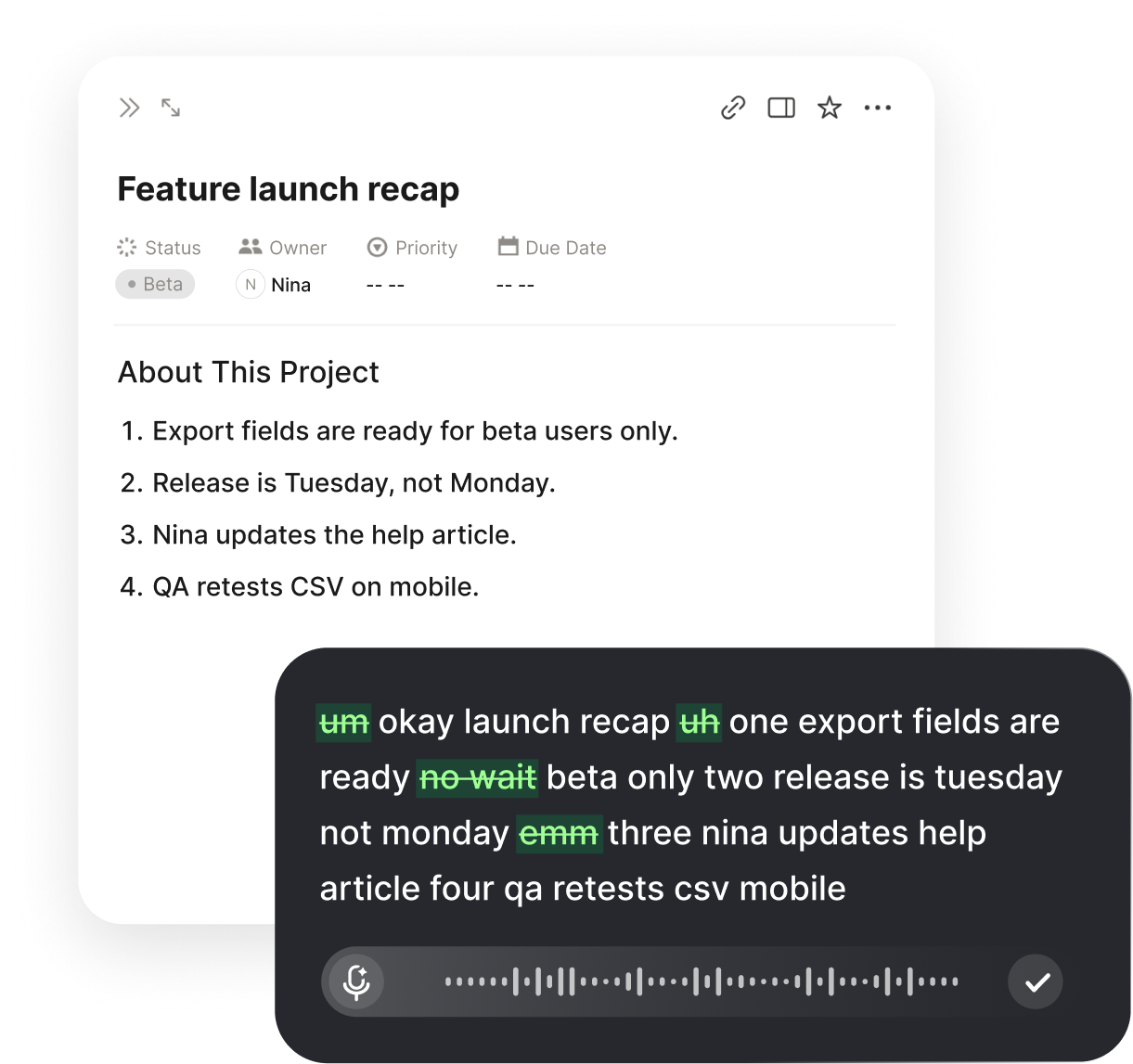
Plan the edit as three separate passes with three separate jobs, and do not let them merge into one doomed marathon. The first pass removes the litter of speech: filler, doubling, stray constructions, everything mechanical. The second pass works on stance, deciding for every hedge and every assertion which one survives. The third pass is a read-aloud in which you check that the essay still sounds like you and that it conforms to the assignment's rules. Each pass takes twenty minutes at most, because each has one job. Dictation makes the passes themselves faster: Voiskey writes your corrections straight into the document, so the fixed sentence replaces the old one in place, and the record of changes stays visible without a single line of track-changes clutter.
One Pass Over the Sentence-Level Litter
Start with the litter, all of it. Dictation pulls up the connective tissue of speaking: the kind of, sort of, basically, literally, you know, stuff, things, really, actually, the thing is, and the universal just. None of them carry meaning, and each one can come out with no loss. Search the transcript for them, and where one has infected the sentence, restate the sentence with the word gone. This is the one mechanical step where you cut without reading, and it alone shortens the draft visibly, often by ten percent. The whiplash of a leaner sentence is the best possible motivation to continue the pass.
Then repair the doubling, which is the signature of a spoken draft: you said it, said it again with more hesitation, and the transcript holds both. Read each paragraph and look for the repeated claim, the reason stated twice, the example given in two versions. Keep the clearer cut and delete the other. Where two clauses pull in different directions, split them into separate sentences and give each its own verb, because the run-on was not a stylistic choice, it was the breath running out. Then check every sentence for its subject and its tense, and fix the shifts you introduced by talking, since speech drifts between past and present without notice while prose cannot.
Delete the vocal mannerisms that survive transcription as text: the opening I think that before every claim, the rhetorical question asked to buy time, the fragment answering it moments later, and the double conjunction and so that starts half the paragraphs. Where the fragment was doing real work, convert it into the complete sentence it wants to be; where it was only breathing, let it go. Be careful with the tautology of conversational emphasis, the really quite, the very truly, because a single intensifier in a sentence is a choice and two are an apology. The pass finishes when every sentence survives on its own, without leaning on the tone of your voice for support.
Tone, Hedging, and Confidence
Hedging is where dictated prose and academic prose disagree most, so decide each hedge on purpose. An academic claim hedges to match its evidence, maybe, tends to, appears to, and the result is precision. A spoken draft hedges because the speaker has not decided, maybe, sort of, possibly, and the result is drift. Read the draft with only hedges highlighted and assign each one a verdict: keep, because the evidence genuinely supports the qualified version, or delete, because the claim stands on its own. The kept hedges should cluster at the claims your evidence does not fully settle, and the deleted ones should leave a confident claim that the rest of the paragraph then has to support.
Then run the scale of confidence in the other direction. Spoken drafts overreach as often as they underreach, and the overreach is harder to see because it sounds impressive: every, never, always, proves, destroys, these claim more than four pages can deliver. Work through them sentence by sentence and replace the absolute with the claim your evidence actually supports: the novel shows, the argument suggests, the passage tends to. This is not shrinking the claim, it is landing it, and the difference is audible when you read the sentence aloud after the change. The strongest essays say what they can prove and prove that, which is why the confident version of a good claim is almost always more specific, not more sweeping.
Cut the apology machinery, the meta-commentary that speech inserts out of politeness and typing inserts out of habit. It is important to note, this may seem obvious, in my humble opinion, and the parenthetical as we all know add a layer between the reader and the argument, and they all go. Delete the references to your own process wherever they appear: in this essay I will discuss reads as a nervously confessed itinerary in a draft that no longer needs to be signed off. The essay should begin with its claim or its question, not with a note about the essay. If the paragraph starts weaker after the deletion, move the real subject to the front of the sentence and begin there.
Keeping the Voice You Started With
The voice you kept is not the slang; it is the verbs, and this is the insight that makes the whole process work. The verbs you chose while talking are the ones you actually believed, so protect them. When a formal sentence needs a word, do not replace believed with a synonym cage, replace the furniture around it. Your rhythms too: the short sentence after a long one, the paragraph that ends on a phrase rather than a resolution, these are your fingerprints. Keep the example you told the way you told it, with its details inside, since an anecdote translated into abstraction loses the evidence along with the character. Voice, it turns out, is mostly judgment: which words do you trust?
Run the two-voices test near the end of the second pass. Read the edited paragraph aloud, then the original spoken version, and ask one question: could anyone who has never met me have written this edit? If the answer is yes, you converted rather than translated, and the fix is surgical. Take the sentence you most believed in the original and restore its phrasing, verb, meter, and the bit of personality the register can hold, which is more than most students think. Then find a second sentence, the one where you said something quietly in the middle of the ramble, the observation you almost didn't keep, and make sure it is still in the first person you actually claim it in. Two restored sentences are usually enough to make the whole draft sound owned again.
Rehearse the judgment before you commit the whole essay. Take one paragraph, the weakest, and edit it three different ways: formal to the point of dryness, conversational with a light formal coat, and the middle you actually want. Dictate each version as a separate block in the document, read them across the top of the session, and feel the difference. The middle version will probably win, because it holds the two things you need, rigor and identity, and the experiment teaches you what to do to the rest. Practice like this prevents the most common ending of a voice-drafted essay, which is a draft that no longer sounds like anyone, and it takes less time than the regret of having ruined the best material you had.
Do not edit the whole draft in one sitting. The day after, read it fresh, and the fresh read is where the changes you are ambivalent about reveal themselves for what they are: the sentence you doctored twice is usually the one that was fine the first time, and the paragraph you skipped because it read smoothly is usually the one with a subject missing. Dictate the corrections into the document; the spoken version of a repair is almost always simpler than the typed version you would have produced, because your ear prefers the sentence you would actually deliver. Then let it rest again and do the last pass in the morning, when the essay reads the way a grader will read it, as a stranger.
A Check List Before the Final Draft
Run this checklist in order, and the last pass takes twenty minutes instead of an evening. First, tense: every sentence in the past or every sentence in the present, with changes only where the argument genuinely moves between them, and no accidental slip. Second, person: first person allowed or banned by your discipline, and where it is allowed, use it for the argument rather than for autobiography, and where it is banned, convert I believe into the claim itself. Third, register: no contractions anywhere, because a contraction in a formal essay reads as noise no matter the content. Fourth, transition: reverse the order of the paragraphs and read the topic sentences alone; the argument should still make sense, and if it does not, the connective work is unfinished.
Continue the same list: fifth, claims and evidence, every paragraph marked by a claim the reader could disagree with, with its support attached and its interpretation explicit. Sixth, quotes: exact wording, integration into the sentence rather than display, and a citation format checked against the style guide you were given, not the one you remember. Seventh, vocabulary: one technical term per concept, used consistently, no synonyms circling the same idea, no jargon added to sound impressive that you could not define on the spot. Eighth, endings: each paragraph closes where your argument does, and the essay's final sentence says the last thing the reader should think, not restates the first thing you said.
Finish with the read-aloud, out loud and uninterrupted, because an essay's register only becomes visible in sound. Where you stumble, the sentence needs the fix even if it looks polished; where you speed up, the reasoning is landing; where your voice drops in the middle of a paragraph, the paragraph has lost its way. Listen for the last time for the two voices: the voice of the essay, which should be you with a formal coat, and the voice of the assignment, which should be satisfied, cite format, length, everything the rubric names. When both voices pass, stop editing. A dictated draft needs less polish than you fear, because it began from your actual thinking, and the goal of the pass was never to make it sound like someone else, only to make it sound like you on your best day.
FAQ s
Three: one for the mechanical litter of speech, one for hedges and the confidence scale, and one read-aloud for rhythm and formatting rules. Each pass has one job, twenty to thirty minutes, and they can be spread across two days so the final read is fresh.
It depends on your discipline and the assignment. Where first person is allowed, keep I argue and I read, and delete I think and in my opinion, which hedge rather than assert. Where it is banned, convert the claim into the sentence itself and let the evidence carry the voice.
Read it aloud and ask whether it sounds like a textbook. If you cannot hear yourself in it, you over-flattened. Restore two signature sentences from the original dictation, the one you believed most and the one you almost deleted, and the essay usually sounds owned again without losing the register.
Yes, and it is usually faster. Make the correction out loud into the document, one sentence at a time, and let Voiskey replace the old wording in place. The spoken version of a fix tends to be simpler and more direct than the typed one, because your ear prefers the sentence you would actually deliver.


 Voiskey
Your voice, amplified.
Choose a real task, follow the steps, and review the results with your team before expanding the rollout.
Use it across macOS, Windows, iOS, and Android