
Dictating a Research Proposal
Outline first, draft problem and method, then build the timeline
 Voiskey Team
Outline the Proposal Before You Speak
Dictating a Research Proposal is faster than typing one, but only if the outline exists before the microphone opens. A proposal is judged on the fit between a problem, a question, a method, and a plan, and speech encourages you to connect those parts aloud. Spend the first session speaking only headings and one-sentence promises: what the problem is, why it matters, what you will examine, how you will examine it, and what you can finish in the time available. Do not write the background yet. An outline spoken in twenty minutes gives your advisor something concrete to correct before you invest hours in paragraphs.
Start from the call or the rubric, not from your interest alone. Copy the headings the program or course requires and put them in order. If the requirement is a two-page proposal, plan about one paragraph per heading. If it is a ten-page version, plan a section per heading with an evidence note for each claim. Speak the required length and the deadline at the top of the document so they stay visible while you draft. A proposal that ignores the required structure is rejected on form before anyone reads the idea, and a spoken outline tied to the rubric avoids that avoidable failure.
Write the research question as one sentence you can repeat from memory. A strong question names the population, the relationship, and the setting in plain language. Speak three candidate versions, then choose the one that a reader outside your field could understand. Put it alone on a line and keep it in view during every later session. When a paragraph does not help answer that sentence, cut it or move it to background. A proposal drifts when the question is vague, and speech makes the drift obvious because you can hear yourself answering a different question than the one on the page.
Assign roles before the drafting sessions. You dictate the argument, an advisor or peer checks the logic, and a third reader checks the citations and the format. Set a short feedback window for each round so the draft keeps moving. If you work alone, assign the checks to different days rather than doing everything in one sitting, because the same reader catches different problems on a second pass. Write the plan at the top of the document: who reads which section, by when, and what kind of comment you want. An explicit plan turns vague encouragement into usable corrections and keeps the proposal on schedule.
Draft the Problem and Method in Sequence
Draft the problem statement before the background. Speak the problem in three moves: what is currently known, what is missing or contested, and why the gap matters to someone outside the field. Keep each move to two or three sentences. The background section then expands the first move with sources, but it never replaces the problem statement. When you speak the missing part, name it precisely, such as no study compares the two conditions over a full term. Vague gaps produce vague proposals. After dictating, read the problem statement and mark any sentence that would still be true if your study never happened; those sentences usually belong in background.
State the method as a sequence of decisions rather than a list of tools. Say what you will compare, how you will decide when a case belongs in the study, and what result would support the claim. If the design has a comparison, name both sides and the condition that separates them. If it has a single case, say what would count as disconfirming evidence. Speak the method in the present tense and in the order the work will happen. A method written as a tool list cannot be evaluated, while a method written as decisions can be checked by an advisor in one reading and revised before the plan is fixed.
Keep the proposal's claims proportional to the evidence you can gather. When you speak a strong claim, add the evidence that would support it and the limit you accept. Voiskey adapts wording and tone to the task, so a sentence spoken as a limitation lands differently from the same idea spoken as a promise, and telling it that you are stating a limit helps. Avoid promising general conclusions from a small or narrow study. A reader trusts a proposal that states its boundaries, and an honest limitation is stronger than an inflated claim that invites a challenge you cannot answer.
Write the method section in short paragraphs, one decision per paragraph. Each paragraph should say what happens, what it produces, and what could go wrong. If a step depends on access you do not yet have, say how you will confirm that access before the study starts. If a step depends on a partner, name the person or office and the date you will ask. Read the section aloud and stop at every sentence that assumes something unstated. Those sentences are either assumptions to declare or gaps to fix. A method built from short, checkable paragraphs is easy for an advisor to approve and easy for you to follow when the work begins.
Speak the Timeline and Feasibility Case
Build the timeline from the deadline backward, not from today forward. Put the submission date at the top, then the weeks for each stage: reading, design, recruiting or sourcing, analysis, writing, and revision. Speak each stage as a start and an end, and mark the stage that cannot slip without moving the deadline. Leave one full week empty near the end for revision and one short buffer before each handoff. A timeline spoken backward exposes an impossible plan quickly, because the last stages collide when the early ones are too generous. Record the buffer as a real block rather than as a hope.
Make the feasibility case explicit in one short section. Say what resources you need, which ones you already have, and who confirmed access. If the study depends on a course, a lab, a partner organization, or a supervisor's time, state the commitment as a condition of the plan. Speak the fallback for each dependency: a smaller sample, a shorter window, or an alternative site. A proposal that names its fallback looks prepared rather than fragile. When you dictate this section, keep each dependency to one paragraph with the confirmation date, so a reviewer can see that the plan rests on facts rather than optimism.
Describe the work you will do personally and the work that needs someone else. Speak your own tasks in the first person and the shared tasks with the role that owns them. If a task needs a reviewer or an approval, put it on the timeline as a block with a name and a date. This distinction matters because a plan that hides shared work behind passive sentences looks simpler than it is. A reviewer who can see the division of labor can judge whether the schedule is realistic. Revisit the division each time the timeline changes, and move the dependent blocks rather than pretending the shared work takes no time.
Close the planning section with a risk register of three items. For each risk, speak the trigger that would tell you it is happening, the response you would take, and the date you would decide. Keep the list short and specific; a long generic list signals that no one thought about which risks actually matter. Read the register aloud and check that each response is something you can do without new approval. If a response needs permission, treat that permission as a dependency in the feasibility section. Three live risks with dates are more convincing than ten abstract worries, and they give you a plan for the week the schedule first slips.
Refine the Draft With Voiskey
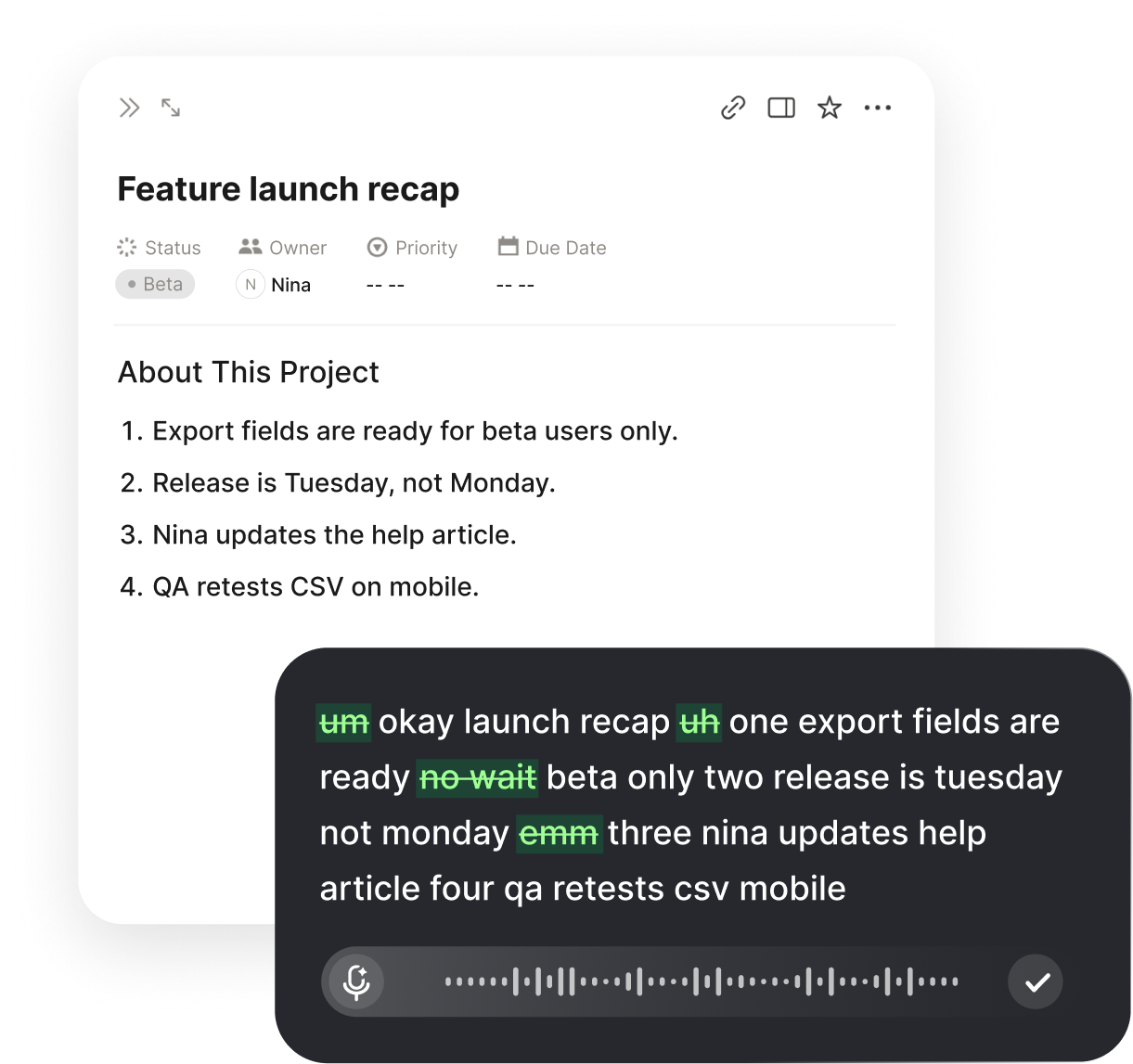
Use a spoken revision pass before you send the proposal anywhere. Download Voiskey if it is not on the machine you write on, then open the draft and put the insertion point at the top. Read each section aloud and speak the fix rather than describing it: shorten this paragraph, move the limitation earlier, replace this claim with the sentence from the sources note. Voiskey removes filler and false starts, so the revision arrives as clean prose instead of a trail of spoken repairs. Keep the outline and the rubric open beside the draft, and check every heading against them as you go.
Revise for one property at a time. First, check that every heading in the rubric has a matching section and that no section drifts from its heading. Second, check that the research question appears early and that each section returns to it. Third, check the method for missing decisions, then the timeline for missing dependencies. Speaking one check at a time keeps the revision focused and prevents a long pass that changes everything slightly and nothing decisively. After each check, dictate a one-line note describing what you changed or why the section passed. Those notes become the revision history your advisor can read at a glance.
Tighten the prose to the length the program allows. Cut every sentence that repeats a point already made, and merge paragraphs that contain one idea. When a section runs long, ask which sentence a reviewer could remove without losing the argument; if the answer is none, the section is probably two sections. Speak a shorter version of the longest paragraph and compare it with the original before replacing it. Voiskey adapts formatting to the task, so a spoken rewrite tends to come out shorter and more direct than a typed edit, which is exactly what a page limit rewards. Record the new length at the top before the next pass.
Run a careful read-aloud check with a peer who has not seen the draft. Ask them to stop you whenever a sentence needs a second hearing. Those stops mark dense prose, undefined terms, or hidden assumptions. When you speak the corrected sentence, keep the peer's question in the document as a comment so the fix has a reason attached. Do this before the final proofread, because rephrasing after proofreading reintroduces errors. A proposal that survives one cold read is usually ready for the advisor, and the questions your peer asked often predict the questions a reviewer will ask later.
Submit a Proposal You Can Defend
Prepare for the defense while the draft is still fresh. Download Voiskey on your laptop and open a new document beside the proposal. Speak the five questions a reviewer is most likely to ask, then speak your answers in full sentences. Include the uncomfortable ones: why this method, why this site, what happens if access is refused, how you will know the claim is wrong. Read the answers aloud and cut any that dodge the question. The document you produce is not a script; it is a set of prepared positions that keeps you steady when the questions arrive in a different order during the session.
Check the packet against the submission rules line by line. Read the rules aloud and speak each requirement into a checklist with a yes or no beside it. Cover length, headings, citation style, required attachments, and the naming of files. Ask a second reader to run the same checklist without your notes, then compare the two lists. Differences usually point to a rule that is easy to misread. Keep the checklist with the submitted version so you can prove what was sent if a question arises later. A rejected submission is almost always a form problem, not an idea problem, and the checklist catches it before the deadline.
Keep a single source of truth for the submitted version. Name the final file with the date and a version number, store it in one folder with the outline, the revision notes, and the reviewer comments, and stop editing copies scattered elsewhere. If you must send an updated draft, say which version it replaces and delete or archive the older one. When you dictate the cover note, state the title, the track, and the one sentence that summarizes the study. A clear cover note and a single final file reduce the chance that a reviewer reads a version you have already improved.
Finish with a short reflection you can reuse for the next proposal. Speak what took longest, which check caught the biggest problem, and which dependency you would confirm earlier next time. Add the reflection to the folder and keep the checklist for reuse. If the proposal is accepted with conditions, speak those conditions into a follow-up list with dates and owners before you celebrate. If it is rejected, record the stated reasons without editing them into something softer, then map each reason to a section you can change. The next proposal starts faster because the method, the checklist, and the honest reflection already exist.
FAQ s
Speak your outline, problem statement, and method as complete sentences, and Voiskey places the text at the insertion point in your draft. It removes filler and false starts and adapts punctuation, so each section reads cleanly when you check it against the rubric.
Voiskey learns names, jargon, acronyms, and spelling preferences. Say a field-specific term clearly once, then use it normally in later sections; repeated vocabulary settles into a consistent form, which makes it easier to compare the problem statement, the method, and the timeline.
Speak the headings and one-sentence promises before any background prose. State the problem, the question, the method, and what fits the time available, then expand each heading in a later session. Starting from the required structure keeps the draft aligned with the rubric.
Open a second document, speak the five questions a reviewer is most likely to ask, and answer each in full sentences. Read the answers aloud and cut any that dodge the question. The result is a set of prepared positions rather than a script, which helps when questions arrive in a different order.


 Voiskey
Your voice, amplified.
Download Voiskey for Mac and Windows to draft and revise a research proposal in place.
Use it across macOS, Windows, iOS, and Android