
Dictating Reading Summaries and Annotations
Speak summaries and annotations as you read, then shape them into a chapter-level log.
 Voiskey Team
Read With a Summary Target in Mind
Dictating Reading Summaries and annotations works when you decide the shape of the summary before the first page. A target turns reading from a passive sweep into a search. For a chapter, the target might be one claim, two pieces of evidence, and your own reaction in three sentences. For an article, it might be the question, the method, and the finding. Write the target at the top of the log before you begin. Without it, you will dictate whatever catches your attention and end with a page that describes the reading without explaining it. The target is a promise to your future self.
Choose the size of the target to match the source. A dense chapter deserves a one-page summary with three or four sections; a short article deserves a paragraph. The size is not a measure of effort but of use: a summary should be short enough to reread in five minutes and complete enough to answer a question without returning to the source. If you cannot decide, aim smaller. A short summary that you actually use beats a long one that you file and forget, and the short one is much easier to keep accurate. Write the size at the top of the target.
Read actively by marking the pages where you pause. A pencil mark in the margin, a folded corner, or a note in the reader is enough. The mark records the moment your attention caught on something, and those moments are the raw material for the annotations you will speak. Do not stop to write a full note during the first pass; mark and continue. The first pass is for the shape of the argument, and the second pass, which you will do with the log open, is for the detail. Separating the passes keeps both of them fast. One pass to find the shape, one to fill it in.
Set up the reading desk before you start. Put the source on one side of the screen and the log on the other, with the page field at the top of the log. Keep a pen beside you for the margin marks and for diagrams you cannot describe in words. Turn off notifications and set a timer for the reading block. If you are reading on paper, keep the log open on the laptop and write the page number before you speak each annotation. A predictable desk makes the difference between a reading session and a reading intention. Set it up before you open the source.
Dictate Annotations as You Read
Pause at the end of a paragraph and speak one annotation before you continue. Start with the page number, then the type of note, then the content: page forty-two, definition, the author uses scarcity to mean a supply constraint rather than a price signal. Speaking the page first is a small habit with a large payoff, because it keeps the annotation anchored when you return to it weeks later. Keep each annotation to one or two sentences. If it needs more, it is probably a summary rather than an annotation, and it belongs in the chapter log. One page number per annotation.
Use four annotation types and no more: definition, evidence, objection, and connection. A definition records a term the author uses in a specific way. Evidence records a fact, a study, or an example that supports the argument. An objection records a weakness or a counterexample you noticed. A connection records a link to another reading or to your own project. Four types are enough to cover most academic reading, and the fixed set makes the log scannable. Say the type at the start so you can sort the annotations later without rereading them. Four types also stop the log from drifting into prose.
Handle quotations carefully. When a sentence is worth keeping, say the word quote, then the sentence, then the page, then stop. Do not paraphrase and call it a quote, and do not quote more than two sentences at a time. After the session, check each quotation against the source, because a spoken quotation can drift by a word or two even when the meaning survives. A quotation with a wrong word is worse than a paraphrase, because it looks authoritative and fails under scrutiny. Keep quotations rare and exact. Mark the check date beside each one. Two quotations per chapter is a good limit.
Resist the urge to rewrite the book in your annotations. The purpose is to record your interaction with the text, not to reproduce it. If you notice yourself summarising whole sections in the annotation field, stop and mark the section for the chapter log instead. A page of short, typed annotations is more useful than three pages of prose, because you can scan it in a minute and find the four lines that matter. The discipline of stopping is what keeps the reading log a tool rather than a second draft of the reading. Stop at three sentences. If the thought needs four, it is a summary.
Build a Chapter Summary from Annotations
Consolidate the chapter within a day, in a fifteen-minute block. Open the annotations and read them in order, then speak a summary that answers the target you wrote at the top of the log. Do not include every annotation; choose the four or five that carry the argument. The summary should stand alone, so a reader who has not seen the chapter can follow the claim and the evidence. If the summary needs an annotation to make sense, the annotation was doing work that belongs in the summary, so move it up. Then delete the annotation. The summary absorbs it, so nothing is lost.
Group the annotations by theme before you speak. Most chapters return to two or three ideas, and those ideas are the sections of your summary. Say the theme, then the evidence the author used, then your reaction. This three-part shape makes the summary useful for an essay, because it separates what the author claimed from what you think about the claim. A summary that blends the two is hard to cite and easy to misremember, especially when you return to it during the exam period under pressure. Keep the reaction in its own paragraph. Label it with your initials, not with the author's name.
Keep the author's claim and your view visibly separate. Use a phrase such as the author argues for the claim and a separate phrase such as my view is for your reaction. This sounds mechanical, and it prevents a common and expensive mistake: attributing your own interpretation to the author in a later essay. The separation also makes the summary more honest, because it shows where the evidence ends and your judgement begins. When you reread the summary in a month, you will know which sentences you can cite and which ones you must argue for yourself. Two labels are enough.
Close with a one-page chapter note that contains the summary, the page references, and three questions. The questions should be the ones the chapter raises but does not answer, because those are the questions that make a seminar or an essay interesting. Put the note at the top of the file and the annotations below it, so the summary is the first thing you see. If the note is longer than a page, cut it; a chapter note that takes ten minutes to reread will not be reread. The page limit is a feature. Cut the least cited paragraph first.
Compare Summaries Across Sources
When two readings cover the same topic, compare them before the seminar. Put the two chapter notes side by side and speak a comparison with three parts: where they agree, where they disagree, and what the disagreement turns on. The third part is the most valuable, because it names the evidence or the assumption that separates the two positions. A comparison that stops at agreement and disagreement is a list; a comparison that names the hinge is an argument. Write the hinge as a single sentence at the top of the comparison page. Then check that both sources actually address it.
Build a small evidence table by voice. Say the source, the claim it supports, and the page, and repeat for each source in the comparison. Voiskey adapts formatting to the task, so a spoken list of three items arrives as a table or a list you can tidy. Keep the table to four rows; a larger table becomes a document rather than a study aid. The table is particularly useful in an exam, where you may need to compare two positions quickly and cite the evidence for each one without returning to the sources. Four rows are enough for most comparisons.
Give the comparison a shape you can reuse across the term. A simple three-part shape works: what each source claims, what each source uses as evidence, and which one you find more convincing and why. Speak the shape in the same order every time, and the comparisons will feel like a series rather than a set of unrelated pages. Voiskey adapts punctuation and tone to what you are trying to do, so a comparison spoken for your own eyes reads tighter than a summary spoken for submission. The shape is what makes the comparison fast to write and fast to reread.
Use the comparison to prepare one seminar question. The best question usually sits at the hinge, where the two sources disagree about evidence or scope. Speak the question in one sentence, then add one sentence about why the answer matters for the course. Keep both in the comparison page and read them before the session. One download covers the whole system, so the comparison page and the source notes can live in the same place and the same shortcut works in both. A comparison without a question is preparation; with a question, it is participation. Write the question before the seminar, not during it.
Carry the Log into Essays and Exams
Turn chapter notes into essay paragraphs by speaking the paragraph before you write it. Choose a claim from the chapter note, say the evidence that supports it, and add the link to your own argument. Speak the paragraph in four or five sentences, then edit the result into the shape your essay requires. Voiskey keeps up at up to 220 words per minute, about five times faster than typing, so a paragraph that would take ten minutes at the keyboard takes two or three spoken. The edit is where the argument is sharpened, and it is much easier to sharpen a draft than a blank page.
Check every citation detail while the source is open. A page number spoken from memory is a guess, and a guessed page number is the most common error in student essays. Keep the source beside the draft and verify the page, the year, and the spelling of the author's name as you speak each citation. If a detail is missing, mark it rather than inventing it. A marked gap takes a minute to fix; a confident wrong citation takes an hour to discover and damages the argument around it. Check the page while the source is open. Then record the check in the log.
Review the log at the end of the term and prune it. Keep the chapter notes that fed an essay or answered an exam question, and archive the rest. A reading log grows quickly, and an unpruned log becomes a second library that you cannot search. Write one page that lists the ten sources you would cite first for the course, with the reason for each. That page is the handoff from reading to revision, and it is much shorter than the log it came from. Pruning is part of keeping the log usable. Do it before the next term starts.
Carry the log across devices and terms. If you move to a new laptop, download the current installer, sign in, and run a two-sentence test in the log field before the next reading session. Keep the chapter notes in a folder your next device can reach, and keep the vocabulary of author names and terms with them. At the start of the next term, read the ten-source page once and add one line about what you would read differently. A reading log that survives a device change is a log you will still have in your final year.
FAQ s
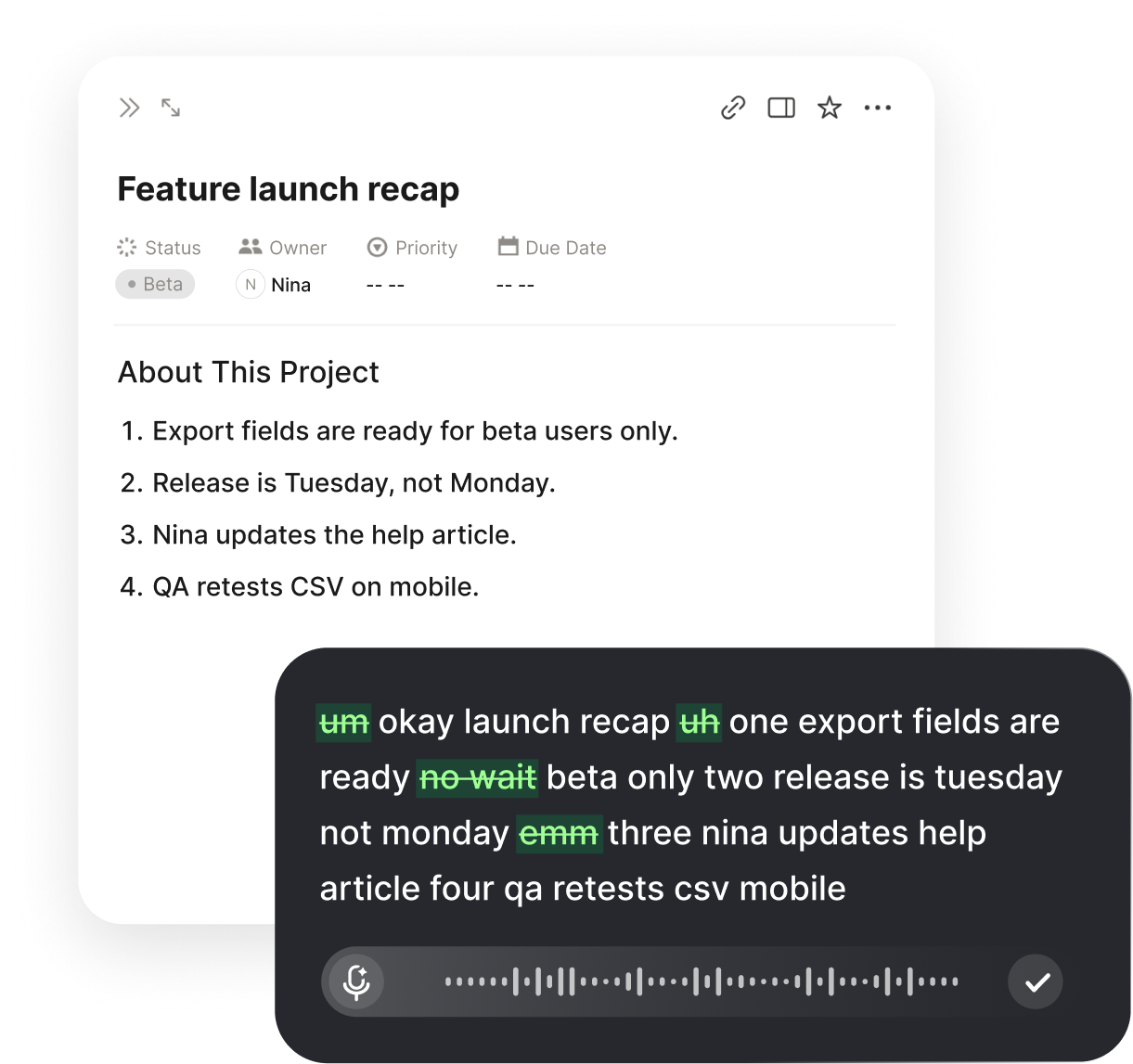
No. Voiskey is a voice typing app. You read the source yourself, then speak a summary or an annotation, and the text appears at the insertion point in your log. It removes filler words, stutters, false starts, and self-corrections, and it adapts punctuation and formatting to the note. It does not open, scan, or interpret the document.
Start with the page number, then the annotation type, then the content. Use four types: definition, evidence, objection, and connection. Keep each annotation to one or two sentences, and say quote aloud before a quotation, followed by the sentence and the page. That pattern keeps the log scannable and every line anchored to the source.
Annotate in short lines with page numbers, then consolidate within a day into a one-page chapter note with the claim, the evidence, and your view kept separate. Put the summary at the top and the annotations below. Add three questions the chapter raises. The one-page limit forces selection, and selection is what makes the note reusable.
Yes. Dictate a comparison in three parts: where the sources agree, where they disagree, and what the disagreement turns on. Add a four-row evidence table with the claim and page for each source. Voiskey types the spoken comparison at the insertion point and adapts formatting to a list, so the comparison is ready to edit into a seminar question.


 Voiskey
Your voice, amplified.
Download Voiskey for Mac and Windows and dictate reading notes while the page is still open.
Use it across macOS, Windows, iOS, and Android