
Dictating Reading Responses
Speak a reading response in one pass, then refine the argument.
 Voiskey Team
Plan the Response Before You Speak
Dictating Reading Responses works best when you decide the claim before you open the microphone. Read the prompt twice and underline the verb: analyze, compare, evaluate, or respond. Write a single sentence that answers that verb, then list the two or three passages you will use as evidence. Keep the plan to one screen so you can glance at it while speaking. Note the citation style your course requires and the expected length, since both shape how much you can say. Set a timer for the planning stage and stop when it rings, even if the plan feels rough. A rough plan you can speak is more useful than a polished outline you never finish.
Annotate the text before you plan, not while you draft. Mark the passages that surprised you, the sentences that contradict each other, and the places where your own experience pushes back. Write a short margin note beside each mark using your own phrasing. These notes become the evidence list for the spoken draft and keep you from drifting into summary. If the reading is long, choose three sections and treat them closely rather than covering everything lightly. The quality of a response usually comes from one sustained observation, not from a tour of the whole article. Decide which observation you can defend with the strongest passage.
Give the response a simple shape before you speak: a claim, a concession, and a consequence. The claim states what you think the text argues or fails to argue. The concession names the strongest objection or the passage that complicates your view. The consequence explains why the difference matters for the course question. Speak this shape aloud once without notes, then adjust the plan where you hesitated. A three-part structure is easy to hold in mind and easy for a reader to follow. It also prevents the common failure where a response lists reactions without ever committing to an interpretation.
Define what a finished response must contain before you start drafting. Check the rubric for required elements such as a clear thesis, direct quotation, analysis rather than summary, and a works cited entry. Turn each requirement into a yes-or-no question you can answer at the end. Note the submission format and the file naming rule. If the assignment asks for a personal response, decide how much of your own experience belongs in the page and where it should appear. Write these criteria at the top of the file and leave them there during the draft. The final check becomes a short checklist rather than a last-minute guess.
Draft in One Continuous Spoken Pass
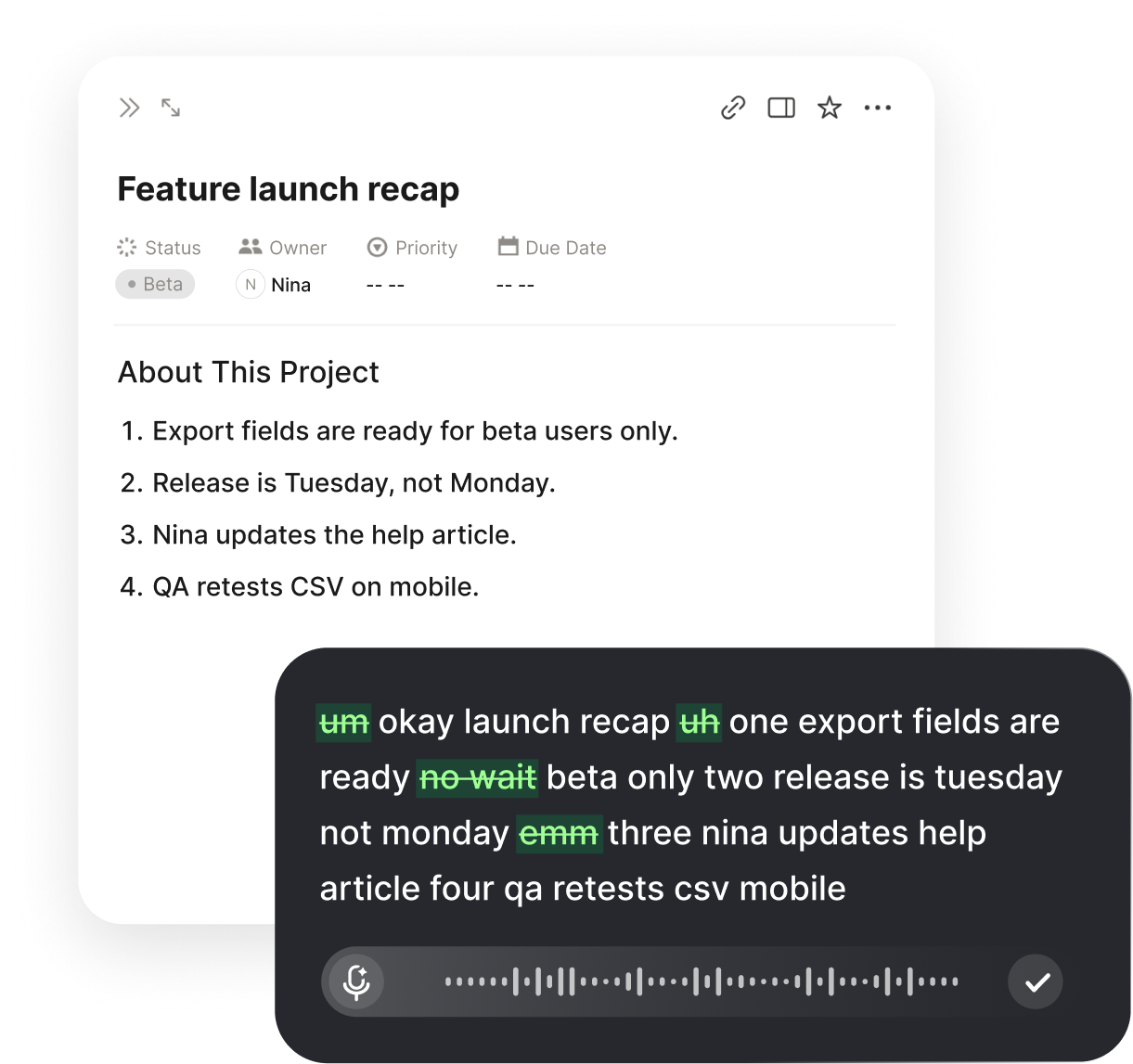
The first spoken pass should move forward without correction. Open your response file, place the cursor after the heading, and speak the claim sentence, then the evidence, then the consequence. Do not stop to fix a term or reorder a sentence; the app removes filler, stutters, false starts, and self-corrections, so the transcript will read more cleanly than the performance felt. If you lose the thread, say the next planned point and continue. Keep the plan visible at the edge of the screen and glance at it only between paragraphs. The aim is a complete draft in one sitting, because a complete rough draft is easier to improve than a perfect opening.
Speak in paragraphs rather than in one long stream. Begin each paragraph with a short signpost, such as the first problem or a second reading, then give the evidence and the interpretation. Pause briefly between paragraphs; the pause gives the app a natural boundary and gives you a moment to check the plan. If a paragraph runs past six sentences, stop and ask whether it contains two ideas. When it does, say split here and continue with the second idea under a new signpost. This habit produces a draft with visible structure, which reduces the amount of reorganization needed in the polish pass.
Quotations need special handling in a spoken draft. Say quote, then read the passage slowly enough to be captured, then say end quote. If the quotation is long, read only the clause you will analyze and paraphrase the rest. After the quotation, speak one sentence that explains what the quoted terms are doing in the argument. Do not rely on memory for wording; keep the book or article open beside you and read directly. If you cannot find the exact sentence, mark the spot with a spoken placeholder such as quotation needed and keep moving. Accuracy can be restored later; momentum cannot.
Plan a stop condition for the moments when the draft stalls. If you have nothing to say for more than a few seconds, speak a question instead of silence, then answer it in one sentence. If the answer is weak, mark the paragraph as thin and continue to the next section. When you reach the end, stop the draft and read the last paragraph aloud before adding anything. Most stalled responses need one more piece of evidence, not a longer conclusion. Write that need at the bottom of the file and return to it during revision. A marked gap is a task; an unmarked gap becomes a vague worry.
Keep Quotations and Citations Accurate
Check every quotation against the source before you polish anything else. Read the printed sentence and the captured sentence side by side, then correct spelling, punctuation, and ellipses. Confirm the page number and the edition, since a quotation that is accurate in one edition can differ in another. If the course uses a specific citation style, follow its rules for in-text citations and the final list. Mark any quotation you cannot verify and either verify it or remove it. A response with three exact quotations is stronger than one with eight approximate ones, and instructors notice the difference quickly.
Distinguish quotation from paraphrase in the draft. A quotation uses the source's exact phrasing inside quotation marks; a paraphrase restates the idea in your own sentence and still carries a citation. During the spoken pass these can blur, so review each sentence that mentions the source and decide which form it should take. If the phrasing is distinctive, keep the quotation. If only the idea matters, rewrite it in your own language and cite the page. Never present a paraphrase as a quotation or a quotation as your own sentence. This check is mechanical, and it protects the argument from a serious academic error.
Build the citation list while the sources are open. Add each work as you use it rather than reconstructing the list at the end. Record the author, title, publication details, and the page range you actually used. If the course provides a citation guide, keep it beside the draft and follow one example exactly. Check that every in-text citation has a matching entry and every entry is cited at least once. Remove sources you consulted but did not use. A short, accurate list is easier to verify than a long, uncertain one, and it saves time during final review.
Read the evidence sentences without the surrounding paragraph and ask whether they still support the claim. A quotation can be accurate and still irrelevant. For each piece of evidence, write one sentence explaining the link between the quoted language and your thesis. If the link needs more than one sentence, the evidence may be doing too much work. Check that you have not quoted the same passage twice for different points. Confirm that the strongest counterexample is addressed rather than avoided. Evidence earns its place by advancing the argument, not by filling space toward the required length of the assignment.
Refine the Argument with Voiskey
The second pass turns the transcript into an argument. Read the draft once without editing to see whether the claim appears early and whether each paragraph advances it. Then work paragraph by paragraph: state the point in one sentence, check that the evidence follows, and cut anything that repeats. Voiskey adapts punctuation, formatting, tone, and word choice to the task, so a spoken aside can become a controlled academic sentence after a short edit. Use the Speak-Polish-Type-Edit order: speak missing transitions, let the app clean the phrasing, type headings and citations, then edit for precision. Keep the original draft until the revision is complete so you can compare.
Tone should be consistent with the assignment. A seminar response can be direct and personal; a formal analysis should stay measured and evidence-led. Say the intended register aloud before revising, then adjust sentences that drift. Replace conversational hedges with precise claims, and replace overstated claims with qualified ones. If the app offers a smoother phrasing, check that it has not changed your position. Keep key terms from the course exactly as the instructor uses them, even when a synonym reads more naturally. A consistent register helps the reader trust the analysis and keeps the response from sounding assembled from different drafts.
Strengthen the structure during this pass. Confirm that the introduction states the claim, the body moves from evidence to interpretation, and the ending explains the consequence rather than summarizing. If a paragraph begins with a quotation, add a sentence before it that says what the quotation will demonstrate. If a paragraph ends with a question, answer it or replace it with a conclusion. Type short headings while revising, then remove them before submission if the format forbids headings. Read the first sentence of each paragraph in sequence; they should form a readable outline of the argument on their own, without extra commentary.
Finish with a read-aloud check. Read the revised response at a normal speaking pace and mark every place where you stumble, breathe oddly, or lose the thread. Those marks usually indicate a sentence that is too long or a transition that is missing. Cut the response by about one tenth, starting with repeated examples and vague qualifiers. Verify that the final sentence answers the prompt rather than trailing off. Compare the result with the criteria you wrote before drafting, and record which ones are now met. The response is ready when the argument can be followed by someone who has not read your plan.
Finalize and Submit the Response
Run a final checklist against the assignment rather than against your memory of it. Confirm the word count, the citation format, the required file type, and the naming rule. Check the heading for your name, course, and date if the instructor requires them. Verify that every quotation is exact and every citation matches an entry in the list. Read the prompt one last time and underline the verb; confirm that your response performs that verb rather than a nearby one. If a requirement is missing, fix it before touching the prose. Following the required format is the cheapest part of the grade to secure.
Ask one reader to check the argument, not the commas. Give them the prompt and your claim sentence, then ask whether the body supports the claim and whether the evidence is convincing. Take notes on their questions without defending the draft. If two readers ask about the same paragraph, that paragraph needs work. If a reader cannot restate your thesis after one reading, rewrite the opening. Keep the exchange short and specific; a fifteen-minute review with a clear question is more useful than a general request for feedback. Thank the reader by returning the favor on their next response.
Set up your own writing environment before the next assignment. Download Voiskey, install it for your operating system, and test the shortcut inside the document editor you use for coursework. If you qualify for the student offer, sign in with a school email and enter the code sent to that address. Create a template with your heading, citation style reminder, and the three-part plan. Save it beside the course reading list so it is easy to duplicate. A familiar setup reduces the time between deciding to write and actually producing sentences, which matters most when several responses are due in the same week.
Archive each response with enough context to reuse later. Keep the final version, the spoken draft, and a one-line note about what you would change next time. Name the file with the course code, week, and text, then place it in the course folder rather than on the desktop. Before an exam or a longer essay, skim the archive to see which arguments developed well and which evidence you overused. If a response received feedback, add the main point to the next template. Over a term, this small archive becomes a record of your reading and a source of stronger starting points.
FAQ s
Speak your claim and evidence in one continuous pass while the text is open beside you. Voiskey places the text at the insertion point in your document, removes filler and false starts, and adapts punctuation to your sentences, so the first draft keeps your reasoning instead of your hesitation.
Voiskey captures what you read aloud, but you still verify each quotation against the printed source. Say quote and end quote around the passage, read slowly, then compare the captured sentence with the page. Correct spelling, punctuation, and the page number before the polish pass.
Voiskey adapts tone and phrasing to what you are trying to do. State the register before you revise, such as a direct seminar response or a measured analysis, and adjust any sentence that drifts. Check that smoother alternatives preserve your position and keep course terminology exact.
Read the prompt, underline its verb, and write one claim sentence plus two or three passages you will cite. Add a concession and a consequence so the response has a shape. Speak the plan aloud once, fix the places where you hesitate, then start the continuous spoken draft.


 Voiskey
Your voice, amplified.
Download Voiskey for Mac and Windows and speak your next draft into place.
Use it across macOS, Windows, iOS, and Android