
dictating meeting notes dev teams: A Practical Guide to Dictating Meeting Notes for Dev Teams
Capture decisions in the ten minutes after the call, not the day after
 Voiskey Team
Meetings That Produce Nothing
Most dev meetings end with nothing, not because the discussion was bad, but because the output died on the way to a written summary. The decision is made, the room disperses, and by the time someone volunteers to write the notes, the context has slid away and the summary becomes a list of attendance. Dictating meeting notes dev teams will actually read is the instant after the call, before lunch, before the next message, while the decision and its reasoning are both still in the room. The notes are written by whoever has the context; the person is you, and the moment is now. The recorder is whoever holds the context, and you are it.
The meeting itself usually produces the raw material: the problem framed, the options raised, the decision argued. The raw material is conversational, and that is exactly why it survives transcription badly. Freehand notes fragment it; dictation preserves the causal order: we considered X, rejected it because Y, and chose Z. When the notes are dictated with the same words the room used, the recap reads like the meeting instead of like a summary of it. A recap that sounds like the meeting is a recap the team will read. The causal order is the part that dies in the retelling. Save it with the same words.
Notice what your meetings cost and what they lack. A one-hour meeting with two decisions and a follow-up list can be returned to the team in four sentences. Skip the recap and the same discussion repeats in Slack and in the corridor, or the decision is re-litigated and one of the options wins because nobody remembers why it lost. The recap is the cheapest way to prevent the argument a second time. Dictating it is the cheapest way to write it. The habit is a minute adjacent to the meeting that saves more time than it costs. The minute is tiny and the re-argument is expensive.
Capture Decisions Before the Room Empties
The first rule is timing: the recap can be dictated before the room empties, while the participants are still in the call. Ask the last sentence of the discussion out loud, then dictate it back into the meeting chat or notes: so we are going with the approach that cleans up the dead code in a follow-up, and that is part of the release. Closing the meeting with the decision makes the decision official. Dictate it right then, and there is nothing left to reconstruct. The summary no longer depends on a volunteer. The decision spoken in the room is the decision the room owns.
The second rule is the owner of the capture. Rotate it through the team rather than leaving it to the person who talks least, because the person who takes the notes is the person most likely to miss the point. The note-taker does not have to be the decider, and in fact the decider should not write the notes. When the decider dictates, the notes are the decision itself; when they are written by a third party, the notes are the record. Give each meeting a named owner for the summary, and the recap question disappears. The owner of the notes is the owner of the record.
The third rule is to capture the disagreement, not just the agreement. Dictate the alternative that was rejected and the reason it lost, because that is the half of the decision the team forgets. Six months later, when someone proposes the same alternative, the recap answers it before the argument starts. Dictate the rejected option in one line: we did not take the queue route because the retry policy was not ready. The record is not about the winner; it is about why the loser lost. The why is the durable part. The losing option is the half of the story that saves the next argument.
The Ten-Minute Dictated Recap
Ten minutes after the call, open a blank doc and speak the recap in this order: the decisions, the owners, the dates, the open questions. Decisions are one line each, with the reason. Owners are one name each, with the task and the date. Open questions are the ones raised but not decided, with the person who will answer them and by when. The order is the template; state it, and the recap fills itself. Dictate the whole thing in one pass, then edit for the cut. Ten minutes is the whole job. The template is the order; the order is what makes it readable.
Keep the recap in a file the whole team can find and search, and put the date and the meeting title at the top. Put the linked tickets and the people in a fixed spot so the reminders can find them. If the recap is long, keep the decisions at the top and the discussion below, so the reader gets the point without the argument. The recap is a document like any other: the top is the answer and the rest is the reasoning. Dictate the answer first and the detail second; the reader's attention is the resource being spent. The reader's route is the same every time, which is the point.
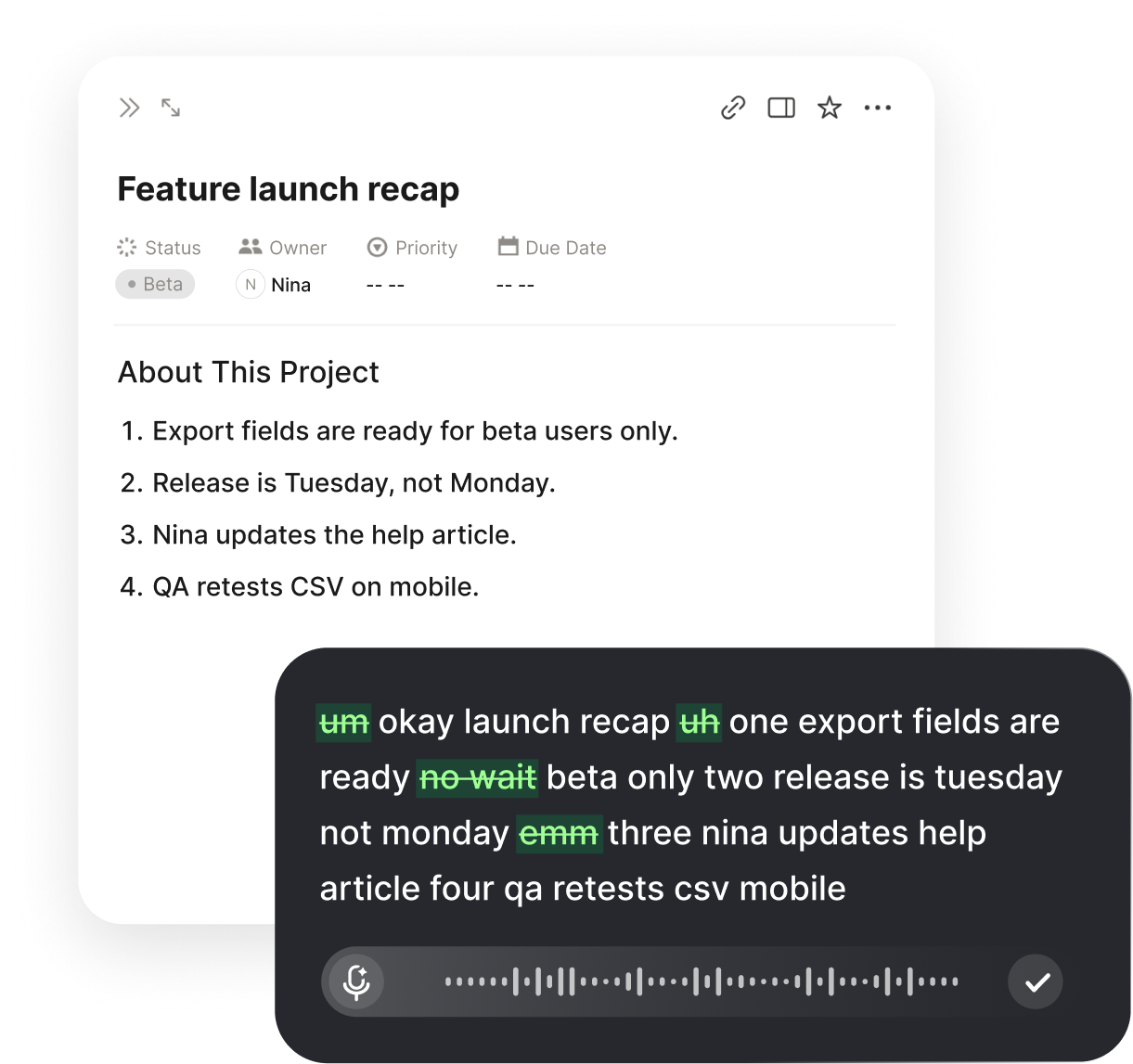
The ten minutes includes the edit. When you dictate, you speak the natural version with the hesitations and the corrections, and the tool cleans up the words. Then read the recap aloud, once, to hear the reasoning run. If a sentence does not sound like a decision, it is a note, and notes belong in the discussion below. The read-aloud is the sanity check. If the recap does not fit on one screen and the team does not read the long version, cut the detail to the decisions and the open questions and let the discussion stay in the thread. The read-aloud is the test a summary has to pass.
Distributing Notes That Get Read
Distribution is the step that decides whether the notes matter. Post the recap in the channel the team actually watches, and mention the people who own a task. Paste the linked ticket and the decision into the thread, and the two lines after the recap are the action items. If the meeting involved people outside the dev team, shorten the recap for that audience and remove the jargon before posting. The notes are written for the reader, not for the author: the author should not need to explain them later. The channel is where the readers actually are; post it there.
For the readers, the notes need a place: the same channel, the same heading, the same schedule. Start a meeting-notes channel so the recap is searchable and the pattern is constant. Every recap calls out the decisions, the owners, and the dates, and the team gets used to finding them in the same place. When a decision is disputed, the channel is the arbiter, and the thread is the record of the argument. The recap is what makes the team's memory external and shared, and shared memory is what makes the next meeting faster. The pattern is what makes the recap findable without a search.
The notes that get read have a headline: the biggest decision of the meeting. Dictate the headline into the subject line and the decision under it: timeline decided, database migration split into two releases, the second one next month. The reader can scan the day's recaps and know which meetings matter. If the headline is not the decision, the meeting may be too long. The team reads what is specific; the channel is the place where the specific lives. The headline is the decision; the body is the reasoning. A recap without a headline is a meeting without a decision. Say the decision first, always.
Binding Notes to Tasks and Owners
The last step is binding: each decision becomes a task or a ticket, with the owner and the date. Dictate the translation as you write the recap: the migration task goes on the board for the second release, owned by Sam, due the 21st. Put the task id into the recap next to the decision, so the notes and the board agree. The thread is the record, and the ticket is the workflow. If the two disagree six weeks later, the recap is the tie-breaker, and the recap is the one that records the reasoning. The ticket id in the recap is the bridge between the talk and the work.
For the owner changes, make the task the surface: the recap names who is doing what, and the board shows the progress. Review the notes in the next meeting by voice, starting with the open questions from the last one. Dictate the review directly into the recap of the current meeting: the migration is still on the queue, the reviewer is out next week. The standup and the recap become the same record. When the team reviews the past recap by voice, the loop closes the same way every week. The review by voice is the record of what the meeting gave back.
Once a month, spend five minutes reviewing the meeting notes by voice and look for the pattern: the decisions and the owners, the ones that never got done, and the open questions that resurfaced. Dictate the observations into the process doc and note the fix: meetings that produce no tasks start with the problem. The notes are the evidence of whether the meetings produce decisions or only discussion. If the recap has no tasks, the meeting had no decisions; that is the diagnosis, and it is worth saying out loud once a month. The monthly check is the maintenance the process needs.
FAQ s
Do both: jottings during, dictated recap after. During the meeting, note only the decisions and the owner names; trying to transcribe the whole call means you are missing it. After, spend ten minutes dictating the recap with the decisions, the owners, the dates, and the open questions. The jottings are the trail; the dictation is the record. Skipping the recap is how decisions get lost.
Four things: the decisions with the reason, the owners with the dates, the open questions with the answerers, and the links to the tickets. That is it. Anything beyond the four belongs in the discussion, or the recap is a transcript. The template is fixed so the reader knows where to look: top for the decisions, middle for the owners, bottom for the questions and links. Dictate to the template and the recap writes itself.
Look at what you are posting: long summaries and vague subject lines get skipped. Post the decisions as bullets in the channel the team actually watches, with owners and dates, and a headline that is the biggest decision. If they still do not read, ask in the next meeting what would make the notes worth reading. Sometimes the fix is format: move the recap into the channel and cut it in half.
Yes: one person captures the decisions, one captures the open questions and owners, then they compare and the one who missed the least dictates the recap. Splitting keeps both people in the conversation and covers the overlap. The trade-off is two people half-listening instead of one full listener; for long design meetings the capture is worth the loss. Recapitulate within the hour, while both sets of notes are still warm.


 Voiskey
Your voice, amplified.
Choose a real task, follow the steps, and review the results with your team before expanding the rollout.
Use it across macOS, Windows, iOS, and Android