
Dictating Legal Memoranda for Partners
Outline the memo, state the question, and dictate analysis a partner can review quickly.
 Voiskey Team
Outline the Memorandum Before Dictation
Dictating Legal Memoranda for Partners starts with an outline a partner could read in one minute. Write the question presented, the short answer, the main authorities, and the recommendation in four lines at the top of the file. Then list the analysis sections in the order the reader will want them: the governing rule, the application to the facts, the counterarguments, and the practical conclusion. Mark which sections are settled and which still need research. A partner reads a memorandum to make a decision, so the outline should show the decision the memo supports before any prose exists. Keep the outline visible while you dictate and check each section against it before moving on.
Fix the facts and the scope before drafting. Write a short fact statement in plain chronological order, and mark any fact that is disputed or unconfirmed. Identify the jurisdiction, the parties, the transaction or dispute, and the time frame the question depends on. Decide what the memorandum will not cover, and say so in the scope line. An unstated assumption is the most common reason a well-written memo fails to help the partner who commissioned it. If the assignment arrived verbally, restate it in one sentence and confirm it before dictation. Scope written down at the start prevents an hour of analysis on a question the partner did not ask.
Gather the authorities into a working list before you speak the analysis. For each authority, note the citation, the holding, and the proposition it supports. Group the authorities by the element or issue they address. Mark the leading case, any contrary authority, and any open question the research did not resolve. If a citation is incomplete, flag it rather than speaking around it. Keep the list beside the outline so you can reference authorities by a short name while dictating. A clean authority list turns the analysis section into an argument you can speak in order, rather than a search for support in the middle of a sentence.
Decide the format and the reader. Most internal memoranda use headings for the question, the short answer, the facts, the analysis, and the recommendation. Some partners prefer a one-page executive summary before the analysis. Ask which format the reader expects, and set up the headings now. Note the length the partner prefers and the deadline for the decision. If the memorandum supports a client communication or a filing, note the related document and the date it is needed. Format decisions are cheap at the start and expensive later, because restructuring a dictated memo means rewriting transitions that only make sense in the original order.
State the Question and Short Answer
Write the question presented as one sentence that frames the legal issue and the key facts. Avoid a question so broad that the answer must summarize the whole matter, and avoid one so narrow that it hides the real decision. A useful test is whether a partner could read the question and know what kind of answer to expect. Then write the short answer directly below it, beginning with a clear conclusion such as yes, no, or likely. Follow the conclusion with the reason in one or two sentences and the level of confidence the research supports. Speak both sections aloud before dictating the analysis, because an unclear question produces an analysis that wanders.
Dictate the short answer before the long analysis. The short answer disciplines the analysis: each section that follows must support it or explain why it changes. State the conclusion, the governing rule in a sentence, and the key fact that drives the result. If the answer depends on an assumption, state the assumption. If the research supports more than one outcome, say which is more likely and why. Keep the short answer short enough to read in fifteen seconds. Partners often read the question and short answer first and the analysis only if the conclusion surprises them, so these two sections carry most of the memo's value.
Calibrate the confidence of the answer. Distinguish between a settled point, a majority rule with exceptions, and an open question. Use language that matches the research: the statute requires, courts have generally held, or the issue is unsettled. Do not overstate certainty to make the memo sound decisive, and do not hedge every sentence until the partner cannot tell what you recommend. If the answer turns on facts that are not yet known, say which facts would change it. A well-calibrated short answer lets the partner decide whether to rely on the memo immediately or ask for more research.
Check the question and answer against the assignment. Reread the original request, whether it came in a message, a meeting note, or a comment on a draft. Confirm that the question you drafted is the question the partner asked, not a related question that was easier to answer. If the assignment has changed, update the question and note the change. Confirm the jurisdiction and the date of the research, since an answer can change with a new decision or an amended rule. Then read the question and short answer aloud together. If they do not fit, fix them before dictating a word of analysis.
Polish Structure and Tone for Partners
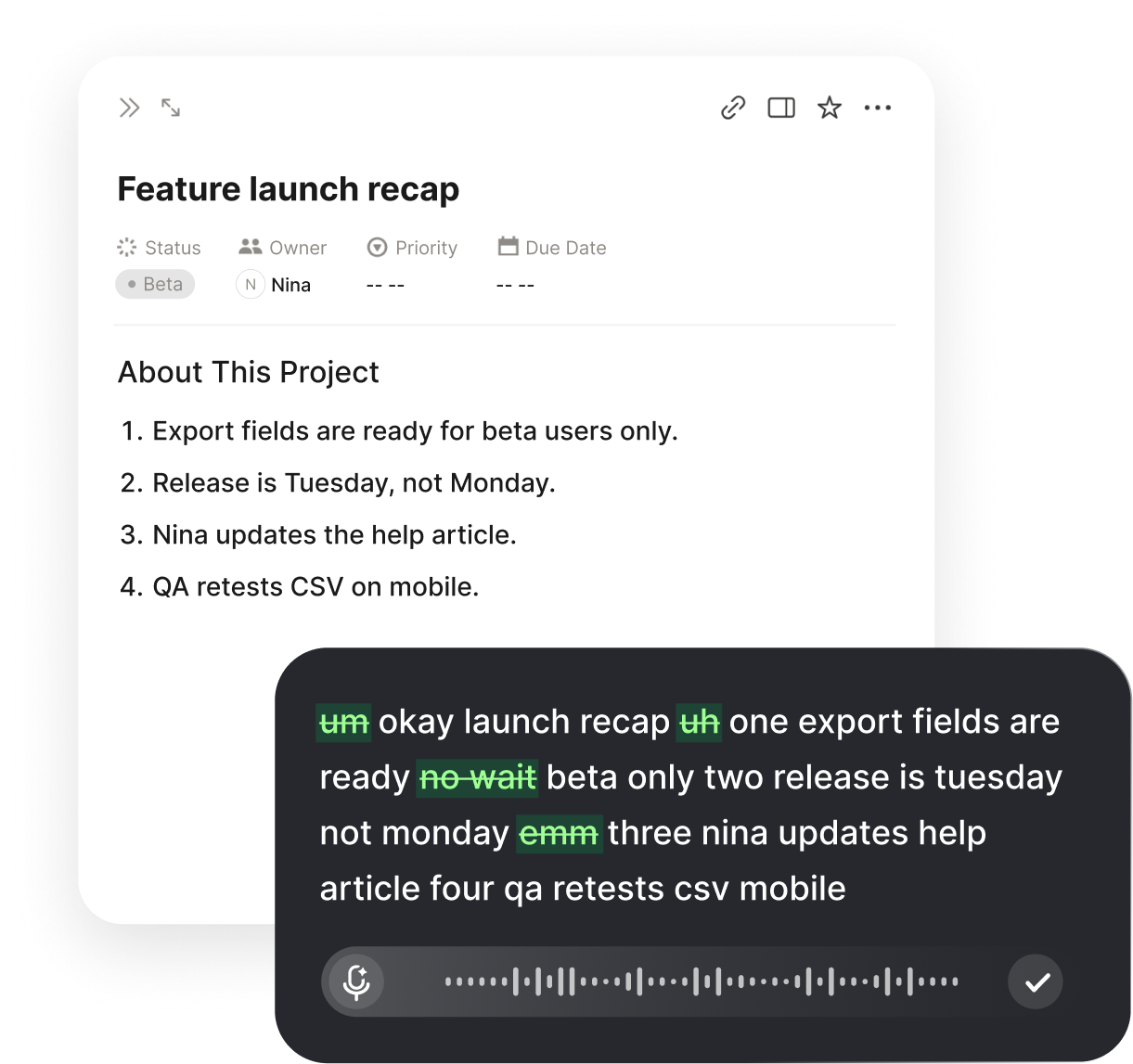
Polish the memorandum for a reader with limited time. Put the question and short answer first, then the facts, then the analysis. Check that every heading states the point of its section rather than a generic label. Read the first sentence of each paragraph and confirm that it carries the main idea. This is where Voiskey's cleanup helps: it removes filler words, stutters, false starts, self-corrections, and grammar slips as you speak, and adapts punctuation, formatting, and tone to the document, so the draft arrives closer to a finished memo. Download Voiskey for the device you use for memos and run one complete memorandum through the routine before adopting it for every assignment.
Check the citations and the facts. Replace short names with full citations and confirm that each authority says what the memo claims. Verify quotations against the source and confirm the date of each decision. Check that the fact statement matches the record and that no disputed fact is presented as settled. Confirm that the jurisdiction stated in the question matches the jurisdiction of the authorities relied on. Read the memo once for consistency between the short answer, the analysis, and the recommendation. Read every quotation against the page where it appears. Citation errors are the fastest way to lose a partner's confidence in an otherwise sound memo.
Tighten the tone. A memorandum for a partner should be direct, precise, and free of advocacy that belongs in a brief. Remove adjectives that editorialize and sentences that restate the heading. Prefer short sentences for conclusions and longer sentences only where the reasoning genuinely needs them. Use the same term for the same concept throughout, and define any term the reader might read differently. Read the memo aloud and mark any sentence you would not say to a colleague. Those sentences are usually the ones that need rewriting. A memo that sounds like clear speech is easier to review than one that sounds like a template.
Check the practical details before sending. Confirm the addressee, the matter number, the date, and the header the firm uses. Check the table of contents if the memo is long, and confirm that page numbers and headings match. Add a short list of open items if the research is incomplete, so the partner knows what remains. Save a clean copy with a version label. If the partner asked for a specific format, confirm that the memo follows it. These details do not change the legal analysis, but they determine whether the memo looks ready for the decision it was written to support.
Review Cycle, Sign-Off, and Reuse
Send the draft to the partner with a short note that states the question, the conclusion, the confidence level, and the open items. Ask for a decision on the specific points where you need direction. Do not send a memo with an unresolved citation or an unstated assumption and hope the partner will not notice. Keep the review short by marking the sections where you want comment. When comments arrive, address each one and record the change. If the partner disagrees with the conclusion, ask whether the reasoning or the facts should change, and revise accordingly. A review cycle with specific questions is faster and produces a better memo than an open request for feedback.
Use the same drafting setup for revisions. Voiskey works at the system level on macOS and Windows: press a shortcut, speak, and text appears at the insertion point in the memorandum you are editing. It learns names, jargon, acronyms, and spelling preferences, so case names and defined terms stay consistent during a late revision. The workflow is Speak-Polish-Type-Edit, and at up to 220+ words per minute it is about five times faster than typing, which makes a second pass practical even under a deadline. When the memo is live, download Voiskey and dictate the revisions into the master file so the review history stays in one place.
Confirm the sign-off and the record. Note who approved the memorandum and when. Save the approved version, the research notes, and the authority list together. If the memo supports a client communication or a filing, link it to that document and record the deadline. If the partner asked for a follow-up, put it on the calendar with an owner. Confirm that the final version replaced the draft in the matter file so no one relies on an outdated conclusion. A memo is only useful if the team can find the approved version and see what it relied on.
Reuse the structure without reusing stale analysis. Keep a template with the headings, the format, and the question-and-short-answer pattern. Keep a separate list of authorities by topic, but verify each one before relying on it again. Note which sections of the last memo took the most dictation time and adjust the outline for the next one. If the partner preferred a particular length or format, record it. Over several assignments, the template and the authority list shorten the first draft, and the review cycle focuses on the analysis rather than on formatting. The goal is a repeatable routine that produces a memo a partner can decide from.
FAQ s
Voiskey removes filler words, stutters, false starts, self-corrections, and grammar slips as you speak, so the memo text that appears at the insertion point needs less repair. It adapts punctuation, formatting, and tone to the document. The outline, the question, and the short answer remain your work. At up to 220+ words per minute, you can finish a full first draft and spend the saved time on citation checks.
Yes. Voiskey learns names, jargon, acronyms, and spelling preferences, which helps when a memorandum repeats case names, defined terms, and party names throughout the analysis. Build a glossary for the matter and confirm citations during the editing pass. Learned terms reduce spelling drift, but the drafter still verifies every citation and quoted passage against the source before the memo goes to the partner.
Press a shortcut, speak into the memo file, and text appears at the insertion point. Voiskey cleans the spoken text and adapts punctuation, formatting, and tone to the memorandum. Polish is the pass where you restore full citations, check the facts, and align the short answer with the analysis. At up to 220+ words per minute, the routine produces a complete draft that is ready for a partner's review.
Yes. The team plan offers shared vocabulary and workflows, which helps a group of associates keep case names, defined terms, and memo formats consistent when they dictate legal memoranda for partners. Each drafter still reviews the analysis and citations, and the partner still makes the decision. Shared vocabulary reduces spelling drift across a team, but it does not replace the authority check or the sign-off.


 Voiskey
Your voice, amplified.
Download Voiskey for Mac and Windows and dictate partner-ready legal memoranda from outline to sign-off.
Use it across macOS, Windows, iOS, and Android