
Dictating Lab and Field Observations
Keep both hands on the work while precise observations land in your log
 Voiskey Team
Preparing a Field-Ready Note Template
Dictating Lab and Field observations only works if the log is ready before your hands are busy. Build a template with fixed slots: date, time, location, sample or subject identifier, conditions, observation, measurement, and follow-up. Open that template in the document you already use and place the insertion point at the first empty slot. A fixed order means you can speak the entries without deciding where each one belongs, which matters when you are wearing gloves or holding equipment. The template also makes later reading faster, because every entry follows the same shape and you can compare one observation with another without hunting for the relevant line.
Decide which items must be spoken as exact values and which can be described. Numbers, units, sample codes, and instrument names should be spoken slowly and repeated once; descriptions of color, texture, behavior, or weather can be spoken in ordinary language. Write a short reminder at the top of the template about this distinction, because under pressure it is easy to rush the exact values and slow down on the descriptions, which is the opposite of what you need. A simple marker such as value before a number and note before a description keeps the two kinds of entries separate and readable.
Prepare a vocabulary list for the specific site or experiment. Add sample identifiers, species names, chemical names, equipment labels, and the abbreviations your course uses. Names and technical terms are where spoken notes most often go wrong, so say them once during setup and keep the list beside the template. If a term is easy to confuse with a similar one, add a spoken qualifier that you will use every time, such as the full name instead of the abbreviation. The list takes a few minutes to build and prevents a whole session of corrections later. It is the single highest-value preparation step for field and lab work.
Test the template in the actual conditions you expect. If you will be outdoors, test outdoors; if you will wear gloves, test with gloves. Speak one complete entry and check that the text lands in the right slots and that the exact values are readable. Note any problem with background noise, distance from the device, or the position of the microphone, and fix it before the session. Adjust the template if a slot is awkward to speak in order. A rehearsal under realistic conditions is worth more than a longer rehearsal at a desk, because the constraints of the field are what break a note-taking plan.
Speaking Observations with Hands Busy
When your hands are occupied, speak in short, complete units. Say the slot name, then the content, then stop. For example: sample, tray four; observation, the left colony is larger and has a darker edge; follow-up, photograph at the next interval. Short units are easier to speak accurately and easier to correct afterward than a long narrative. They also match the template, so each unit lands where it belongs. Resist the urge to explain your reasoning while you are working; reasoning belongs in a separate note after the task, where your hands are free and you can think without interrupting the procedure.
Narrate what you actually see rather than what you expect. This sounds obvious, but under time pressure people describe the expected result and quietly ignore the anomaly. Speak the anomaly first, then the rest of the observation. If something looks wrong, say so plainly and record the next action, such as repeat the measurement or check the label. An accurate record of an unexpected result is often the most valuable entry in the log. The habit of speaking the anomaly first protects you from the common failure where a strange observation is noticed, not recorded, and then forgotten by the time the report is written.
Use a consistent spoken order for measurements. Say the quantity, the value, the unit, and the instrument, then repeat the value once. This order prevents the classic error where a number is separated from its unit or its instrument. If the instrument is unstable, say the range you observed rather than a single value, and note what you did about it. Keep your voice steady and avoid estimating aloud; if you must estimate, say estimate before the number so the entry is not confused with a measured value. Small spoken conventions like these are what make a hands-busy log reliable over a long session.
Leave deliberate gaps instead of guessing. If you cannot read a label, see a reading, or identify a sample, say unchecked and describe where the information can be found later. A gap is easy to close after the session; a plausible guess is hard to detect and can contaminate the whole record. Say the gap in the same template slot so it is visible when you review. Also speak the reason for the gap, such as glare on the display or a label that was wet. The reason helps you decide whether the entry needs a second visit or can be resolved from the protocol sheet.
Capturing Numbers, Units, and Names
Numbers deserve a slower, more deliberate speaking rhythm than prose. Say the digits one at a time for identifiers, and say the value as a whole number or decimal for measurements. Pause between the value and the unit so they do not run together. If a value has a decimal point, say point clearly; if it has a sign, say plus or minus before the number. Repeat every exact value once immediately after saying it. This repetition feels awkward at first, but it catches most slips before they reach the log. A slow, boring number is far better than a fast, wrong one that you cannot trace later.
Keep units and instruments attached to their values. Decide in advance how you will say each unit, especially ones with symbols that sound similar, and use the full spoken form every time. Say the instrument name after the value so the entry records how the measurement was taken. If you switch instruments mid-session, say the switch explicitly and record the new instrument for every later value. Mixed instruments are a common source of confusion in lab logs, and a spoken marker at the moment of the switch is the simplest way to prevent it. The rule is simple: never let a number travel without its unit and its tool.
Treat names as exact values too. Sample codes, subject identifiers, species names, and chemical names should be spoken in full and repeated once. If a name has a common abbreviation, say the full name the first time and note the abbreviation you will use afterward. Keep the spelling list beside the template and update it when a new name appears. Names are the part of a spoken record that later readers trust most and question least, which is exactly why they need the most care. A misspelled species name can undermine an otherwise careful observation log. Say it the same way every time.
Build a final check into the session. Before you leave the site or finish the procedure, read back the numbers, units, and names from the log while you can still verify them against the instrument, the label, or the sample. Correct anything that does not match. This read-back is much easier while the work is in front of you and much harder after you have packed up. If a value cannot be verified, mark it unchecked rather than leaving a confident number in place. The few minutes spent on read-back protect the credibility of every entry in the session.
Reviewing Entries Before They Become Records
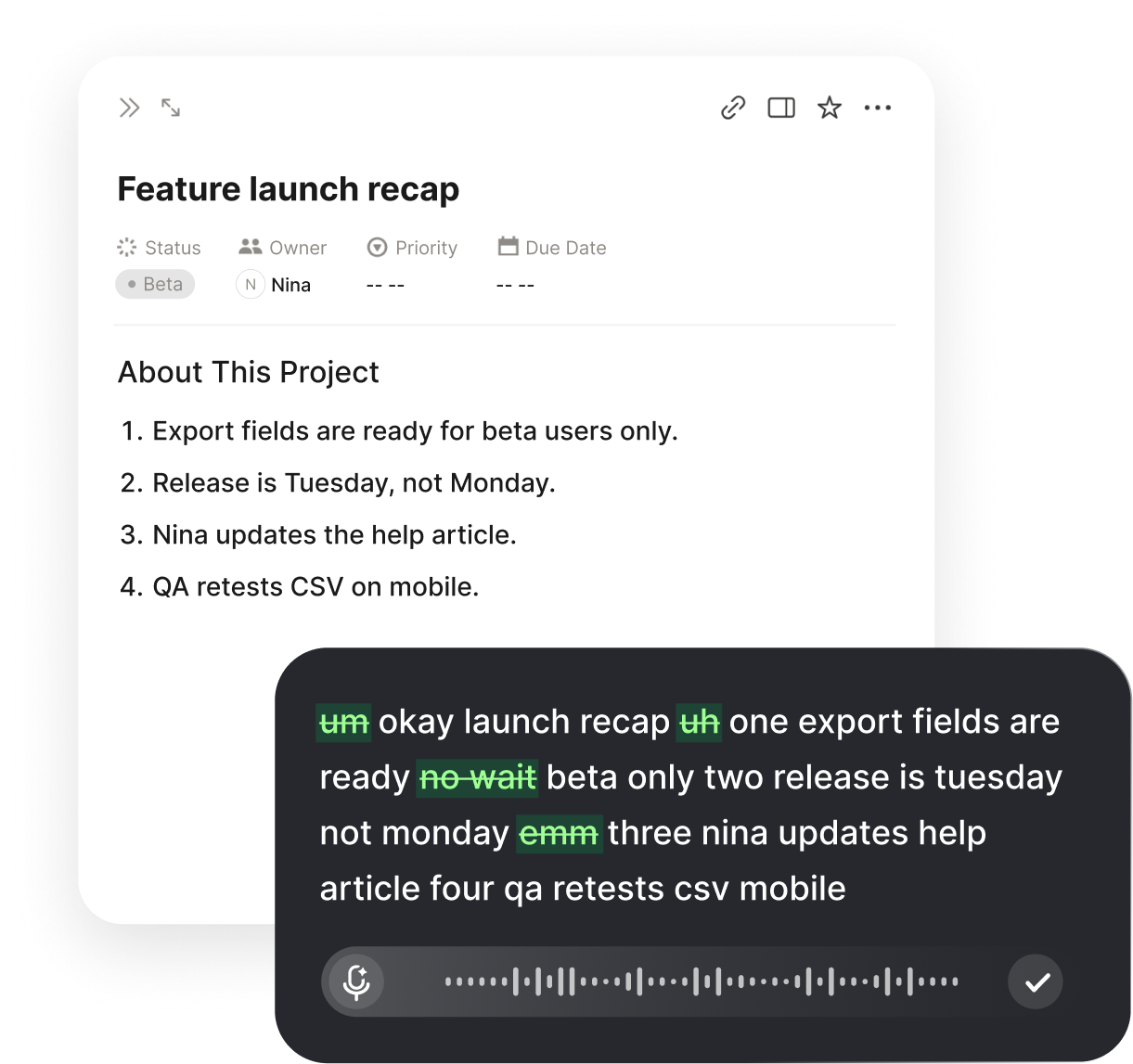
Voiskey changes the review stage because the text is already in the document where you work. You press a shortcut, speak the entry, and text appears at the insertion point, so the review starts from a real draft rather than a blank page or a separate file. Voiskey removes filler words, stutters, and false starts and adapts punctuation to what you are doing, which keeps the log readable without extra cleanup. The workflow is Speak-Polish-Type-Edit: speak the observation while your hands are busy, polish the wording, type the exact references, then edit against your notes. Keeping everything in one place means the field entry and the final record never drift apart.
When you download Voiskey, set a review rule for the same day. Open the log before the session ends, read each entry against the template, and fix the slots that are empty or inconsistent. Check that every number has a unit and an instrument, that every name is spelled once correctly, and that every gap has a reason. Mark anything you cannot resolve as unchecked and assign a time to resolve it. The same-day review catches errors while your memory of the procedure is still reliable. A log reviewed the next morning is a reconstruction; a log reviewed the same day is a record.
Separate observation from interpretation explicitly. The observation slot holds what you saw and measured; the follow-up slot holds what you think it means and what to do next. If an interpretation slipped into the observation, move it. This separation matters because a later reader needs to know which parts are direct evidence and which are your reasoning. Use plain markers such as observed and interpreted when the distinction is important to the experiment. A clean separation also makes the write-up easier, because you can pull observations into a results section and reasoning into a discussion without rewriting the whole log.
Finish the review with a consistency pass across the session. Compare the first and last entries to check that the template was used the same way throughout, and scan for values that look implausible relative to their neighbors. If a value is far outside the others, mark it for a repeat rather than deleting it; the fact that it was recorded is itself useful information. Download Voiskey and keep the shortcut available so a correction can be spoken into the right slot in seconds. The goal of this pass is not a perfect log but a trustworthy one, where every entry can be traced and every anomaly is visible.
Handling Bad Conditions and Missing Details
Bad conditions are normal in field and lab work, so plan for them rather than hoping for a clean session. Wind, rain, noise, gloves, poor light, and a device that is out of reach all interfere with speaking notes. Decide in advance which conditions will make you switch to paper and record the switch in the log. A hybrid approach is fine: speak the entries when you can, jot a short paper note when you cannot, and transfer the paper note by voice during the same-day review. The important thing is that no observation is lost and that the method used for each entry is clear.
When background noise is high, move closer to the device and speak in shorter units. If that is impossible, wait for a lull and speak the most important entries first. Prioritize exact values and anomalies, then descriptions. If you must skip an entry, say skipped and the reason so the gap is intentional rather than accidental. A log with a few clearly marked gaps is more useful than one with missing sections that no one notices. Voiskey removes filler words and false starts, so you can speak plainly under pressure without worrying about every hesitation appearing in the record. Keeping the method clear for each entry matters more than keeping the format pretty.
Missing details need a recovery plan, not a guess. At the end of the session, list every unchecked item and decide how to resolve it: revisit the site, check the instrument log, ask a partner, or consult the protocol. Assign each item a time and an owner, and place the list at the top of the next session. If an item cannot be resolved, write a short note explaining what is missing and why, so a reader is not left wondering whether the omission was deliberate. A transparent missing detail is a normal part of research; a hidden one is a problem that surfaces at the worst possible time.
Protect the habit across a whole term. Keep the template, the spelling list, and the review rule in one place, and use the same versions for every session so entries stay comparable. When a new condition appears, such as a different site or instrument, add it to the template rather than improvising. Download Voiskey on the device you carry to sessions and keep the shortcut within reach, so starting a log takes seconds. The routine is what makes the difference: a consistent template, spoken in short units, reviewed the same day, and corrected without guessing. A consistent routine is what turns a term of scattered notes into evidence you can defend.
FAQ s
You press a shortcut, speak the observation, and text appears at the insertion point in your log. Voiskey removes filler words, stutters, and false starts, so short spoken units such as sample, value, unit, and follow-up arrive as readable entries while both hands stay on the work.
Voiskey learns names, jargon, acronyms, and spelling preferences, so repeated sample codes and technical terms become more consistent over time. If you use a fixed spoken order such as value, unit, and instrument, each entry follows the same shape and is easier to compare during the same-day review.
Yes. Voiskey works at the system level, so you press a shortcut and speak, and text appears at the insertion point in any app or text field. You can dictate into the log you already use without switching tools or copying entries between documents.
Read each entry against your template and confirm that every number has a unit and an instrument, that names are spelled correctly, and that any gap has a reason. Mark unresolved items as unchecked and resolve them the same day while your memory of the procedure is still reliable.


 Voiskey
Your voice, amplified.
Download Voiskey for Mac and Windows and dictate clean lab and field logs.
Use it across macOS, Windows, iOS, and Android