
Dictating Immigration Case Narratives
Build the chronology, dictate the story in beats, and keep names and dates consistent.
 Voiskey Team
Build the Chronology Before the Narrative
Dictating Immigration Case Narratives begins with a chronology, because a narrative that drifts in time is hard for any reader to follow. List every event that matters to the case in order, with the date, the place, the people involved, and the source that supports it. Include the events that explain why the person left, what happened during the journey, and what has happened since arrival. Mark the dates that are approximate and the events that need confirmation from the client or a document. A chronology written before dictation gives the narrative a spine and prevents the common problem in which the story jumps between years and leaves the reader to reconstruct the sequence.
Identify the legal questions the narrative must support before you write it. A narrative for an asylum claim, a hardship waiver, a visa petition, and a removal defense each needs different facts emphasized. Write the elements the decision-maker must find, and mark which facts support each element. Note the facts that are missing and the questions to ask the client. Do not draft legal argument into the narrative; the narrative should tell the client's story in the client's terms, with the legal framing added elsewhere. Knowing the elements helps you decide which parts of the story need detail and which can be summarized without weakening the claim.
Decide the language and the translation path. If the client will review the narrative in another language, decide who will translate it and who will confirm the translation. Note whether an interpreter will be present at the interview and whether the narrative will be read aloud. If the client speaks limited English, plan to read the statement back with an interpreter rather than assuming comprehension. Check the format the filing requires, including any declaration, signature, and certification language. Language and translation decisions belong at the start, because a narrative that the client cannot review is a narrative the client cannot correct.
Prepare the working file and the review path. Open the statement template, confirm the heading, the declaration language, and the signature block, and place the cursor at the first paragraph. Keep the chronology, the client's identifying details, and the list of supporting documents beside the document. Decide who will review the facts, who will review the legal framing, and who will speak with the client. Note the filing deadline and the date of any interview. If the client will receive the draft for review, plan how the draft will be delivered and returned. A prepared file and a named review path prevent the narrative from becoming a single unreviewed pass.
Dictate the Story in Chronological Beats
Dictate the narrative in short chronological beats rather than as one long account. Start with the client's background: family, home, work, and the circumstances that shaped the decision to leave. Then move through the events that led to departure, the journey, the arrival, and the life since. Each beat should cover one period or one incident and end at a natural stopping point. Announce the transition to the next beat with a date or a phrase. Dictating in beats keeps the story readable and makes it easier to insert facts that the client later confirms or corrects. Keep each beat to a few sentences.
Use the client's own words where they carry meaning, and mark where you are summarizing. A narrative that sounds like a lawyer's brief is less persuasive than one that sounds like a person describing what happened. Ask the client for the details that make an event concrete: what was said, who was present, what the place looked like. At the same time, keep the account organized, and note the places where the client's recollection is uncertain. The best narrative preserves the client's voice and the reader's ability to follow the sequence, without smoothing away the details that make the account credible.
Dictate specific facts rather than conclusions. Instead of saying the client feared harm, describe the threat, who made it, when, and what happened next. Instead of saying the client had no choice, describe the options the client considered and why they were unavailable. Specific facts give the reader something to evaluate and give the legal team something to corroborate. When a conclusion is necessary, state it after the facts that support it. This discipline is especially important in immigration narratives, where a general assertion can be dismissed while a specific account invites attention. The reader should be able to check each fact you state.
Manage the emotional weight of the material. Immigration narratives often include violence, loss, and fear, and dictating them can be difficult for the client and the drafter. Plan breaks, and tell the client they can stop at any point. Keep the language factual and respectful rather than dramatic. If the client becomes distressed, pause the narrative and return later; a rushed account is worse than a slower one. Note the parts of the story that may need a follow-up conversation with a mental health or social service professional if the client wants that support. A careful pace protects both the client and the quality of the record.
Keep Names, Dates, and Forms Consistent
Build a names block before dictation and use it throughout. Record the client's full name exactly as it appears on the passport or identity document, plus any spelling variants, aliases, and transliterations. Record the names of family members, officials, organizations, and places, with the spelling the client prefers. Note the date of birth and the country of origin as the forms state them. Immigration filings are compared across forms and statements, so a spelling that differs from the passport can create a costly discrepancy. Read the names block aloud with the client and confirm each spelling before it enters the narrative.
Keep every date consistent with the forms. Build a date table that lists each event, the date used in the narrative, and the date used in each form. Where a date is approximate, state the range or the season and explain why the exact date is unknown. Check that dates of birth, entry, marriage, and filing agree across documents. If two documents conflict, note the conflict and ask the client which is correct. A narrative that gives a different date from a form invites a request for explanation and can undermine an otherwise strong account. The date table is the simplest way to catch this before filing.
Read the narrative against the other filings before dictating changes. If the case includes an application, a declaration, a support letter, or a prior statement, note the facts each one asserts and compare them with the chronology. Mark any difference and decide whether it is an error to correct or a detail to explain. Do not silently align documents by changing a date or a name without the client's confirmation. Consistency across the record is persuasive; an unexplained inconsistency is one of the most common reasons a case draws scrutiny. Give the reviewer the comparison table so the check can be repeated independently.
Keep the narrative's structure consistent with the forms and the interview. If the interview will follow the narrative, use the same sequence and the same terms so the client can prepare. If the forms use a particular label for a family relationship or an event, use the same label in the narrative. Note the questions the narrative does not answer, so the client can prepare for them. Prepare a short summary of the key dates and names for the client to review before the interview. Consistency between the statement, the forms, and the client's preparation is what makes the account credible when it is tested.
Polish the Statement and Verify Details
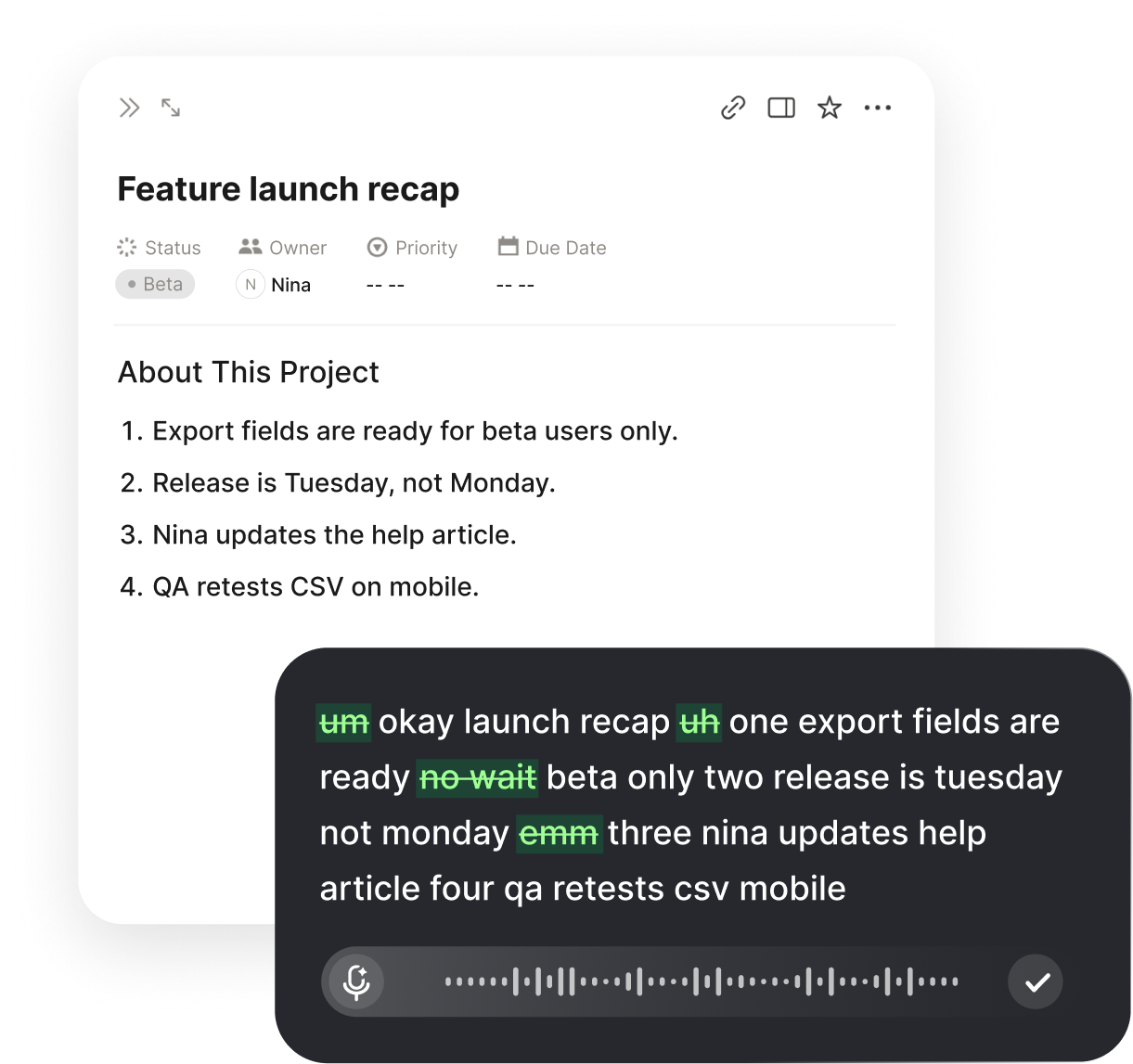
Polish the statement before the client reviews it. Read it for sequence, clarity, and tone, and check that every paragraph answers a question the reader will have. This is where Voiskey's cleanup helps: it removes filler words, stutters, false starts, self-corrections, and grammar slips as you speak, and adapts punctuation, formatting, and tone to the statement, so the draft arrives closer to finished prose. But cleanup does not verify facts. Download Voiskey for the device you use for case drafting and run one complete narrative through the routine before relying on it for a filing. Then read the statement alongside the chronology and the forms.
Verify names, dates, and places against the source documents. Read the client's name character by character against the passport, and check every family member's name and relationship. Compare each date with the chronology and the forms. Confirm the spelling of cities, regions, and organizations, especially where transliteration varies. Check that the narrative does not assert a fact that no document or client statement supports. If a detail is uncertain, mark it and ask the client rather than choosing a plausible version. Verification is slow, but a narrative that survives a careful check is far more useful than one that reads well and cannot be defended.
Check the language for clarity and dignity. Remove dramatic adjectives that the facts do not support, and remove legal conclusions that belong in a brief. Keep sentences short enough for a reader who may be reading through an interpreter. Use the same term for the same person or event throughout. Read the statement aloud and mark any sentence that the client would not recognize as their own account. A narrative should sound like the client, organized by a professional, not like a template with the client's name inserted. Dignity in the language also helps the reader take the account seriously.
Complete the declaration and format checks. Confirm the declaration language, the signature line, the date, and any certification the filing requires. Check the heading, the page numbering, and the exhibit references. Confirm that the statement identifies the client and the matter correctly. If the narrative will be translated, confirm that the translation matches the version the client approved and that the translator is identified as the filing requires. Save a clean copy with a version label. A statement with the wrong declaration or a missing signature line can delay a filing even when the account itself is strong. Check that the date matches the client's signature date.
Review With the Client and Finalize
Review the statement with the client in a setting where they can read it or hear it read. Use an interpreter if the client needs one, and confirm that the client understands every paragraph. Ask the client to correct names, dates, and details, and record each correction with the date. Read the narrative aloud and pause where the client seems uncertain. Do not pressure the client to accept a version they do not recognize. The client's confirmation is the foundation of the statement's credibility, and a correction made now is far better than an inconsistency discovered at the interview. Take notes during the review.
Use the same drafting setup for revisions. Voiskey works at the system level on macOS and Windows: press a shortcut, speak, and text appears at the insertion point in the statement you are editing. It learns names, jargon, acronyms, and spelling preferences, which matters when a client's name or a place name recurs throughout the narrative and must be spelled the same way every time. The workflow is Speak-Polish-Type-Edit, and at up to 220+ words per minute it is about five times faster than typing, so client corrections can be dictated and reviewed in the same session. Download Voiskey when you are ready to dictate case narratives consistently.
Confirm the client's approval and prepare the filing. Read the final statement to the client once more, confirm that the corrections were made, and obtain the signature the process requires. Note the date of approval and who interpreted if anyone did. Check the statement against the forms one last time, and confirm that the exhibits referenced are attached. Prepare a short summary of key dates and names for the client's interview preparation. File the approved statement, the chronology, the comparison table, and the client's corrections together. A complete record makes the account easier to defend and easier to supplement if new facts emerge.
Review the routine for the next case. Note which parts of the narrative needed the most correction, which details the client could not recall, and where translation slowed the process. Update the chronology template, the names block, and the date table. If a particular type of case needed a different structure, record it. Keep a short lessons note with the matter file. Over several cases, a consistent chronology, a careful names block, and a client review that uses an interpreter produce narratives that are more accurate and easier to finalize, and the legal team spends less time repairing inconsistencies and more time on the legal questions.
FAQ s
Voiskey learns names, jargon, acronyms, and spelling preferences, so a client's name and a recurring place name stay spelled the same way throughout a narrative. It adapts punctuation, formatting, and tone to the statement. The names block still controls the accepted spelling, and the drafter confirms each name against the passport and the forms before the client reviews the statement.
Voiskey supports 100+ languages and translation, which can help when a client reviews a narrative in another language or when the drafting team works across languages. You still need a qualified reviewer and interpreter for accuracy, and any translation the filing requires must follow its own rules. Treat the dictated text as a drafting aid and verify names, dates, and details with the client.
Press a shortcut, speak the narrative into the statement file, and text appears at the insertion point. Voiskey removes filler words, stutters, false starts, self-corrections, and grammar slips and adapts punctuation and formatting to the document. Polish is the pass where you verify names, dates, and places and read the account with the client. At up to 220+ words per minute, the routine keeps the client's own wording close to the page.
Yes. Voiskey is system-level, so text appears at the insertion point in whatever app or text field holds the statement. You dictate directly into the declaration template and revise it in the same file, with no separate suite to open. The workflow is Speak-Polish-Type-Edit, and client corrections land in the master version so the approved statement is the one you reviewed.


 Voiskey
Your voice, amplified.
Download Voiskey for Mac and Windows and dictate immigration case narratives from chronology to client review.
Use it across macOS, Windows, iOS, and Android