
Dictating Flashcards and Quiz Questions
Scope the deck, dictate one card at a time, test real recall
 Voiskey Team
Decide the Card Scope First
Dictating Flashcards and Quiz questions works best when the scope is decided before the first card. Choose one topic and one level of detail, such as definitions for a single lecture or formulas for one problem set. Count the cards you expect: a focused deck of forty cards beats a sprawling deck of two hundred that you never finish. Write the topic, the source, and the exam date at the top of the deck. If the topic is too large, split it by lecture or by chapter and finish one section before starting another. Scope is the first thing that decides whether the deck gets used.
Choose the card types that match the material. Definitions suit term and meaning pairs, processes suit ordered steps, and problem solving suits worked examples or setups. Decide whether each card asks for recall, explanation, or application, and keep the type visible so you can mix them deliberately. A deck that is all definitions trains recognition, while a deck that includes application trains transfer. Write the type beside each planned card before you dictate. This small label helps you spot a deck that is too easy for the exam you are preparing to face. Ask a classmate whether the label matches the exam.
Gather the source material and mark the exact places you will use. A card should trace back to a page or a slide, so an error can be checked quickly. If two sources disagree, decide which one the course treats as authoritative and note the reason. Keep quotations short and paraphrase where the exact wording is not required. If a card needs a diagram, plan how you will describe it in words, because a spoken card must work without an image. A prepared source list prevents the vague cards that sound reasonable but cannot be verified against the course material.
Set a target for the deck and a stop rule. A reasonable target is one card per key idea, not one per sentence. Stop adding cards when a new card repeats an idea you already have, and merge duplicates instead of keeping both. If a card is too long to answer in ten seconds, split it. Write these rules at the top of the deck document. A stop rule protects the deck from the common failure of becoming a second copy of the textbook, which is harder to review and far easier to abandon in the middle of exam week.
Dictate One Card at a Time
Speak each card as a pair: the prompt, then the answer. Keep the prompt short and specific, and say the answer in one or two sentences. If the answer needs a list, say the items in order and number them. Start a new card with a spoken marker such as next card, so the two parts stay separated when you review the text. Keep your voice steady and finish the ends of sentences. A spoken card is only useful if the prompt and the answer remain distinguishable after the text lands in the deck file, hours later during a later review session.
Write prompts that point to one answer. A question such as tell me about the method invites a paragraph, while which step follows the wash invites a word. Choose the narrower form unless the exam asks for explanation. For explanation cards, name the number of parts you expect, such as give two reasons. For definition cards, ask for the term from the meaning and the meaning from the term as two separate cards. Precise prompts make the deck faster to review and expose gaps that a broad question would hide behind a long, vague answer that looks complete without being complete.
Keep the answer on the card and the explanation in your notes. A card is for retrieval, so it should hold the minimum needed to check yourself. If an answer needs context, add a short note beneath it rather than turning the card into an essay. Link the card to its source page so the full explanation is one step away. When you review, say the answer first and then read the note. Separating the answer from the explanation keeps review quick and keeps the deck from drifting into a summary document with far too many words and too little retrieval.
Handle the cards that resist dictation. A formula may need you to say each symbol and its meaning slowly. A diagram may need a described position, such as the upper left, then the arrow. A process may need numbered steps with a pause between them. Practice these three shapes once before building the deck, and keep the patterns consistent throughout. When a card still sounds confusing when you read it back, rewrite the prompt rather than the answer. A confusing prompt is usually the cause, and a clearer question fixes more cards than a longer, more detailed answer ever will.
Write Questions That Test Recall
A good quiz question asks for something you must produce, not something you can recognize. Prefer fill in the blank, define from the meaning, and explain the step over multiple choice, because recognition feels easier and teaches less. If multiple choice is required, make the distractors plausible and explain why each is wrong in your notes. Vary the wording across cards so you learn the idea rather than the sentence. Review a batch of questions and mark any that can be answered by guessing. A deck full of guessable questions produces confidence without knowledge, which is the worst outcome before an exam.
Cover the levels your exam will test. Recall cards check terms and facts, comprehension cards check explanation, and application cards check use in a new case. Build the deck in that order, then count how many cards fall into each level. If almost every card is recall, add application cards from the problem sets. If almost every card is application, add a few recall cards for the vocabulary the questions assume. A balanced deck matches the exam and gives you a realistic sense of readiness instead of a single number that hides which level of knowledge is actually weak for you.
Write answers that a reviewer could mark without your help. State the essential content, the unit if relevant, and the condition that makes the answer correct. Avoid answers that say it depends without saying on what. If a question has several acceptable answers, list the core idea that all of them must include. Keep the answer short enough to say in one breath. A markable answer makes self-testing honest, because you cannot claim partial credit for a paragraph that circles the idea without reaching it. It also makes the review faster, since a wrong answer is obvious within a few seconds.
Test the questions on a classmate before the deck is final. Ask them to answer five cards aloud while you note where they hesitate. A hesitation often marks an ambiguous prompt rather than a knowledge gap. Rewrite those prompts, then test again on different cards. If a classmate answers confidently but wrongly, the card may be too easy to misread, and the answer needs a clearer condition. A short peer test finds more problems in ten minutes than a week of reviewing alone, because a fresh reader notices the ambiguity you have learned to ignore in your own writing and cards.
A Trial Deck With Voiskey
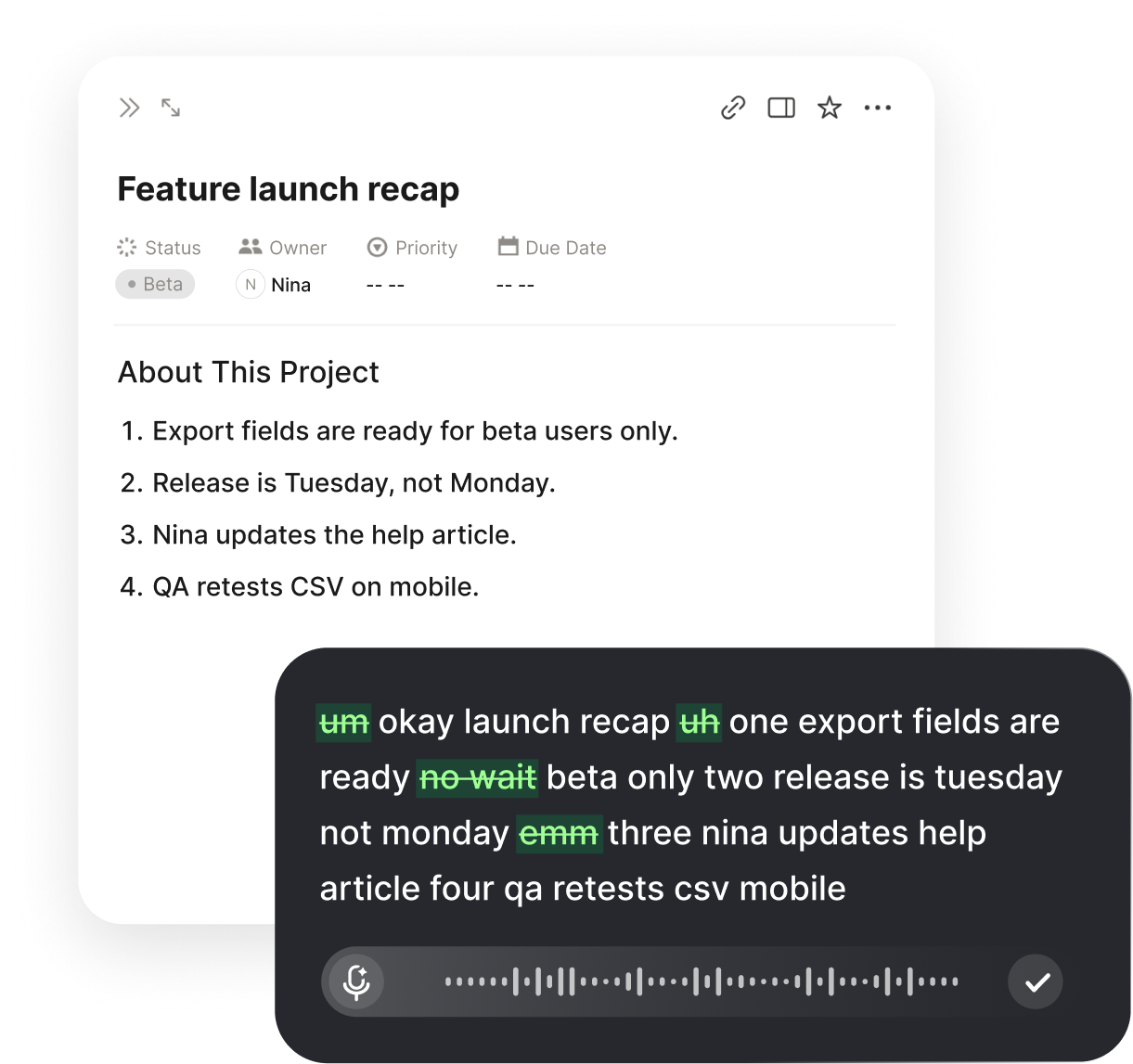
Build a trial deck of twenty cards before committing to a large one. Dictate the prompt, the answer, and the source line for each card, and label the card type as you go. Voiskey helps because you press a shortcut, speak, and text appears at the insertion point in the deck document you already use. It removes filler words, stutters, false starts, and self-corrections, so a spoken card reads like a written one. It adapts punctuation and formatting to the list style you choose, which keeps the prompt and the answer distinct when you read them back during a review session.
Review the trial deck before you expand it. Read every card aloud and mark the prompts that sound ambiguous, the answers that run long, and the cards that repeat an idea. Count the cards by type. If the balance is wrong, add or remove before dictating more. Voiskey learns names, jargon, acronyms, and spelling preferences, which helps with a course's recurring vocabulary. Download Voiskey if you want to build the rest of the deck on another device, and keep the same card order so the sets merge cleanly into one file without duplicate cards or mixed formats. Check the order before you start.
Test the deck in a real review session. Answer ten cards from memory, then check against the answers, and note the ones you missed. If a miss comes from a confusing prompt, rewrite it; if it comes from a missing fact, add a card or a note. If you miss a card twice, split it into two simpler cards. Keep a small log of misses so the pattern is visible. A trial deck is complete when you can review it in one sitting without stopping to repair the wording, and when your miss rate tells you something useful about what to study next.
Close the trial with a verdict and a template. Keep the card shapes that produced clear prompts, drop the field you never used, and write the three fixes you made most often. Then dictate ten more cards with the revised template. A trial is complete when a classmate can review the deck without asking what a card means and when the answers are markable in one pass. If not, the prompts need another revision, not a longer answer. Record the verdict beside the deck so the next topic starts with a tested format. The verdict should take five minutes and save hours of review.
Keep the Deck Current
A deck decays when the course moves on. Set a weekly review to check whether the cards still match the lectures and readings, and add cards for new material as it arrives. Remove cards that test an idea the course has dropped or a detail the exam will not cover. Merge duplicates and split cards that keep confusing you. Keep the deck in one place with the source lines intact. A weekly pass of fifteen minutes keeps the deck aligned with the course, and it prevents the last-week discovery that half the deck is out of date or simply redundant.
Use your misses to decide what to keep. Cards you miss once deserve a second look; cards you miss three times need to be rewritten or split. Cards you always answer might be too easy, so replace a few with application questions. Keep a short log of miss counts by card, and review the log before each session. The log turns the deck into a ranked list of priorities rather than a pile of cards. If you use Voiskey to dictate new cards, the same shape keeps new additions consistent with the reviewed set and keeps the log easy to update.
Refresh the deck before each exam with a targeted pass. Sort by topic and by miss count, then review the weakest cards first. Rewrite any prompt that still sounds unclear, and note the change so you can tell whether it helped. Add one card for each question you missed on a practice paper. Stop adding cards two days before the exam and switch to full review. A refresh pass turns a large deck into a short priority list, which is what you actually need when time is genuinely short and the exam is close. A short list beats a large deck.
Close the term with an archive and a handover note. Save the deck, the miss log, and one strong set of revised cards as an example. Download Voiskey if you want to dictate the handover note and the first cards of the next topic into the same template. Write three lines about what to keep, what to change, and which card types worked best. Check the card shape and the spoken marker once before the new topic begins. An archived deck is a tested starting point for the next course, and it turns one term of dictation into a reusable study method for the next term. It takes ten minutes.
FAQ s
Speak each card as a prompt, then an answer, then a source line, and label the card type as you go. Voiskey places text at the insertion point in your deck document, removes filler words and false starts, and adapts punctuation, so the prompt and the answer stay distinct when you review them.
Voiskey learns names, jargon, acronyms, and spelling preferences, so a course's recurring vocabulary becomes easier as the deck grows. Say an unfamiliar term clearly once, then use it normally in later cards. Support for 100+ languages also helps when definitions or readings include another language.
Build a small starter deck first, then read every card aloud to find ambiguous prompts and long answers. Voiskey polishes filler and grammar slips, so a spoken card reads like a written one. Answer ten cards from memory, mark the misses, and rewrite the prompts that caused confusion rather than lengthening the answers.
Voiskey supports up to 220+ words per minute, about 5x faster than typing, which helps when a topic needs many short cards. You press a shortcut, speak the prompt and answer, and text appears at the insertion point. The Speak-Polish-Type-Edit workflow leaves a clean card to correct.


 Voiskey
Your voice, amplified.
Download Voiskey for Mac and Windows and speak your flashcards into a review deck.
Use it across macOS, Windows, iOS, and Android