
Dictating Demand Letters
A five-stage routine for drafting demand letters by voice, from facts to final review.
 Voiskey Team
Set the Demand Letter Frame Before Speaking
Dictating Demand Letters works best when the frame is settled before you speak a single sentence. Decide who the letter is for, what outcome it asks for, and which facts must appear on the page. Name the matter, the adverse party, the amount or action demanded, and the deadline in a short outline at the top of the file. Then choose the tone: firm but professional for a first request, sharper for a final notice. Read the outline aloud once to hear whether the sequence is logical. If a step feels out of order while spoken, it will read that way too. Ten minutes of framing saves an hour of corrections and keeps your delivery focused on substance rather than structure.
Pin down the legal basis before drafting. List the contract clause, statute, or prior correspondence that supports the demand, and note the exact paragraph or date for each item. A demand letter that cites the wrong clause undermines the whole request, so verify references against the source file before dictation begins. Write the correct spelling of every party, entity, and defined term in a small glossary at the top of the page, because you will say those names repeatedly. Mark which facts are undisputed and which still need confirmation. If a fact is missing, leave a spoken placeholder such as insert invoice date and keep moving. The glossary and citation list become the reference you actually use while dictating, so keep them visible and current.
Think about the reader. A demand letter is often read by an adversary, a claims adjuster, or a judge, and each reader rewards different details. Write one sentence describing what the recipient must understand and do after reading. Then decide the length: most demand letters run one to three pages, with a short factual summary, a clear demand, and a deadline. Plan the sections in the order the reader will look for them. Reserve a separate paragraph for the consequence of nonpayment or noncompliance, and make sure it matches the actual remedy available. Note the delivery method and the date the deadline starts. These choices are easier to make before dictation than to repair after a full draft exists.
Assign the work before you start. One person dictates, a second reviews citations and amounts, and a third checks arithmetic if the demand includes money. If you work alone, plan two separate passes: one for content and one for verification. Set the document format up front, including letterhead, reference line, and signature block, so the spoken text lands inside the right structure. Test the app once with a short sentence to confirm the cursor is in the correct field and the language is set correctly. Agree on where the draft will live and who may edit it. A clear division of roles prevents the common failure where one person both writes and approves the same letter.
Assemble Facts, Exhibits, and Deadlines
Build a dated chronology before you draft the narrative. List every relevant event in order, with the source document beside it: the agreement, the invoice, the message thread, the delivery receipt, the prior warning. Keep entries short, one line each, so the sequence is easy to scan while speaking. Mark the events that must appear in the letter and those that merely support it. Check that the dates agree across documents, because a payment posted on one date and demanded on another invites dispute. The chronology is the backbone of the factual section, and a clean one lets you dictate confidently instead of pausing to reconstruct events mid-sentence.
Choose exhibits deliberately. For each document you plan to reference, note the exhibit label, the page or clause relied on, and the proposition it supports. Keep the list short enough that the letter remains readable, and attach only what proves the demand. Check that every referenced exhibit is actually enclosed and that labels match the list. For amounts, prepare a small calculation sheet showing principal, dates, and any agreed interest, so the figure you speak is the figure you can defend. Copy the exhibits into the working folder before dictation starts. When an exhibit is missing or illegible, resolve that first, because speaking around a gap produces vague sentences that weaken the demand.
Set the deadline with a reason, not just a date. Decide the notice period, the calendar date it produces, and whether weekends or holidays affect it. State what happens if the deadline passes: further action, referral, or filing. Avoid promising a consequence you are not prepared to carry out. If the matter involves a statutory notice period, confirm the calculation against the governing rule. Write the deadline sentence in advance and read it aloud to check clarity. Then review the tone of the whole request: a demand letter should be direct without being abusive, and specific without threatening more than the available remedy. Sharpen the wording now so the dictation pass carries the right register.
Prepare a skeleton with headings you will speak into. Typical headings include the parties, the facts, the basis for the demand, the amount or action requested, the deadline, and the reservation of rights. Fill each heading with a one-line note about what belongs there. This skeleton does double duty: it keeps the spoken draft organized and makes later review faster because every letter follows a familiar path. Save the skeleton as a template for similar matters, but review each clause before reuse, since facts and parties change. If the matter is unusual, add or remove headings now rather than improvising in the middle of a sentence. A prepared structure is the difference between dictating a letter and narrating a search for one.
Speak the Demand in Structured Passes
Dictate in passes rather than trying to produce a finished letter in one breath. Start with the factual summary, speaking in short sentences and naming dates and amounts precisely. Use a consistent phrase for each repeated entity so the text stays clear. If you misspeak, correct it immediately in a few words and continue; the editing pass will clean the rest. Do not stop to fix punctuation while speaking, because that breaks the rhythm and produces fragments. Read the outline, speak one point, then glance back. Keep each paragraph to a single idea. When the factual section is complete, read it back once before moving on. This first pass should produce a complete, plain account that a reader could follow before any polishing.
Move to the demand section, where precision matters most. State the action required, the amount, the deadline, and the method of performance in separate sentences. Avoid stacking conditions in one long clause. Name the account, address, or delivery point exactly as it appears in the source documents. If the demand has alternatives, present them in a numbered sequence and say clearly which is preferred. Speak the consequence sentence last. Then read the section against the chronology to confirm that every factual claim supporting the demand has already appeared. A demand that arrives before its supporting facts, or after unrelated detail, reads as an afterthought.
Dictate the closing and reservations with care. State that the letter is not a waiver of rights, that partial payment does not discharge the obligation, and that the sender reserves further remedies. Use the wording your practice has approved rather than inventing new phrasing under pressure. If the letter should remain open to negotiation, say so explicitly and set the channel for a response. Read the closing aloud to check that it does not contradict the deadline or the demand. Then add the signature block and any enclosure list. These closing elements are easy to forget during dictation precisely because they are predictable, so keep them in the skeleton and speak them deliberately rather than assuming they will be added later.
Plan for the moments when dictation goes wrong. If a name or citation is unclear, say a clear placeholder and keep going; hunting mid-sentence destroys momentum and produces half-finished thoughts. If you lose your place, stop, read the last complete sentence aloud, and resume from the next outline point. If a fact turns out to be wrong while you speak, finish the paragraph, then dictate a correction note at the end of the section for the editing pass. Keep a running list of open items such as missing dates or unsigned exhibits. At the end of the session, read that list back and assign each item to a person.
Polish and Self-Edit the Dictated Draft
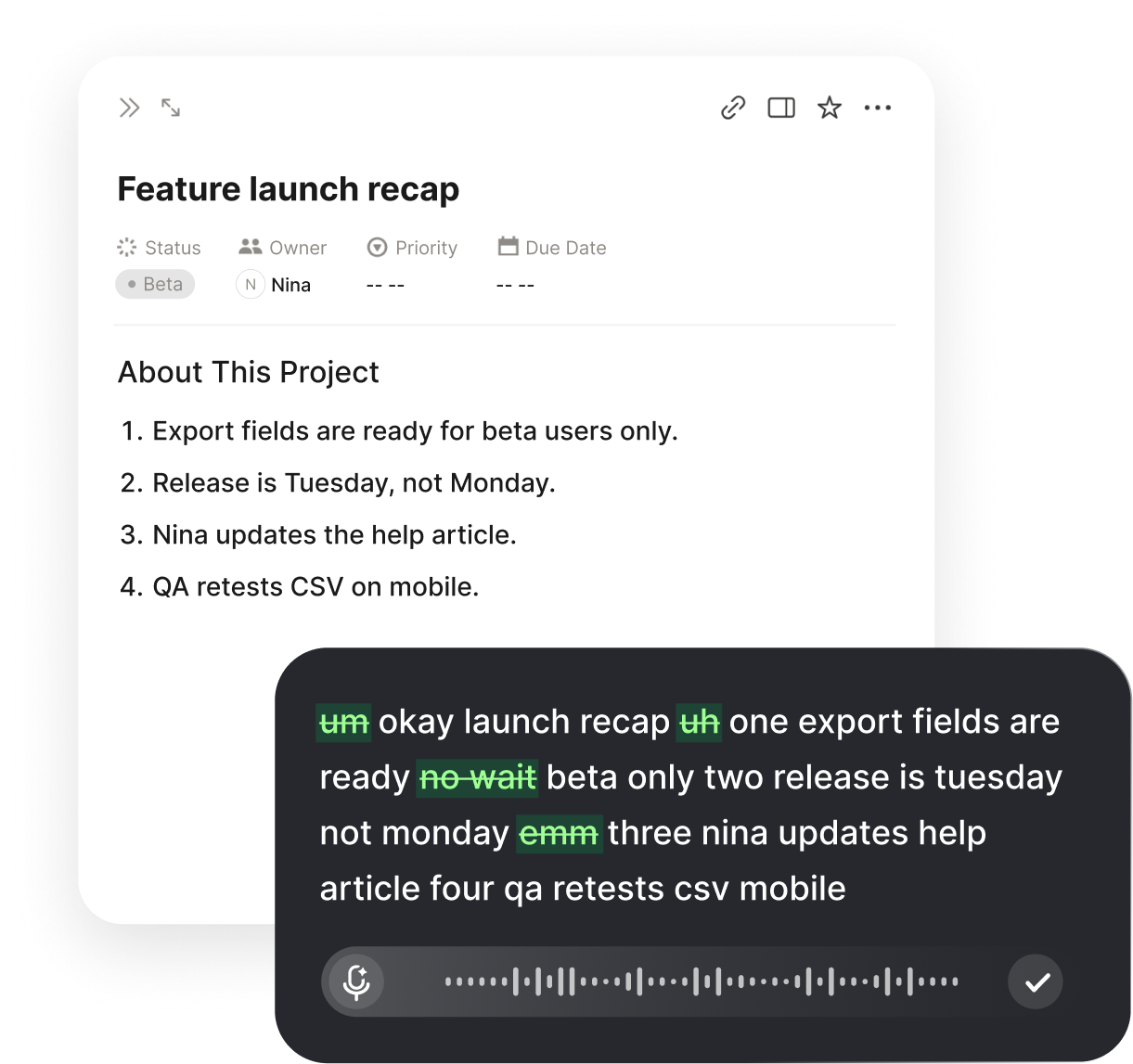
The first pass produces content; the second pass produces a letter. Read the draft once for structure, checking that facts, demand, deadline, and closing appear in that order. Then read again for precision, confirming names, amounts, dates, and clause references against the source file. This is where Voiskey helps: it removes filler words, stutters, false starts, and self-corrections as you speak, so the raw text needs less repair than a literal transcript would. Correct grammar slips and tighten sentences that wander. Delete any sentence that does not support the demand or explain the facts. Download Voiskey for the machine you use most so the routine stays identical. The aim is a draft that reads as if it were written, not spoken.
Check every number twice. Read amounts aloud in words and figures, then compare them with the calculation sheet. Verify that dates in the letter match the chronology and that the deadline stated is the date the recipient will actually receive it. Confirm that party names match the signature block and the referenced documents. Then review the demands for ambiguity: does the reader know exactly what to pay, to whom, by when, and how? Replace vague qualifiers with specific terms. Keep sentences short enough to survive a careless reading. This review is slow on purpose; it is far cheaper than withdrawing a letter that demanded the wrong sum or cited the wrong clause.
Edit for tone after the substance is right. A demand letter should sound controlled. Remove sarcasm, personal remarks, and adjectives that add heat without adding meaning. Replace accusations with descriptions of conduct and its consequences. Check that the level of firmness matches the stage of the dispute and the remedy available. Read the opening and closing paragraphs aloud, since those set the impression. If a paragraph sounds like an argument rather than a request, rewrite it as a statement of fact plus a demand. Have a second reader mark any sentence that could be read as a threat rather than a lawful consequence.
Finish with a mechanical pass. Check headings, numbering, paragraph spacing, and the enclosure list. Confirm that defined terms are used consistently and that every exhibit mentioned in the body is attached. Add the reference line, date, and delivery method. Run a final read of the whole letter at normal speed; this catches repeated phrases and missing transitions that silent reading misses. Note the version and save a clean copy for the file. If you plan to speak future letters in this matter, keep the glossary and skeleton beside the final version so the next draft starts from an approved model. A clean, consistent letter signals that the sender is organized, which supports the demand itself.
Route the Letter for Review and Delivery
Send the draft through a short, named review chain. The drafter checks facts and tone, a second reviewer checks citations, amounts, and the deadline, and the responsible attorney approves the final text. Give each reviewer a specific question rather than a general request to look it over. Ask one to confirm that every factual sentence can be traced to a document, and another to confirm that the demand is enforceable as written. Record who approved which version and when. If a reviewer changes a sentence, the drafter should read the change before it becomes final. A review chain with named tasks catches more errors than an open invitation for comments, and it prevents the situation where three people assume someone else checked the arithmetic.
If your firm dictates often, standardize the tooling around the task. Voiskey runs at the system level on macOS and Windows: you press a shortcut, speak, and text appears at the insertion point in whatever app or field holds the draft, including your letter template. It adapts punctuation, formatting, and tone to the kind of document you are producing, and it learns names, jargon, acronyms, and spelling preferences, which matters when a matter involves unusual party names. The workflow is Speak-Polish-Type-Edit, and at up to 220+ words per minute it is roughly five times faster than typing. That speed changes the economics of a first draft: you can produce a complete letter and spend your time on review rather than keystrokes. When you are ready, download Voiskey and run one real letter through the full routine.
Prepare delivery with the same care as the text. Confirm the recipient's correct name, title, and address. Decide whether the letter goes by mail, courier, or electronic means, and note the date of dispatch. If proof of delivery matters, arrange it before sending. Save the sent version, the delivery confirmation, and the enclosure list together in the matter file. Update the chronology with the dispatch date and the deadline it creates. If the letter invites a response, set a follow-up reminder for a few days before the deadline. Delivery failures are common and preventable: an outdated address or a missing exhibit can restart the clock and undermine the demand, no matter how well the letter itself was drafted.
After dispatch, debrief the process. Note which parts of the dictation needed the most correction, which glossary terms were missing, and where the review chain slowed down. Update the template or glossary with what you learned so the next letter starts stronger. If the recipient responds, add the response to the chronology and record the next action and its owner. If no response arrives by the deadline, confirm that the escalation is authorized before acting. Store the final letter, the exhibit set, and the approval record together. The deliverable is not just a sent letter but a repeatable routine: a frame, a fact set, a structured dictation, a polished draft, and a documented review.
FAQ s
Voiskey removes filler words, stutters, false starts, self-corrections, and grammar slips as you speak, so the text that appears at the insertion point is closer to finished prose. You still check facts, amounts, and deadlines yourself. The cleanup handles the spoken debris of a first pass, while the legal judgment about what the demand should say stays with you and your reviewer.
Yes. Voiskey learns names, jargon, acronyms, and spelling preferences, which helps when a demand letter repeats an unusual entity name or a defined term many times. Build a short glossary and dictate it once, then review the output against your source documents. Correct spelling of parties and clauses still deserves a deliberate verification pass before the letter leaves the office.
You press a shortcut, speak into your drafting app, and the text appears at the insertion point. Polish is the editing pass where you fix structure, tone, and citations. Type and Edit cover the remaining formatting and review work. Voiskey adapts punctuation, formatting, and tone to the task and runs at up to 220+ words per minute, about five times faster than typing, so the routine produces a full first draft quickly.
Yes. Voiskey works at the system level, so you press a shortcut, speak, and text appears at the insertion point in any app or text field. That means your letter template, your matter file, and your drafting app all receive the text directly. The workflow is Speak-Polish-Type-Edit, and there is no separate suite to open or export from.


 Voiskey
Your voice, amplified.
Download Voiskey for Mac and Windows and dictate your next demand letter from outline to final review.
Use it across macOS, Windows, iOS, and Android