
Dictating Contract Language Carefully
Spoken conventions for contracts where one word carries the whole deal
 Voiskey Team
Why Contract Speech Needs Rules
Dictating Contract Language Carefully means treating your voice as a drafting instrument with rules, because a contract punishes imprecision more than any other document. A letter can be clarified in a follow-up call, and a memo can be revised before it circulates, but a clause that says shall instead of may, or a defined term that shifts by one letter, becomes the thing the parties argue about. Speech is fast and contracts are unforgiving, so the method has to supply the discipline that speech lacks. The discipline is not complicated: a term list, a set of spoken conventions, a fixed order of work, and a read-back against a checklist.
Begin with the deal vocabulary, not with the first clause. List the parties exactly as they will be defined, the defined terms the deal already uses, and the labels that will appear dozens of times. Include the ones that are easy to confuse: Affiliate and Subsidiary, Notice and Communication, Business Day and calendar day. Say each aloud once at normal pace, and note any that your voice makes ambiguous. The list does two jobs, because it warms up pronunciation and it tells you which terms to confirm on first use. A contract is a closed system of language, and the list is its frame.
Decide the spoken conventions before the session. Say quote and end quote for language that must be reproduced from a prior draft or a term sheet. Say new clause when a new numbered clause begins, and say subclause for a nested item. For cross-references, speak the section number in a fixed pattern, such as section five point two, and confirm it during the read-back. For a list, say the ordinal and then the item. Write the conventions on one page and keep it visible. Conventions only help if they are used without a decision each time, and a visible page removes that decision.
Set the order of work so that judgment comes before polish. Read the term sheet and the prior draft first, then outline the clause order, then speak the operative language, then run the read-back, and only then adjust style. Speaking before you have read the source produces confident sentences that miss the deal. Polishing before the read-back produces elegant language that may be wrong. The order is the cheap part of the method and the part most often skipped, especially when a partner is waiting. Skipping it converts a fast draft into a slow correction, which is the exact outcome the method exists to prevent.
Load the Vocabulary of the Deal
Load the vocabulary before you dictate a sentence, and load it in the form the contract will use. If the agreement defines the buyer as Purchaser, say Purchaser every time, even if the deal team calls them the buyer in meetings. The spoken habit follows the document, not the conversation. Voiskey learns names, jargon, acronyms, and spelling preferences, so repeated use reinforces the right form, but the first use of each defined term still deserves a glance after it appears. A single early confirmation prevents a pattern of errors that would otherwise repeat through forty pages. Say the defined form once, check it once, and then trust the repetition.
Build the list in three groups. First, the parties and their defined labels. Second, the deal-specific terms: the property, the product, the schedule, the closing date. Third, the ordinary words that this contract defines in an unusual way, such as Service, Fee, or Territory. The third group is the dangerous one, because a familiar word with a defined meaning invites you to use it casually. Mark those words in the list and slow down when you speak them. The definitions are not a glossary at the back, because they are the rules that decide what every other clause means.
Include acronyms and short forms, and say them the way the document will print them. If the agreement uses an acronym, say the letters clearly and confirm the expansion at first use. If it uses a short form, say the short form and resist the urge to vary it for readability, since legal drafting values repetition over elegance. Voiskey supports 100+ languages and translation, which matters when a deal involves a second language, but the term list still governs which form appears in the operative text. Translation can help you understand a document, and it does not decide what your contract says.
Review the list against the actual document before you start, not against your memory of the last deal. Definitions migrate, labels change, and a term that meant one thing in the term sheet may mean another in the draft. Read the definitions section and the first page of the operative clauses, and update the list. This takes ten minutes and prevents the most expensive kind of error, which is consistent use of the wrong term. Consistency is only valuable when it points at the right definition, and a term list that is a week old may be worse than no list at all.
Dictate the Operative Clauses
Dictate the operative clauses one at a time, and finish each before starting the next. An operative clause does something: it grants, requires, prohibits, conditions, or excuses. Say the actor, then the verb, then the object, then the condition. For example, the Purchaser shall deliver the Deposit to the Escrow Agent within five Business Days after the Effective Date. That order is easy to speak and easy to check. When a clause has two obligations, speak them as two clauses or as a clearly numbered list, because a spoken and that joins two duties is the most common source of ambiguity in dictated contracts. If the two duties have different deadlines, they almost certainly need separate clauses.
Speak conditions before consequences. A conditional clause reads more clearly when the reader meets the trigger before the result, and speaking in that order keeps you from losing the thread. Say if the Seller fails to deliver the certificate by the Closing Date, then the Purchaser may terminate this Agreement by written notice. If you begin with the consequence, you will often forget the exception that belongs to the condition, and the exception is usually the negotiated part. Slow down at the word unless, because a spoken unless carries a whole carve-out and is easy to swallow. Say the carve-out as its own clause and then read it back on its own.
Handle lists with explicit numbering and a closing sentence. Say first, second, and third, start a new paragraph for each item, and after the last item say a short sentence that closes the list and returns to the main clause. Then check the count: the number of items you spoke should match the number in the draft, and the punctuation should make the boundaries obvious. Lists in contracts fail in two ways, by dropping an item and by making the last item look like it continues into the next sentence. Both are visible at a glance if you know how many items to expect.
Keep modifiers close to what they modify, and say them in that order. A spoken clause tends to accumulate trailing phrases, and a trailing phrase can attach to the wrong noun. If a phrase describes the notice, say it next to notice, not at the end of a long sentence. Where a clause needs a proviso, say provided that as a clear boundary and start a new sentence if the proviso is long. These habits are not stylistic preferences in a contract, because they decide which obligation a court will enforce. Speaking in the order the reader will parse is the simplest protection available. When a clause feels tangled, say it again in a different order rather than adding words.
Read Back Against a Clause Checklist
Read back against a checklist rather than against a feeling. The checklist has five lines: parties and defined terms, operative verbs, conditions and exceptions, numbers and dates, and cross-references. Read the clause once for each line, and do not combine the passes. Five short passes find more than one long read, because each pass gives your attention a single target. Voiskey keeps the text inside the drafting app, so the checklist can sit beside the clause without moving the file. The read-back is the part of the method that turns a fast draft into a contract you can send.
On the defined-terms pass, look for two failures: a defined term used before it is defined, and a term used in two forms. Read the definitions, then read the operative clauses, and mark every variation. On the operative-verbs pass, check shall, may, and must against the deal's intent, since a spoken shall that should be may changes a right into an obligation. On the conditions pass, confirm that every exception you spoke is present. These checks are mechanical by design, so they can be done when you are tired, which is when contracts are usually finished. Keep the five lines on a card and tick each one as you finish it.
On the numbers pass, compare every figure with the term sheet, and read the figure aloud as you compare. Spoken numbers are the most common silent error in dictated contracts, because a wrong figure looks like a right one. If a figure appears twice, compare both places rather than one. Check dates in the same way, including the year, and check any period expressed in Business Days against its definition. On the cross-reference pass, confirm that every section number exists and points to the right clause. If a cross-reference changed during negotiation, update it in one batch and note the change. A contract that cites a section that no longer exists reads as careless.
When the checklist is complete, download Voiskey if you have not already and run the same five passes on the next agreement. Doing it twice is what turns a checklist into a habit, and reading it once is what turns a checklist into a document nobody uses. After a few agreements, you will notice which pass catches the most errors in your own drafting, and you can give that pass a little more time. The goal is not a perfect process but a repeatable one, because repetition is what makes a check reliable under deadline pressure. A checklist you have run ten times is faster and more accurate than one you are reading for the first time.
Hold Versions and Hand Off Cleanly
Hold versions with a discipline that matches the stakes. Save a numbered version before each significant block: before the first spoken clause, before the read-back, and before any round of comments. Name versions by function rather than by emotion, such as draft two with comments, and avoid the label final until the document is actually executed. Keep the term list with the version it belongs to, because a list from an earlier draft can quietly reintroduce an old label. When you hand off, state which clauses were spoken and which were typed, so the reviewer knows where the risk sits.
Keep a clause-level change note during negotiation. For each comment, record the clause, the requested change, the decision, and who made it. The note can be a short table in the same file, and it makes the next round faster because you do not have to reconstruct the reasoning from tracked changes. When a clause is redictated, replace it rather than editing inside it, so the change is clean and the old language does not survive in fragments. Fragments are how contracts acquire two versions of the same obligation, one in the body and one in a proviso. Read the replaced clause against the comment it answers before you move on.
Use the team plan when more than one person drafts. Shared vocabulary and workflows keep party names, defined terms, and clause patterns consistent across contributors, which is exactly where multi-author contracts fail. The shared list does not remove the read-back, and it should not: each drafter still confirms the first use of a term and each reviewer still runs the five passes. What it removes is the slow argument about which label is correct. That argument is worth having once, at the start, and worth writing down so it does not recur in every draft. A single shared list is easier to defend than a folder of individual preferences.
Close the matter with a short record. Note the clause order that worked, the definitions that caused trouble, the exceptions that were negotiated late, and the checks that caught real errors. Carry that record into the next agreement with the same client, because the second contract should inherit the first one's lessons. A contract practice is cumulative, and most of the value sits in these small records rather than in any single document. The drafter who keeps them starts every new agreement with a vocabulary and a checklist already built. Keep the record short enough to reread before the next engagement letter.
FAQ s
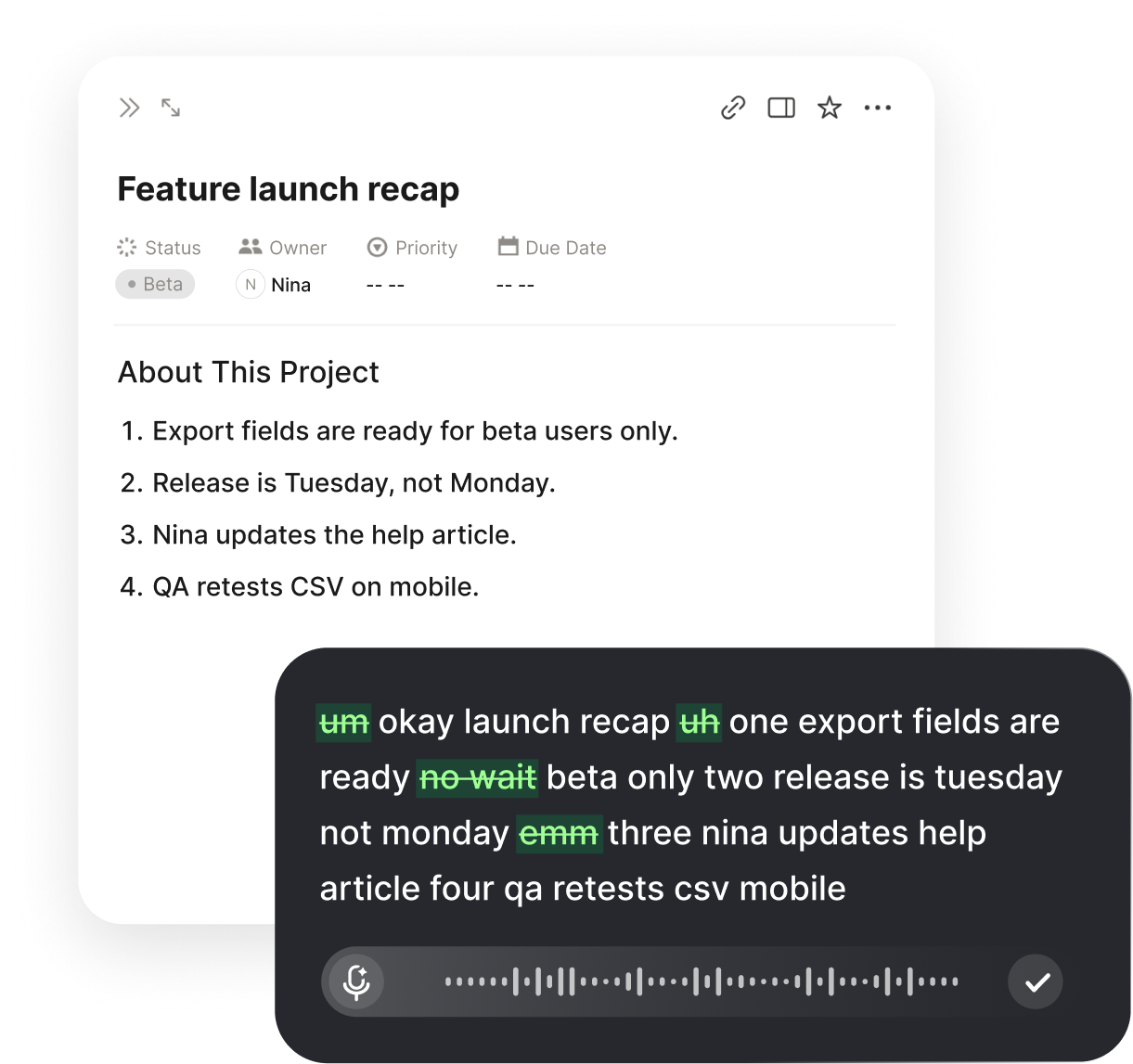
Voiskey is an AI voice typing app: you press a shortcut, speak, and text appears at the insertion point in the drafting app you already use. It removes filler words, stutters, false starts, self-corrections, and grammar slips, so a spoken clause arrives as clean text. You still read back party names, defined terms, verbs, conditions, numbers, and cross-references against your checklist.
Voiskey learns names, jargon, acronyms, and spelling preferences as you use it, which helps repeated defined terms arrive in the same form. Read the deal vocabulary aloud at the start of a session and confirm the first use of each label. On the team plan, shared vocabulary and workflows can carry confirmed terms across several drafters working on the same agreement.
Run five separate passes: parties and defined terms, operative verbs, conditions and exceptions, numbers and dates, and cross-references. Read each clause once per pass rather than combining them. Read figures aloud against the term sheet, confirm every section number exists, and check that a spoken shall was not meant as may. Mechanical passes can be run when tired, which is when contracts are usually finished.
Yes. Voiskey works at the system level, so you press a shortcut, speak, and the words appear at the insertion point in any app or text field. For contract work that means dictation lives inside the drafting app, with no export from a separate suite, and the clause you check is the clause you will send.


 Voiskey
Your voice, amplified.
Download Voiskey for Mac and Windows and start drafting by voice today.
Use it across macOS, Windows, iOS, and Android