
Dictating Arbitration Submissions
Fix the issues and relief, order the facts, and verify every citation before filing.
 Voiskey Team
Fix the Issues and the Relief
Dictating Arbitration Submissions starts with a decision about the issues the tribunal must decide and the relief you are asking it to award. Arbitration rarely rewards a broad narrative; it rewards a submission that ties each issue to a request. Write the issues in numbered form, then write the relief beside each one: a sum, a declaration, an order to perform, or a dismissal. Note which issues are within the tribunal's jurisdiction under the arbitration clause and which are not. A submission that asks for relief the tribunal cannot grant wastes the tribunal's time and weakens the requests it can grant. Fix the issues and the relief before you dictate a single factual paragraph.
Read the arbitration agreement and the procedural order before drafting. The agreement defines the scope of the dispute, the seat, the language, and the rules that govern. The procedural order defines the page limits, the filing dates, the format of the submissions, and the treatment of exhibits and witness statements. Copy the relevant terms into a short compliance note at the top of the file. A submission that ignores a page limit or a formatting rule may be rejected or returned, and a submission that argues outside the clause invites a jurisdictional objection. The procedural rules are not decoration; they shape what the tribunal will read.
Identify the governing law and the questions it leaves open. State the law the parties chose and the law the tribunal may apply to procedure. Mark the points where the parties disagree about the applicable rule, because those disagreements often decide the outcome. If the contract has a choice-of-law clause, quote it. If the dispute involves a treaty or a set of institutional rules, note the provisions that matter. A submission that assumes one legal framework while the tribunal applies another will spend its pages answering the wrong question. The legal framework belongs at the front of the outline, not in a footnote.
Prepare the working file and the review path. Create the standard sections: introduction, factual background, issues, submissions on each issue, relief, and a list of exhibits. Keep the arbitration clause, the procedural order, the chronology, and the exhibit index beside the document. Decide who drafts the facts, who drafts the law, and who reviews the whole for consistency. Note the filing date and the word or page limit. If the submission will be filed with witness statements, note which witnesses support which issue. A prepared file with the sections already named turns a complex submission into a sequence of manageable drafting tasks.
Order the Facts Around the Issues
Build a chronology before you dictate the factual background. List the events that matter to each issue with the date, the document or witness that supports the event, and the exhibit number. Keep the chronology to the events the tribunal must understand, not every event in the relationship. Mark the facts that are disputed and the facts that are common ground. A tribunal reads a submission with the issues in mind, so the factual background should follow the order of the issues rather than the order of the calendar. When the calendar order and the issue order conflict, use the calendar order and signpost the issue each period addresses.
Dictate the factual background in short, sourced paragraphs. State the fact, then the exhibit or witness statement that proves it, then its significance for the issue. Avoid adjectives and conclusions; let the documents carry the weight. Where a fact is disputed, say so and state your version with its support, then address the other side's version in the submissions rather than in the narrative. Keep the citations consistent: the same exhibit should carry the same label throughout. A tribunal that can trace each fact to a document will trust the submission more than one that asks it to accept a story on the drafter's authority.
Separate the facts the tribunal needs from the evidence it will hear. A submission is not a witness statement and should not reproduce one. Summarize what each witness will say, cite the statement, and leave the detail to the statement itself. Where a witness's account conflicts with a document, note the conflict and plan to address it in the submissions. Where a fact depends on an inference from several documents, say what the inference is and show the steps. This separation keeps the factual background readable and reserves the detailed evidential argument for the sections where the tribunal expects it.
Check the factual background against the exhibit index before you move on. Confirm that every exhibit cited exists, that every page reference is correct, and that no exhibit is cited for a proposition it does not support. Look for facts that appear once and are never used; either connect them to an issue or remove them. Look for issues that have no facts behind them; either add the support or narrow the issue. A factual background that is fully sourced and fully used gives the tribunal a map of the case and gives your legal submissions a foundation that does not need to be rebuilt later.
Dictate the Argument in Stages
Dictate the submissions on each issue in a fixed sequence: the proposition, the governing rule, the application to the facts, and the conclusion. Say the proposition in one sentence, then the rule with its source, then the facts that satisfy or defeat the rule, then the result you ask for. Keep the sequence identical for every issue so the tribunal can follow the structure without effort. If an issue has sub-issues, number them and treat each one with the same sequence. A predictable structure helps the tribunal compare your submissions with the other side's and makes the strongest points easy to find.
State the governing rule before you apply it. Quote the clause, the statute, or the authority that supplies the rule, and keep the quotation short. Paraphrase the rule in one sentence in your own words so the tribunal can see how you read it. If the other side reads the rule differently, state both readings and explain why yours is correct. Do not bury the rule in a string of citations; the tribunal needs to know which words control. A submission that argues the application before the tribunal understands the rule asks it to accept a conclusion without a standard.
Apply the rule to the facts with specific references. For each element of the rule, name the fact that satisfies it and the exhibit or witness statement that proves the fact. Where an element is contested, address the other side's best evidence and explain why it does not change the result. Do not repeat the factual background; cite it. Use short paragraphs and topic sentences, because a tribunal often reads a submission under time pressure. A submission that maps each element to a fact and a source lets the tribunal decide the issue without reconstructing the argument from scattered passages.
Dictate the relief as a separate stage with precise terms. State the sum, the declaration, or the order you seek, and tie each term to the issue that supports it. If interest is claimed, state the rate, the period, and the basis. If costs are claimed, state the rule and the amount or the basis for assessment. If the tribunal has discretion, name the factors and apply them. A vague request for such other relief as the tribunal deems just leaves the tribunal to guess. A precise request, supported by the issues you have already argued, is far easier to grant and far harder to overlook.
Assemble the Submission and File Notes
Assemble the submission in the order the tribunal expects. Put the introduction first, then the factual background, then the issues, then the submissions, then the relief, then the exhibit list. Confirm the page or word count against the procedural order. Check the formatting: the font, the margins, the numbering, and the headings. If the rules require a table of contents or a table of authorities, prepare them from the final text rather than from an earlier draft. A submission that is well organized and within the limits is easier to read, and it signals that the advocate respects the tribunal's procedures and its time.
Prepare the exhibit bundle and the witness statement references. Confirm that the exhibits are numbered in the order they are first cited and that the bundle matches the index. Check that each witness statement is identified and that the submission cites the correct paragraph. If the tribunal requires a core bundle, select the documents the tribunal must read and identify them clearly. Keep a master copy of the bundle with the submission. A submission whose citations do not match the bundle forces the tribunal to search, and a tribunal that has to search reads less of the argument than the advocate intended.
Write the filing note for the team. Record what was filed, the date, the method, and the confirmation. List the issues argued, the relief requested, and the items reserved for the next stage. Note any procedural question the tribunal raised and the response. Voiskey supports this work with 100+ languages and translation when a submission or a related communication must be prepared in more than one language, and it turns spoken requests into AI-ready prompts, including file names, paths, and commands. Download Voiskey to keep the filing note and the submission in the same voice. A clear note lets the next advocate pick up the matter without rereading the whole file.
Review the routine for the next submission. Note which sections needed the most revision, which authorities were hardest to verify, and where the exhibit list broke down under the pressure of a filing date. Update the template, the compliance note, and the verification log. If a particular tribunal has its own preferences, record them for reuse. Keep a short lessons note with the matter file. Over several submissions, a fixed structure, a sourced factual background, and a logged verification pass reduce the time spent repairing citations and let the team spend its effort on the issues that decide the case.
FAQ s
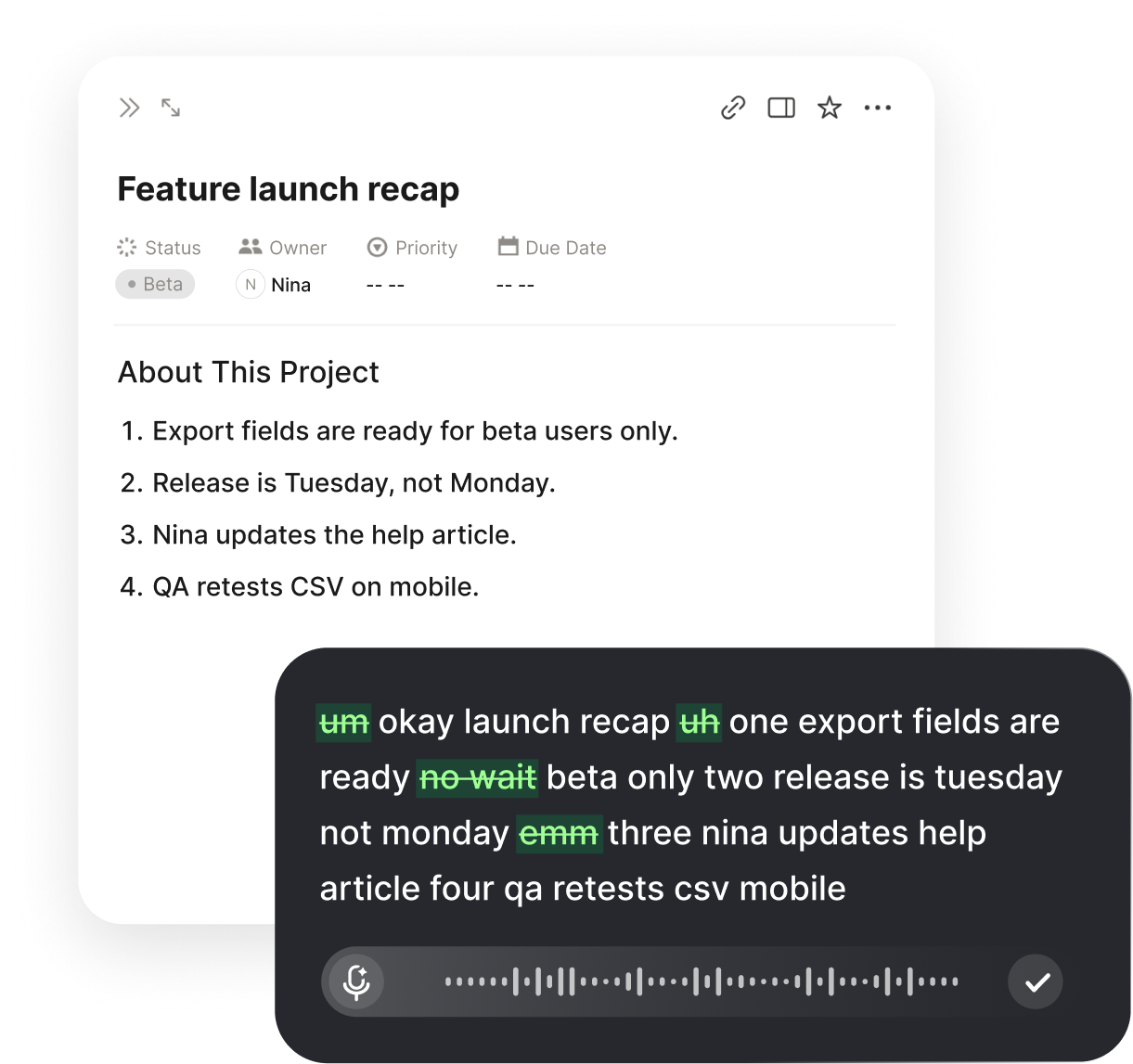
Voiskey is an AI voice typing app for the desktop. Press a shortcut, speak a paragraph or a correction, and the text appears at the insertion point in your submission file. It removes filler words, stutters, false starts, and grammar slips, so a spoken correction lands as clean text. You still verify every authority, exhibit number, and page cite against the record before filing.
Yes. Voiskey learns names, jargon, acronyms, and spelling preferences, which helps when a submission repeats party names, contract terms, and exhibit labels across many sections. A definitions table and exhibit index still fix the approved forms. The spoken draft reduces retyping, and the reviewer checks each reference against the chronology and the index before the submission is filed.
Press a shortcut and speak the submissions issue by issue into the document, and text appears at the insertion point. Voiskey removes filler words, stutters, and false starts and adapts punctuation, formatting, and tone. Polish is the pass where you check authorities, exhibits, and cross-references. At up to 220+ words per minute, the routine produces a complete draft that is ready for the verification pass.
Yes. Voiskey is system-level, so text appears at the insertion point in whatever app or text field holds the submission. You speak sections directly into the drafting file and revise them in the same place, with no separate suite to open. The workflow is Speak-Polish-Type-Edit, so corrections land in the version that will be checked and filed.


 Voiskey
Your voice, amplified.
Download Voiskey for Mac and Windows and dictate arbitration submissions from issues to verified exhibits.
Use it across macOS, Windows, iOS, and Android