
Dictating Research Memos and Case Summaries
A memo shape that answers the question before it explains the law
 Voiskey Team
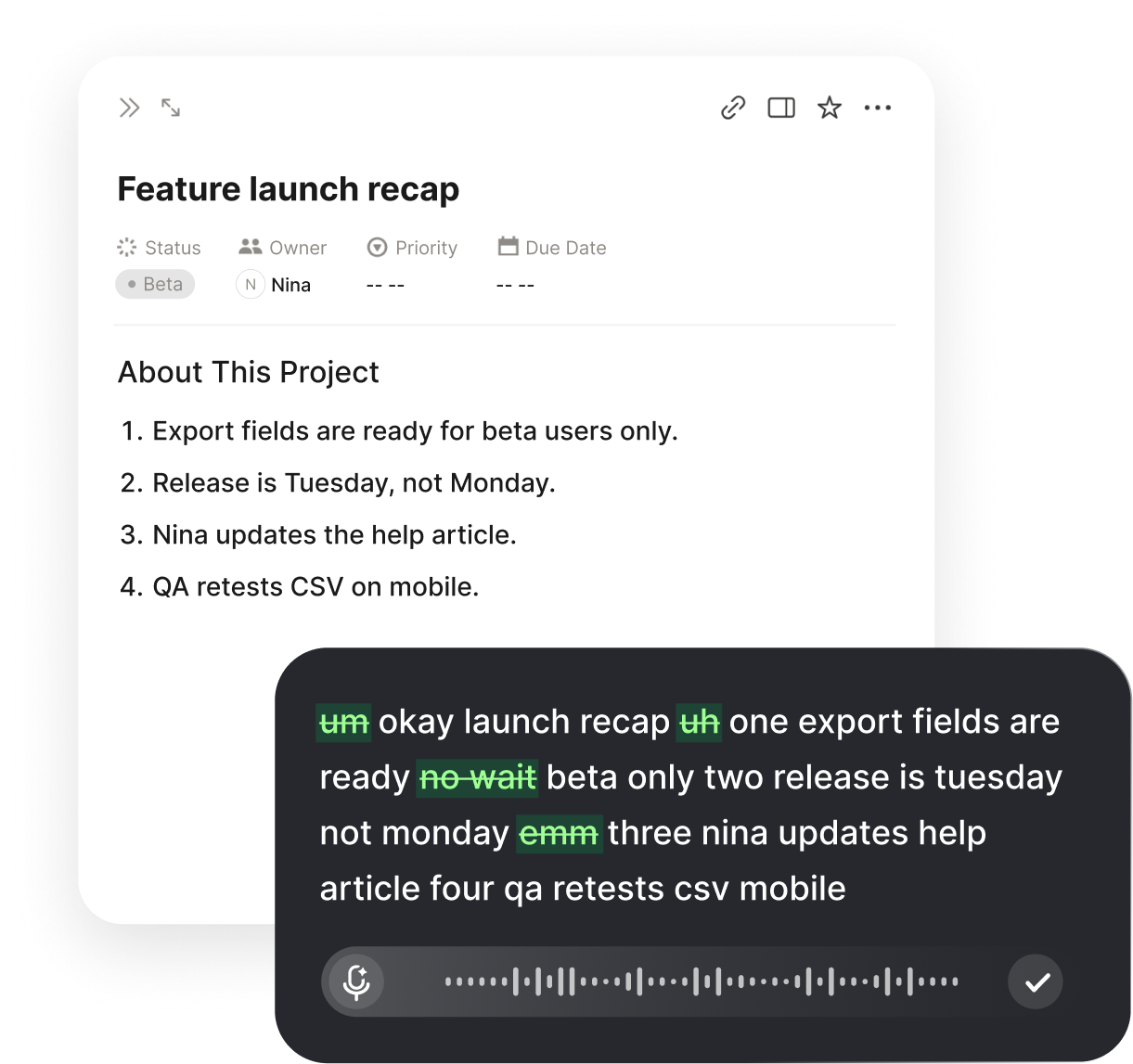
Memo Shape Before Memo Text
Dictating Research Memos and case summaries rewards a strict shape, because the reader of a memo wants an answer and the reasoning behind it, in that order. A memo is not a brief; it does not persuade a court, it informs a colleague who has to decide. That audience changes what you say and how fast you can say it. A spoken memo works when the question is already framed, the answer is stated early, and the analysis follows the elements of the rule. Without that shape, a spoken memo becomes a tour of the research, which is the least useful form of legal writing.
Frame the question before you open the microphone. Write the question presented in one sentence, with the parties, the issue, and the jurisdiction. If you cannot state it in one sentence, the research is not ready to be written. The question controls the scope, because a well-framed question tells you which authorities belong and which are background. Keep the draft question visible while you speak, and check each section against it. A memo that answers a different question than the one asked is a common failure, and it usually starts with a vague question. Keep the sentence under forty words, because a long question usually contains two questions.
Decide the memo's depth before you start. A short memo for a partner who needs a yes or no has three parts: question, answer, and a few sentences of reasoning. A full memo for a file has the question, the brief answer, the facts, the analysis, and the conclusion. Choosing the depth first prevents the most common waste in legal research writing, which is producing a long memo when a short one was requested. Ask the person who requested it, or infer from the deadline. Then write to that length and stop. If the request is ambiguous, write the shorter version and note what a longer memo would add.
Create the skeleton with headings and leave them in place while you speak. Headings keep a spoken memo from drifting, and they show the reader the structure before the substance. For a research memo, the usual headings are the question presented, the brief answer, the facts, the discussion, and the conclusion. Some offices add a recommendation. Use the office's headings rather than inventing new ones, because a memo that looks like every other memo is easier to review. The skeleton is a promise about the shape of the answer, and it should be kept. If the office has no standard headings, borrow the structure from the last memo that was well received.
Question, Answer, Then Analysis
Speak the question presented as a single sentence, then speak the brief answer as a single paragraph. The brief answer should state the conclusion and the main reason, without a survey of the authorities. For example, the answer is likely yes, because the statute applies to the conduct described and the exception does not. That paragraph is the part a busy reader will remember, so say it slowly and check it against the analysis. A brief answer that hedges in every clause is not cautious; it is unhelpful. If the answer depends on a fact that is not yet known, say so in the first sentence rather than the last.
In the analysis, take the rule apart before applying it. State the rule, list its elements, and then address each element with the facts and the authority. Say the elements as a numbered list, because a spoken list is easier to follow and easier to check. When an element is unsettled, say so and explain what the uncertainty means for the conclusion. Do not let a confident spoken sentence smooth over a genuine split in the authority. The memo's value is in the accuracy of its uncertainty, not in the confidence of its tone. Number the elements in the order the rule states them, not the order you researched them.
Treat the facts section as a source list with sentences. Each fact should be traceable to the record, the interview, or the document that establishes it. Speak the facts in the order the analysis will use them, which is often not the order they occurred. For a memo, relevance beats chronology. When a fact is disputed, say so and give both versions, then explain which version the analysis assumes. A memo that picks a version silently will mislead the reader who relies on the conclusion. Keep the facts short enough that the analysis can refer to them by a short label rather than a paragraph.
End with a conclusion that answers the question in the same words. If the question was whether the statute applies, the conclusion says whether it applies, not that the issue is complex. Add a short recommendation when the reader needs one, and separate it from the answer. The conclusion is not a summary of the memo; it is the answer restated with the confidence the analysis supports. Read it against the brief answer and confirm they agree, because a memo whose opening and closing disagree is worse than no memo. If the answer is qualified, state the qualification in the conclusion rather than only in the discussion.
Summarize Cases Without Distortion
Summarize a case by its holding first, then its reasoning, then its facts only as far as the reasoning needs them. A spoken case summary that begins with the facts tends to become a story, and the holding arrives late or not at all. Say the court, the year, the holding, and the rule the case establishes. Then say why the court reached that result. Keep the facts brief unless a fact is doing analytical work. A reader who needs the facts can go to the case, and a reader who needs the rule should not have to hunt for it.
Distinguish what the court held from what it said in passing. Dictation tends to flatten that distinction, because both arrive in the same confident voice. Mark dicta explicitly with a phrase such as the court noted, without deciding, that. Mark plurality opinions and concurrences in the same way. A memo that treats a passing comment as a holding will mislead the reader, and the error is hard to see later. When you are unsure whether a statement is a holding, check the disposition and the question the court was answering. A quick test is to ask what the court was asked to decide, because anything beyond that is usually dicta.
Quote sparingly, and mark quotations clearly. A spoken quotation should be short and exact, introduced with quote and end quote, and checked against the source. Paraphrase the rest, and keep the paraphrase close enough that a reader can find the supporting passage. Avoid the habit of quoting a sentence because it sounds authoritative, and quote when the exact words matter. A memo full of quotations is hard to read, and a memo with an inaccurate quotation is worse than one with none. When you quote, say why the exact words matter in a few words before the quotation, so the reader knows what to look for.
Say how each case fits the question. A summary that stops at the holding leaves the reader to do the analogizing, which is the work the memo was supposed to do. After the summary, add one or two sentences that connect the case to the element under discussion, such as this case supports the second element because. If the connection is weak, say so. The value of a research memo is the mapping between authorities and elements, and that mapping is exactly what a spoken summary tends to omit. If a case is only background, say that too, so the reader knows it is not part of the argument.
Verify Citations and Holdings
Verify every citation and every holding before the memo leaves your desk. Read the citation as it will appear, confirm the reporter and the page, and confirm that the passage says what you claim. Then read the holding against your summary, because a summary written from memory drifts. This pass is slower than the writing, and it is the pass that gives the memo its value. Voiskey keeps the text in the drafting app, so the memo and the source can sit side by side while you check. A memo with unverified citations is a liability, not a work product.
Check the authorities that cut the other way. A memo that cites only supporting cases is advocacy, not research. List the contrary authority, summarize it fairly, and explain why it does not change the conclusion. If it does change the conclusion, revise the brief answer. Speaking the contrary authority is a useful discipline, because it forces you to state the position you would rather avoid. A reader who sees the counterargument addressed will trust the rest of the memo more. If the contrary authority is strong, say so plainly and let the reader decide with full information, because a memo that hides it will be distrusted when it surfaces.
When the memo is ready, download Voiskey if you have not already and dictate the next one from the same skeleton. Reusing the shape is what makes a research memo fast without making it careless. Keep a short verification checklist with the skeleton: citations checked, holdings confirmed, contrary authority addressed, question and answer aligned. Run the checklist on the first three memos, and then keep it beside the skeleton so it is used without being remembered. Download Voiskey once, and let the checklist carry the standard. Keep the three memos in one folder so the checklist can be compared across them.
Record what you could not verify. A memo that says the cited case was unavailable and the conclusion rests on the summary in a secondary source is more honest and more useful than one that pretends to have read everything. Note the gap, note what it affects, and note what would close it. The reviewer can then decide whether the gap matters. This practice also protects you, because a clear record of the limits of the research is the difference between a judgment call and an error. A gap stated plainly is a professional judgment, while a gap discovered by someone else is a mistake.
File the Memo So It Gets Reused
File the memo where the next person can find it, with a name that states the question. A memo called research memo is lost within a month, while a memo called whether the statute applies to remote work is findable. Include the matter, the date, and the author in the file name, and keep the skeleton and the checklist with it. Voiskey keeps the draft in the app you already use, so filing is a matter of saving the file in the right place rather than exporting it from somewhere else. Add a line to the abstract when the memo is updated, so a reader knows which version is current.
Write a short abstract at the top of the file, separate from the memo itself. Three lines are enough: the question, the answer, and the state of the authority. The abstract is for the person who is deciding whether to read the memo, and it is also for you in six months. A memo without an abstract gets reread in full or not at all. The abstract is the cheapest form of knowledge management a practice can build, and it takes two minutes. Update the abstract when the answer changes, and keep the old version rather than overwriting it. A dated abstract is enough to tell a reader which version to trust.
Keep a list of the memos you have written, by question. When a new matter raises a similar issue, the list tells you whether the research already exists. This is not a substitute for checking whether the law has changed, because it is a way to avoid starting from zero. Update the list when a memo is superseded, and note the reason. A practice that remembers its own research spends less time repeating it, and repetition is the largest hidden cost in legal writing. A short index with the question and the date is enough, and it takes less time than one search.
Finally, review the memo shape after a few uses. If reviewers consistently ask for the same missing section, add it to the skeleton. If the brief answer is always read and the discussion never is, keep the discussion short and put the reasoning where it will be seen. The shape should follow the way the memo is actually used, not the way it was taught. A research memo is a working document, and a working document earns its keep by being read, trusted, and reused. Ask the person who reads the memos most often which section they skip, and shorten that section.
FAQ s
Voiskey is an AI voice typing app: you press a shortcut, speak, and text appears at the insertion point in the app you already use. For a memo, speak the question and the brief answer first, then the analysis, so the shape holds while you talk. Voiskey removes filler words, stutters, false starts, self-corrections, and grammar slips, so the reasoning arrives as clean paragraphs.
Voiskey turns speech into text and adapts punctuation and formatting to the task, but accuracy depends on how you speak and what you check. State the holding, then the reasoning, and mark dicta explicitly. Use clear boundaries for any quotation, then compare each summary and citation with the source before the memo goes to a reader.
Verify the citation, the page, and the holding, then read the holding against your summary because a spoken summary drifts. Confirm that contrary authority is listed and addressed, and that the question and the brief answer use the same terms. Note anything you could not confirm, along with what it affects, so the reviewer sees the limits of the research.
Voiskey keeps the draft in the app you already use, so the memo can be saved and named by the question it answers without exporting it elsewhere. Add a three-line abstract, keep a list of past memos by question, and store the skeleton and verification checklist with the file. Later matters then start from an existing shape rather than a blank page.


 Voiskey
Your voice, amplified.
Download Voiskey for Mac and Windows and start drafting by voice today.
Use it across macOS, Windows, iOS, and Android