
From Case Notes to Client Letter by Voice
Turn a file note into a letter a client can read and act on
 Voiskey Team
Notes First, Letter Second
From Case Notes to a client letter is a short distance if you keep the two artifacts separate, and a long one if you write the letter while the notes are still a pile. Case notes are written for you: fragmentary, chronological, full of abbreviations and reminders. A client letter is written for someone who was not in the room and who needs to know what happened, what it means, and what comes next. The work between them is translation, not transcription. Speech helps most at the translation stage, when the facts are settled and the only task left is to say them clearly.
Begin with notes you can actually use. During the meeting or call, write only what you will need to reconstruct the facts: names, dates, documents, decisions, and open questions. Do not try to write polished prose, and do not worry about order. Within an hour, add a short summary at the top of the note with three lines: what the client wants, what we decided, and what happens next. That summary is the seed of the letter, and writing it while the conversation is fresh is worth more than any later reconstruction. Notes that lack a summary force you to reread everything to find the point.
Verify the facts before you write a sentence the client will rely on. Read the notes against the documents: the dates, the amounts, the names, and the sequence. Mark anything you cannot confirm, and resolve it before drafting. Clients remember details differently, and a letter that repeats a wrong date damages trust more than a letter that is late. The verification pass is also where you decide what to omit, because notes often contain speculation and speculation does not belong in a client letter. Separating what you know from what you inferred is the first act of good client communication.
Choose the purpose before the content. A client letter usually does one of four things: reports a development, explains options, recommends a course, or confirms an instruction. Each purpose implies a different structure and a different tone. Write the purpose as one sentence at the top of the draft, such as this letter confirms the settlement terms and explains the next three steps. That sentence keeps the letter from becoming a summary of everything you know. A letter with a clear purpose is shorter, and clients read short letters more carefully than long ones. Write the purpose in the first line of the file, not only in your head.
Turn Notes Into Verified Facts
Turn notes into a fact list before you turn them into prose. A fact list is a sequence of short declarative sentences in time order, each tied to a document or a conversation. Write it in the same order the client will experience the story. This list is the spine of the letter, and it is easier to correct than a paragraph. When the facts are wrong, you fix one line; when facts are embedded in elegant prose, you rewrite the paragraph and lose the wording you liked. Speaking the fact list aloud is also a good test of whether the sequence makes sense.
Give each fact a source tag in your working copy, and remove the tags when you draft the letter. A tag can be as short as a document name or the date of a conversation. The tags let you check the letter against the record in one pass, and they prevent the drift that happens when a fact is repeated from memory in three different places. Tags are scaffolding, not content, so they should never appear in the letter the client reads. Keeping scaffolding separate from the deliverable is the habit that makes a fast draft safe. When the tags come out, read the letter once to be sure none were left behind.
Decide the level of detail the client needs, and cut the rest. Clients need enough detail to understand the situation and make a decision, not a transcript of the file. A useful test is to ask what the client must be able to explain to someone else after reading the letter. If a fact does not support that explanation, it probably belongs in the file note rather than the letter. This test also protects you from the opposite error, which is a letter so compressed that the client cannot see why your conclusion follows. A letter that explains the link between fact and conclusion is doing real work.
Write the difficult facts plainly and without euphemism. Clients notice when a letter avoids the central problem, and avoidance costs more trust than bad news. State the problem, state its consequence, and state what can be done. Do not bury a material fact in the middle of a paragraph of reassurance. A letter that says the filing deadline has passed and we are seeking an extension is more useful than one that describes procedural developments for two pages. Plain bad news, followed by a concrete next step, is the most professional form of client communication. If the news is bad, say when the client will hear from you again.
Speak the Letter in Plain Language
Speak the letter in the voice you would use on a call, then remove the parts that do not belong on paper. Spoken language is naturally direct, and directness is what clients need. Voiskey adapts punctuation, formatting, tone, and word choice to what you are trying to do, so a spoken explanation of a settlement can arrive as a clear paragraph rather than a transcript. Read the result and ask whether a smart person outside the law would follow it in one pass. If not, the problem is usually a sentence that carries two ideas or a term that needs a plain gloss.
Say each legal term once, then translate it. A client letter can use consideration or discovery if the term matters to the decision, but it should not assume the client knows what the term means. Speak the term, then say what it means in this matter. That pattern keeps the letter accurate and readable at the same time. Avoid the reverse pattern, which replaces every legal term with an approximation and loses the precision the client is paying for. The goal is not to sound informal, but to be understood without being misled. If a term needs a paragraph to explain, the letter probably does not need the term.
Keep sentences short and paragraphs shorter. Spoken drafting produces longer sentences than typing, because speech has no natural full stop, so make the stops explicit with new paragraph at each change of subject. A client letter with paragraphs of three or four sentences is easier to read on a phone than one with dense blocks. Use headings for a letter that runs beyond a page, because a heading tells the reader what to skip if they already know it. Structure is a courtesy to a busy reader, and busy readers are the ones who most need your letter. Read each paragraph aloud once and stop where you run out of breath.
Put the action at the end, in a short list. A client letter should close with what happens next, who does it, and by when. Speak the list as a list: first, we will file the motion by Friday; second, you will send the signed form; third, we will confirm receipt. Then read the list back and check it against the body, because the most common client-letter error is a next step that appears nowhere in the explanation. A clear closing list turns a description into a plan, and a plan is what the client is paying for. If the list has more than four items, the letter is probably trying to do too much.
Read It as the Client Will
Read the letter as the client will, on a small screen and with limited patience. Read the first sentence and the closing list first, then the middle. If those two parts do not tell a coherent story, the letter needs work regardless of how good the middle is. Check for anything that could be read as a promise you cannot keep, and check for anything that sounds like a guarantee of an outcome. When you are satisfied, download Voiskey and dictate the next letter from the same fact list, so the method becomes a routine rather than a one-off experiment.
Ask a colleague who does not know the matter to read the letter and state what the client must do next. If they cannot answer in one sentence, the letter is not clear. This test is faster than a style review and more relevant, because clarity about the next step is the functional core of a client letter. Note where the colleague paused, and fix those places first. Do not defend a sentence because it is technically accurate, since accuracy that requires rereading is not yet communication. Give the colleague the letter without your explanation, because the explanation is what the client will not have.
Check the tone for this client, not for clients in general. A long-standing client with a background in the subject can take more detail, and a first-time client needs more context and less shorthand. Read the draft and ask whether it sounds like the way you speak to this person in a meeting. If it sounds like a letter to an opponent, soften the verbs; if it sounds like a note to a colleague, add the context the client lacks. Tone is not decoration in a client letter, because it is part of how the advice is received.
Keep a record of what you sent and when. A letter is often the only contemporaneous account of what the client was told, and a short note of the date, the channel, and the main points protects both sides. This is not a bureaucratic step, since it is how you avoid relitigating a conversation six months later. When the client replies, attach the reply to the same record and note any instruction that changes the plan. The letter and the record together form a small, reliable history of the matter, which is worth more than a folder of drafts. Save it with the letter so the two are found together.
Build a Letter Pattern You Reuse
Build a pattern for the letters you write most often: the status update, the options letter, the instruction confirmation, and the closing report. Each pattern is a skeleton with a fixed opening, a fact section, an analysis section, and a closing list. Speak into the skeleton, and the letter stays consistent from client to client. Voiskey adapts tone and word choice to the task, which helps a status update sound like a status update, but the structure is yours. A pattern is not a form letter; it is a shape that makes a good letter faster to write and easier to review.
Keep a small bank of sentences that work, and use them deliberately. Openings that state the purpose, transitions that move from facts to options, and closings that list next steps are reusable in most letters. Speak them from memory or keep them in a note beside the draft. Reuse is not laziness in client communication, because it is consistency, and consistency is what makes a letter recognizable as coming from your practice. Vary the substance and the specifics, and keep the frame steady. Review the bank twice a year, remove any line that no longer sounds like you, and add the sentences clients respond to.
Update the pattern when a letter fails. If a client calls to ask what a letter meant, that is evidence the pattern needs a clearer section rather than evidence that the client did not read carefully. Note the question, and add the missing explanation to the pattern. Over a year, this produces a set of letters that answer the questions clients actually ask. The same discipline applies to the fact list: if a fact is repeatedly missing, add it to the intake note so it is captured at the source. A pattern that absorbs these small corrections becomes a genuine asset of the practice.
Hand the pattern to anyone who writes letters for the same clients. A short template, a fact-list format, and a closing checklist are enough for an assistant or a junior colleague to produce a draft you can review quickly. If your group uses the shared vocabulary and workflows in the team plan, the client and matter names you confirm once can carry across the group. Whether you share the pattern or keep it, review it twice a year, because a pattern that never changes slowly stops matching the way you actually advise clients. A short review with a date is enough, and it keeps the pattern honest.
FAQ s
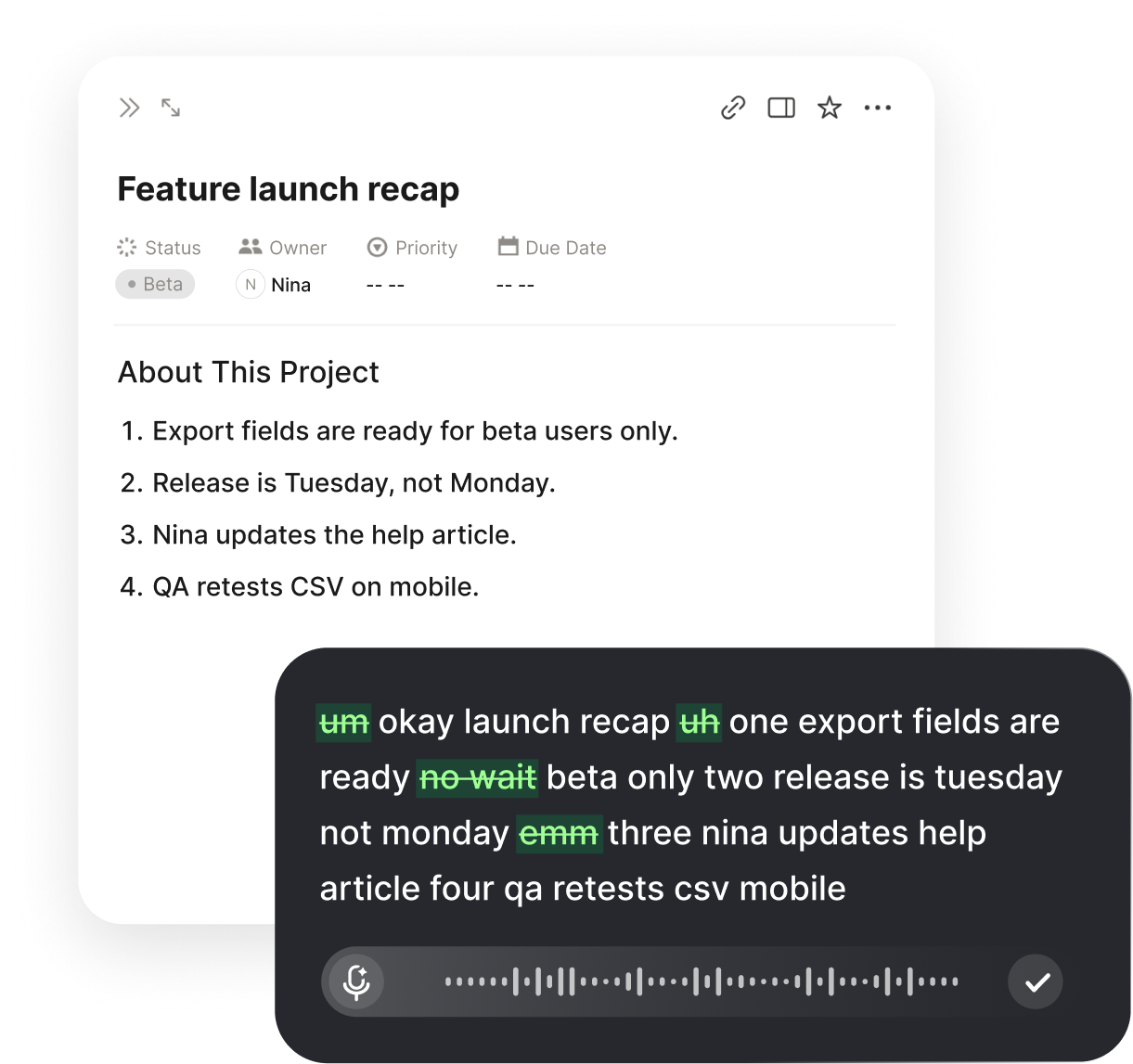
Voiskey is an AI voice typing app: you press a shortcut, speak, and text appears at the insertion point in the app you already use. For a client letter, that means you can speak from a verified fact list and get clean prose in the same window where you will send it. Voiskey removes filler words, stutters, false starts, self-corrections, and grammar slips, so the spoken draft needs less cleanup.
Voiskey adapts punctuation, formatting, tone, and wording to what you are trying to do, so a spoken explanation can arrive as a readable paragraph rather than a transcript. You still control plain language: say each legal term once, translate it for the client, and keep sentences short. Then read the result as the client will before you send it.
Yes. Voiskey is system-level, so you press a shortcut, speak, and the text appears at the insertion point in any app or text field. For client letters that means the draft lives in the same place you will edit and send it, with no copying between apps. You can keep the fact list and the letter side by side while you review.
Read the opening sentence and the closing list first, then the middle. Confirm that every fact matches the record, that each next step names a person and a date, and that no sentence reads as a guarantee. Ask a colleague to state what the client must do next; if they cannot answer in one sentence, clarify the letter before it goes out.


 Voiskey
Your voice, amplified.
Download Voiskey for Mac and Windows and start drafting by voice today.
Use it across macOS, Windows, iOS, and Android