
Anthropic's IPO and the Economics of AI Writing
Why AI writing valuations rise while the keyboard still caps your daily output.
 Voiskey Team
Anthropic's IPO and the Writing Market
Anthropic's filing to list under the ticker ANT, with a mid-November debut expected, turns a private research lab into a public bet on AI writing. That framing matters because writing is not a side use case for these systems; it is the daily habit that drives subscriptions, retention, and word of mouth. When investors assign a market value to a company whose most common task is drafting text, they are effectively pricing the writing workflow itself. The filing documents revenue and growth, but the underlying product is simpler: people hand a model a prompt, a document, or a question, and they expect usable prose back. The public market is now putting a number on how much that habit is worth.
The clearest demand signal sits in consumer behavior rather than in a prospectus. Claude already accounts for close to one third of UK consumer AI subscriptions, which means a large share of paying users chose a writing-focused assistant over general purpose chatbots. That is a striking concentration for a category with dozens of competitors. It suggests that when people pay monthly for AI, they are buying help with emails, reports, proposals, and drafts far more often than they are buying novelty. Investors reading the same data see durable intent: users renew tools that make their writing faster, and they abandon tools that only impress them once. The subscription mix is a vote for writing as the core job to be done.
For knowledge workers, the practical meaning is that AI writing tools are becoming infrastructure rather than experiments. Budgets that once sat with individual enthusiasts now move through team plans, procurement, and IT review. That shift raises expectations: a writing assistant has to work inside the tools people already use, respect company data rules, and produce text that can be sent without heavy repair. It also changes how teams evaluate value. A clever demo is no longer enough; the tool must survive a normal Tuesday of email, meeting notes, and document review. The IPO simply makes this maturation visible, because public companies are judged on repeat usage rather than on launch week excitement. Writing is now a line item, and line items get scrutinized.
Yet the market conversation rarely reaches the part of writing that consumes the most human time. Valuations describe demand for output, not the mechanics of producing it. Every draft still starts with a person moving an idea from memory into a machine, and for most people that move happens on a keyboard, one keystroke at a time. A model can be excellent at restructuring a paragraph, but it cannot begin until someone supplies the raw material. That gap between what a person knows and what a person can type is where the economics of AI writing actually meet daily life. The IPO prices the destination; it says very little about the road that leads there.
What Investors Are Pricing
What investors are pricing, first and foremost, is frequency. Writing is one of the few AI tasks that happens many times a day, across email, chat, documents, and code comments. High frequency produces the subscription behavior that public markets reward: predictable usage, low churn, and a credible path to expansion inside organizations. A tool used twice a month is a novelty; a tool used twenty times a day becomes part of the operating system of a job. The writing market looks attractive for exactly this reason. Its value does not depend on a single dramatic use case, but on the accumulated minutes of ordinary composition that fill a working week.
Second, investors are pricing quality and trust. Writing is personal and often sensitive; drafts contain strategy, customer details, and unfinished thinking. A tool that leaks data or produces text a professional cannot defend will not survive procurement, no matter how fluent its output. That is why security posture, retention policies, and compliance certifications have moved from footnotes to headline requirements. Public markets also price the ability to serve teams rather than individuals, because shared workflows and admin controls are what turn a seat license into an account. The economics of AI writing therefore rest on two pillars that have little to do with model benchmarks: whether the output is trustworthy, and whether the surrounding product can be deployed responsibly at scale.
What the market cannot easily price is the friction before the first word. Analysts can count subscriptions and estimate revenue per seat, but seats are not the same as usage. A team can pay for a writing assistant and still leave most of its capacity unused because composing a good prompt, or even a rough first paragraph, takes effort at the keyboard. Utilization depends on how quickly a person can get intent out of their head and into the tool. When input is slow, the subscription becomes a sometimes-tool: opened for special projects, ignored for routine replies. The valuation assumes engagement, yet engagement is capped by a bottleneck that appears nowhere in the financial statements.
The missing line item is expression. Every organization that buys writing AI is also paying, invisibly, for the minutes employees spend typing into it. Those minutes do not show up in software budgets because they are absorbed into salaries, but they determine whether the investment compounds. If a writer can move from thought to draft in a fraction of the usual time, the same subscription produces more usable output per week, and the return on the seat rises without any change to the model. If input stays manual, the tool remains a premium convenience. Framing expression as part of the economics is not a marketing trick; it is the difference between a license that sits idle and one that earns its place.
The First Mile of Every Draft
Every draft has a first mile, and it happens before any tool can help. Someone has to decide what the document is for, which points matter, and in what order they should appear. Then that thinking has to leave the head and become words on a surface. Most discussions of AI writing skip this stage and focus on revision, where models are genuinely strong. But revision assumes material exists. The first mile is where blank pages stall projects, where a simple status update takes fifteen minutes, and where the difference between a productive day and a fragmented one is decided. Any serious account of writing economics has to start at that boundary between thought and text.
It is also where the time actually goes. Editing a paragraph is fast because the constraints are visible: the sentence exists, and the task is to improve it. Producing the first version is slow because the constraints are internal and unordered. This asymmetry explains why AI writing tools feel magical in demos and uneven in practice. A model can turn a rough note into a polished email in seconds, but only after the note exists. The first mile is therefore the highest leverage point in the whole workflow. Improving it does not require a better model; it requires a faster way for a person to externalize intent. That is an input problem, not a generation problem.
The quality of what the model receives also depends on this stage. Vague typed prompts produce vague answers, and the usual advice, write a better prompt, quietly relocates work rather than removing it. A person who is tired at four in the afternoon will not compose a beautifully structured three paragraph brief on a keyboard; they will type a fragment and accept the generic result. Speaking changes the effort curve. It is easier to narrate context, name the audience, and list the points that must appear when you are talking than when you are editing yourself in real time. Better raw material follows naturally, and better raw material is what makes every downstream step, including the model's output, more useful.
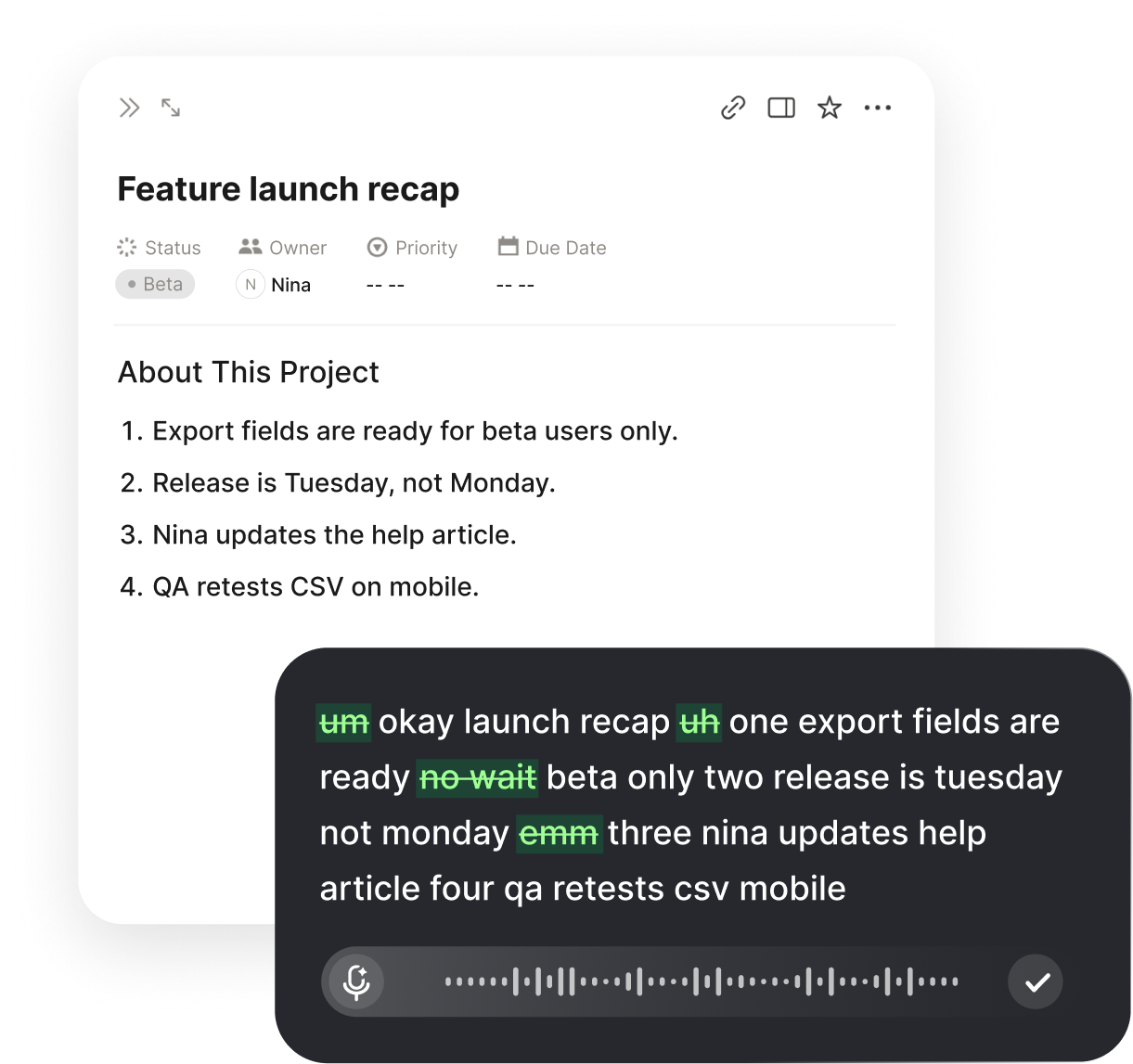
The practical sequence is simple: speak the draft, let the system polish it, type the final adjustments, then edit with full attention. This is the Speak, Polish, Type, Edit workflow, and it matches how the first mile actually works. Speaking captures structure and intent while they are fresh; polishing removes the false starts and filler that make raw speech hard to read; typing handles names, numbers, and precise phrasing; editing applies judgment. Each step uses the channel best suited to it. The result is not a transcript and not a machine-written essay, but a real draft that a person can stand behind. That distinction matters for anyone who has tried dictation and abandoned it after seeing the messy output.
Where Typing Slows the Workflow
Typing slows the workflow in places that are easy to overlook because each instance is small. A reply to a colleague takes a few minutes. A status update takes ten. A ticket description takes fifteen, including the mental reset before starting. Individually these tasks look trivial, which is why they are rarely measured. Collectively they consume a large share of the working day, and they cluster around the moments when a person's attention is already divided. The cost is not just keystrokes; it is the transition from thinking to composing to sending, repeated dozens of times. Each transition has a startup cost, and the keyboard is where that cost is paid.
The deeper slowdown is latency, not raw speed. Typing forces a person to sit still and convert thought into linear text before anything can be shared. That requirement is incompatible with how ideas often arrive, during a walk, between meetings, or mid conversation. By the time someone reaches a keyboard, the phrasing that felt clear has usually faded, and the draft begins with reconstruction rather than recall. Voice removes the requirement to be at a desk. It lets a person capture the sentence while it is still formed, then refine it later. The benefit is not only words per minute; it is the number of ideas that survive long enough to be written down at all.
There is also a cleanup tax that shows up after the text exists. Typed drafts often arrive as fragments, with placeholder phrases and incomplete sentences that the writer intends to fix later. Spoken drafts arrive with different problems, such as repetition and filler, but they tend to carry more complete reasoning because talking encourages explanation. A polishing step can remove the spoken noise while preserving the argument, which is harder to do with a typed outline that never contained the argument in the first place. Over a week, the difference changes how much time is spent repairing drafts versus advancing them. The workflow stops feeling like a sequence of small writing emergencies.
Teams can see the effect if they measure the right things. Time to first draft, number of revision rounds, words produced per writing session, and the share of messages sent without a second pass are all observable without instrumenting anyone's keystrokes. Ask a group to record these numbers for one week with their current habits, then repeat the exercise after introducing voice input for a single category of writing. The comparison is usually clearer than any survey, because it reflects real tasks rather than stated preferences. What matters is not a dramatic headline number; it is whether the same people finish more of the writing they actually owe, with less friction at the start.
Voice Input as the Drafting Engine
Voice input becomes a drafting engine when it lives at the system level rather than inside one application. Voiskey runs on Mac and Windows and works wherever text can be entered, including email clients, chat tools, document editors, and code environments such as Cursor. That placement matters because drafting rarely happens in one place. A thought starts in a chat, becomes a ticket, then turns into a document. If voice only works in a single app, users learn to avoid it for everything else. System level input removes that decision. The tool follows the work instead of asking the work to move to it, which is the difference between a feature people try and a habit they keep.
The workflow is deliberately plain: speak, polish, type, edit. Speech becomes structured text through a polishing step that removes filler, resolves false starts, and formats the result for its destination. Voiskey supports more than one hundred languages, which matters for teams that write in a second language or switch between markets. Processing is local by default, with zero retention and SOC 2 Type II compliance, so sensitive material does not become training data or a lingering transcript. Those properties are not extras; they are what allow a professional to dictate a customer email or a strategy note without stopping to worry about where the audio goes.
For a business already paying for writing AI, voice input changes the return on that spend. The model's cost is fixed per seat; the variable is how much usable text each seat produces. Removing the typing bottleneck raises that number without raising the subscription. It also shifts where human attention goes. Instead of spending energy on transcription, people spend it on judgment: what to say, to whom, and how firm the tone should be. That is the part of writing that models cannot own and that companies actually pay for. Expression intelligence is a useful name for the layer that handles the rest, because it describes the goal: not hearing words, but producing text that can be sent.
The sensible way to start is small and measurable. Pick one writing task that repeats daily, such as follow up emails or meeting summaries, and use voice input for that task alone for a week. Keep the same tools, the same recipients, and the same standards. At the end, compare time to first draft and the number of edits required. Most people find that the habit sticks when it is attached to a specific task rather than introduced as a general capability. Teams can then extend the pattern with shared workflows on the Team plan, giving new members a starting configuration instead of asking everyone to invent one.
FAQ s
You speak your draft naturally, Voiskey polishes it into clean structured prose, the text is typed at your cursor, and you edit the result before sending. Each stage has one job: capture, cleanup, insertion, and judgment. Speaking keeps your reasoning intact, while the typing and editing steps let you control names, numbers, and final tone.
The Team plan shares vocabulary and workflows, so recurring client names, product terms, and dictation patterns stay consistent across members. A new teammate starts with the conventions the group already agreed on instead of inventing a personal setup. That matters for outward facing writing, where two people should produce the same spelling and the same tone.
Open Voiskey settings and find the custom vocabulary section. Add each name, acronym, or product term with the exact spelling you want returned, one entry per line. Voiskey then prefers those spellings in every text field, which reduces corrections when you dictate client names, project codes, or technical abbreviations that recognition would otherwise guess at.
Say where each paragraph should break and Voiskey applies punctuation and line breaks as it inserts the text. Speak one idea per paragraph, pause between them, and avoid restating the same point twice. The result arrives as separate readable blocks rather than one wall of text, which makes editing quick and the finished message easy to scan.


 Voiskey
Your voice, amplified.
Start with one repeating writing task, dictate the first draft, and measure how much faster your team sends finished work.
Use it across macOS, Windows, iOS, and Android