
Speaking Acceptance Criteria into a Build Request
A practical way to speak testable criteria, examples, and a reviewable build request
 Voiskey Team
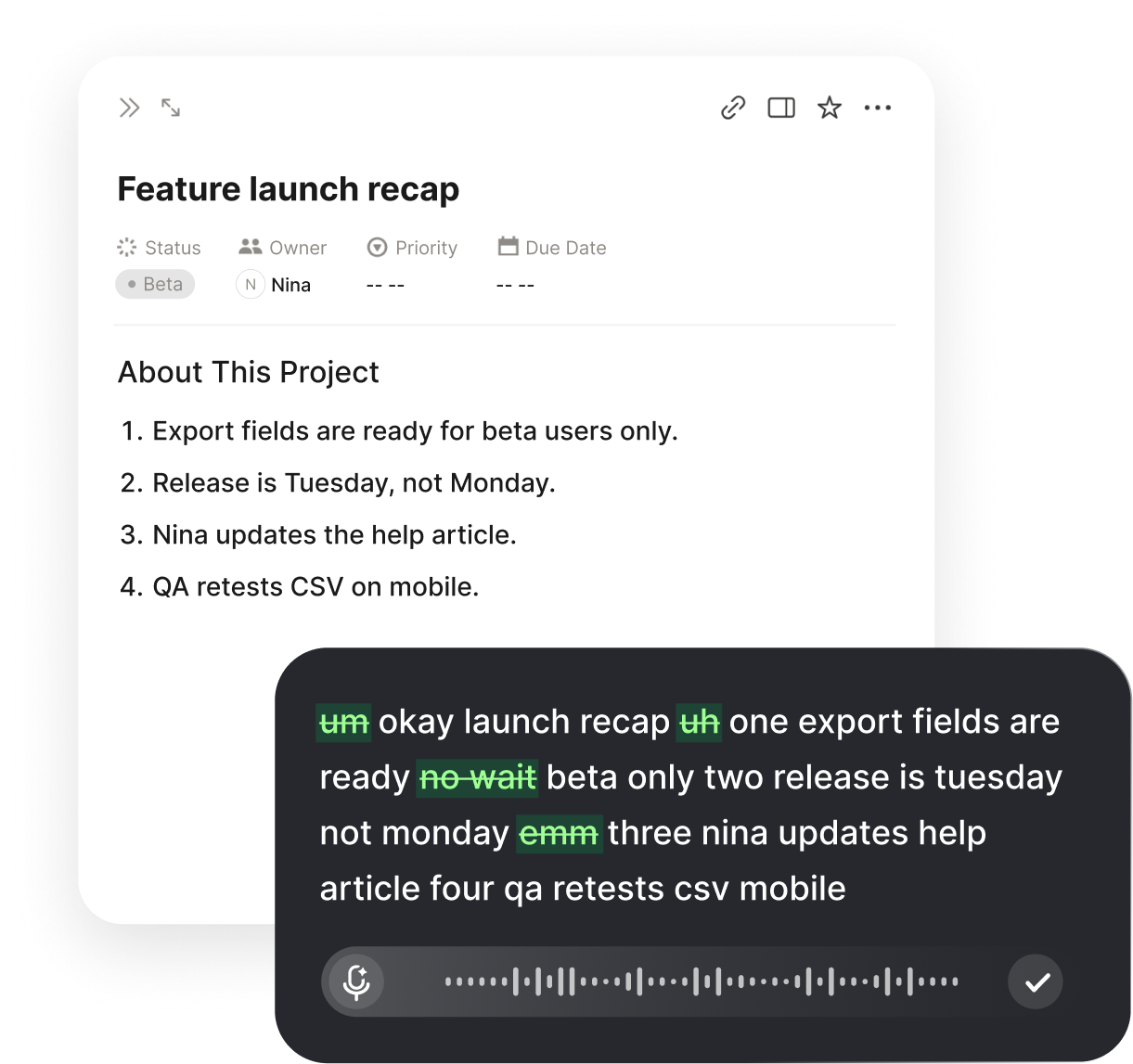
Turn Requirements Into Checkable Statements
Speaking Acceptance Criteria into a build request is the point where a vague wish becomes a testable requirement. An acceptance criterion is a statement that can pass or fail, not a description of effort. If you can read a sentence and a reviewer can disagree about whether it happened, the sentence is not a criterion yet. The fix is to add a condition and an observable result. Write the criteria before the build request, not after the first result arrives, because criteria written afterward tend to describe whatever the code already does. A wish can be discussed forever, while a criterion can be checked once.
Convert each requirement into a condition and a result. The form is simple: given a situation, when an action happens, then an observable result follows. Given an empty list, when the page loads, then the empty state appears. This form is easy to speak, easy to check, and hard to misread. It also separates the setup from the behavior, which helps when a criterion fails and you need to know which part was wrong. Not every criterion needs all three parts, but any criterion missing a condition or a result is probably still a wish. Setup, action, and result are also the three places a check can go wrong.
Keep each criterion independent so a failure points to one thing. A criterion that bundles several results into one sentence makes a partial pass ambiguous. Split it into separate sentences, one per result, and number them. Independence also makes the build request easier to review, because each sentence can be marked pass or fail on its own. When two criteria genuinely depend on each other, state the dependency explicitly rather than merging them. A numbered list of independent criteria is the most useful artifact you can hand to an agent and to a reviewer. An independent list is a checklist waiting to be used.
Separate must-have criteria from nice-to-have criteria. The build request should make clear which criteria define done and which are optional polish. Say that the first three are required and the last one is optional. This distinction prevents the agent from treating every sentence as equally important and prevents the reviewer from blocking on a detail that was never required. It also gives you a principled way to cut scope when time is short. Requirements that are not separated by priority tend to turn into a negotiation at review time. Priority is part of the contract, not an afterthought at review time.
Speak Criteria With Clear Conditions
Speak each criterion in the same grammatical shape so they are easy to compare. If one criterion starts with given and another starts with the then clause, the list becomes hard to scan. Use the same three-part pattern for every item: given, when, then. Pause between the three parts so the app punctuates them separately. A consistent shape is more than style; it makes a missing part visible. When you hear a criterion that jumps straight to the result, you know the condition is missing before you send. A consistent shape is the quiet engine of a comparable list.
Use concrete nouns and observable results. Say the summary card shows the total for the current month, not the summary is accurate. Accuracy is not observable; a total for a month is. The same rule applies to states: say the button is disabled and grey, not the form feels finished. When you must describe something visual, name the element, the property, and the change. Concrete language turns a criterion into a check that anyone can run, and it removes the room for a confident but incorrect interpretation. Observable language is the difference between a shared criterion and an opinion. Say both plainly.
Define the boundary conditions out loud. Most bugs live at the edges: an empty list, a single item, a very long name, a slow response, an error from the server. Add one criterion for each edge that matters, and say which ones you are deliberately not covering. Naming the excluded edges is as important as naming the included ones, because it prevents a reviewer from assuming coverage you never promised. Boundary criteria are usually the most valuable sentences in the whole request, since they catch the failures that ordinary paths hide. Edges are where ordinary checks stop looking, and where failures live.
Keep numbers and thresholds explicit, and give the unit. Say the list loads within two seconds for fifty items, not the list loads quickly. A threshold without a unit is not a criterion. When a number comes from a requirement or a design, say so. When it is a judgment call, say that too, so the reviewer knows the number can be discussed. Explicit thresholds make a criterion testable and make disagreements specific, which is far better than a debate about whether something feels fast enough. A unit turns a number into a measurement someone else can repeat in exactly the same way.
Attach Examples to Each Criterion
Attach one concrete example to each criterion, and say clearly that it is an example. An example makes an abstract condition real and gives the agent a target. Say for example, a list with zero items shows the empty state and no pagination controls. Then say that is the only example for this criterion. Without the boundary sentence, the agent may treat the example as a complete specification and ignore nearby cases. Examples sharpen a criterion; they should not replace it. Examples make an abstract criterion concrete without narrowing it to one case that the agent might overfit and repeat everywhere.
Choose examples that sit at the boundary, not in the middle. A typical case often passes for the wrong reason. An empty list, a single item, and a list at the page limit expose the decisions that a normal case hides. When a criterion has two plausible interpretations, add an example for each and say which one is correct. This is the fastest way to resolve ambiguity before it becomes a build, and it gives the reviewer a concrete case to test. Boundary examples are worth more than elegant prose. Boundary cases are the ones a normal run never teaches you.
Keep examples short enough to speak. One sentence per example is usually enough: given a name of eighty characters, the row truncates and shows a tooltip. If an example needs a long input, paste the input and describe its shape in one sentence. Long examples are hard to follow when spoken and hard to compare when reviewed. Short examples also survive the cleanup step better, since there is less room for the app to guess which clause you meant. Speak the shape, paste the content. Short examples are easier to compare, easier to speak, and easier to reuse later in a check.
Store the examples next to the criteria so they travel together. A criterion without its example is easy to reinterpret; a criterion with its example is anchored. When the build request goes to the agent, include both. When the review happens, test both. If an example and a criterion disagree, that disagreement is a defect in the request, and it should be fixed before the build continues. Examples and criteria are one artifact, and keeping them together prevents the slow drift that separates a requirement from its evidence. A paired criterion and example is a small, portable test case already.
Deliver the Build Request by Voice
Deliver the build request by voice in a fixed order: goal, scope, criteria, examples, check. Speaking in a fixed order keeps a long request navigable and makes a missing section obvious. If you use Voiskey, the request lands at the insertion point in the editor where the work will happen, which means the criteria and the code stay in the same place. Read the spoken request back before sending it. A build request is a contract, and a contract is worth one extra minute of reading before anyone starts building. A fixed order is what makes a long request repeatable by anyone.
Introduce the criteria as a numbered list and keep the numbers stable. Say criterion one, given an empty list, when the page loads, then the empty state appears. Repeat the number when you return to a criterion after a correction. Stable numbers let you say criterion four is wrong without restating the list, and they let the reviewer refer to the same items later. When a criterion changes during the build, update the number rather than appending a new one, so the list stays comparable with the original request. Stable numbers are the spine of a request that will be edited.
State what is out of scope in the same request. Say this build does not change the save path or the header. Out-of-scope sentences are cheap and prevent the agent from tidying things you wanted left alone. They also protect the review, because a reviewer can ignore changes that were never requested. When you download the latest Voiskey build, speak the same request again in the same order, so a tool change does not alter the structure of the contract you are testing. Scope boundaries are cheaper to state now than to negotiate later at review time. State it early.
Close the spoken request with the check and with the handoff. Say how the build will be verified and who will review it. Then ask for a short summary of what changed so the result can be compared with the criteria. Naming the check at the end is deliberate: it is the part most likely to be forgotten, and it is the part that decides whether the build is done. A spoken request that ends with the check is a request that can be judged without another round of clarification. A request that names its check can be judged without a meeting.
Verify the Build Against Spoken Criteria
Verify the build by walking through the numbered criteria in order. Mark each one pass or fail, and write one line of evidence next to it. Do not skip a criterion because it looks likely to pass; the skipped one is often where the failure hides. If a criterion cannot be tested as written, that is a defect in the criterion, and it should be rewritten rather than quietly marked pass. The review is finished when every number has a result and every failure has a specific note. Evidence turns a pass into a claim someone else can audit later.
Test the boundary examples first, since they carry the most information. An empty list, a single item, and a full page will expose more than a typical case. Run the examples exactly as written, not a simplified version, and compare the result with the then clause. If the result differs in wording but not in behavior, mark it pass and note the difference. If it differs in behavior, mark it fail and describe the gap in one sentence. Boundary first is the fastest route to a trustworthy review. A habit built at the edge is a habit that catches real failures early.
Keep the criteria and the results together in one record. The record should show the original sentence, the example, the result, and the evidence. When a later change touches the same area, the record becomes the regression check, because it tells you what passed before. If a criterion was added mid-build, mark it as added so the record stays honest about what was originally promised. A review record that preserves the original criteria is far more useful than a status update that only says the build passed. The original sentence is the part a later reader will need most.
Close by deciding whether the build meets the contract, not whether it is good in general. A build can meet every criterion and still have room for improvement; that is a separate conversation. State the decision plainly: the build meets criteria one through six, and criterion seven is deferred with an owner and a date. This framing keeps the review specific and keeps the next step obvious. Speaking acceptance criteria is only valuable if the final decision is measured against the same sentences that started the build. A decision framed against the contract is easy to accept or reject cleanly.
FAQ s
Voiskey is a system-level voice typing app. Press a shortcut and speak the goal, scope, numbered criteria, and examples, and the text appears at the insertion point in your code editor. It removes filler words, stutters, false starts, self-corrections, and grammar slips, so the request reads as a clean contract rather than a spoken draft.
Use a condition and an observable result: given a situation, when an action happens, then a result follows. Keep each criterion independent and number it, and separate required items from optional polish. Add the boundary cases that matter, such as an empty list or a long name, and say which edges are out of scope. This shape makes each item testable.
Yes. After each criterion, speak one short example and label it clearly, such as given a name of eighty characters, the row truncates and shows a tooltip. Voiskey places the example at the insertion point and removes filler words, stutters, false starts, and self-corrections, so it stays short and comparable. Keeping examples next to criteria prevents either from drifting during the build.
The text appears at the insertion point in whatever app or text field is focused, including your code editor. Voiskey turns spoken requests into AI-ready prompts, including file names, paths, and commands, and it learns names, jargon, acronyms, and spelling preferences. It supports 100+ languages and translation, so a long criteria list can be spoken in the language you prefer.


 Voiskey
Your voice, amplified.
Download Voiskey for Mac and Windows and speak your acceptance criteria into the build.
Use it across macOS, Windows, iOS, and Android