
Team Voice SOP Generator
Build Team SOPs With a Voice-Powered SOP Generator
A voice sop generator fits the one window your team never has: a quiet hour to write everything down. With Voiskey, whoever already knows the process narrates each step while doing the work, and a clean procedure lands in your shared doc. Consistent onboarding and clean handoffs, without a documentation sprint. Free to start.
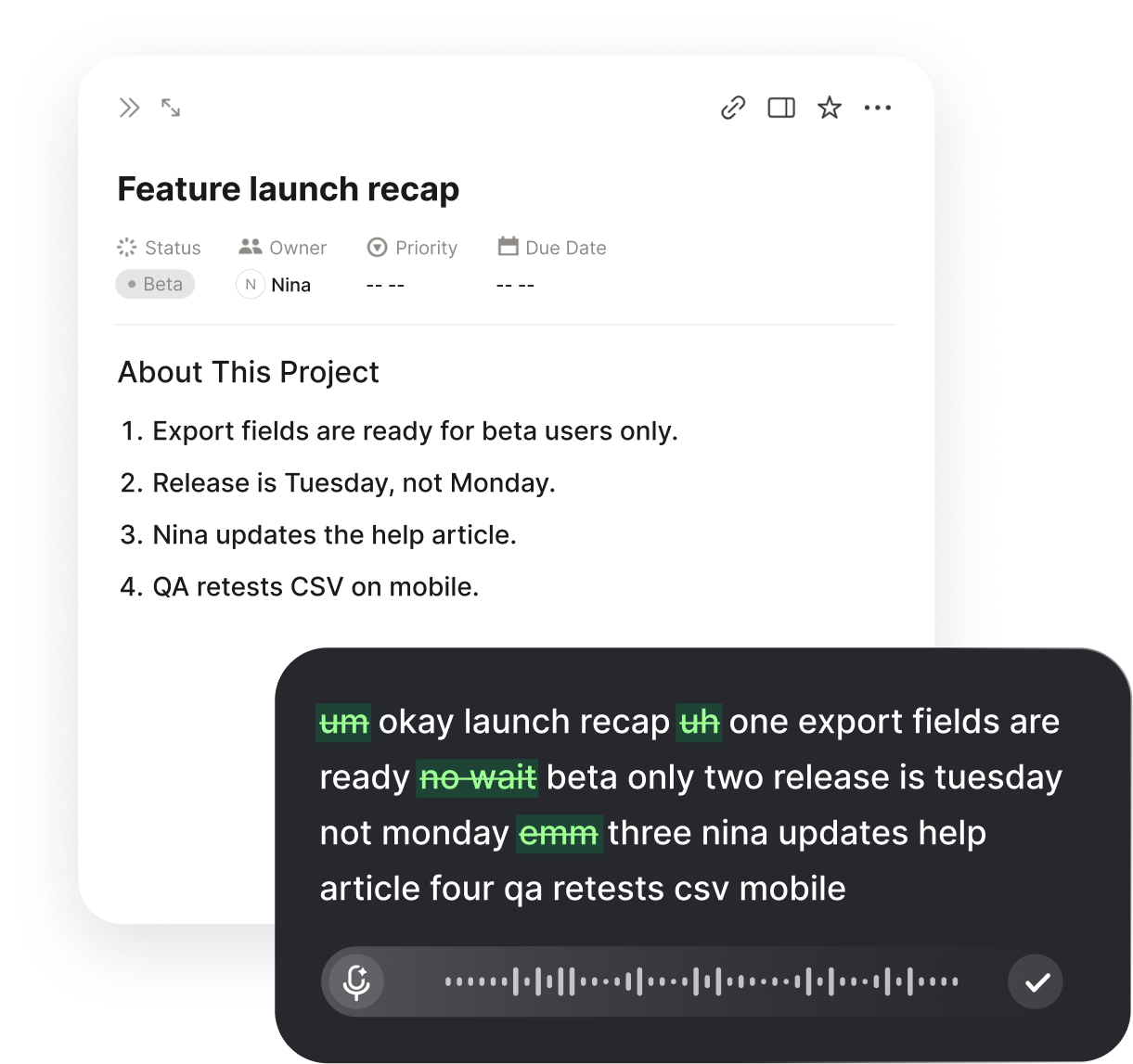
Why Team Process Lives in People's Heads
A team voice sop generator solves a problem every operations lead knows too well: the procedures that keep the team running are not written down anywhere, they live inside the people who do them. One person knows how the monthly close works, another is the only one who can run the deployment, and a third onboards every client from memory. Everything is fine until that person is on leave, slammed, or gone, and suddenly nobody can reproduce a task the business depends on.
The reason this knowledge never gets documented is not laziness. It is that writing SOPs is slow, and the people who hold the knowledge are the busiest people on the team. Asking a senior operator to spend a quiet afternoon typing out procedures at 45 words a minute is asking for time they do not have, so it slips to next quarter, every quarter. The result is a team that runs on tribal knowledge and a documentation folder full of half-finished stubs.
Narrating the work breaks that stall. People talk at roughly 220 words a minute, close to the speed they think and work at, so the person who owns a process can simply describe each step as they perform it. Voiskey turns that spoken walkthrough into clean, ordered text in your shared doc, which means the SOP gets built during the work itself instead of in a documentation session that never gets scheduled. The knowledge in someone's head becomes a procedure the whole team can follow.
Where Teams Need SOPs Most
The procedures worth capturing first are the ones that cause the most pain when the owner is unavailable, and in most teams they cluster around onboarding, handoffs, and anything that repeats on a schedule. These are the tasks where a missing step costs real money or a frustrated customer, and they are exactly the tasks people run on autopilot without ever writing down.
The practical move is to have each person narrate their own procedures in the normal course of doing them, rather than scheduling a documentation project that competes with real work. When the monthly report comes due, the owner talks through pulling it. When a new client signs, whoever onboards them narrates the sequence. Over a few weeks the shared library fills itself, built from the actual work instead of from memory in a conference room.
This matters most for an ops lead because consistency is the whole game. When four people do the same task four slightly different ways, quality drifts and problems become hard to trace. A spoken SOP for each repeatable process gives everyone the same steps to follow, so the output is the same no matter who is on shift.
Team processes worth narrating into SOPs:
- New-hire onboardingOne narrated walkthrough replaces repeating it per person
- Role and shift handoffsClear steps when someone covers or takes over a task
- Recurring ops: close, reporting, deploysThe same sequence every cycle, regardless of who runs it
- Customer-facing proceduresConsistent service so quality does not depend on who answers
How Your Team Dictates an SOP Step by Step
Give the team one simple rule: document the procedure the next time you actually run it, by narrating as you go. The person who owns the task opens the shared doc or wiki page, starts Voiskey, and performs the task while describing each action out loud, the way they would train someone standing beside them. Doing and narrating together keeps the steps in true order and surfaces the small details that get skipped when people write from memory later.
Once the walkthrough is captured, a quick reread tightens it, and because every SOP follows the same shape, the next person can pick it up without translation. The structure is what makes a loose set of spoken steps into documentation a team can actually rely on.
A repeatable pattern every teammate can narrate to:
- State the title, owner, and goal: what the procedure is and what a correct result looks like.
- List prerequisites: the access, tools, or files the next person needs before starting.
- Narrate the task live: perform it and describe each action in the exact order it happens.
- Flag decision points and exceptions: say what to do when a check fails or an edge case appears.
- Define done: describe how anyone can confirm the task finished correctly.
- Note handoff details last: who to tell, what to log, and the common mistake to avoid.
Consistent Wording the Whole Team Can Follow
An SOP is only useful if the next person can follow it without the author in the room, and that depends on specifics. When you narrate, it costs nothing to say the exact screen, the exact filter, the exact field, because talking is far faster than typing and nobody is tempted to shorten steps to save keystrokes. Voiskey captures the full phrasing, so "open the admin panel, go to Settings, then Billing, not the Billing tab on the main nav" lands in the doc intact instead of collapsing into a vague instruction the next person has to decode.
Voiskey learns the names and field-specific vocabulary your team uses, so internal tool names, product names, and shorthand come out spelled consistently across every procedure and every author. It punctuates as you speak and handles the technical terms that normally force a stop to fix autocorrect. For a genuinely unusual term, say it clearly once and glance at the text; from then on it recognizes the vocabulary that is specific to how your team works.
Because every SOP is plain, editable text, teams can standardize and reuse. Agree on one shape for all procedures, copy shared setup blocks between related SOPs so the wording is identical, and update a step in one place when a process changes. That consistency is what turns a pile of individual write-ups into a coherent operations manual the whole team trusts.
Fits Your Existing Stack
Voiskey is a voice keyboard, so it works anywhere your team can type, with no integration to configure and nothing for IT to approve. Narrate procedures straight into Google Docs or Word, into Notion or Confluence if that is your wiki, into a project tool or ticket when the steps belong next to the task, or into Slack and email for an immediate handoff. Wherever the cursor sits, each person's voice becomes the text.
That removes the oldest excuse for skipping documentation, which is that it means switching into some separate tool nobody opens. If people can capture a procedure in the same window where the work already happens, the habit survives a busy week. And because Voiskey picks up softer speech, including a whisper, someone can narrate a process quietly at a shared desk or in an open office without turning it into a performance for the whole floor.
Where teams keep their spoken SOPs:
- Notion and ConfluenceThe shared wiki your team already searches
- Google Docs and WordFormal procedures and the master operations manual
- Jira, Asana, and ticketsSteps attached to the task they belong to
- Slack and emailFast handoffs and coverage when someone is out
Getting Started Is Free
Every person on the team gets the same generous start: one month of Pro free when they create an account, up to two more months for inviting others, and 2,000 words a week on the free plan after that, with no expiry date. That is more than enough for individuals to document their own procedures and prove the habit works before the team standardizes on it, and the words spent become permanent assets rather than effort that disappears.
There is nothing to verify and nothing to procure. People install it on Mac, iPhone, iPad, or Android, open the shared doc where your procedures should live, and narrate the next task they run. The documentation your team has been meaning to write for a year gets built a few minutes at a time, by the people who actually know how the work is done.
FAQ s
Have each person narrate the procedures they own, in the normal flow of their week, into your shared doc or wiki. There is nothing to integrate, so people start on day one. A short rule like "document it the next time you do it" turns a stalled documentation project into a steady habit that fills your library a procedure at a time.
Yes. Because the output is plain text, teams can agree on a simple shape for every SOP, a goal line, numbered steps, and a done-check, and everyone narrates to that pattern. You can copy shared setup steps between related procedures so wording stays identical across the people and tasks that depend on them.
Voiskey learns names and field-specific vocabulary, so your internal tool names, product names, and team shorthand come out spelled the way you use them. Say an unusual term clearly once and check it; after that it recognizes the vocabulary that is specific to how your team actually operates, which keeps procedures readable for the next person.
That is one of the strongest uses. Instead of a senior person repeating the same walkthrough for every new hire, they narrate it once while doing the task and it becomes a reusable procedure. New hires follow the written steps, and the expert's time is spent on questions rather than on repeating the basics.
Narrated SOPs are the fastest way to capture what lives in one person's head before it walks out the door. Someone going on leave can talk through their recurring tasks in an afternoon rather than typing them for a week, and the person covering has clear, ordered steps instead of guessing or waiting for a reply that is not coming.
Each person gets their own generous start: a month of Pro free, up to two more months for inviting others, and 2,000 words a week after that with no expiry. That is plenty for individuals to document their own procedures and prove the habit works before a team standardizes on it more widely.


 Voiskey
Your voice, amplified.
Speak naturally, write effortlessly, and move faster. Turn your voice into polished, ready-to-use text wherever you work.
Use it across macOS, Windows, iOS, and Android