
Working With a Typist Injury
Typist Injury: Keep Working While Your Hands Recover
A typist injury has terrible timing, because the work does not pause just because your hands need rest. Voiskey lets you speak your emails, documents, and transcription-style tasks so your output stays up while your wrist recovers. Free to start.
The Work Does Not Stop for an Injury
A typist injury has a cruel sense of timing, because the moment your hands most need to rest is usually the moment your inbox, your documents, and your deadlines refuse to ease up. Every keystroke adds to the strain you are trying to let go of, and taking it easy starts to feel like falling behind on everything that matters. The slow, aching grind of typing through the pain is often exactly the thing you have been told to stop doing, and yet the emails still need answering and the reports still have to go out.
The core issue is that your whole working day is routed through your hands. Typing runs at around 45 words a minute even when you feel fine, so an injured wrist turns a normal afternoon of writing into hours of guarded, careful tapping that leaves you sore and behind at the same time. Resting properly and keeping your output up look like two goals that cannot both win, which is why so many people quietly keep typing when they should not.
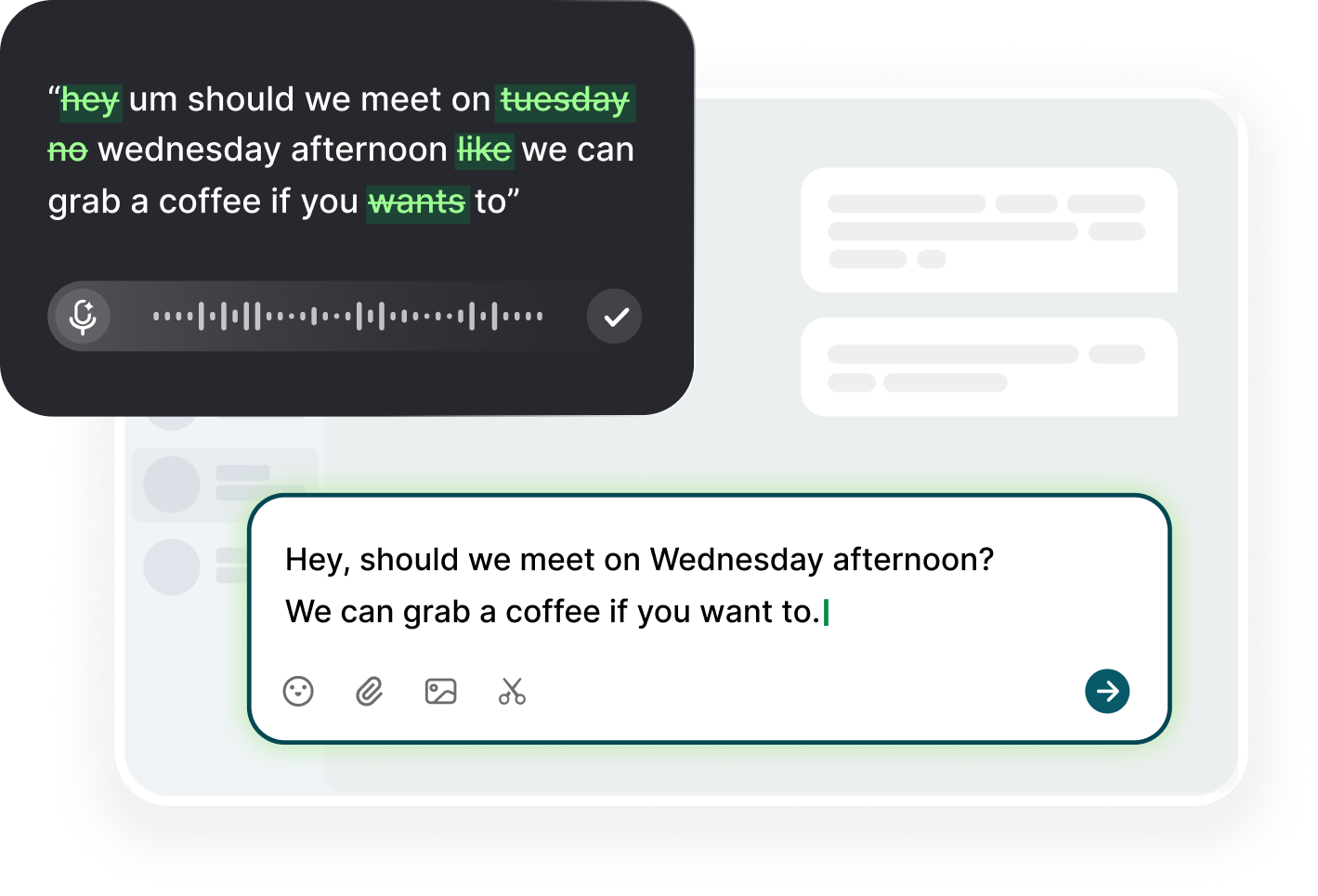
Speaking is the way out of that trade-off. You talk at roughly 220 words a minute, so you can say a paragraph in the time it takes to type a sentence, and your hands stay off the keys the whole while. Voiskey turns those spoken words into clean text directly in the app you are already working in, which means you can keep answering clients, drafting documents, and clearing your queue while your hands do far less of the work. The output stays steady; the strain comes down.
What You Can Hand Off to Your Voice
Almost everything a desk worker types in a day can be spoken instead, and when you are recovering from a typist injury the goal is to move as much of that volume off your hands as possible. The point is not to prove you can go completely keyboard-free in one heroic afternoon. It is to shrink the number of keystrokes you make so the small amount of typing you do keep, such as a quick correction or a password, is no longer the thing that re-aggravates the injury.
Start with whatever is highest-volume and lowest-stakes, because those are the tasks where speaking pays off fastest and a stray typo matters least. Email is almost always the biggest single source of keystrokes, followed by routine documents and the long transcription-style drafting that fills out notes and reports. Hand those to your voice first and you will feel the daily load on your wrist drop before lunch.
The categories below are the ones people lean on most while their hands recover, with the reason each one helps.
Where voice takes the load off your hands:
- Email and repliesClear the biggest keystroke source first
- Documents and reportsDraft long text without the aching tap
- Transcription-style notesSpeak pages in the time typing fills a paragraph
- Chat and quick messagesKeep conversations moving hands-free
How to Switch to Voice, Step by Step
Moving your workday to your voice while your hands recover does not need a grand plan, and it certainly should not involve a long, keystroke-heavy setup that irritates the injury before you even begin. The honest approach is to change one habit at a time, starting with the task that currently hurts the most, and to let each small win build your confidence before you hand over the next thing. Within a day or two, speaking becomes the default and reaching for the keyboard becomes the exception.
Keep the keyboard nearby for the handful of things that are genuinely faster to tap, like a single corrected word. The aim is not purity but relief: every sentence you speak is a sentence your hands did not have to type, and those saved keystrokes add up quickly across a working day. If a long document used to leave your wrist throbbing by the afternoon, speaking most of it can mean the strain never builds in the first place.
A gentle switch that protects your hands:
- Install Voiskey and open the one app where you type the most, usually email, so the first win is also the biggest.
- Dictate your next three replies out loud instead of typing them, speaking in full sentences the way you would say them to a colleague.
- Reread the text with your eyes, not your hands, and only reach for the keyboard for a tiny fix if one is needed.
- Add a second app the next day, such as your document editor, and speak your longer drafts there in one continuous pass.
- Set a simple rule for yourself: if a thought is longer than a few words, say it rather than type it.
- At the end of each day, notice how much less your wrist aches and let that guide how much more you move to voice.
Clean Text, Not Rough Transcription
A tool that drops in messy, half-punctuated text would just move the strain from typing to fixing, so the quality of what comes out matters as much as the fact that you spoke it. Voiskey writes clean, punctuated sentences from natural speech, which means the email or document is usually ready to send after a quick read rather than a heavy round of keyboard editing. For someone resting an injured hand, that difference is the whole point, because a draft that needs a dozen corrections is a draft that keeps your hands busy anyway.
It also learns the way you actually work. Voiskey picks up names and the field-specific vocabulary you use most, so client names, product terms, and the jargon of your role come out spelled correctly instead of forcing you to go back and retype them. Say an unusual word clearly once, glance at the result, and it settles into place over the next few uses. When you do need a stray symbol or a format the voice cannot easily describe, you can type that one character and dictate everything around it, so the keyboard handles the rare exception while your voice handles the bulk.
Works In the Apps You Already Use
Voiskey is a voice keyboard, so it works anywhere you can type, with no integration to install and nothing to configure. That matters more than usual when your hands hurt, because the setup for most new tools is itself a burst of clicking and typing you would rather avoid. Here, you open the same inbox, the same document, the same chat window you were using yesterday, and you simply speak into it. Nothing about your filing, your folders, or your workflow has to change.
That means you can keep every tool your job runs on and just stop typing into them. Draft in Gmail or Outlook, write in Google Docs, Word, or Notion, keep a team updated in Slack, and log notes in your CRM, all by voice. It runs on Mac, iPhone, iPad, and Android, so if your wrist is sore at your desk you can switch to your phone and keep going. And because it picks up softer speech, including a whisper, you can dictate in a shared office or a quiet room at home without raising your voice.
Everyday tools you can run by voice:
- Email in Gmail or OutlookClear the inbox hands-free
- Docs in Word, Google Docs, NotionDraft long text without typing
- Team chat in SlackStay in the loop, keys untouched
- Notes and records in your CRMLog details by speaking
Getting Started Is Free
You can start resting your hands today without a budget conversation. Everyone gets the same generous start: one month of Pro free when you create an account, up to two more months when you invite friends, and 2,000 words a week on the free plan after that, with no expiry date. For many people recovering from a typist injury, that free weekly allowance already covers a meaningful share of daily email and notes, and the Pro month lets you move your whole workload across while the strain is at its worst.
There is no .edu address to supply and no enrolment or employment to verify, so nothing stands between you and a quieter keyboard. Create an account, open the app where you type the most, and say your next message out loud instead of tapping it out. Your hands get the break they need, and the work still goes out the door.
FAQ s
No. This article is informational only and is not medical advice, diagnosis, or treatment, and Voiskey is a typing tool rather than a health product. For any pain, numbness, or lasting discomfort, talk to a qualified clinician about your situation. What voice typing can do is simply reduce how many keystrokes you make in a day.
For most desk work, yes. Emails, documents, notes, and transcription-style drafting are all things you can speak instead of type, and because talking runs near 220 words a minute against roughly 45 while typing, you often move faster than before. You keep your hands off the keyboard for the bulk of the day and reserve them for small edits.
No integration or configuration is required. Voiskey works as a voice keyboard anywhere you can already type, so you open the same app you always use and start speaking. That matters when your hands hurt and the last thing you want is a long setup full of clicking and typing.
Voiskey learns names and field-specific vocabulary over time, so the words you use most come out right. Say an unusual term once, clearly, and check it in the text; after a few uses the recognition settles in. For odd symbols you can type the character and dictate the words around it.
Yes. Voiskey picks up softer speech, including a whisper, so you can work in a shared office or at home without raising your voice. If a sentence comes out wrong because you spoke very quietly, say it again a little more clearly and keep going.
You get one month of Pro free when you create an account, up to two more months for inviting friends, and 2,000 words a week on the free plan after that, with no expiry. There is no .edu requirement and nothing to verify, so you can start resting your hands today.


 Voiskey
Your voice, amplified.
Speak naturally, write effortlessly, and move faster. Turn your voice into polished, ready-to-use text wherever you work.
Use it across macOS, Windows, iOS, and Android